How to measure SEO ROI in one formula
SEO ROI is the return you get from organic search relative to what you spend to get it. The formula is:
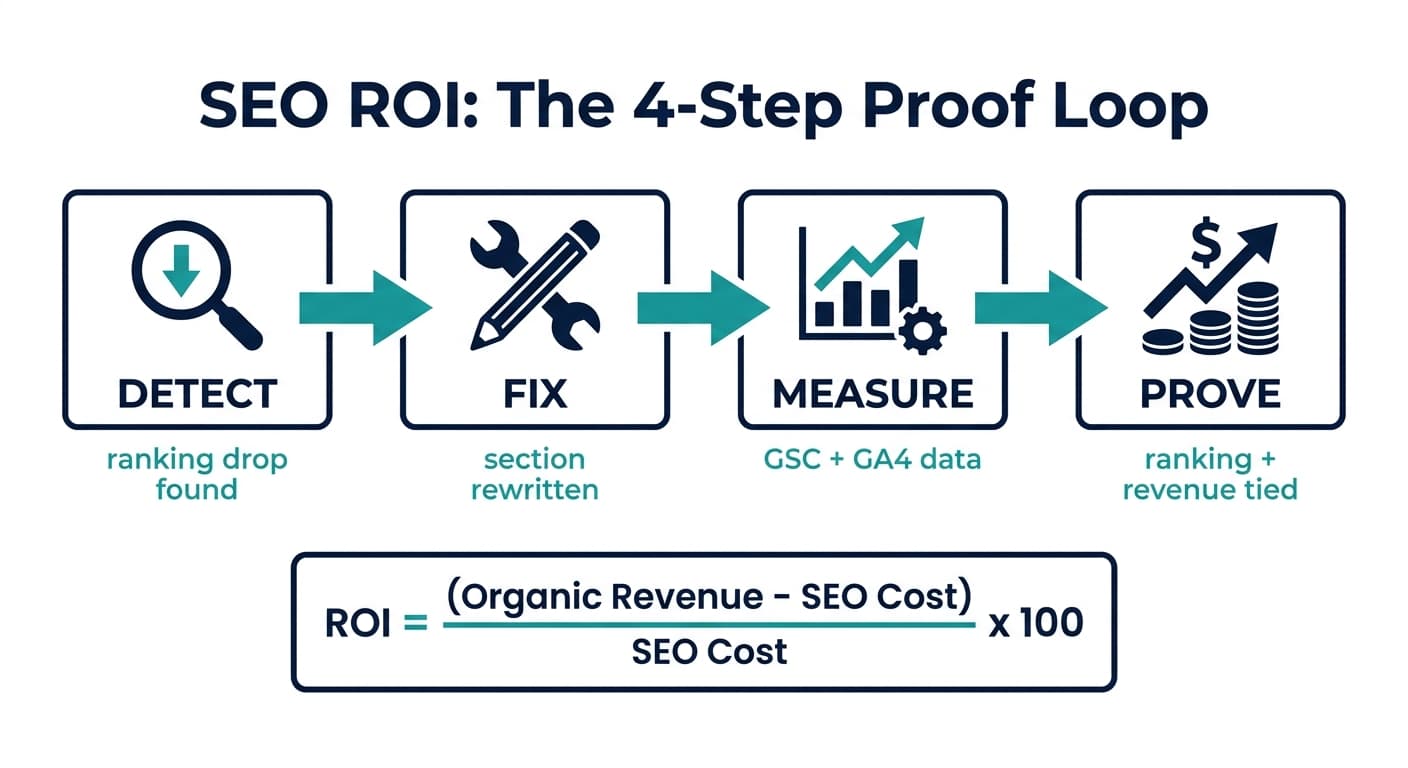
SEO ROI = ((Revenue from organic search − Cost of SEO) / Cost of SEO) × 100
If organic search drove $12,000 in attributed revenue last quarter and you spent $3,000 on the work (tools, writing, an agency retainer, your own time), your ROI is (($12,000 − $3,000) / $3,000) × 100 = 300%.
That formula is the easy part. Every article on this topic gives you the same math. The part that actually stalls marketers, and the part this piece spends most of its time on, is getting two clean numbers into that formula in the first place: a real cost figure and a revenue figure you can defend when someone in finance asks "how do you know that came from SEO." Get those two numbers right and the ROI conversation stops being a guess.
Why measuring SEO ROI is harder than PPC ROI
With paid search, the cost per click is a known number, so ROI is close to arithmetic. SEO does not work that way for three reasons:
- There is no per-click price tag. You are not buying visits; you are earning them, so the "cost" side has to be assembled from time, tools, and content spend rather than read off an invoice.
- Attribution is fuzzy. A visitor might find you through organic search, remember your brand from a LinkedIn post two weeks earlier, then convert after a direct visit. Standard last-click attribution in Google Analytics will hand that conversion to "Direct," not "Organic Search," even though the ranking is what put you on the map.
- The lag is real. Content published today rarely ranks, let alone converts, for weeks or months. Measuring ROI on a 30-day window will almost always understate it, and measuring it too early is the single most common reason teams conclude "SEO isn't working" when it's actually just early.
None of this makes SEO ROI unmeasurable. It means you need a consistent method, not a one-off spreadsheet, and you need to look at ranking recovery as a leading indicator alongside the lagging revenue number.
Step 1: Total up what SEO actually costs you
Add every real cost for the period you're measuring (monthly or quarterly is easiest to defend):
- Tools. Your rank tracker, keyword research tool, or all-in-one SEO platform subscription.
- Content production. Freelance writer or agency fees, or your own hours priced at a reasonable internal rate if you write in-house.
- Technical work. Any developer time spent on site speed, schema, or migrations that was specifically SEO-driven.
- Link building or PR, if you run it as a distinct line item.
Do not include costs that would exist anyway (your website hosting, your CMS license) unless SEO is the reason you upgraded them. The goal is a number that represents the incremental spend you could stop tomorrow if you decided SEO wasn't worth it.
Step 2: Get organic revenue out of Google Analytics, correctly
This is where most SEO ROI calculations quietly go wrong. Two setup steps matter before you trust the number:
- Segment traffic by channel, not just by source. In GA4, filter your reports to the "Organic Search" default channel group, not "google / organic" as a raw source/medium, since branded search and other referral quirks can bleed in and inflate the number.
- Assign a value to every conversion, not just ecommerce sales. If you sell a product directly, GA4's ecommerce revenue reporting gives you a real dollar figure per organic session. If you're B2B or SaaS, assign a fixed dollar value to your lead-generating events (a demo request, a signup, a contact form) based on your actual close rate and average deal size, then treat that as a "soft conversion value." A $50 value per demo request, multiplied by however many came from organic that month, is a defensible number even without a shopping cart.
Once revenue (hard or assigned) is segmented to organic search specifically, you have the numerator for the ROI formula.
Step 3: Fix the attribution gap with GSC alongside GA4
Google Search Console and Google Analytics answer different questions, and you need both:
- GSC tells you what happened in search: which queries you rank for, at what position, how many impressions and clicks each page earned, and whether that changed after you made an edit.
- GA4 tells you what happened after the click: whether that visitor engaged, converted, or bounced.
The practical workflow is to connect GSC to GA4 (or to a tool that already layers both together) so you can see, page by page, "this page's average position moved from 14 to 6, and in the same window its organic sessions and conversions moved by X." That page-level pairing is what turns "traffic went up" into "this specific page improvement is what moved it," which is the difference between a chart and proof.
<mark class="km-highlight" style="--hl:#FEF08A;background:#FEF08A">The most reliable ROI number ties a specific content fix to a specific ranking change to a specific revenue change, not a company-wide traffic trend.</mark> A rising line on a dashboard could be seasonality, a paid campaign, or a competitor's outage. A page that moved from position 14 to 6 after you rewrote its thin middle section, and then started converting, is a causal story you can actually defend.
A worked example
Here's how the full calculation looks for a small SaaS site over one quarter.
| Item | Value |
|---|---|
| SEO tool subscription (3 months) | $450 |
| Freelance writer, 6 articles | $1,800 |
| Developer time (schema + speed fixes) | $250 |
| Total SEO cost | $2,500 |
| Organic sessions this quarter | 9,400 |
| Demo requests from organic sessions | 38 |
| Average value per demo request (25% close rate x $600 avg deal) | $150 |
| Attributed organic revenue | $5,700 |
| SEO ROI | (($5,700 − $2,500) / $2,500) × 100 = 128% |
Two things to notice. First, the revenue side leaned on an assigned lead value, not an ecommerce cart, because this is a SaaS example; that is a legitimate and common approach as long as your close rate and deal size assumptions are documented and consistent quarter over quarter. Second, this is a trailing number: it tells you what already happened. The leading indicator that told you this quarter would look good was the ranking recovery on specific pages weeks earlier, which is why tracking rankings and revenue together matters more than checking either one in isolation.
How often should you measure it
- Weekly: keep an eye on ranking movement and impressions in GSC. This is your early warning system, not your ROI number.
- Monthly: check organic sessions and conversions in GA4 against the previous month, mainly to catch problems early.
- Quarterly: run the full ROI calculation. This is the cadence that smooths out SEO's natural lag and gives you a number stable enough to bring to a budget conversation.
Trying to prove ROI on a 30-day view after publishing new content is the single most common way teams talk themselves out of SEO. Give a page's ranking time to settle (often 8 to 12 weeks after a real content change) before you read too much into its revenue contribution.
Where a lot of teams get stuck, and the low-hanging-fruit shortcut
If your SEO ROI number is flat or negative, it is rarely because "SEO doesn't work." More often it's because the budget is going into new content while pages that are already ranking on page two, positions 11 to 20, sit untouched. Those pages already have some authority and relevance in Google's eyes; a comparatively small content update (fresher stats, a missing subtopic, better internal links) is often enough to push them onto page one, where click-through rates jump sharply. That kind of fix is usually the fastest ROI you can generate in a quarter, because you are improving assets you already own rather than starting from zero. If you want a systematic way to find which of your pages are one push away from page one, Murkuz's low-hanging-fruit workflow scans your Google Search Console data for exactly these positions-11-to-20 opportunities and scores them by potential impact.
The same discipline applies to reporting the result. Murkuz's features include an Agentic Impact Scorecard that links a specific content fix to the ranking change it caused, and on the Scale plan and up you can layer in a live Google Analytics (GA4) connection so that scorecard shows traffic and conversion movement alongside the ranking recovery, which is the exact pairing this article has been describing by hand. Whether you build that view yourself in a spreadsheet or use a tool that automates it, the underlying principle is the same: pair the ranking change with the revenue change, on the same page, in the same window, and your ROI number becomes something you can defend rather than something you hope is true.
FAQ
What is a good SEO ROI?
There is no universal benchmark, because cost structures and deal sizes vary too much between businesses. What matters more is your own trend: is the ratio of organic revenue to SEO cost improving quarter over quarter? A positive and growing ROI, even a modest one, is a healthier signal than chasing an industry-wide average that may not reflect your business model.
How long does it take to see SEO ROI?
Most sites need 3 to 6 months before ROI numbers stabilize enough to trust, and 6 to 12 months for the compounding effect of published content and earned authority to show up clearly. Judging ROI on anything shorter than a full quarter usually just measures noise.
Can you measure SEO ROI without ecommerce revenue?
Yes. Assign a fixed dollar value to your lead-generation conversions (demo requests, trial signups, contact form fills) based on your actual close rate and average deal size, then use that assigned value as your organic revenue figure. It is less precise than a shopping cart total, but it is consistent and defensible if you keep the underlying assumptions the same every period.
Is SEO worth it if I can't get exact numbers?
Yes, with the caveat that "exact" is the wrong bar. PPC gives you precision because you're buying each click; SEO gives you a compounding asset instead. A directionally accurate ROI calculation, refreshed every quarter with consistent assumptions, is enough to make a sound budget decision, and it is far more informative than no measurement at all.
Junaid Khalid is the founder of Ertiqah and the builder of Murkuz. He has run SEO as the first growth channel across his own SaaS products and built Murkuz around the belief that SEO should be treated as an engineering problem: detect what's slipping, fix it, ship the fix, and prove it worked.