Structured data is code you add to a webpage, usually in Schema.org vocabulary written as JSON-LD, that labels what the page's content actually means: this is a product name, this is a price, this is an author, this is a step in a recipe. Search engines and AI answer engines read that labeled data directly instead of guessing at meaning from raw text, which is why the same page can show a star rating, an FAQ dropdown, or a price in Google, and why an AI overview can quote it with confidence.
That distinction, labeled meaning versus raw text, is the whole reason structured data matters for SEO. Google has read your paragraphs for two decades and inferred what they mean. Structured data removes the inference. It hands the machine the fact directly, in a format it does not have to guess at. As AI systems increasingly summarize and cite content rather than just ranking it, that direct hand-off matters more, not less.
This guide covers what structured data actually is, the schema types worth your time, a worked example you can copy, the mistakes that get markup ignored, and how it feeds AI search specifically, the part most explainers skip entirely.
Structured Data vs. Unstructured Data (the Short Version)
Most explanations of structured data start with a database lecture: rows, columns, spreadsheets. That is accurate but not useful if you run a website. Here is the version that matters for SEO:
| Structured data | Unstructured data | |
|---|---|---|
| What it looks like | Labeled fields: "price": "49.00", "author": "Jane Doe" | Plain prose: "This costs $49 and was written by Jane" |
| How a machine reads it | Directly, with certainty | Inferred, with some error rate |
| Where it lives on a page | A <script type="application/ld+json"> block, invisible to readers | The visible text, headings, and images |
| What it earns you | Rich results, better AI-answer extraction, clearer entity understanding | Whatever your writing and on-page SEO earn on their own |
The key point: structured data does not replace your content. It sits alongside it, describing it. A product page still needs real copy; the schema just tells search engines exactly which sentence is the price and which is the review count, instead of leaving them to parse it out of a paragraph.
The Schema Types Worth Actually Using
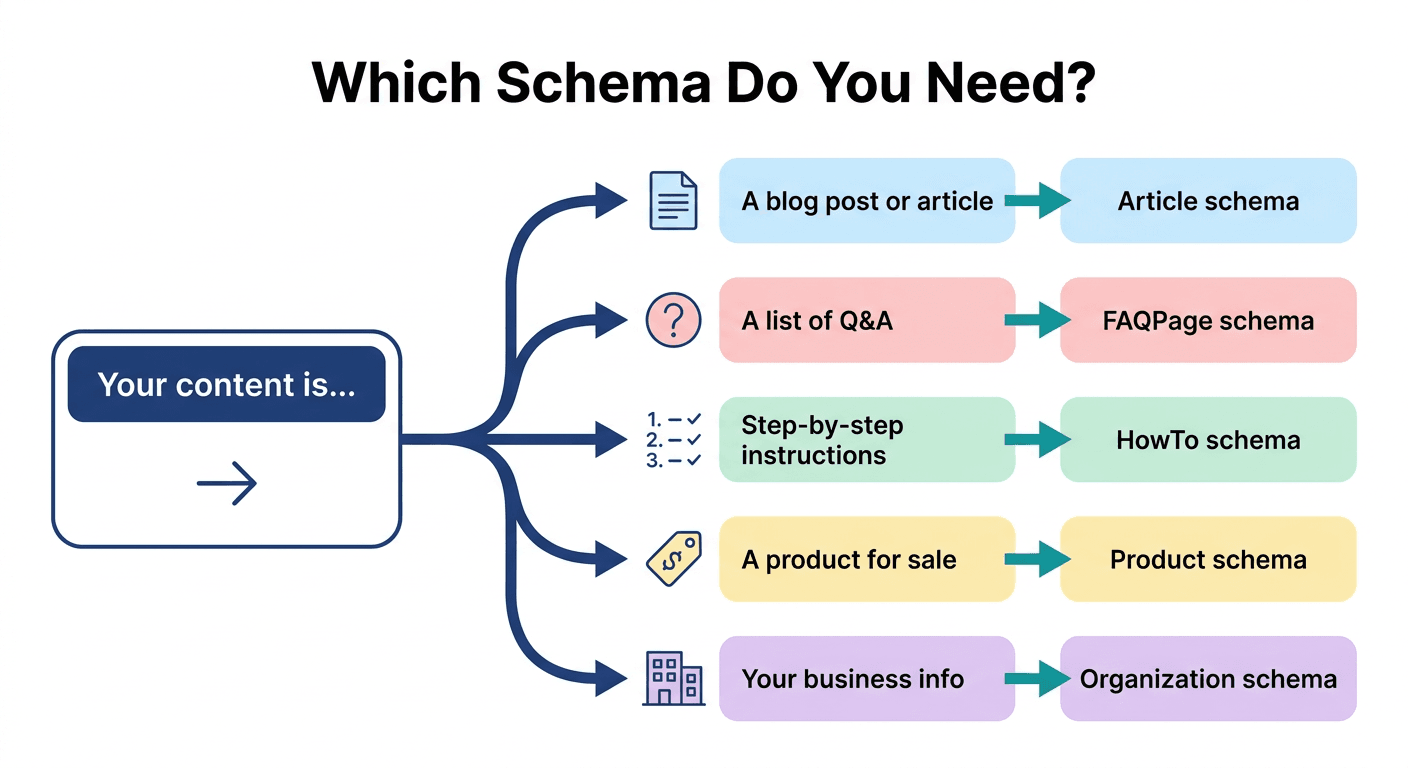
Schema.org defines hundreds of types. Almost none of them matter for a typical SEO project. These are the ones that consistently earn visibility:
- Article / BlogPosting. Marks up headline, author, publish date, and image. This is the baseline for any content site and a prerequisite for several AI-answer features that expect clear authorship.
- FAQPage. Marks up a list of questions and answers. Historically triggered an expandable FAQ rich result in Google (Google narrowed eligibility to certain well-known, government sites in 2023, so do not expect the rich result on most sites today). It still matters because it is one of the cleanest, most extractable formats for an AI system pulling a direct answer to a question, regardless of whether Google itself renders the dropdown.
- HowTo. Marks up sequential steps. Useful for tutorials and process content; like FAQ, the rich-result eligibility has narrowed over time, but the extractability value for AI answers remains.
- Product. Marks up price, availability, and review data. This is what produces the star rating and price you see under a product result, and it is one of the highest-value schema types for ecommerce.
- Organization / LocalBusiness. Marks up your name, logo, address, and hours. This feeds the Knowledge Panel and is foundational for how search engines and AI systems identify who is publishing the content, which ties directly into E-E-A-T signals.
- Review / AggregateRating. Marks up star ratings and review counts. High scrutiny from Google here: only mark up reviews that genuinely exist on the page, never invented ones.
- BreadcrumbList. Marks up your site's hierarchy. Low effort, produces the breadcrumb trail under a result, and helps establish topical structure.
If you only implement three, make them Article/BlogPosting on every content page, FAQPage where you already have a real FAQ, and Organization on your homepage. That combination covers authorship, direct-answer extractability, and entity identity, the three things both classic SEO and AI search reward most.
A Worked Example: FAQ Schema
Here is what FAQPage schema actually looks like once written, using a plain question and answer:
{
  "@context": "https://schema.org",
  "@type": "FAQPage",
  "mainEntity": [{
    "@type": "Question",
    "name": "What is structured data?",
    "acceptedAnswer": {
      "@type": "Answer",
      "text": "Structured data is code, usually JSON-LD in Schema.org vocabulary, that labels the meaning of content on a page so search engines and AI systems can read it directly instead of inferring it from text."
    }
  }]
}
That block sits in the page's <head> or body as a <script type="application/ld+json"> tag. It is invisible to a human reader and read only by crawlers and parsers. Writing this by hand for every FAQ section on a site gets tedious fast and is an easy place to introduce a syntax error that invalidates the whole block, which is exactly the kind of repetitive, mechanical task worth automating rather than hand-coding. If you want to skip the hand-coding, Murkuz has a free FAQ schema generator that turns a plain list of questions and answers into valid JSON-LD you can paste straight into the page.
How Structured Data Feeds AI Search Specifically
This is the part most structured-data explainers never get to, because they were written for classic SEO and never updated for how AI answer engines actually work.
Google AI Overviews, ChatGPT's search feature, and Perplexity are not reading your page the way a human does. They are extracting a claim, checking it is well-attributed, and deciding whether to surface it in a generated answer. Structured data changes that extraction in three concrete ways:
It removes ambiguity about authorship. An AI system deciding whether to trust and cite a claim looks for a clear, attributable source. Article schema with an author field, tied to a real name and (ideally) a sameAs link to that person's other profiles, gives the system an unambiguous signal about who is making the claim. A page with no schema and a generic "Team" byline gives it nothing to key off.
It pre-packages the exact claim an AI answer needs. FAQ schema is, structurally, already in the question-and-answer shape an AI system wants to extract and quote. You have effectively done the extraction work for it. That is why FAQ schema remains worth writing even where the visible rich-result dropdown has narrowed: the schema's value for AI extraction did not go away when Google tightened the display eligibility.
It reinforces entity identity across the web. Organization schema, consistent NAP (name, address, phone) data, and sameAs links to your other verified profiles help every crawler, not just Google's, build a confident picture of who you are. AI systems weigh that entity confidence when deciding whether to cite you as a source versus an anonymous page that happens to mention the same topic.
None of this replaces good content. A page with perfect schema and a thin, vague answer still will not get cited. But a page with a genuinely good answer and no schema is handing the AI system more inference work than it needs to do, and inference is exactly where you lose to a competitor who made the extraction easy.
Common Structured Data Mistakes That Get Markup Ignored
Google's own documentation is clear that invalid or misleading markup is not just wasted effort, it can trigger a manual action. The mistakes that show up most often on real sites:
- Marking up content that is not visible on the page. Schema must describe what is actually shown to a visitor. FAQ schema for questions that do not appear anywhere in the visible content is a policy violation, not just bad practice.
- Syntax errors that invalidate the whole block. A single missing comma in JSON-LD can silently break the entire schema object. Always validate after every change.
- Marking up fake reviews or ratings. Review and AggregateRating schema is one of the most heavily scrutinized types. Only mark up ratings that genuinely exist and are genuinely sourced from real reviewers.
- Letting schema drift out of sync with the page. A price in your Product schema that no longer matches the live price, or an FAQ answer that was edited on the page but not in the schema, is exactly the kind of decay that quietly erodes trust signals over time as a site grows past what one person can manually re-check.
- Using the wrong type for the content. HowTo schema on a listicle that is not actually sequential steps, or Article schema on a page that is really a product listing, confuses more than it clarifies.
How to Check If Your Structured Data Is Working
Three checks, in order of how often they catch real problems:
- Google's Rich Results Test. Paste a URL or code snippet and it tells you which rich results are eligible and flags syntax errors immediately. This is the first stop for any new markup.
- Search Console's Enhancements reports. Once markup is live and crawled, Search Console shows you validation errors and warnings across the whole site, not just one page, which is how you catch schema that broke after a template change nobody noticed.
- A manual search for your own page. Search the exact query your FAQ or product page targets and see what actually renders. Rich-result eligibility shifts over time (as it did for FAQ and HowTo in 2023), so what worked a year ago is worth re-checking periodically rather than assumed to still be true.
Catching a broken or drifted schema block early is the same underlying problem as catching a decaying page early: a small, mechanical thing quietly stops working and nobody notices until traffic already dropped. That is the exact gap Murkuz's E-E-A-T compliance tooling is built to close: it scans pages for missing or broken trust and structured-data signals on a schedule and turns each gap into a task, instead of requiring someone to re-check every page by hand every few months.
FAQ
Is structured data the same as schema markup?
Not quite, though the terms get used interchangeably. Structured data is the general concept: organized, labeled information a machine can read directly. Schema markup, specifically Schema.org vocabulary written as JSON-LD, is the implementation most commonly used on the web today to produce structured data for search engines. In practice, when someone in SEO says "structured data," they almost always mean schema markup.
Does structured data actually improve rankings?
Google has stated that structured data itself is not a direct ranking factor. What it does is make your content eligible for rich results (stars, FAQ dropdowns, breadcrumbs) that can improve click-through rate, and it improves how confidently search and AI systems understand and extract your content. The ranking benefit is indirect but real: better CTR and clearer machine understanding both correlate with stronger performance over time.
What is an example of structured data on a website?
A recipe page with JSON-LD marking up cook time, ingredients, and calorie count is a classic example; it is what produces the recipe card with a photo, star rating, and time estimate you see in Google search results instead of a plain blue link.
Do I need structured data for AI search like ChatGPT and Perplexity?
You do not strictly need it to be crawled or mentioned, but it materially helps. Clear Article and FAQ schema pre-packages your content in a shape that is easy for an AI system to extract and attribute, which is one of the concrete levers you actually control in an otherwise opaque process.
What tools can I use to add structured data without coding it by hand?
Google's Rich Results Test validates existing markup, and purpose-built generators exist for specific schema types so you do not have to write JSON-LD from scratch. Murkuz's free FAQ schema generator is one option if you just need valid FAQ markup from a list of questions and answers.
Junaid Khalid is the founder of Ertiqah and the builder of Murkuz, the SEO platform that closes the loop from detecting a content or trust-signal gap to proving the fix worked. He has run SEO as the first growth channel across his own SaaS products, including the shift toward treating structured data and E-E-A-T signals as an operational checklist, not a one-time setup task.