Most link building advice still reads like it is 2015: guest post outreach, blogger email blasts, "10 sites that accept sponsored posts." Digital PR is the tactic that actually works in 2026, because it does not ask for a link. It gives a journalist something worth writing about, and the link shows up as a natural citation inside a real story.
This guide is the practitioner version: what digital PR actually is, the five tactics that consistently earn coverage, a pitch you can adapt today, realistic timelines and budgets, and how to tell whether a campaign actually moved your rankings instead of just collecting press mentions.
What digital PR for link building actually means
Digital PR is the practice of creating something newsworthy (a data study, a survey, a tool, a timely reaction to news) and pitching it to journalists and publications so they cover it and link back to your site as the source. The link is a byproduct of the coverage, not the ask.
That distinction matters because it changes who says yes. A journalist covering a story about remote work trends will not link to your site because you emailed asking nicely. <mark class="km-highlight" style="--hl:#FEF08A;background:#FEF08A">They will link to you because you are the source of the statistic in their third paragraph.</mark>
Digital PR is not the same as traditional PR. Traditional PR chases brand awareness and share of voice. Digital PR is built specifically to earn a followed, contextual backlink from a page with real editorial authority, which is why it sits inside the SEO team's toolkit and not just the comms team's.
Digital PR is not the same as guest posting. A guest post is content you write and place, usually with an author bio link, on a site that has agreed (often for a fee) to publish it. Digital PR content is written by the journalist, on their platform, in their voice, because your data or angle earned it. That is also why digital PR links tend to sit on higher-authority domains than the sites that take guest posts, and why they resist the kind of manual-action risk that comes with obviously paid link placements.
Why it works better than most link building tactics right now
Three things changed the math in digital PR's favor:
- Google's link-spam systems got much better at spotting paid and reciprocal links. A link earned because a reporter genuinely needed a stat is structurally different from a link inserted into an old article for a fee, and it holds up under scrutiny.
- Journalists are under more pressure to publish, faster, with less research time. A ready-made data point with a named source saves them the reporting work. You are not interrupting their day, you are doing part of their job for them.
- AI-generated summaries and answer engines increasingly favor content with third-party citations. A page that gets referenced by outside publications carries a different kind of trust signal than one making unverified claims about itself, which is part of why sites appearing in AI Overviews and chat-based answers often have a citation footprint spanning several independent domains.
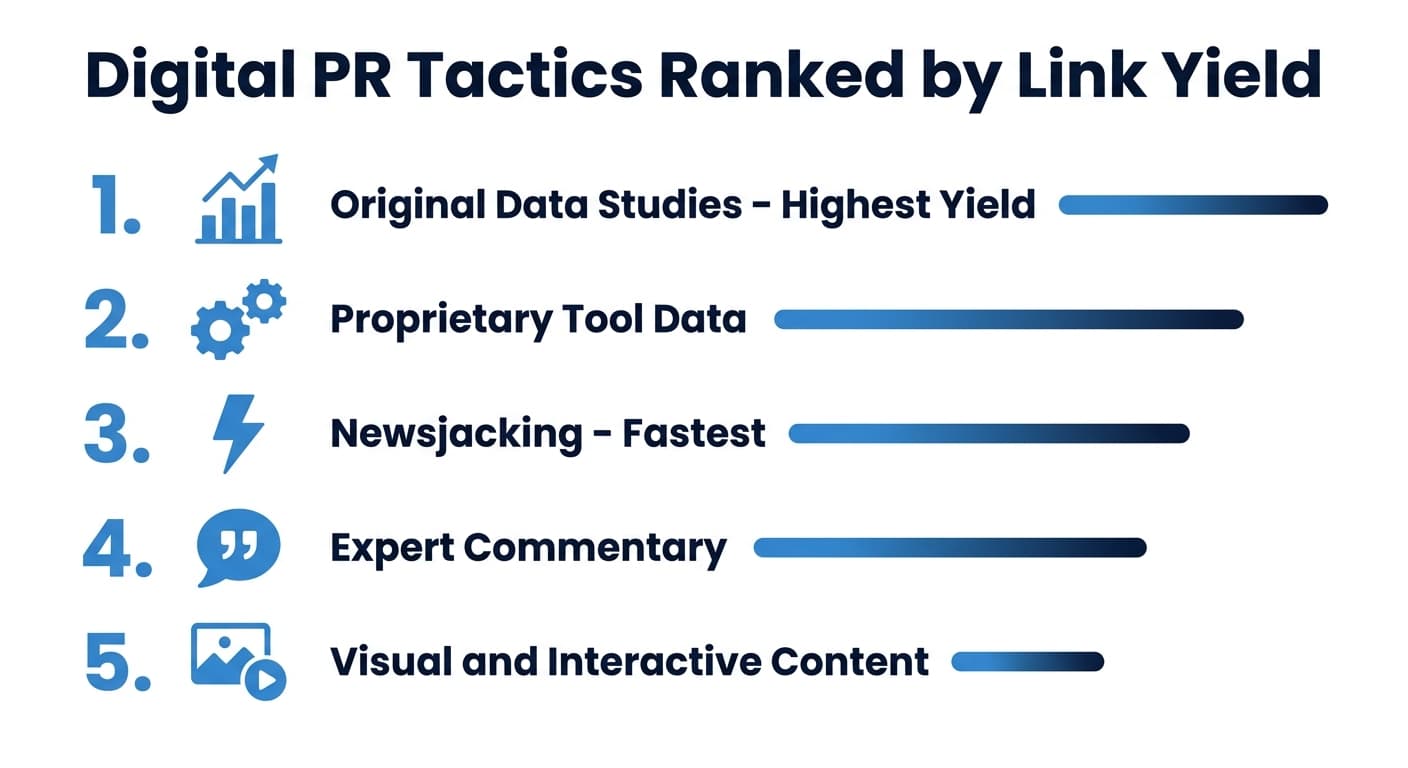
Five digital PR tactics that actually earn links
Not every "digital PR idea" earns coverage. These five show up again and again in campaigns that actually land placements.
1. Original data studies
Survey your own users, customers, or a representative sample of the public, then publish the findings as a standalone page. A well-run study with a clear, quotable headline number ("62% of remote workers check email before 7am") gives journalists a citable fact with your brand attached. This is the single highest-yield tactic because it produces something no competitor can copy: your data.
2. Proprietary tool or calculator data
If you already run a free tool, the usage data behind it is a built-in study. A salary calculator that has processed 50,000 queries can publish "the most searched-for job titles by region" without commissioning new research. This is also the natural link between digital PR and the free tools a product already has on its site.
3. Newsjacking
React to a breaking news story with expert commentary or a fast piece of original analysis within hours, not days. Speed is the entire tactic. A prepared subject-matter expert on standby, plus a short, quotable reaction, can land coverage that a slower, more polished piece would miss entirely because the news cycle moved on.
4. Expert commentary and thought leadership
Building a reputation as the go-to source for a narrow topic means journalists come to you instead of the other way around. This compounds: the first few placements take real outreach, but each one increases the odds a reporter finds you next time through a database like HARO-style platforms or a simple Google search for your niche.
5. Visual or interactive content
Maps, interactive charts, and original infographics get embedded and cited differently than plain text. A well-designed visual that answers a specific, searched question travels across sites that would never accept a guest post pitch but will happily embed and credit a chart.
A pitch template that gets replies
The difference between a pitch that gets ignored and one that gets a reply is almost always specificity. Journalists get dozens of pitches a day; most are generic. Here is a structure that consistently performs better:
- Subject line with the number, not the topic. "62% of remote workers check email before 7am" beats "New survey on remote work habits."
- First line states the finding, not your company. Lead with the data point. Save the company name for the second sentence.
- One relevant stat the journalist can use immediately, formatted so it can be copied straight into a draft.
- An offer of an exclusive or early access for the first journalist who covers it, which gives them a reason to move fast instead of filing your email away.
- A named, reachable contact for a quote, not a generic "let us know if you have questions" close.
Keep the whole email under 150 words. A pitch that requires scrolling gets skipped.
Timelines and budget: what to actually expect
Digital PR is not instant, and setting the wrong expectation internally is one of the most common reasons campaigns get killed before they produce results.
| Stage | Typical timeframe | What is happening |
|---|---|---|
| Research and angle development | 1 to 3 weeks | Survey design, data collection, or angle validation against current news |
| Asset creation | 1 to 2 weeks | Writing the study page, building the visual, drafting pitch variants |
| Outreach and follow-up | 2 to 6 weeks | Initial pitches, follow-ups, journalist Q&A, revisions |
| First links land | Week 3 onward | Coverage starts appearing, usually in a cluster rather than evenly spread |
| Rankings respond | 4 to 12 weeks after links land | Google needs to crawl, evaluate, and factor the new links into rankings |
Budget scales with ambition. A single newsjacking reaction can cost almost nothing beyond a subject-matter expert's time. A proper data study, from survey panel costs through a designer's time on the visual, commonly runs from a few thousand dollars for a lean in-house effort to five figures for an agency-run campaign with paid survey panels and dedicated outreach staff. The realistic range most freelance SEOs and small teams should plan for a single focused campaign is time-intensive rather than expensive: the biggest cost is usually a person's hours, not tool spend.
How to evaluate whether a campaign actually worked
This is the step most digital PR write-ups skip, and it is the one that decides whether you get budget for a second campaign.
Coverage count is a vanity metric on its own. <mark class="km-highlight" style="--hl:#BBF7D0;background:#BBF7D0">Twelve mentions across low-authority blogs is a worse outcome than three placements on sites with real domain authority and real referral traffic.</mark> Before calling a campaign a win, check:
- Which links are actually followed and indexed, not just mentioned. A journalist can name your brand without linking, or link with
nofollow. - What happened to the target page's rankings in the weeks after the links landed, not the week the coverage was published. Link equity takes time to flow through.
- Whether referral traffic from the covering domains is real and sticks, versus a one-day spike that disappears.
This is also where most link building tracking breaks down: a spreadsheet of "links earned" tells you what happened externally, but not whether your own rankings moved because of it. Pulling the target page's Google Search Console position history before and after the campaign is the only way to see if the links translated into anything. Murkuz's Google Search Console integration pulls that ranking data automatically, and its Impact Scorecard ties a ranking recovery back to the specific change, including a link-earning campaign, so you are not left guessing whether the PR spend actually moved the needle or just generated mentions. Read more on why backlinks still matter for rankings before you decide how much of your process to invest in earning them.
Common mistakes that waste a digital PR campaign
- Pitching a story with no real news hook. "We think X is important" is not a pitch. A specific number, a specific reaction to a specific event, or a specific tool is.
- Sending the same generic pitch to fifty journalists. Personalization is not optional; a pitch referencing a journalist's recent coverage gets read differently than a mail-merge blast.
- Giving up after one round of outreach. Most placements come from the second or third follow-up, not the first email.
- Skipping the measurement step. Without a before/after look at rankings and referral traffic, you cannot tell your own team, or a client, whether the campaign was worth repeating.
- Treating digital PR as a one-off instead of a program. The compounding value comes from becoming a repeat source journalists trust, not from a single successful pitch.
FAQ
What is digital PR link building?
Digital PR link building is the practice of creating newsworthy content (data studies, surveys, expert commentary, or original visuals) and pitching it to journalists so they cover it and link back to your site as the source, earning links as a byproduct of genuine media coverage rather than direct link requests.
How do you get digital PR links?
You get digital PR links by producing something genuinely citable (original data is the most reliable route), identifying journalists who cover that beat, and pitching a specific, quotable finding rather than a generic company story. Speed matters for newsjacking; personalization matters for everything else.
What is link building in digital marketing?
Link building is the practice of getting other websites to link to yours, because search engines treat inbound links as a signal of trust and authority. Digital PR is one modern tactic within link building, alongside others like resource link building, broken link building, and guest posting.
How do you get PR links specifically, as opposed to guest post links?
PR links come from journalists publishing genuine coverage, not from a placement fee or content-swap arrangement. The practical difference is the pitch: guest posting pitches a finished article for placement, while digital PR pitches a newsworthy angle and lets the journalist write the story in their own words.
How long does a digital PR campaign take to show ranking results?
Plan for 4 to 12 weeks after the links actually land, on top of the 4 to 8 weeks it typically takes to research, build, and pitch the campaign itself. Coverage often appears in a cluster rather than a steady trickle, so rankings tend to move in a step rather than a gradual climb.
If you are a freelance SEO running this playbook across multiple client accounts, the operational challenge usually is not the pitching, it is proving which campaign caused which ranking movement across a dozen sites at once. That reporting problem is exactly what Murkuz for freelance SEOs is built to solve: it automates the detection work, generates a client-ready Impact Scorecard, and connects the ranking data back to the specific fix, whether that fix is a content rewrite or an earned link, so you can show the client the recovery instead of a coverage list.
Digital PR earns the kind of links that hold up. It takes longer than a guest post outreach spreadsheet and it costs more in time than money for most independent practitioners, but the links survive scrutiny and the coverage compounds. Run one focused campaign, track what actually happened to rankings afterward, and let that result decide whether it earns a permanent spot in your process.
Junaid Khalid is the founder of Ertiqah and the builder of Murkuz. He has run SEO as the first growth channel across his own SaaS products, including using earned coverage and outreach to support ranking recoveries rather than relying on content rewrites alone.