Most backlink guides assume you already have something to work with: an audience to promote to, competitors whose links you can study and replicate, or at least a few relationships in your industry. If you are starting a brand-new website and nobody has heard of it yet, that advice does not apply to you. This guide is the cold-start version: how to get your first real backlinks when you have zero audience, zero relationships, and zero budget, without touching anything that could get your new site penalized before it has a chance to rank.
Why "Just Do What Ahrefs Says" Doesn't Work Yet
Standard link building advice (guest posting, competitor backlink replication, HARO-style journalist outreach) is not wrong. It is just built for a site that already has some baseline credibility: a few months of content, a recognizable name, or at least a Google Search Console account with impression data to work from. A brand-new domain has none of that. Two problems compound each other early on:
- Nobody has a reason to link to you yet. Earning links requires something worth linking to, and a two-week-old site with three pages rarely clears that bar, no matter how good the writing is.
- Cold outreach barely works even for established sites. Industry data on outreach response rates consistently shows single-digit-to-low-teens success rates for cold link requests. A brand nobody recognizes yet performs worse than that baseline, not better.
So the sequence has to change. Instead of starting with outreach, start with the handful of link types that do not require an audience, a relationship, or a pitch at all.
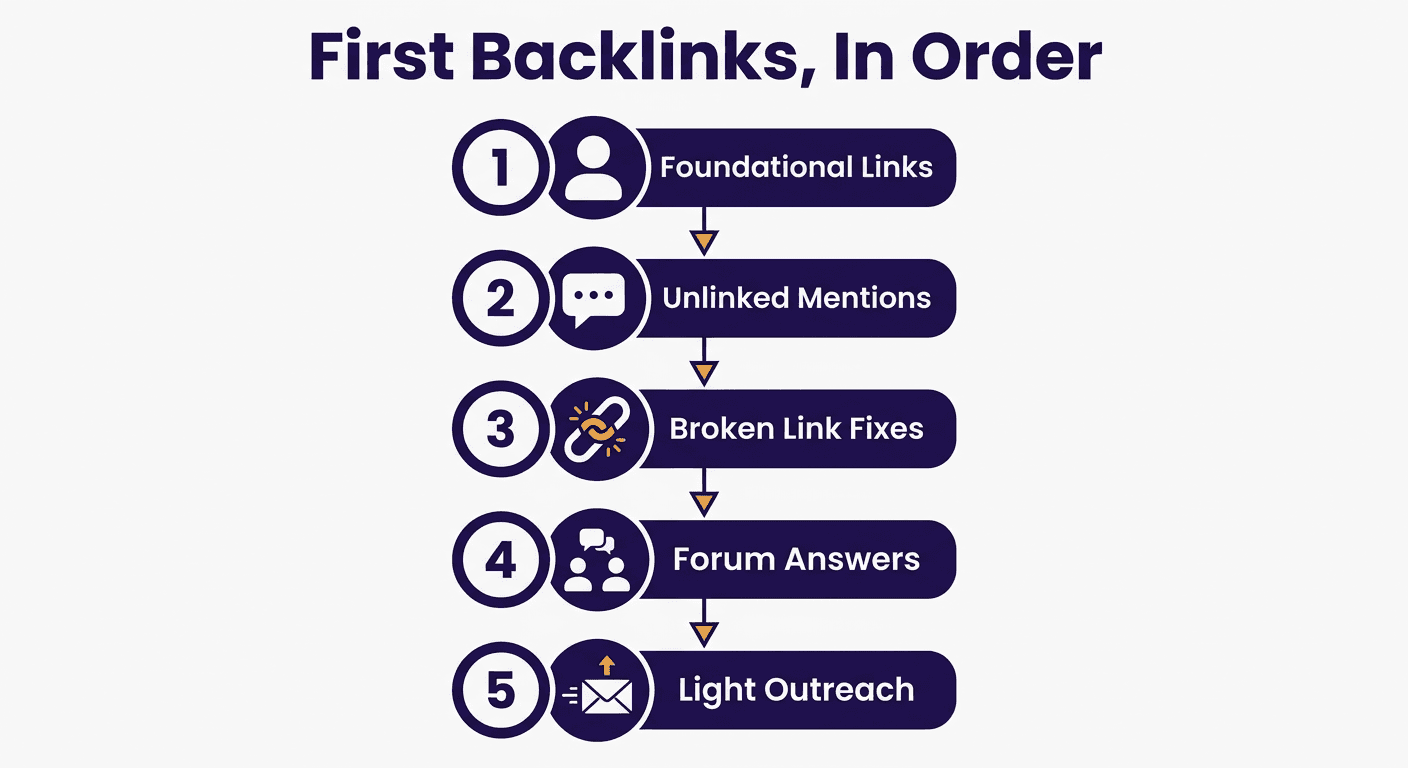
Step 1: Claim Your Foundational Links First
Before you write a single outreach email, claim the links that exist purely because your business exists. These will not move rankings much on their own, but they are free, fast, and they give Google (and any human who checks) a consistent trail confirming your business is real.
- Social profiles. Create branded profiles on the major platforms relevant to your industry (LinkedIn Company Page, X, YouTube if relevant) and link your site from each bio.
- Business directories and review sites. List your business on the handful that are genuinely relevant to your niche: Trustpilot, G2 or Capterra for software, Yelp or Google Business Profile for local, ProductHunt for a product launch. A few dozen relevant listings is the ceiling here, not a target to keep chasing indefinitely.
- Your own other properties. If you run other sites, a GitHub profile, a personal portfolio, or an active community account, link back from each. These are your links to give, so use them.
Most of these links carry little direct ranking weight and are frequently nofollow. Claim them anyway. They are effectively free, they take an afternoon, and professional link builders call this "foundational link building" for exactly this reason: it is the baseline every legitimate site eventually has, and it costs you nothing but time.
Step 2: Find Mentions of Your Brand That Aren't Linked Yet
This works even for a brand-new site, because it does not depend on you having an audience. It depends on your name, your founder's name, or your product having been typed anywhere on the public web, even once.
- Search your exact brand name in quotes, excluding your own domain:
"Your Brand Name" -site:yourdomain.com. Add-site:linkedin.com -site:facebook.com -site:x.com -site:reddit.comto cut social noise from the results. - Check anywhere you were already mentioned before the site existed: a ProductHunt launch comment, a founder's guest appearance, a press release, a directory listing that named you without linking.
- Read the context before you ask. A neutral or positive mention is worth pursuing. A negative one is not worth the awkward email.
- Send a short, specific note, not a template that reads like one:
Subject: Quick question about [Article Title]
Hi [Name], I noticed you mentioned [Your Brand] in [Article Title]. Thank you for the reference. Would you be open to linking it to [specific URL]? It would help readers find the actual page.
This tactic has an unusually high acceptance rate relative to every other link tactic on this list, precisely because you are not asking for a favor out of nowhere. You are asking someone to finish a reference they already started.
Step 3: Fix Broken Links Instead of Asking for New Ones
Broken link building is one of the few tactics that works regardless of how new or unknown your site is, because the pitch is not about you. It is about fixing something that is already costing the other site's own readers a bad experience.
- Find a page in your niche with an outdated or dead resource. Free browser extensions that flag broken links on a page work, or manually click through resource lists and "further reading" sections on relevant blogs.
- Confirm what used to be there. The Wayback Machine (web.archive.org) shows you the original page's content, so your replacement can genuinely cover the same ground, not just superficially resemble it.
- Build or already have a real replacement. This only works if your page actually deserves the link. A thin page pitched as a broken-link fix gets ignored just as fast as a cold pitch.
- Pitch the fix, not yourself:
Subject: Broken link on your page
Hi [Name], I noticed [Article Title] links to [dead URL], which no longer works. We recently published [Your Article], which covers the same topic and might be a solid replacement. Either way, thought you'd want to know about the broken link.
Site owners fix these because it is in their own interest, not because they owe you anything. That is exactly why it works for a site nobody has heard of.
Step 4: Answer Questions in Public Where People Already Look for Answers
Before you have content worth linking to, you can still build the kind of visibility that leads to links later: answering real questions on Reddit, Quora, and niche forums in your space, with your site linked in your profile or mentioned only when it is a genuinely useful answer, not a drive-by plug.
This rarely produces a direct backlink of ranking value (most forum links are nofollow), but it does two things a brand-new site needs: it puts your name in front of the exact people who might later mention or link to you organically, and it gives you a paper trail of expertise that makes a future guest post or interview pitch look credible instead of speculative.
Step 5: Once You Have One Genuinely Useful Page, Start Light Outreach
Everything above does not require you to have written anything exceptional yet. This step does. Before you send a single outreach email, make sure you have at least one page worth linking to: a genuinely useful guide, a free tool, or a clearly better answer to a question the current top results answer poorly.
Then, and only then:
- Pitch resource pages. Search
[your topic] + "resources"or[your topic] + intitle:resourcesto find curated lists in your niche, and suggest your page as an addition, briefly explaining what it adds. - Try HARO-style journalist platforms (Connectively, Qwoted, Featured). Respond only to requests inside your actual expertise, answer the exact question asked, and keep it to a few sentences. Speed and specificity beat polish here.
- Offer a genuine guest post, pitched around a specific angle the target site has not covered, not a generic "can I write for you" email.
| Tactic | Needs an audience? | Needs existing links? | Typical timeline |
|---|---|---|---|
| Foundational links (profiles, directories) | No | No | Same day |
| Unlinked mention recovery | No | No | Days to a few weeks |
| Broken link fixes | No | No | Weeks |
| Forum and community answers | No | No | Ongoing, compounds slowly |
| Resource page and guest post outreach | Helps, not required | One solid page | Weeks to months |
What to Avoid Completely on a New Site
A new domain has no track record to absorb a mistake, so the tactics that carry real risk elsewhere carry outsized risk here.
- Buying links. It is against Google's spam policies and the penalty risk is not worth it for a site that has nothing built up yet to lose.
- Reciprocal link schemes at scale. An occasional genuine link exchange between related sites is fine; a structured "I'll link you if you link me" campaign is exactly the pattern spam detection looks for.
- Directory link farms and low-quality mass listings. A handful of relevant, real directories helps. Hundreds of irrelevant ones do not, and they are frequently the first thing flagged in a manual review.
- Chasing link count over link quality. One relevant, editorially-given link from a real site in your niche outweighs dozens of low-quality directory or forum links combined.
<mark class="km-highlight" style="--hl:#FEF08A;background:#FEF08A">A brand-new site does not need hundreds of links. It needs a small number of real ones, earned in the right order.</mark>
How This Fits Into the Rest of Your SEO
Link building for a brand-new site is not a one-time checklist you finish and forget. The pages you eventually earn links to are the same pages you will need to keep an eye on later: a page that ranked at position 14 last quarter because of a new backlink can quietly drift as competitors catch up, and that is a different, smaller problem than starting from zero again. Murkuz's low-hanging-fruit workflow is built around exactly that adjacent case: it scans your Google Search Console data for pages already sitting in positions 11 to 20, the ones a single push (a stronger internal link, an updated section, a newly earned backlink) can move onto page one, and scores each opportunity so you know which page to work on next instead of guessing.
If your link building starts paying off across a large number of similar pages, such as city, industry, or use-case variations of the same template, that is a different scaling problem worth knowing about too. Murkuz's programmatic SEO use case covers generating and monitoring hundreds of pages from one template without producing the thin, interchangeable content that both readers and Google penalize.
FAQ
Can you get backlinks for a new website without spending money?
Yes. Foundational links (social profiles, relevant directories), unlinked brand mention recovery, and broken link fixes all cost time, not money, and none of them depend on having an existing audience. Paid tactics like sponsored placements or link-building services can accelerate results later, but they are not required to start.
How long does it take to build backlinks for a new site?
Foundational links can be claimed the same day. Unlinked mention recovery and broken link fixes typically take a few days to a few weeks per link, since they depend on someone else responding to an email. Outreach-based links (guest posts, resource page placements) usually take weeks to months, because they depend on having a genuinely strong page to pitch first.
Is it bad to build backlinks too fast on a new site?
A sudden, unnatural spike in low-quality links (especially from clearly unrelated or spammy domains) can look suspicious. A steady trickle of a few real, relevant links a month is a safer pattern than dozens appearing overnight, particularly in a site's first few months.
Do backlinks still matter if I'm optimizing for AI search too?
Yes, and increasingly for a related reason. Beyond their traditional ranking role, mentions and links from relevant sites shape how AI systems like ChatGPT and Google's AI Overviews associate your brand with a topic. The same unlinked-mention and resource-page tactics that build traditional backlinks also build the citations AI systems draw on.
What is the single best link building tactic for a website with zero traffic?
Unlinked brand mention recovery, if any mentions exist at all, because it has the highest acceptance rate of any tactic on this list: you are not asking a stranger for a favor, you are asking them to finish a reference to you that they already started.
I'm Junaid Khalid, founder of Ertiqah, the team behind Murkuz. Building backlinks with no starting audience is exactly the kind of unglamorous, sequential work that either compounds or gets abandoned halfway, and the order in this guide is the one I have used to get a brand-new domain its first real, non-spammy links before it had any traffic to offer in return.