No, AI is not killing SEO. It is killing the version of SEO that treats ranking as the finish line. Search volume for informational queries has not collapsed, Google still sends billions of clicks a day, and the retrieval systems behind ChatGPT and Perplexity still depend on the same indexed, crawlable web that SEO has always optimized for. What has actually changed is where the clicks go, how many of them survive an AI Overview, and which pages get cited instead of clicked.
If you searched "will ai kill seo," you are probably watching your own traffic graphs move and wondering if you should panic. You should not panic. You should change what you measure and how you write. That is the entire argument of this piece, and it is a more useful answer than the two extremes flooding your feed right now: the "SEO is dead" doom posts and the "nothing has changed, keep doing what you're doing" denial posts. Both are wrong in ways that will cost you traffic in 2026.
The Honest Answer: SEO Is Not Dying, It Is Splitting in Two
Search used to be one job: rank a page, win a click. In 2026 it is functionally two jobs running in parallel.
- Traditional SEO still governs the ten blue links, local packs, shopping results, and anything with strong commercial or transactional intent, where people compare, click through, and buy.
- Generative/AI search (what most people now call GEO, generative engine optimization) governs whether your content gets synthesized, quoted, or cited inside an AI Overview, a ChatGPT answer, or a Perplexity summary, often without a click at all.
Both are real, both are growing, and neither has replaced the other. The mistake is treating this as an either/or question, which is exactly the mistake most of the "is SEO dead" content on page one makes: it either declares SEO dead with no framework for what comes next, or it insists nothing has changed and offers no evidence either way. Neither view survives contact with the data.
What Has Actually Changed (With Evidence, Not Vibes)
Here is what is measurably different about search behavior heading into late 2026, and what has not moved at all.
Zero-click behavior is real and growing, but it is not new. Featured snippets started absorbing clicks back in 2014. Zero-click search results were already a well-documented phenomenon years before ChatGPT existed. AI Overviews accelerated a trend that was already underway; they did not invent it. <mark class="km-highlight" style="--hl:#FEF08A;background:#FEF08A">The pattern of "this feature will kill SEO" has repeated at least three times since 2014</mark>, and organic search traffic did not go to zero any of those times.
AI Overviews sit on top of rankings you already earned, and can eat the click even when the ranking holds. A page holding position 2 for a competitive query can watch its click-through rate fall even though its rank has not moved, because an AI Overview above the results already answered the question. Classic rank tracking will not show this as a drop. Your analytics will.
Retrieval systems still need a healthy, crawlable, well-structured web to draw from. ChatGPT's browsing mode, Perplexity's retrieval layer, and Google's AI Overviews all pull from indexed, structured, attributed content. If your page is not crawlable, not structured, and not attributed to a real author, none of these systems can cite it even if the content itself is excellent. AI search did not remove the technical floor SEO already required; it added a citation layer on top of it.
Query shape is shifting toward longer, conversational phrasing, which rewards direct, extractable answers over keyword-stuffed pages built for 2015-era matching. This favors people who already write clearly for humans and penalizes thin, templated content written purely to rank.
Informational search volume has not collapsed. People still search "is seo dead," "will ai replace seo," and dozens of variants every month, which is itself proof the underlying discipline is not dead: dead things do not generate ongoing search demand about their own death.
Where AI Genuinely Threatens the Old SEO Playbook
Being fair to the "AI kills SEO" argument matters, because parts of it are true. Here is what is actually at risk:
- Thin, templated content built only to rank, not to help. If your page exists to match a keyword and says nothing an AI model, or a reader, could not get faster elsewhere, you were always vulnerable. AI just accelerated the reckoning.
- Traffic-only business models with no other distribution. Publishers and affiliate sites entirely dependent on click-through referral traffic are the most exposed group in this shift, because AI Overviews answer the query and the click never happens.
- Keyword-matching without topical depth. Ranking by hitting a keyword density target, rather than comprehensively answering the query, is a weaker signal for both classic rankings and AI citation than it was five years ago.
- SEO-as-manual-spreadsheet-work. The parts of SEO that were pure data pulling, ticket writing, and manual publishing are the parts most exposed to automation, AI-assisted or otherwise. That is a real labor shift inside the profession, distinct from the discipline itself disappearing.
None of these four are "SEO is dead." They are "the low-effort version of SEO is dead," which is a very different, much more useful claim.
What Still Works Exactly Like Before
- Technical crawlability: fast pages, clean HTML, no crawl blocks, mobile-first design. Every retrieval system, human or AI, needs this floor.
- Topical authority: comprehensively covering a subject beats one thin page targeting one keyword, for rankings and for AI citation alike.
- E-E-A-T signals: named authors, real credentials, demonstrated expertise. AI models weigh authorship the same way a human quality rater does when deciding whether to trust a claim.
- Backlinks and domain trust: still a meaningful signal for both classic rankings and which sources a retrieval system treats as authoritative.
- Search intent matching: understanding what the searcher actually wants and building the page around that intent, not around a keyword string.
A Practical Framework: What to Actually Do About It
| If you are seeing... | It means... | Do this |
|---|---|---|
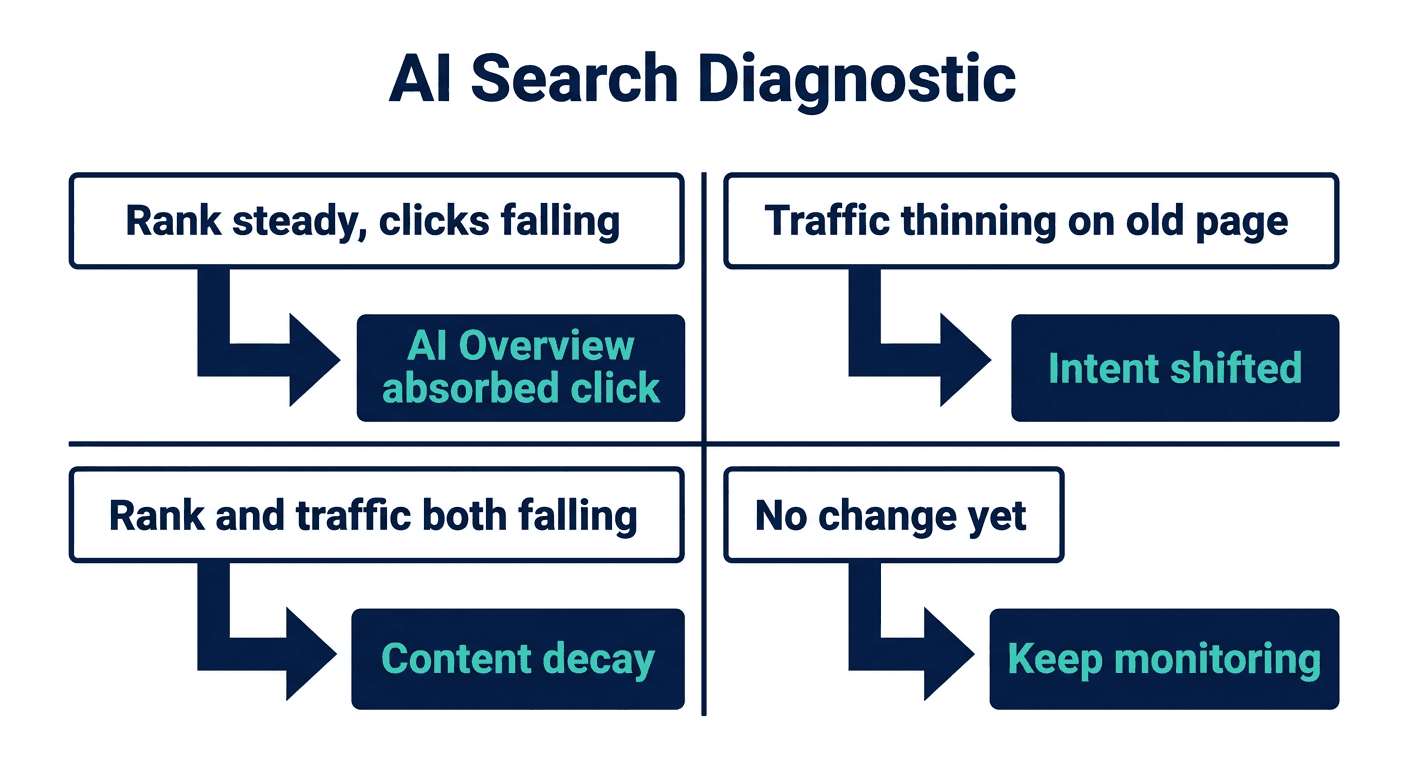
| Rank holding steady, but clicks and impressions falling | An AI Overview is likely absorbing the query above your position | Add a direct, quotable answer in the first 100 words; add FAQ schema; check if you are cited inside the AI Overview itself |
| A page that used to convert well now getting thinner traffic | Search intent for that query may have shifted toward pure informational lookup | Re-check the SERP; if commercial intent has dropped, consider whether that page still deserves the same investment |
| No visible change at all yet | You are either in a query space AI has not touched much yet, or your content already meets the AI-citability bar | Keep monitoring; do not assume permanence either way |
| Traffic and rankings both falling together | This is classic content decay, not an AI-search problem | Diagnose separately: stale stats, broken links, a stronger competitor page, or an algorithm update unrelated to AI Overviews |
The single biggest mistake we see teams make here is diagnosing every traffic dip as "AI killed my SEO" when it is often plain content decay, a competitor outranking them, or a core algorithm update that has nothing to do with generative search. Confusing the two means you fix the wrong problem. This is exactly the distinction a GEO vs SEO comparison is built to make clear, because the fixes for each are different.
The Real Skill Shift Inside SEO Teams
The practitioners who are thriving right now are not the ones who mastered a new tool. They are the ones who stopped treating SEO as a reporting job and started treating it as a fix-and-monitor loop: catch the problem, understand whether it is a ranking issue or a citation issue, make the specific change, and verify the change actually moved the number. That loop, not any single AI tactic, is what separates teams still growing in 2026 from teams still arguing about whether SEO is dead.
This is also the practical reason LLM SEO has become its own skill rather than a subset of classic SEO: optimizing for a system that reads and synthesizes multiple sources into one answer requires different structural choices (direct answers up top, real FAQ sections, clear authorship) than optimizing purely for a ranking algorithm. Teams that only know the old playbook are not obsolete, they are simply missing half the current job description.
We built Murkuz around this exact loop, because most existing tools stop at the "here is a problem" step and leave you to diagnose, brief, write, publish, and check the result manually. Murkuz's daily scan flags declining pages and content decay from your Search Console data, grades every page A through F specifically for AI search readiness (structure, authorship, freshness, citation potential), and then closes the loop with an Impact Scorecard that shows which specific fix caused which specific ranking change, so you are not left guessing whether your last round of edits actually worked.
FAQ
Will SEO get replaced by AI?
No. AI is changing how some queries get answered, particularly informational ones that AI Overviews can resolve directly, but transactional, local, and comparison-shopping searches still rely heavily on traditional search behavior. AI retrieval systems themselves also depend on a healthy, well-indexed, crawlable web, which means SEO's technical foundation remains necessary even for a page to be eligible for AI citation.
Is SEO dead or evolving in 2026?
Evolving, not dead. Search volume for informational queries has not disappeared, and the practices that earned rankings (technical health, topical depth, authority, intent matching) still work. What changed is that a growing share of queries also surface an AI-generated answer, which is why measuring citations and AI visibility now sits alongside rank tracking rather than replacing it.
Is SEO still relevant if most people use ChatGPT now?
Yes, for two reasons. Google still handles the overwhelming majority of search queries worldwide, and ChatGPT's own browsing and retrieval features pull from the same indexed web that SEO has always targeted. Being invisible to search also makes you invisible to AI retrieval, since most AI systems discover sources through the same crawl infrastructure.
What is the actual difference between SEO and GEO?
SEO optimizes a page to rank on a traditional results page so a user clicks through. GEO (generative engine optimization) optimizes content to be cited or quoted inside an AI-generated answer, where the user often never clicks at all. They share a technical and authority foundation but are measured differently: rankings and clicks for SEO, citations and brand mentions for GEO.
How do I know if AI Overviews are hurting my traffic?
Check whether your rankings have held steady while impressions or click-through rate declined for the same queries in Google Search Console. A stable rank with falling clicks is the clearest signal an AI Overview is absorbing the click above your listing. A falling rank alongside falling clicks points to a different problem: content decay, a stronger competitor, or an algorithm update unrelated to AI search.
Should I block AI crawlers from my site?
Generally no, if you want AI citations. Blocking bots like GPTBot or PerplexityBot makes you invisible to the systems you are trying to be cited by. The more common approach is distinguishing between AI training crawlers and AI search/retrieval crawlers in your robots.txt, since the goals of each are different, and being cited by a search-facing AI product typically still drives some referral value even without a click.
Junaid Khalid is the founder of Ertiqah and the builder behind Murkuz. He has run SEO as the first growth channel across his own SaaS products, watching this same "SEO is dead" cycle repeat at every major search shift, and built Murkuz around closing the loop from detection to fix to proof rather than adding another dashboard that just reports the problem.