Type "best project management software" into Google today and you might not click a single blue link. Instead, an AI Overview synthesizes an answer from five sources, names three tools, and you never scroll further. That is GEO happening to you, whether you have heard the term or not.
GEO stands for generative engine optimization: the practice of getting your content cited, quoted, or recommended inside AI-generated answers from ChatGPT, Perplexity, Google AI Overviews, and Copilot. SEO is the older discipline: getting your page to rank on the traditional results page so a person clicks through to your site. When people search "geo vs seo" or "seo vs geo," what they are really asking is whether these are two names for the same job. They are not. They are not measured the same way, and treating them as interchangeable is the single most common mistake we see teams make right now.
This guide breaks down exactly what is different between GEO and SEO, what still overlaps, and what a real, practical plan looks like for winning both at once, because both is the only option that makes sense in 2026.
What Is SEO (Quick Refresher)
SEO is the practice of optimizing a website so it ranks higher in the organic results of a traditional search engine, primarily Google and Bing. The mechanics are well understood after two decades of collective industry practice:
- Crawlers index your pages and evaluate relevance against a query.
- Rankings are influenced by backlinks, keyword usage, technical health (page speed, mobile-friendliness, crawlability), and content quality.
- Success is measured in rankings, organic traffic, click-through rate, and conversions from that traffic.
- The output is a list of links. The user chooses which one to click.
SEO has always been about winning the click. Every tactic, from keyword research to link building to technical audits, exists to move your URL higher on a page the user is actively scanning.
What Is GEO (Generative Engine Optimization)
GEO is the practice of optimizing content so generative AI systems select it as a source when constructing an answer. The mechanics are newer and still settling, but the pattern is consistent across ChatGPT, Perplexity, and Google's AI Overviews:
- The AI system retrieves and reads content from multiple sources related to the query.
- It synthesizes those sources into a single conversational answer, often citing two to six of them.
- Success is measured in citations, brand mentions inside AI answers, and share of voice across the AI tools your buyers actually use, not in a ranking position.
- The output is a direct answer. The user often never visits a website at all. This is why GEO is sometimes called "zero-click optimization."
You are not optimizing to be clicked. You are optimizing to be <mark class="km-highlight" style="--hl:#FEF08A;background:#FEF08A">trusted enough by the model to be quoted</mark>.
GEO vs SEO: The Core Differences
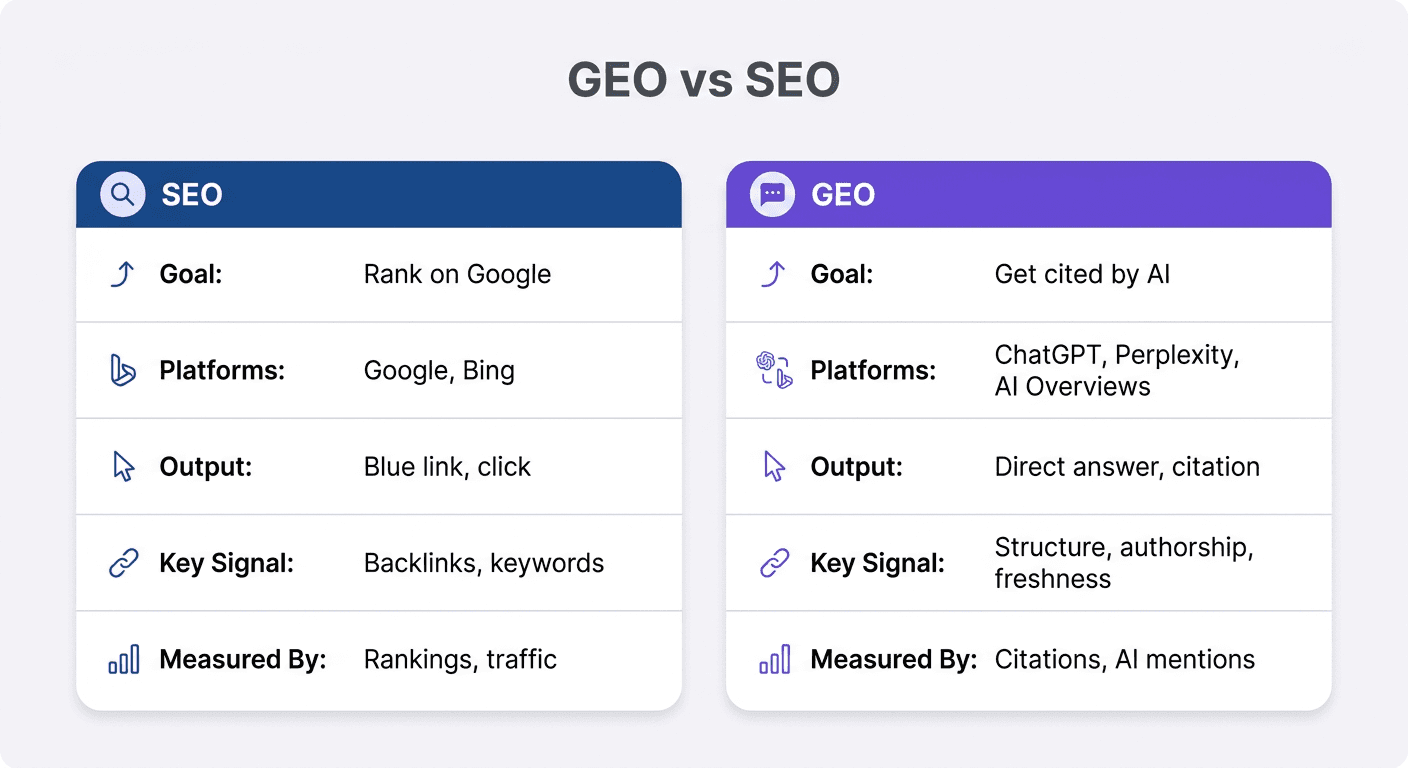
If you are still asking "what is GEO vs SEO" at a glance: SEO is generative engine optimization's older sibling, built for crawlers and rankings, while GEO (also written as generative engine optimization vs SEO in some searches) is built for AI models and citations. Here is the side-by-side that most articles gesture at but rarely make concrete.
| Dimension | SEO | GEO |
|---|---|---|
| Primary platforms | Google, Bing | ChatGPT, Perplexity, Google AI Overviews, Copilot |
| What you're optimizing for | A ranking position on a results page | A citation or mention inside a generated answer |
| Traffic outcome | User clicks through to your site | AI answers the query directly; click-through is optional and often skipped |
| Query shape | Short, 2-4 word keyword phrases | Long, conversational, question-shaped prompts |
| Ranking/selection signal | Backlinks, keyword relevance, page speed, domain authority | Factual clarity, structured answers, named authorship, topical depth, freshness |
| How to measure success | Rank tracking, organic sessions, CTR | Citation tracking, brand mention frequency in AI answers, prompt-level visibility |
| Content format that wins | Comprehensive pages targeting a keyword cluster | Direct, extractable answers: definitions, FAQs, numbered steps, clear claims |
| Time to see results | Weeks to months (crawl, index, rank) | Can shift quickly as models re-ingest content, but no guaranteed refresh cycle |
The practical distinction underneath all of this: SEO optimizes for a machine that ranks documents. GEO optimizes for a machine that reads, synthesizes, and rewrites your content in its own words before a human ever sees it. That second machine does not care about your backlink profile nearly as much as it cares whether your page states a fact clearly enough to lift and quote.
Where They Overlap (More Than People Assume)
This is the part most "GEO vs SEO" content skips, and it matters more than the differences. AI systems still rely heavily on the traditional web index to discover and evaluate content. Google's AI Overviews draw from pages that are already well-indexed and structured for search. ChatGPT's browsing and retrieval features favor authoritative, well-linked, frequently-cited domains, the same signals SEO has rewarded for years.
Concretely, the shared foundation includes:
- Topical authority. Both systems favor sites that comprehensively cover a subject rather than a single thin page.
- Technical crawlability. If a bot cannot access or parse your page, neither Google's index nor an AI retrieval layer will use it. Clean HTML, fast load times, and no crawl blocks matter to both.
- Structured content. Clear headings, schema markup, and well-organized sections help traditional rank-and-snippet features (like featured snippets) and help an AI model extract a clean answer. The same H2/H3 hierarchy that helps you rank for a "People Also Ask" box tends to help you get cited in an AI answer for the same question.
- E-E-A-T signals. Named authors with real credentials, clear sourcing, and demonstrated expertise help both a human Google quality rater and an AI model deciding whether to trust your claim over a competitor's.
So the honest answer to "is GEO replacing SEO" is no. GEO is closer to a new layer built on top of the same foundation, with a different measurement system and a different endgame. <mark class="km-highlight" style="--hl:#BBF7D0;background:#BBF7D0">If your SEO fundamentals are weak, your GEO performance will be weak too</mark>, because the retrieval systems behind GEO still lean on the open web's existing signals of trust and structure.
A Practical GEO Checklist You Can Run This Week
If you already have solid SEO fundamentals, here is what to add specifically for AI citability:
- Write direct, quotable answers near the top of the page. Answer the core question in one or two sentences before you elaborate. AI systems extract the clearest, most self-contained statement, not the best-written paragraph three screens down.
- Add a genuine FAQ section. Structure real "People Also Ask"-style questions as their own headings with concise answers underneath. This is the single easiest lever for GEO, and it is also one of the most under-used, since most competing content in this exact space recommends FAQs without actually including one.
- Attribute content to a named, credentialed author. AI systems weigh authorship signals when deciding which source to trust for a factual claim.
- Keep statistics and claims current. Freshness is an explicit trust signal for retrieval-based systems. A page citing 2023 numbers in 2026 is a weaker citation candidate than one with this year's data.
- Use schema markup, particularly FAQ schema and Article schema, so machine-readable structure backs up what a human reader sees.
- Check whether your key pages allow AI crawlers. GPTBot, ClaudeBot, PerplexityBot, and similar crawlers respect
robots.txt, and a growing number of sites also publish anllms.txtfile to give AI systems a clean, curated map of their most citable pages. If you have blocked these crawlers (sometimes by accident, sometimes as a blanket "block all bots" rule left over from years ago), you are invisible to GEO no matter how good the content is. - Track citations, not just rankings. Ask ChatGPT and Perplexity the questions your buyers would ask, and note whether your brand shows up. AI-visibility trackers like Profound, Otterly, and Semrush's AI toolset are starting to do this at scale; until you adopt one, a recurring manual spot-check across your 10-15 highest-intent questions is the GEO equivalent of a rank check.
None of this replaces your existing SEO work. It sits on top of it.
Why You Need Both, Not One or the Other
Here is the case for running both disciplines at once, not sequentially and not as a replacement.
Search behavior is fragmenting, not consolidating. People still type short queries into Google for local businesses, transactional searches, and anything with strong commercial intent. They increasingly ask ChatGPT or Perplexity conversational, research-style questions. Betting entirely on one channel means ceding the other to whoever shows up prepared.
AI Overviews already sit on top of your traditional rankings. Picture a SaaS blog ranking #2 for "best invoicing software for freelancers," a page-one position it worked a year to earn. Google now shows an AI Overview above the results that names three competitors and never mentions the page at all. The click-through rate on that #2 spot can fall even though the ranking itself has not moved, because the AI Overview absorbed the query before the user ever reached the organic list. That is the same page, the same query, losing ground on a surface that classic rank tracking will not even show as a drop.
Zero-click answers do not eliminate the need for a destination. Even when an AI answer satisfies the immediate question, buyers still visit websites to evaluate vendors, compare pricing, and make a purchase decision. GEO earns you the mention; SEO (and a page worth clicking through to) earns you the visit that follows.
The underlying content is the same asset. A well-structured, expertly authored, current page performs at both jobs. You are not maintaining two separate content strategies. You are maintaining one strategy with two additional layers of structure and attribution on top of what good SEO already required.
The Cost of Getting This Wrong
Teams that treat "GEO vs SEO" as an either/or decision tend to make one of two mistakes. Either they keep publishing exactly as they did in 2022, ignore AI citability entirely, and watch competitors get quoted in AI Overviews for queries they used to own on page one. Or they overcorrect, chase GEO tactics in isolation, publish thin FAQ-stuffed pages with no real authority behind them, and end up with content that satisfies neither a search engine's ranking algorithm nor an AI model's trust signals.
The teams doing this well treat it as one continuous content operation: rank the page well, structure it so it is extractable, keep it current, and attribute it properly, then monitor both outcomes, rankings and citations, as two views into the same underlying performance.
That monitoring step is where most teams quietly fall down. It is one thing to know you should keep content fresh and well-structured. It is another to actually catch the moment a page starts sliding, or notice that a competitor's page just took the AI Overview citation you used to hold. Murkuz was built around exactly that gap: rather than another dashboard that reports a problem and leaves you to fix it, it grades every page A through F for AI search readiness, flags the specific structural gaps (missing author attribution, thin FAQ coverage, stale statistics, weak schema) that keep a page from being cited, and turns each one into a task you can act on. The same detection engine that watches for traditional ranking decay watches for AI search gaps, because in practice they are two symptoms of the same underlying content health problem.
FAQ
Is GEO replacing SEO?
No. GEO is an additional optimization layer for how generative AI systems select and cite sources, not a replacement for traditional search ranking. Both traditional search and AI-generated answers coexist as discovery paths, and most retrieval systems behind GEO still depend on the same web index and authority signals that SEO has always targeted.
Is SEO dead or evolving in 2026?
Evolving, not dead. Search intent and search volume for traditional queries remain high. What has changed is that a growing share of queries now also surface an AI-generated answer alongside or instead of the traditional ten blue links, which is why GEO has emerged as a companion discipline rather than a successor.
What does GEO mean compared to SEO?
GEO means generative engine optimization: optimizing content to be cited or recommended within AI-generated conversational answers. SEO means search engine optimization: optimizing content to rank on a traditional results page. The core difference is the destination, a citation inside an AI answer versus a link on a results page, and the measurement, brand mentions and citations versus rankings and clicks.
Why is AI search sometimes just called GEO instead of SEO?
Because the mechanics differ enough to warrant a distinct name. Traditional SEO optimizes for a crawler that indexes and ranks discrete documents. AI search optimization targets a retrieval-and-synthesis system that reads multiple sources and generates a new, blended answer in its own words. The optimization tactics, direct answers, structured FAQs, author attribution, diverge enough from classic keyword-and-backlink SEO to need their own name.
Is GEO the same as AEO?
They are closely related and often used interchangeably. AEO (answer engine optimization) typically refers to optimizing for direct-answer features like featured snippets and voice assistants, while GEO more specifically targets generative AI chat tools like ChatGPT and Perplexity. In practice, the tactics, clear structure, direct answers, strong sourcing, overlap heavily enough that most teams treat them as one combined effort.
Which is better, SEO or GEO?
Neither is "better" in isolation; they answer different questions. SEO earns you visibility and clicks on traditional search. GEO earns you visibility and trust inside AI-generated answers, often without a click at all. A team optimizing for only one is deliberately ignoring a real and growing share of how their buyers find information.
Will AI replace SEO entirely?
Unlikely in the foreseeable future. AI-generated answers are increasingly common for informational queries, but transactional, local, and comparison-shopping searches still rely heavily on traditional search behavior, and AI retrieval systems themselves depend on a healthy, well-indexed web to draw from. SEO and GEO are more likely to keep converging into a single "search visibility" discipline than for one to fully replace the other.
Junaid Khalid is the founder of Ertiqah, the company behind Murkuz. He has run SEO as the first growth channel across his own SaaS products, from early-stage keyword bets to the operational grind of keeping hundreds of pages from quietly decaying, which is the problem that led him to build Murkuz in the first place.