LLM SEO is the practice of shaping your content and your site so that large language models, the systems behind ChatGPT, Perplexity, Claude, and Google's AI Overviews, can find it, understand it, trust it, and repeat it back as an answer. Traditional SEO earns you a blue link. LLM SEO earns you a sentence inside someone else's answer, often with no click at all.
That trade-off is the whole story. Below is what actually happens between a person typing a question into ChatGPT and your brand showing up in the reply, what you can control, and what is still guesswork even for people who do this daily.
What Is LLM SEO, in One Paragraph
LLM SEO (sometimes written LLM optimization, or grouped under the broader umbrella of GEO, generative engine optimization) is the work of making your content legible and citable to a language model rather than only to a search-engine crawler. A crawler indexes a page and ranks it against a query. A language model does something different: it reads (or was trained on) your page, forms an internal representation of what it says, and later decides, sentence by sentence, whether to repeat your claim, your number, or your framing when it answers someone else's question. You are not optimizing for a rank anymore. You are optimizing for the chance of being the source a model reaches for. To see how one article measures up, a free LLM SEO scoring tool runs ten citability checks on it in your browser.
This is not a rebrand of old SEO advice with "AI" bolted on. The scoring changes, the surface changes, and the failure mode changes. A page can rank #3 on Google and never get mentioned by ChatGPT, and a page ranking nowhere near page one can still get cited by Perplexity because it happened to state a fact more cleanly than anything else the model retrieved.
Two Completely Different Ways an LLM "Finds" You
Most explanations of LLM SEO skip straight to advice (write FAQs, add schema) without explaining the two separate mechanisms that advice is supposed to serve. They call for different tactics, so it is worth separating them before doing anything else.
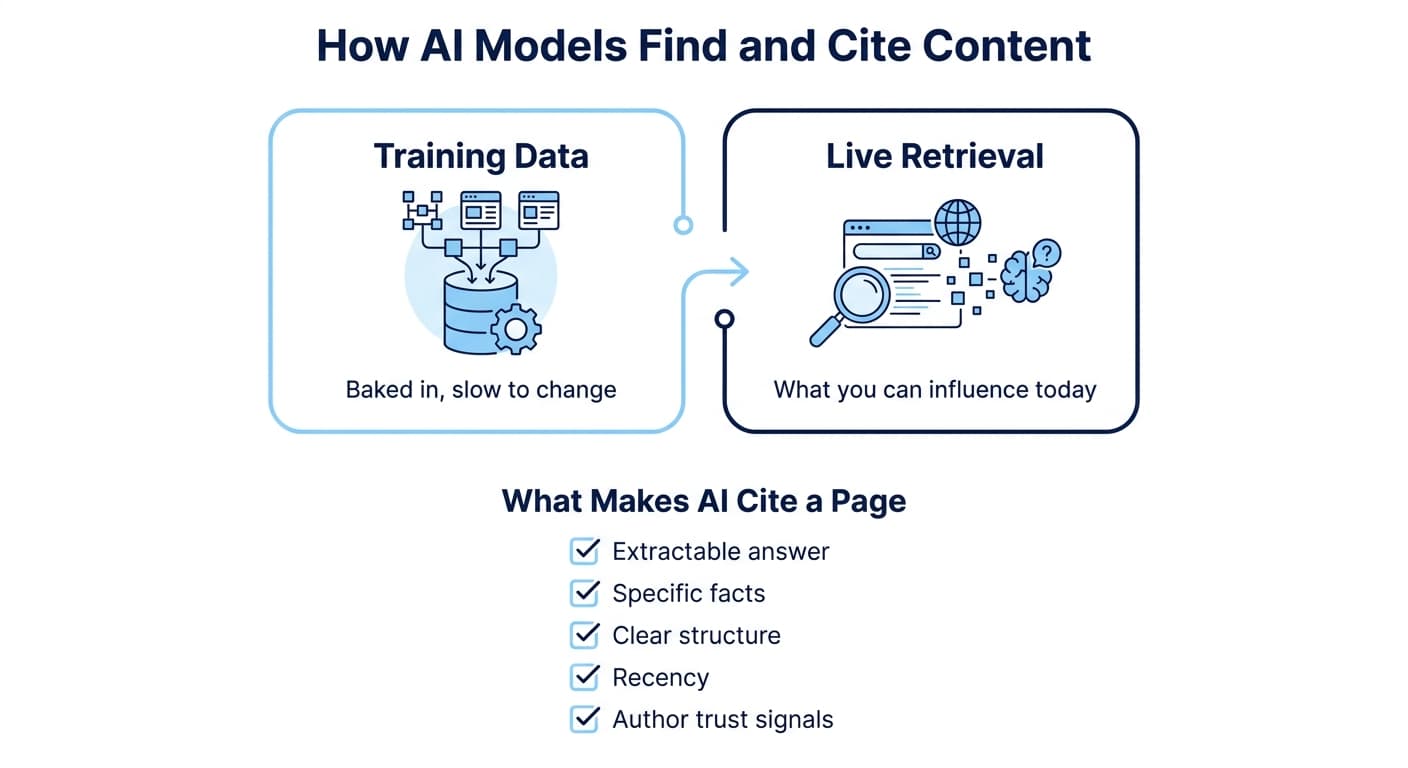
1. Training-Time Knowledge (Baked In, Slow to Change)
Large models such as GPT, Claude, and Gemini are trained on enormous scrapes of the public web, Common Crawl chief among them, plus licensed datasets, forums, and documentation. If your brand, your product, or your claim appeared often enough, consistently enough, across enough independent sources during that training window, the model already "knows" about you before anyone asks a question. This is why backlinks and third-party mentions still matter here: they are not just a ranking signal anymore, they are training-data signal. You cannot edit this after the fact. A training cutoff is a training cutoff. The only lever is what you publish and how widely it gets picked up and referenced by other sites, well before the next training run.
2. Live Retrieval (What You Can Actually Influence Today)
The second pathway is the one you can act on this week. When a model does not have a confident trained-in answer, or when the product is specifically built to browse, it runs a live retrieval step: ChatGPT's search mode routes queries largely through Bing, Perplexity runs its own crawler plus a mix of search APIs, and Google's AI Overviews pull straight from Google's existing index. In every case the model issues something closer to several narrow searches than one broad one, a pattern often called query fan-out. A single question like "best CRM for a 10-person agency" might get broken into three or four separate retrieval searches (best CRM small agency, CRM pricing comparison, CRM for client services) before the model has enough material to compose one answer. This is why ranking for the exact head keyword is not enough: you also need to be retrievable for the narrower sub-questions the model breaks your topic into.
Everything actionable in this guide is aimed at pathway two, because it is the one that responds to changes you make today.
What Makes an LLM Actually Cite a Page
Reverse-engineering citation behavior across ChatGPT, Perplexity, and AI Overviews turns up the same handful of factors, in roughly this order of leverage:
- A self-contained, extractable answer near the top. Models favor a passage that answers the question in one or two sentences without needing outside context. Bury the answer under three paragraphs of scene-setting and it is invisible to extraction, even if a human reader would eventually find it.
- Specific, checkable facts. A named number, a dated study, a concrete method beats "many experts agree" every time. Vague claims are hard for a model to quote with confidence, so it skips them for a source that made a harder, checkable statement.
- Clear structure. Descriptive H2s and H3s phrased the way a person would actually ask the question, short paragraphs, and genuine FAQ sections all make a passage easier to isolate and lift.
- Recency. Retrieval-based answers lean toward content that looks current: a visible update date, statistics from the current year, no dead links. Stale cornerstone content quietly falls out of rotation.
- Author and site trust signals. A real named author with visible expertise, a clear "who publishes this and why should I trust it" signal, and a site that is not obviously thin or auto-generated. This is the same E-E-A-T logic Google has pushed for years, now doing double duty for AI trust scoring.
- Structured data that matches the visible page. Schema (Article, FAQPage, HowTo, Organization) gives a model an unambiguous, machine-readable shortcut to the same facts already on the page. It is a hint, not a replacement for good writing, and it must describe exactly what a reader sees, never more.
- Independent corroboration. If three unrelated, credible sites state the same fact about you, a model treats that fact as more trustworthy than if only your own site says it. This is the live-retrieval cousin of the training-data mention effect above.
None of these factors is a guarantee. Unlike classic SEO, there is no dashboard that shows you your "AI ranking," and the same query can pull a different citation set from ChatGPT one day and Perplexity the next. Treat the list above as the honest odds-improvers, not a checklist that unlocks guaranteed inclusion. The closest you can get to that missing dashboard is a dedicated tracker: we compared nine LLM SEO tools that track AI citations across ChatGPT, Perplexity, and AI Overviews.
How LLM SEO Is Different From Regular SEO (Not a Replacement)
LLM SEO does not throw out classic SEO. It adds a second scoring layer on top of it. If your technical SEO is broken, an LLM has the same trouble reaching your content that Googlebot does, so none of this works in isolation.
| Traditional SEO | LLM SEO | |
|---|---|---|
| Unit of success | A ranked position on a results page | A citation, mention, or quoted passage inside an answer |
| What earns it | Relevance, links, technical health, matched intent | All of that, plus extractability, corroboration, and recency |
| Where it shows up | Blue links you can screenshot | Text inside a chat answer, often with no visible click |
| How you measure it | Rank tracker, Search Console | Manual prompt testing, brand-mention tracking, referral traffic from ai.chatgpt.com / perplexity.ai in your analytics |
| Timeline to see change | Days to weeks after a fix | Live retrieval can shift within days; training-data mentions can take a model generation to update |
The practical implication: keep doing real SEO. Then add the extractability and trust layer on top, because that is the part most sites still get wrong.
Where the Term Gets Confusing: LLM SEO vs GEO vs AEO
You will see LLM SEO used almost interchangeably with GEO (generative engine optimization) and AEO (answer engine optimization). In practice they describe the same underlying work from slightly different angles: LLM SEO emphasizes the model doing the citing, GEO emphasizes the broader "generative" search surface (which includes AI Overviews, not just chatbots), and AEO emphasizes the answer-first framing. Nobody enforces a strict boundary between the three terms yet. If you want the deeper side-by-side on how GEO tactics diverge from classic keyword-and-backlink SEO, the GEO vs SEO comparison walks through that specifically.
A First LLM SEO Checklist for an Existing Page
Before writing anything new, run an existing, important page through this sequence:
- Ask the actual question. Type your target query into ChatGPT, Perplexity, and Google, signed out. Note who gets cited and what exact sentence gets quoted. This tells you what "winning" looks like for this specific query today.
- Rewrite the opening as a direct answer. The first 40 to 60 words should answer the question with no throat-clearing. Everything else in the piece can build on that.
- Add one FAQ section with real, narrow questions. Not padding: the actual sub-questions a model's query fan-out would generate around your topic.
- Put a number where you currently have an adjective. "Significantly faster" tells a model nothing quotable. "40% faster in our test" is something it can lift.
- Add or fix the author byline. A named person, a real bio, a reason to trust them on this specific topic.
- Check your schema matches what is visible. FAQPage schema with FAQs that are not actually visible on the page is a trust problem, not a trust boost.
- Set a real last-updated date and mean it. Refresh the stats, not just the timestamp.
FAQ
Is LLM SEO a real ranking factor, or just a buzzword?
It describes a real, observable behavior change (models citing sources in answers), not a single new algorithm you can "rank" in the traditional sense. There is no unified LLM SEO score published anywhere. What is real is that the factors above measurably change whether a model cites a page, even without a formal scoring system to check against.
Do I need separate content for LLM SEO versus regular SEO?
No. The same page can serve both if it is well structured: a clear, direct answer near the top, real headings, specific facts, and a visible author. Writing two versions of everything is not necessary and usually just doubles your maintenance burden for no real gain.
How do I know if ChatGPT or Perplexity is actually citing my site?
Check your analytics for referral traffic from sources like chat.openai.com, chatgpt.com, and perplexity.ai. Then manually run your important target queries in each tool every so often and note whether you appear, since there is no reliable, automated rank tracker for AI citations the way there is for Google.
Does LLM SEO replace backlinks?
No, it raises their importance in a different way. Backlinks remain one of the strongest signals that a fact about you is independently corroborated, which both training data and live retrieval reward. The mechanism shifts from "link equity for ranking" to "corroboration signal for trust," but the underlying work of earning real mentions from other sites has not gone away.
How long does LLM SEO take to show results?
Live retrieval citations can shift within days of a content change, since the model is pulling fresh pages each time. Training-data mentions are much slower and effectively locked until the next major model training run, which is outside your control. Treat live retrieval as the near-term lever and training-data presence as a long-term compounding one.
Where This Fits Into Your Broader SEO Work
Getting cited by AI models is not a side project separate from your regular SEO work, it is graded the same way a good technical audit already grades your site: is the content structured, is it fresh, does it have real authorship, is the underlying page technically healthy. If you are running SEO in-house without a dedicated AI-search workflow, that grading is usually the missing piece, not a full rewrite of your process.
I have run SEO as the first growth channel across several of my own SaaS products, and the pattern holds every time: the pages that already do real SEO well (clear structure, genuine expertise, current data) are the ones that start picking up AI citations almost as a side effect. The ones that never do the basics well do not suddenly start winning citations just because "AI search" is now a category.
That grading is exactly what Murkuz's AI search readiness use case automates: it grades every page A through F against the structure, authorship, and freshness signals above, then generates the specific fix, whether that is adding FAQ schema, tightening the opening paragraph, or attaching a real author profile, so you are not guessing which of your hundred pages to touch first.
Murkuz will not tell you with certainty that ChatGPT will cite a specific page tomorrow. Nobody can promise that yet, and treat any tool that claims otherwise with suspicion. What it can do is make sure you are not losing citations to something fixable: a missing byline, a buried answer, a schema block that does not match the page. That is the part of LLM SEO that is genuinely within your control, and it is worth getting right regardless of which model, or which version of "AI search," wins the next few years.