Type "best CRM for a small agency" into ChatGPT and watch it cite three sources before it ever mentions yours, and you have already met the problem this article is about. Google's ten blue links gave you a rank tracker and a Tuesday morning routine. AI answers give you a citation, or nothing, and most teams have no idea which one they are getting.
LLM SEO tools exist to close that gap: they tell you whether ChatGPT, Perplexity, Gemini, and Google's AI Overviews are citing your brand, how often, and against which competitors. Below are nine real tools worth knowing, what each one actually does, who it fits, and where the category still falls short of what most teams actually need.
What an LLM SEO Tool Actually Needs to Do
Before comparing products, it helps to know what this category is supposed to solve. At minimum, a genuine LLM SEO tool should:
- Track citations across multiple engines. ChatGPT, Perplexity, Google AI Overviews, and Gemini each retrieve and cite differently. A tool that only checks one is measuring a fraction of the picture.
- Run real prompts, not just keywords. AI visibility is measured by whether you get mentioned inside an answer to an actual question, not by a keyword ranking position.
- Benchmark against named competitors. Knowing you got cited means little without knowing whether your competitor got cited more often, or instead of you.
- Point at a fix, not just a number. A dashboard that reports "12% share of voice" and stops there tells you the score, not what to change. This is the part most of the category still under-delivers on, and it is where the comparison below gets interesting.
The 9 Tools
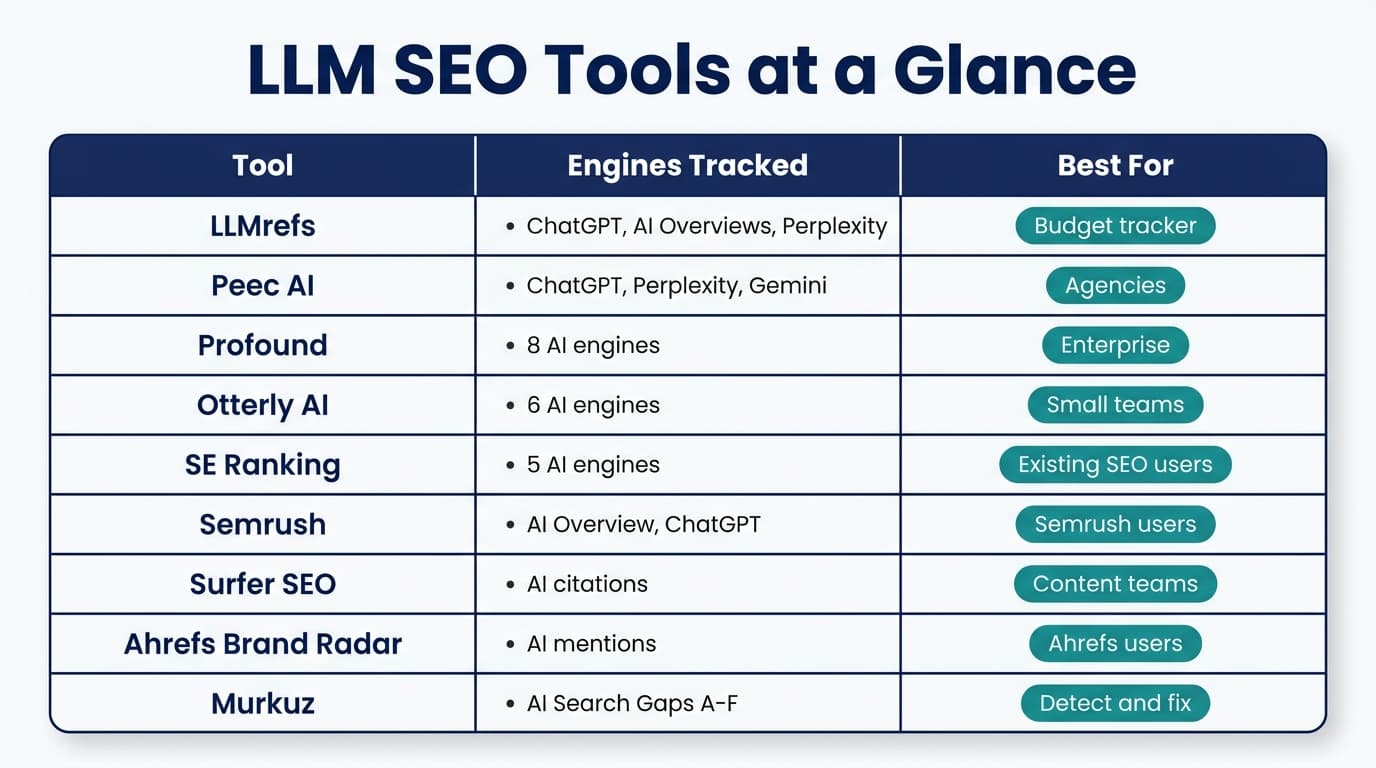
Here is the side-by-side before the tool-by-tool detail. Every value in it comes from the write-ups below.
| Tool | AI engines tracked | Standout feature | Best fit |
|---|---|---|---|
| LLMrefs | ChatGPT, Google AI Overviews, Perplexity, Claude, Grok | Weekly automated reports, geo-targeting in 50+ countries | A focused, no-frills citation tracker |
| Peec AI | ChatGPT, Perplexity, Gemini | Identifies which sources drive your citations, with sentiment | Marketing teams and agencies |
| Profound | ChatGPT, Perplexity, Claude, Gemini, Grok, Microsoft Copilot, Meta AI, DeepSeek, Google AI Overviews | Agent Analytics: how AI crawlers behave on your site | Enterprise brands and agency books of clients |
| Otterly AI | ChatGPT, Google AI Overviews, AI Mode, Gemini, Perplexity, Microsoft Copilot, Claude | Content audit that scores crawlability and AI-readiness | Smaller teams that want broad engine coverage |
| SE Ranking | AI Overview, AI Mode, ChatGPT, Gemini, Perplexity | AI visibility inside a full SEO suite, plus an MCP server | Existing SE Ranking customers |
| Semrush | Via its Copilot and Visibility Overview features | AI-citation signal without adopting a new tool | Existing Semrush customers |
| Surfer SEO | Via its AI Tracker | Pairs citation tracking with content optimization | Existing Surfer content workflows |
| Ahrefs | Via Brand Radar | Ties AI mentions to its backlink and domain index | Existing Ahrefs customers |
| Murkuz | Grades every page A through F for AI-search readiness | Generates the specific fix and publishes it, then monitors the result | Teams that want the fix, not just the score |
On price, from the write-ups below: Otterly AI starts at $29/month and LLMrefs at $79/month; SE Ranking, Semrush, Surfer, and Ahrefs include their AI tracking inside existing suite subscriptions; Peec AI shows pricing only through a demo or trial; Profound is priced for enterprise.
1. LLMrefs
LLMrefs is a dedicated LLM rank tracker built around one job: showing where your brand shows up across ChatGPT, Google AI Overviews, Perplexity, Claude, and Grok, with weekly automated reports and geo-targeting across 50+ countries and 20+ languages. It ships a handful of useful side tools too, an LLMs.txt generator, a Reddit-threads finder, and an AI crawlability checker, plus a client case study claiming a 73% share-of-voice result for one brand.
Where it is thin: methodology is described loosely as "aggregated and weighted," there is no meaningful competitor comparison depth, and the single visible pricing tier starts at $79/month for 500 prompts. Good fit if you want a focused, no-frills citation tracker and do not need it bundled with anything else.
2. Peec AI
Peec AI tracks brand visibility, positioning, and sentiment across ChatGPT, Perplexity, and Gemini. It lets you organize custom prompts with tags, benchmarks competitors across markets, suggests new prompts based on search volume, and identifies which sources (reviews, media, editorial sites) are driving your citations, with export to CSV, Looker Studio, or API.
It is aimed squarely at marketing teams and agencies who want a clean visibility dashboard rather than a full SEO suite. No public pricing is listed on the site; you go through a demo or free trial to see numbers, which is a minor friction point if you are comparing options quickly.
3. Profound
Profound is the enterprise end of this category, tracking brand representation across Perplexity, ChatGPT, Claude, Gemini, Grok, Microsoft Copilot, Meta AI, DeepSeek, and Google AI Overviews. Its standout feature is Agent Analytics: visibility into how AI crawlers actually behave on your site, not just how you show up in their outputs. It also surfaces "Prompt Volumes," aggregate data on what people are actually asking AI at scale, so you can align content to real demand instead of guessing.
This is built for AEO specialists, PR and brand teams, and larger organizations, and it prices and positions accordingly. If you are a solo founder or small team, this is likely more platform than you need.
4. Otterly AI
Otterly AI tracks six engines (ChatGPT, Google AI Overviews, AI Mode, Gemini, Perplexity, Microsoft Copilot, and Claude via API) and adds a content audit that scores page crawlability and AI-readiness, plus GEO recommendations aimed at improving citation odds. Plans start at $29/month with a 7-day free trial, which makes it one of the more accessible entry points in this list. Otterly reports serving over 30,000 marketing professionals and lists a 2025 Gartner Cool Vendor mention and a Tekpon "Top SEO Software" nod.
Good fit for smaller teams that want broad engine coverage and an actual content-quality signal, not just a mentions counter, without enterprise pricing.
5. SE Ranking (AI Visibility Tracker)
SE Ranking bolts an AI visibility tracker onto its existing, well-established SEO suite, covering AI Overview, AI Mode, ChatGPT, Gemini, and Perplexity, with daily brand-mention tracking, competitor benchmarking, and Google Analytics 4 correlation. Its companion product, SE Visible, goes deeper on citation analysis, prompt research, and sentiment tracking. It also ships an MCP server that can feed SE Ranking data directly into AI assistants, a genuinely forward-looking feature for a category this new.
The advantage here is bundling: if you already run SE Ranking for rank tracking, backlinks, and audits, AI visibility becomes one more tab instead of a whole new subscription.
6. Semrush
Semrush added AI visibility tracking (via its Copilot and Visibility Overview features) on top of its existing keyword, backlink, and site-audit tooling. If your team already lives in Semrush for traditional SEO, this is the path of least resistance to get some AI-citation signal without adopting a new tool. It is not a purpose-built LLM SEO product, so expect shallower prompt-level detail than a dedicated tracker like LLMrefs or Peec AI offers, and treat it as an add-on to an existing workflow rather than a reason to switch.
7. Surfer SEO (AI Tracker)
Surfer SEO pairs its content-optimization tooling with an AI Tracker for citation visibility. The fit makes sense: Surfer already tells you how to structure a page for ranking, and now it also tells you whether that structure is earning AI citations. One thing worth flagging plainly, in the spirit of an honest review: Surfer's own roundup of "best AI SEO tools" ranks its own Surfer AI Tracker first, which is worth knowing before you take any vendor's self-ranked list, including comparisons in this article, at face value. Judge it on the feature fit for your workflow, not the marketing copy.
8. Ahrefs Brand Radar
Ahrefs has extended its long-standing backlink and keyword index into AI-mention tracking through Brand Radar, tying citation tracking to the same domain and backlink data Ahrefs already indexes. If you are already an Ahrefs customer for backlink analysis and keyword research, this is a reasonable way to add AI visibility without a new login, though as with Semrush, expect it to feel like an extension of an existing product rather than a purpose-built LLM tracker.
9. Murkuz
Every tool above answers the same question well: are you being cited, and by whom instead of you. None of them, by design, close the next step: once you know a page is invisible to ChatGPT or Perplexity, something still has to rewrite it, and someone still has to prove the rewrite worked.
That is the specific gap Murkuz is built around. Its AI Search Gaps detection grades every page A through F for AI-search readiness (structure, authority signals, citation potential, and freshness) and generates the specific fix, whether that is tightening the opening paragraph into a direct answer, attaching a real author profile, or adding FAQ schema that actually matches the visible page. From there the same closed loop that Murkuz runs for regular SEO applies here too: detect the gap, get a task with the recommended fix, publish the AI-optimized rewrite straight to WordPress, Webflow, or Framer, then monitor whether the fix actually moved anything.
It will not tell you with certainty that ChatGPT will cite a specific page tomorrow. No tool in this list can promise that, and any vendor that implies otherwise is overselling a genuinely young category. What it can do is stop the AI-visibility gap from sitting on a dashboard as a grade with no next step attached, which is the part a pure tracker was never built to do.
How to Choose Between Them
A quick way to narrow the list:
- Want the cheapest dedicated tracker? Otterly AI or LLMrefs, both under $80/month to start.
- Already paying for Semrush, Ahrefs, or SE Ranking? Turn on their built-in AI tracking before buying a separate tool. It will not be as deep, but it costs nothing extra.
- Running this for an enterprise brand or agency book of clients? Profound is built for that scale and that budget.
- Want visibility tracking that also tells you what to fix and publishes the fix? That is the piece Murkuz adds on top of tracking.
None of these is the "wrong" choice in isolation. They solve different-sized versions of the same problem, and several of the vendors above are genuinely good at the specific thing they built.
FAQ
What is the difference between an LLM SEO tool and a regular rank tracker?
A regular rank tracker checks your position on a Google results page for a keyword. An LLM SEO tool checks whether an AI model (ChatGPT, Perplexity, Gemini, Google AI Overviews) mentions or cites your brand inside its generated answer to a prompt, which is a different unit of measurement entirely: a citation inside text, not a position on a page.
Are any of these LLM SEO tools free?
Most listed here run on paid subscriptions, though several (Otterly AI, LLMrefs) offer short free trials, and Peec AI offers a free trial as well. There is no fully free, ongoing dedicated LLM tracking tool as of this writing; the closest free option is manually running your target queries in ChatGPT and Perplexity yourself and noting who gets cited.
Do I need a separate LLM SEO tool if I already use Semrush or Ahrefs?
Not necessarily to start. Both have added AI-visibility features on top of their existing SEO suites, which is enough for a first look at whether you are showing up at all. Move to a dedicated tracker like Peec AI, Profound, or LLMrefs once you need deeper prompt-level detail or multi-engine benchmarking than the bolt-on features provide.
How often should I check my AI visibility?
Most of the dedicated trackers above run automated daily or weekly checks, which is a reasonable cadence: often enough to catch a real shift, not so often that you are chasing day-to-day noise in a system that has real variance built in.
Can a tool guarantee my content gets cited by ChatGPT?
No, and any tool that implies it can should be treated with suspicion. None of the platforms above, including Murkuz, control what a third-party model decides to cite. What they can do is measure whether you currently are being cited, and in the case of tools that go further than tracking, tell you what specifically to fix to improve your odds.
Where This Fits Into Your Broader AI Search Work
Tracking is the easy half of this problem: point a tool at a handful of prompts and it will tell you, correctly, whether you show up. The harder half is turning that number into a specific edit on a specific page, then confirming the edit actually changed anything. That is the practical difference between a dashboard and a workflow, and it is worth being clear-eyed about which one you are buying before you commit a budget to it.
If you want the deeper explanation of what LLM SEO actually is and how citation behavior works underneath these tools, our guide to LLM SEO covers the two discovery pathways (training data versus live retrieval) that every tool in this list is ultimately trying to measure.
I have run SEO as the first growth channel across several of my own SaaS products, and the pattern with AI visibility has been consistent with regular SEO: the tools that only report a number leave you exactly where you started, staring at a grade with no next action. The ones worth paying for are the ones that turn the number into a task you can actually finish this week.