Semrush's free plan lets you run a handful of searches a day before it locks you out. That's fine for checking one keyword before a meeting, but it's not a real research workflow. If you're looking for a free Semrush alternative, the honest answer is that no single free tool replaces Semrush's full suite, but a small stack of genuinely free tools covers most of what a solo operator or small team actually needs, at least until the site grows past what free tiers can support.
Below are 7 free tools worth trying first, what each one is actually good for, where the free limits bite, and a straightforward way to decide when it's time to pay for something.
Why "Free Semrush Alternative" Is the Wrong Search (Sort Of)
Semrush bundles keyword research, rank tracking, site auditing, backlink analysis, and content tools into one paid suite. No free tool replicates all of that, because the data behind it (a crawled backlink index, historical keyword volume, competitor traffic estimates) is expensive to collect and maintain. Free tools survive by giving away a narrow slice: a capped number of daily lookups, a smaller keyword database, or first-party data you already own (like your own Google Search Console numbers).
That's actually good news if you're specific about what you need. Most people searching for a free Semrush alternative aren't trying to run enterprise link-building campaigns. They're trying to find keyword ideas, check a few rankings, or run a basic technical audit without pulling out a credit card. Every tool below is built for exactly that.
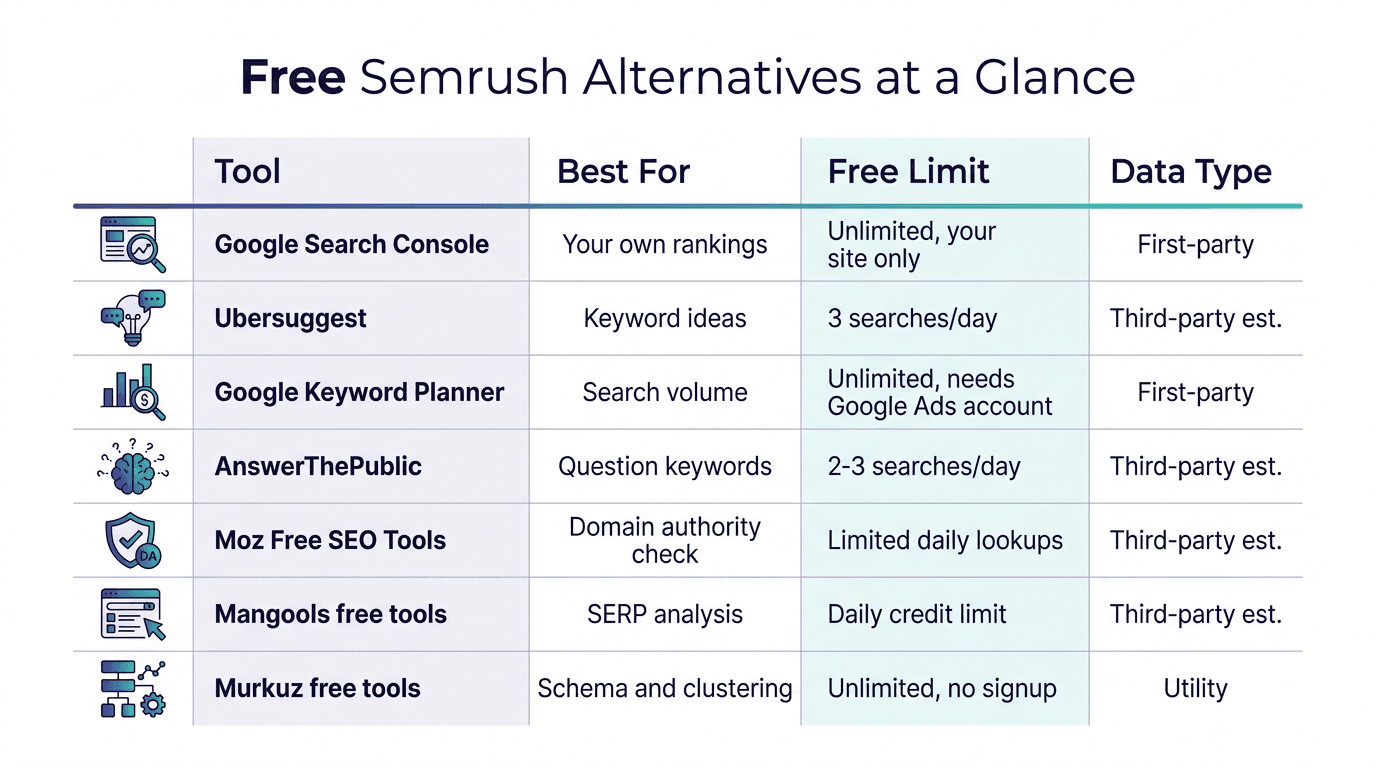
The 7 Free Tools, Compared
| Tool | Best for | Free limit | Data source |
|---|---|---|---|
| Google Search Console | Your actual rankings, clicks, and indexing issues | Unlimited, but your site only | First-party (Google) |
| Google Keyword Planner | Search volume and keyword ideas | Unlimited searches, but volume shows as ranges without ad spend | First-party (Google) |
| Ubersuggest | Keyword ideas and basic site audit | 3 searches per day (unregistered) | Third-party estimate |
| AnswerThePublic | Question-based and long-tail keyword ideas | 2-3 free searches per day | Third-party estimate |
| Moz Free SEO Tools | Domain Authority and link overview checks | Limited daily lookups per tool | Third-party estimate |
| Mangools free tools | SERP simulation and AI search visibility checks | Small daily credit allowance | Third-party estimate |
| Murkuz free tools | Keyword clustering, schema markup, meta descriptions | Unlimited, no signup required | Utility (no scraped index) |
1. Google Search Console: start here, it's already free and it's your data
If you're not already using Search Console, this is the highest-value free tool on the list, full stop. It's not a Semrush substitute for competitive research, but for your own site it's <mark class="km-highlight" style="--hl:#FEF08A;background:#FEF08A">more accurate than any third-party rank tracker</mark>, because it's pulling directly from Google's own index data rather than estimating.
Use it to see which queries actually bring you clicks and impressions, which pages are losing position over time, and which pages Google has indexed versus flagged with errors. The catch: it only shows data for your own domain. You can't use it to research a competitor's keywords or check a page you don't own.
2. Google Keyword Planner: the free volume data everyone forgets exists
Keyword Planner is built for Google Ads, but you don't need to run a campaign to pull search volume and keyword ideas from it. Create a free Google Ads account, skip the campaign setup, and go straight to the Keyword Planner tool under the account's shared library.
The limitation: if you're not actively spending on ads, Google shows volume as a broad range (like "1K-10K") instead of an exact number. That's still useful for gauging relative demand between two keyword ideas, just not for precise volume comparisons the way Semrush's own database gives you.
3. Ubersuggest: closest to a real keyword tool, with a daily ceiling
Ubersuggest, built by Neil Patel's team, gives unregistered users 3 free searches per day covering keyword suggestions, content ideas, and a basic site audit. It's the closest thing on this list to Semrush's actual keyword-explorer experience, with volume, difficulty, and related terms shown side by side.
Three searches a day sounds thin, and it is, if you're researching a whole content calendar in one sitting. It's enough if you're checking one or two target keywords before writing a specific article, which is how most solo bloggers and founders actually use it.
4. AnswerThePublic: built specifically for question and long-tail keywords
If your content strategy leans on answering real reader questions (which most SEO-focused blogs should), AnswerThePublic is worth the daily free searches it allows. It visualizes questions, comparisons, and prepositions people type after a seed keyword, which is a fast way to build an FAQ section or find a genuinely underserved long-tail angle.
It won't give you search volume or difficulty scores. Treat it as an idea generator you pair with Keyword Planner or Search Console, not a full keyword research tool on its own.
5. Moz Free SEO Tools: useful for quick domain-strength checks
Moz's free tools (Domain Authority checker, Link Explorer preview, MozBar browser extension) are handy for a fast gut-check on a domain's overall authority before deciding whether it's worth pursuing a link or comparing yourself to a competitor. Domain Authority itself isn't a Google ranking factor, but it's become a widely understood shorthand across the industry for relative site strength.
The free tier gives you a handful of lookups per day, then asks you to sign up for a trial. Fine for occasional spot checks, not for systematic competitor tracking.
6. Mangools free tools: SERP simulation and AI visibility, no card required
Mangools built a set of standalone free tools, including a SERP Simulator, an AI Search Grader, and a SERP Location Changer, that don't require a paid plan to use. They're narrower than Ubersuggest's keyword tool but genuinely useful for specific jobs: previewing how a title tag and meta description will actually look in search results, or getting a quick read on whether your content shows up in AI-generated answers.
Each free tool runs on a small daily credit allowance shared across Mangools' tools, so heavy daily use will hit a wall quickly.
7. Murkuz free tools: the utility tools that don't compete with the paid tier
Murkuz (the platform behind this article) offers a handful of genuinely free, no-signup tools: a keyword clustering tool that groups a keyword list into topic clusters for planning content, plus free meta description, robots.txt, and schema markup generators. These aren't research tools like the others on this list. There's no crawled index behind them, so they don't compete with Semrush's data at all. They solve a specific mechanical task (turning a messy keyword export into a content plan, or generating valid FAQ schema) without needing an account.
If your bottleneck is closer to "I found the problem, now I need to fix and publish it," that's a different job than any tool on this list solves, including Semrush itself. Semrush and its free-tier competitors are built to help you find issues. What happens after you know a page is declining, drafting the fix, publishing it, and confirming it actually worked, is the part Murkuz's full platform is built to close.
When Free Stops Being Enough
Free tools are a genuinely good starting point, not a permanent strategy, for most sites past a certain size. Watch for these signals that you've outgrown the free tier:
- You're hitting daily search limits before you finish one research session. If 3 searches a day means you're spacing out basic keyword research across a week, the time cost is already bigger than a $20-30/month tool would save.
- You need historical data. Free tools mostly show current-moment snapshots. If you need to see how a keyword's volume or your rankings trended over the last 12 months, that requires a paid tool with stored history.
- You're tracking competitors, not just yourself. Search Console only covers your own site. The moment you need to see what a competitor ranks for, you need a paid tool with a crawled index.
- You're managing more than one site. Juggling daily free-tier limits across multiple domains gets unmanageable fast; most free tools cap out at single-site, ad-hoc use.
If any of those match where you are, it's worth looking at what a genuinely low-cost Semrush alternative actually costs before jumping straight to Semrush's own $140+/month plans, since several tools sit in the $20-70/month range and cover real research depth.
FAQ
Which SEO tool is free?
Google Search Console and Google Keyword Planner are both fully free with no usage cap tied to a daily credit system, though Search Console only covers your own site and Keyword Planner shows volume as ranges without active ad spend. Beyond those two, Ubersuggest, AnswerThePublic, Moz's free tools, and Mangools' free tools all offer a genuinely free tier, capped at a small number of daily searches or lookups.
Is there a free Semrush?
Semrush itself offers a free account, but it's limited to around 10 total searches a day across its tools, which is only enough for the occasional one-off check, not real research. There is no free-forever plan that unlocks Semrush's actual keyword database, site audit, or backlink index at meaningful scale; those require a paid Pro plan or higher.
Can I use Ahrefs for free?
Yes, to a point. Ahrefs offers a set of standalone free SEO tools (a keyword generator, backlink checker showing the top 20 backlinks, broken link checker, and a few others) that don't require a paid account. These are individually useful but narrower than Ahrefs' paid product; the backlink checker's 20-link cap, for instance, is a fraction of what a real link audit usually needs.
Do any free tools show accurate search volume?
Google Keyword Planner is the most accurate free source, because it comes directly from Google, but it shows volume as a broad range instead of a specific number unless you're actively running ad spend. Ubersuggest and similar tools show a specific number, but it's a third-party estimate rather than Google's own figure, so treat it as directionally useful, not exact.
What's the real difference between free and paid keyword tools?
Mostly two things: search caps and data depth. Free tools cap how many searches or lookups you get per day and usually show narrower or estimated data instead of exact historical figures. Paid tools remove the daily ceiling and add historical trending, competitor-level detail, and (with Semrush and similar suites) site audit and backlink data that free tools generally don't include at all.
Junaid Khalid is the founder of Ertiqah and the builder of Murkuz. He has run SEO as the first growth channel across his own SaaS products, which is part of why Murkuz's own free tools solve a specific mechanical problem instead of trying to be a second research suite.