Semrush is a genuinely good SEO suite. It also assumes you have a writer, a project manager, and spare hours every week to turn its reports into actual changes on your site. If that assumption doesn't match your team, you're not looking for a worse tool, you're looking for a different kind of tool.
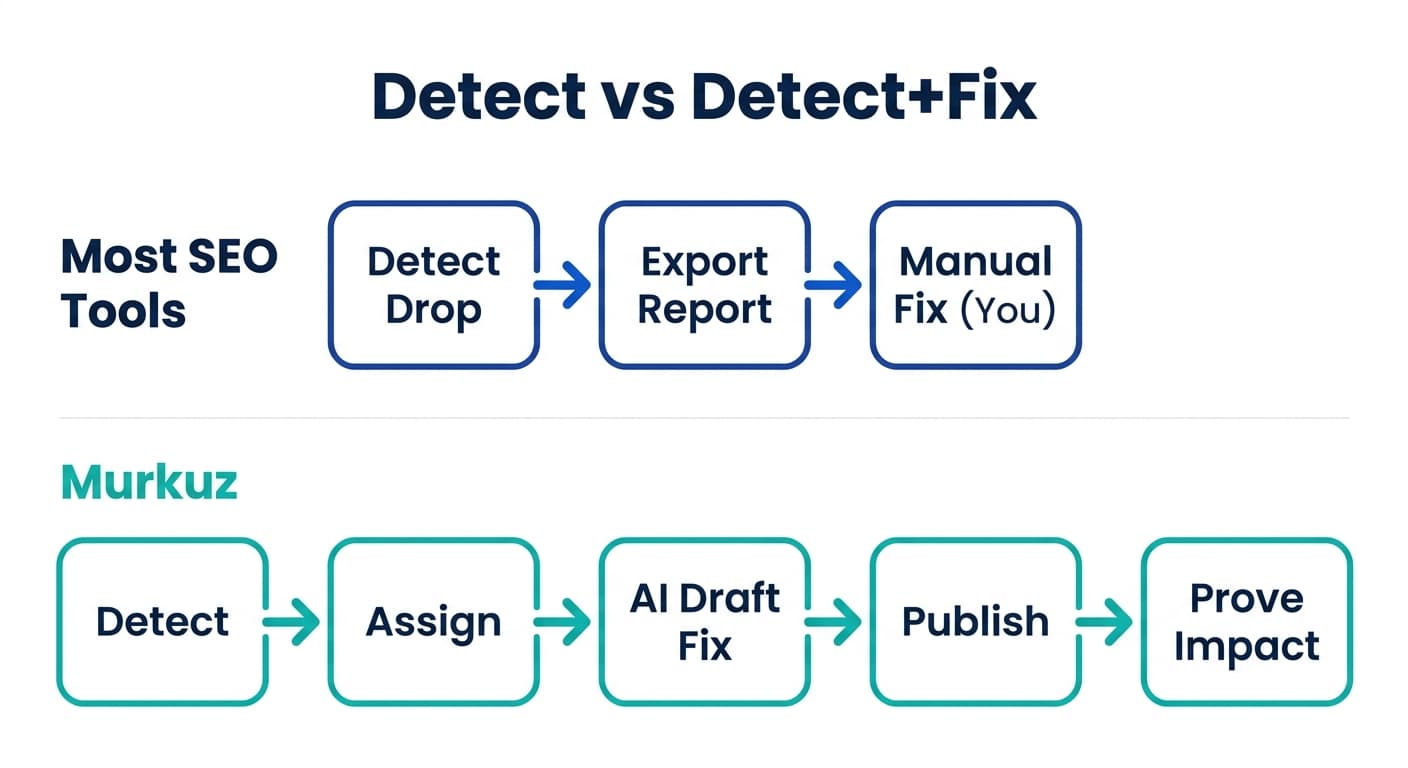
Most "Semrush alternatives" lists compare the same things: keyword database size, backlink counts, interface polish, price per seat. Those comparisons are useful but they all measure the same stage of the work, the finding-problems stage. They rarely ask the question that actually determines whether SEO improves: after the tool tells you a page dropped from position 6 to 14, what happens next, and who does it?
This guide is organized around that gap. You'll get a straight look at the strongest Semrush alternatives for research and monitoring, plus an honest answer on where a fix-and-publish platform like Murkuz fits, and where it doesn't.
Why People Look for a Semrush Alternative
Before the list, it's worth naming which of these is actually your reason, because it changes which alternative makes sense.
- Price. Semrush's core suite starts around $139.95/month for the SEO-only Pro plan, or $199/month once you want the fuller toolkit, and climbs quickly if you add seats or AI visibility tracking as an add-on. For a solo operator or a two-person team, that's real budget for a tool that mostly produces reports someone still has to act on.
- Breadth you don't use. Semrush bundles SEO with PPC research, social media tools, and content marketing modules. If you only ever open the SEO half, you're paying for the other half anyway.
- The data-to-action gap. Semrush's Site Audit and Position Tracking will tell you a page is declining or that you have a content gap. It will not draft the rewrite, publish it to your CMS, or tell you whether the fix worked. That's a separate set of tools, and often a separate person's job.
- Agency overhead. If you run client sites, you likely already stitch together a rank tracker, a project management tool, and a writer or freelancer to close the loop Semrush's dashboard opens. That stitching is where most of the actual weekly time goes.
The Best Semrush Alternatives, Compared
Here's the honest map, sorted by what each tool is actually strongest at.
| Tool | Best for | Starting price | What it doesn't do |
|---|---|---|---|
| Ahrefs | Backlink depth, competitive research | ~$29/mo (credit-based Starter; $129/mo Lite for real use) | No content fixing or CMS publishing |
| SE Ranking | Agencies wanting white-label + AI visibility | ~$129/mo | Still a dashboard; you execute fixes elsewhere |
| Moz Pro | Simpler UI, established Domain Authority metric | ~$49/mo | Smaller index than Ahrefs or Semrush; slower feature pace |
| Mangools | Budget-friendly keyword research and rank tracking | ~$61/mo | No site audit or crawl tooling |
| Ubersuggest | Solo bloggers and beginners on a tight budget | ~$29/mo | Thinner data at scale; basic audit depth |
| Murkuz | Teams who want the fix drafted and published, not just flagged | See pricing | Not a PPC or social media suite; SEO-operations only |
Ahrefs: the closest like-for-like swap
Ahrefs is the tool most existing "Semrush alternative" articles put first, and for good reason: its backlink index is one of the largest in the industry, and its keyword and competitor research tools are a near-exact match for what Semrush covers. If backlink analysis and competitive keyword research are 90% of what you actually use Semrush for, Ahrefs is a reasonable direct swap, and depending on plan, cheaper.
The trade-off is the same one Semrush has: Ahrefs finds the problem and stops there. Seeing that a page dropped from position 6 to 14 still leaves you exporting to a spreadsheet, briefing a writer, and manually publishing the fix.
SE Ranking: better for agencies wanting white-label reporting
SE Ranking has grown into a broader visibility platform, connecting traditional rank tracking with AI-search visibility (ChatGPT, Perplexity, AI Overviews) and social analytics in one workspace. For agencies specifically, its white-label reporting and lower entry price than Semrush make it a common landing spot for teams migrating away.
It's still fundamentally a dashboard-and-reporting tool. The AI visibility and rank data get surfaced clearly, but turning "this page needs a content refresh" into a published, improved page is still manual work on your end.
Moz Pro: simpler, not necessarily smaller-scope
Moz Pro trades some of Semrush's and Ahrefs' data depth for an interface that's easier to pick up quickly, plus the Domain Authority metric that's become an industry shorthand even outside Moz's own tools. Its link and keyword index is smaller than Ahrefs', so if your work leans heavily on backlink prospecting at scale, you'll notice the gap.
Mangools and Ubersuggest: budget picks that still do real research
If price is the actual objection and you don't need enterprise-scale data, Mangools (keyword research, rank tracking, SERP analysis, all under one clean interface) and Ubersuggest (built by Neil Patel, aimed at solo operators and beginners) both cover legitimate ground for a fraction of Semrush's cost. Neither replaces Semrush's site-audit depth or backlink index size, but neither claims to.
Where a Closed-Loop Tool Like Murkuz Fits
Here's the honest version of where Murkuz sits in this list, not a sales pitch: every tool above, including Semrush itself, is built around the same workflow. You check the dashboard, you find a problem, and then a human goes and fixes it somewhere else.
Murkuz was built around a different assumption: that finding the problem is the easy 20% and the real cost is everything after it. Instead of stopping at a dashboard, Murkuz's five-step loop runs detection, task assignment, an AI-drafted fix that you review and approve, direct one-click publishing to WordPress, Webflow, or Framer, and then continuous monitoring until it proves whether the specific fix actually moved the ranking, through what Murkuz calls its Impact Scorecard.
That's the practical difference worth naming plainly: Semrush (and most tools on this list) tell you a page dropped from position 5 to 14. Murkuz drafts the content refresh, lets you approve it, publishes it to your CMS, and then tracks whether that specific change is what brought the ranking back, rather than leaving you to guess whether it was that fix or something else entirely.
This matters most if you are the person actually doing the fixing, not just the reporting. A solo founder, a two-person marketing team, or an in-house SEO without a dedicated content ops function will feel the gap between "here's your report" and "here's your fix, already published" every single week. A large team with a dedicated content function and its own publishing workflow may not need that part automated, and Semrush's broader marketing suite (PPC, social, content calendar) genuinely earns its keep for them.
If you want the fuller side-by-side, including what Murkuz's feature comparison against Semrush covers in detail, or want to see how the detect-to-proof workflow works end to end, both are worth a look before you commit to a switch either way.
How to Choose Without Overthinking It
A short gut-check, in order:
- Is your bottleneck finding problems, or fixing them? If you genuinely don't know what's wrong with your site yet, a research-first tool (Ahrefs, SE Ranking, Moz) is the right first purchase. If you already know what's declining and the fix keeps sitting in a backlog, that's a different problem.
- Do you need PPC and social tools in the same login? If yes, Semrush's breadth still earns its price. If SEO is the only thing you actually use, you're paying for unused modules.
- Who writes and publishes the fix once you find it? If the honest answer is "nobody has time this week," that's the gap a closed-loop tool is built to close.
- What's your actual budget? Ubersuggest and Mangools are legitimate starting points under $70/month; Ahrefs and SE Ranking sit in the $30-130/month range depending on plan; Semrush itself runs $140-200+/month for the full suite. Match the spend to what you'll actually use, not what looks most complete on a features page.
None of this requires a religious answer. Plenty of teams run Semrush or Ahrefs for research and a separate tool for execution. The point of this list is simply making sure you're comparing the right things: not just whose keyword database is bigger, but whose workflow actually gets the fix live.
FAQ
What is the best alternative to Semrush?
There isn't a single best answer; it depends on what you're replacing Semrush for. For backlink depth and competitive research, Ahrefs is the closest like-for-like swap. For agencies wanting white-label reporting and AI-search visibility tracking, SE Ranking is a strong fit. If your actual bottleneck is turning findings into published fixes, that's a different job than any pure research tool solves, which is the gap Murkuz is built around.
Is there a free alternative to Semrush?
Not a full free replacement, no. Ubersuggest and Mangools both offer limited free tiers or trials that cover basic keyword research and site checks, and several tools (SE Ranking, Ahrefs, Similarweb) offer short free trials rather than an ongoing free plan. For genuinely free, ongoing use, expect to combine two or three narrower free tools rather than one all-in-one replacement.
Which is better, Semrush or Ubersuggest?
It depends on budget and scale. Semrush is built for teams with the budget and the manpower to act on a much larger volume of data. Ubersuggest is built for solo operators and small budgets who need core keyword and audit checks without the price tag, and it does that job well, just with thinner data at scale.
Which is better, Moz or Semrush?
Semrush generally has a larger keyword and backlink index and a faster pace of new feature releases. Moz Pro is easier to learn quickly and still anchors the widely cited Domain Authority metric. If you need maximum data depth, Semrush wins; if you want a simpler tool you can onboard a junior hire on in a day, Moz is the more forgiving choice.
What's the cheapest way to cover what Semrush does?
No single cheap tool matches Semrush's full breadth. The cheapest realistic path is usually Ubersuggest or Mangools for keyword research and rank tracking (both well under $70/month), paired with a free tool like Google Search Console for the technical and performance side. You'll trade some data depth for the savings.
If you're already sure execution, not research, is where your SEO stalls, it's worth seeing what Murkuz actually costs against the stack you're paying for today.
Junaid Khalid is the founder of Ertiqah and the builder of Murkuz. He has run SEO as the first growth channel across his own SaaS products before building Murkuz to close the gap between finding an SEO problem and actually fixing it.