Most "best AI SEO tools" lists are the same 15 names shuffled into a different order, with pricing lifted from a vendor's homepage six months ago. What they rarely tell you is the one thing that actually decides whether a tool is worth your money: does it just tell you what is wrong, or does it help you fix it?
That distinction sorts every tool on this list into one of three tiers. Report-only tools hand you a dashboard and a to-do list. Assist tools draft or optimize content for you, but you still publish and track results by hand. Act tools close the loop: they detect the problem, help you fix it, push it live, and show you whether the fix actually worked. Below is where 15 of the most-recommended AI SEO tools actually land, what each one costs, and who should (and should not) buy it.
How We Ranked These (and What "AI SEO Tool" Even Means)
An AI SEO tool uses machine learning or a language model to do something a human SEO used to do by hand: cluster keywords, grade content against a SERP, draft a brief, flag a technical issue, or track brand mentions in ChatGPT answers. That is a wide net, which is exactly why most roundups turn into an undifferentiated wall of 15-20 logos.
We grouped them by what they are actually for, then ranked within each group by three things:
- Depth of the AI layer. Is the AI doing real analysis (matching SERP intent, scoring content against ranking factors, tracking causal ranking changes), or is it a thin wrapper around a generic LLM prompt?
- Workflow position. Does the tool sit at the start of the funnel (research), the middle (writing and optimizing), or the end (publishing, monitoring, proving impact)? A tool that only covers one stage means you are still stitching two or three tools together yourself.
- Real, published pricing. No "contact us" black boxes. If a vendor did not publish a number, we say so.
The Best AI SEO Tools in 2026, by Category
Keyword and Competitor Research
1. Ahrefs. Still the reference point for backlink data and keyword volume, now with an AI Content Helper that flags gaps between your page and top-ranking competitors. Best for teams that already live in Ahrefs for link building and want AI layered on top rather than replacing their stack. Starts around $129/month.
2. Semrush (Semrush One). Combines the traditional toolkit (rank tracking, site audits, backlink analysis) with an AI Visibility Toolkit that tracks how often your brand gets cited inside ChatGPT and Google AI Overviews. The broadest single tool on this list if you need one platform for both classic SEO and AI-search tracking. Pricing starts near $129.95/month.
If your shortlist has already narrowed to the three established suites, a closer look at Ahrefs, Moz and Semrush covers where each one's data genuinely wins and where all three stop.
Content Optimization and Writing
3. Surfer SEO. The tool most people mean when they say "content optimizer." It scans the live SERP for your target keyword and scores your draft against word count, structure, and related terms as you write. Solid at making a mediocre draft rank-ready; it will not tell you if the topic itself is worth writing about. Plans start at $119/month.
4. Clearscope. A stricter, editorial-grade version of the same idea: an A-F content grade and tightly curated related-term suggestions, aimed at teams publishing at scale with multiple writers. Pricier, starting around $189/month, and arguably overkill for a solo blogger.
5. Frase. Cheaper alternative to Surfer and Clearscope: SERP-based content briefs plus an AI writing assistant. Popular with freelance SEOs and small teams.
6. MarketMuse. Dual NLP approach to map topical authority across an entire site, not just one article. Better for content strategists planning a content map than for a single-page fix.
7. Rankability. Combines Google's NLP signals with IBM Watson's language analysis to suggest semantically related keywords. Includes an AI writer at $199/month. A niche pick for technical SEOs who want the "why" behind a suggestion.
AI Search and GEO (Generative Engine Optimization)
8. AthenaHQ. Founded by former Google Search and DeepMind engineers, built to optimize content for citation inside AI answers (ChatGPT, Perplexity, AI Overviews) rather than the traditional 10 blue links. Configures technical settings like LLMS.txt for you.
9. Peec AI. Pure analytics, no writing: tracks brand mentions, share of voice, and sentiment across multiple LLMs. Pairs well with a content tool above since it tells you where you are missing, not what to write.
10. Profound. Another AI-visibility tracker in the same category as Peec, monitoring how often and how favorably a brand appears in generative answers.
All-in-One Platforms
11. SE Ranking. A budget-friendlier all-in-one that recently added an AI Overview Tracker alongside its rank tracking and audits. A good middle ground for agencies managing several client sites.
12. Search Atlas. Combines technical SEO auditing with AI content generation and a built-in AI search tracker, for teams that want fewer vendor relationships. Its OTTO feature goes further than most tools here: it can push title, meta tag, schema and internal-link changes to your live site, which makes it one of the few that actually acts.
Writing-First Tools
13. Writesonic. One of the most accessible AI writers with SEO templates baked in, easy to onboard a non-technical teammate into within an afternoon. Recently added GEO tracking.
14. Scalenut. Similar positioning to Writesonic: SERP-based briefs plus AI drafting, for content teams that write often and want speed over customization.
General-Purpose AI (Use With Caution)
15. ChatGPT / Claude. Useful for brainstorming outlines or a first pass, but neither has live SERP data or SEO-specific scoring built in. Treat these as a co-writer, never a replacement for a dedicated SEO tool.
Quick Comparison: Where Each Tool Actually Sits
| Tool | Category | What it's best for | Report, Assist, or Act | Starting price |
|---|---|---|---|---|
| Ahrefs | Research | Backlinks + keyword data | Report | ~$129/mo |
| Semrush One | Research + AI visibility | All-in-one classic + AI-answer tracking | Report | ~$129.95/mo |
| Surfer SEO | Content optimization | Scoring a draft against the live SERP | Assist | ~$119/mo |
| Clearscope | Content optimization | Editorial teams at scale | Assist | ~$189/mo |
| Frase | Content optimization | Budget brief + draft workflow | Assist | Sub-$100/mo tiers |
| MarketMuse | Content strategy | Site-wide topical authority mapping | Assist | Custom |
| Rankability | Content optimization | NLP-driven keyword suggestions | Assist | ~$199/mo |
| AthenaHQ | GEO | Optimizing for AI-answer citation | Assist | Custom |
| Peec AI | GEO | Tracking brand mentions across LLMs | Report | Custom |
| Profound | GEO | AI-visibility monitoring | Report | Custom |
| SE Ranking | All-in-one | Budget agency stack | Report | Sub-$100/mo tiers |
| Search Atlas | All-in-one | Fewer vendors, broader coverage | Act (via OTTO) | Custom |
| Writesonic | Writing | Fast onboarding, SEO templates | Assist | Sub-$50/mo tiers |
| Scalenut | Writing | High-volume content teams | Assist | Sub-$100/mo tiers |
| ChatGPT / Claude | General AI | Brainstorming and first drafts | Assist (generic) | Free-$20/mo |
Notice the pattern: almost the entire category tops out at Assist. These tools will find a problem or help you write something better. Almost none of them push the fix live, watch what happens to the ranking, and prove it worked. That gap is exactly why most SEO teams still run five separate tools plus a spreadsheet to tie the results together.
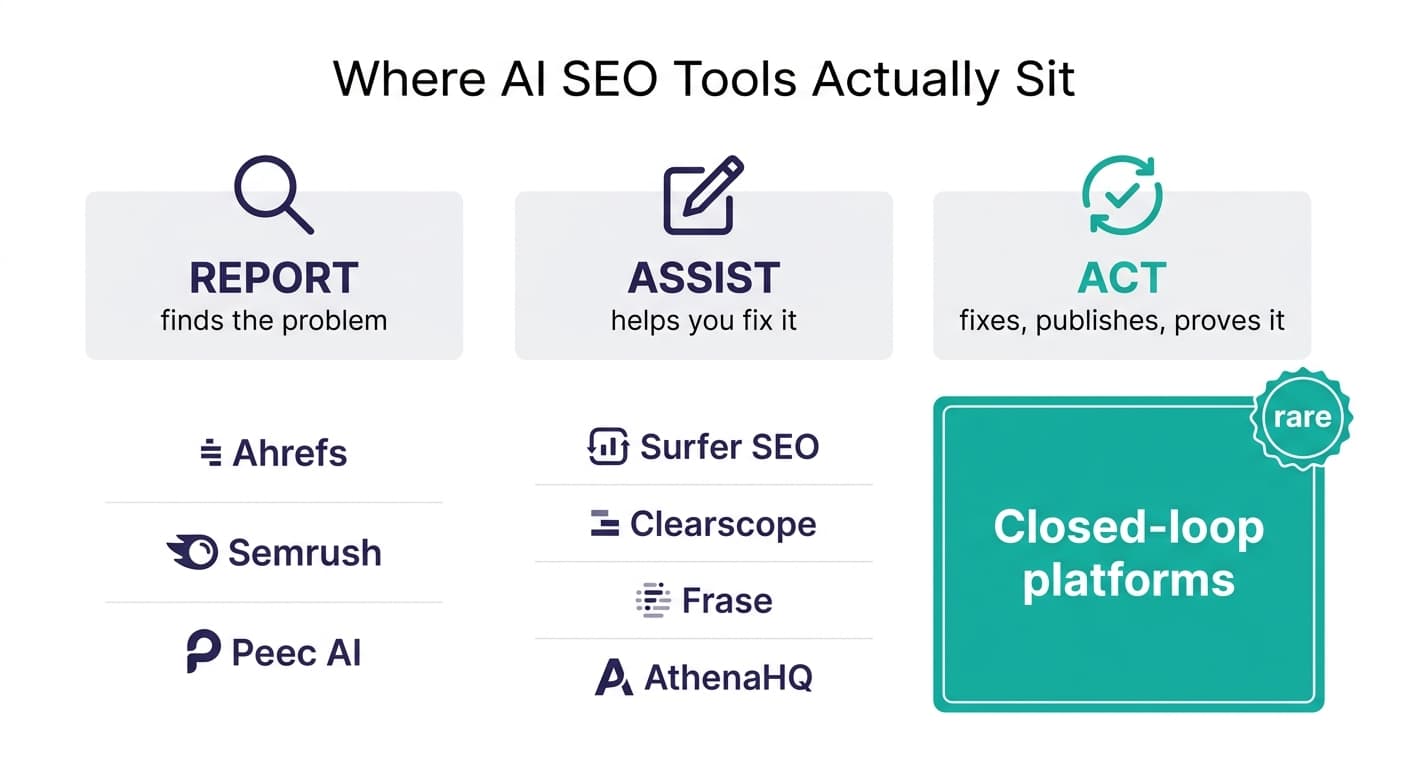
The Gap: Why Almost Every Tool Stops at "Assist"
Here is what most roundups skip: after you buy the research tool, the content optimizer and the GEO tracker, you still have to decide which page needs work, publish the change yourself, and come back weeks later to see whether it helped. Each step happens in a different tab, and the last one is the step most teams quietly drop.
If you already pay for Claude or ChatGPT, there is another way to cover the first and last steps: let the assistant read your own search data. Murkuz is a search-data connector that gives Claude, ChatGPT or any other MCP client read access to your Google Search Console, Google Analytics 4 and Bing Webmaster Tools data, for every site you connect. You ask "which pages lost the most clicks in the last 28 days?" and the answer names your real pages and queries instead of guessing. Three weeks after you ship a change, you ask the same assistant whether that page's clicks and position moved.
It is not a writer and it does not publish anything, so it sits beside the tools above rather than replacing them. Murkuz has no backlink index like Ahrefs and no draft scoring like Surfer. What it removes is the export-to-spreadsheet step between your numbers and the AI doing the analysis. The full list of 32 Murkuz tools shows the question each one answers.
How to Actually Choose (Instead of Buying All 15)
Work through these in order rather than picking the tool with the loudest marketing:
- What stage are you missing? If you already have a writer and just need SERP-scoring, get a content optimizer (Surfer, Clearscope, Frase). If you need to find declining pages before you know what to write, you need detection, not just a writer.
- Do you need GEO tracking yet? If a meaningful share of traffic already comes from AI-answer referrals, add a GEO tool (AthenaHQ, Peec, Profound). If unsure, check your Search Console referral data first.
- Count your handoffs. Every tool boundary is a place work stalls. Three tools means at least two manual handoffs (export data, brief a writer, publish by hand). A platform that runs detection through publishing in one place saves more hours than a marginally better content score.
- Ask for the actual price, not the marketing tier. Several tools above only publish "custom" pricing until you talk to sales. Get the real number before comparing total cost of ownership.
- Check what happens after publish. Almost none of these tools close the loop back to "did the ranking actually move." If proving ROI to a boss or client is part of your job, write down the page's clicks and position before you change it, then compare the same 28-day window afterward. An assistant connected to your Search Console can run that comparison from one question; the plans for Murkuz are on its pricing page.
Real Questions About AI SEO Tools, Including the Free Ones
Which AI is best for SEO?
There is no single winner across every job. For keyword and competitor research, Ahrefs and Semrush remain the deepest data sets. For content optimization, Surfer SEO is the most widely adopted. For AI-answer visibility specifically, AthenaHQ and Peec AI are purpose-built where general SEO tools are still catching up.
Can ChatGPT do SEO?
It can help you brainstorm topics, outline an article, or summarize a competitor's page, but on its own it has no live SERP data and no way to grade your draft against what is actually ranking right now. Connected to your Search Console through an MCP connector, it can also read your own queries, pages and clicks. Use it as a drafting and analysis assistant alongside a tool built for SEO, not as a replacement for one.
Are there free AI SEO tools worth using?
Yes, for single jobs. The free tiers of ChatGPT and Claude handle outlines, title ideas and rewrites. Google Search Console and Bing Webmaster Tools cost nothing and hold your own first-party data on how your pages perform in search. For keyword grouping, Murkuz has a free keyword clustering tool that turns a pasted list into topic clusters in your browser with no login, and a free SEO and GEO analyzer that scores an article for search and AI-answer readiness. Paid tools earn their price when you need live SERP grading, backlink data or tracking across many pages.
What is the best AI SEO tool for a small business?
Usually the one that covers your weakest step for the least money. For most small sites that means free Search Console data plus one paid content tool at most, not a full suite. We compared the realistic options for owners without an SEO team in AI SEO tools for small businesses.
Is it worth paying for more than one AI SEO tool?
Usually yes, but only if the tools cover different stages of the workflow (research, writing, GEO tracking) rather than duplicating each other. Before adding a fourth or fifth subscription, check whether an all-in-one platform already covers the stage you are about to pay separately for.
Do AI SEO tools actually improve rankings, or just save time?
Both, but not automatically. A content optimizer helps a page rank faster once you have decided to write it; it will not tell you a page is decaying in the first place, and it will not prove your specific edit caused a recovery. That verification step still needs manual Search Console analysis, or a tool built to track it, like the AI SEO agent category that emerged specifically to close that gap.
What's the difference between an AI SEO tool and an AI SEO agent?
A tool reports: it finds a problem or grades a draft and leaves the rest to you. An agent acts: it finds the problem, drafts or executes the fix, and verifies the outcome, without you stitching the steps together manually. See our guide on what an AI SEO agent actually does for the full breakdown.
The Bottom Line
If you only need one job done well, plenty of tools on this list will do it: Ahrefs for backlinks, Surfer for content scoring, AthenaHQ if AI search visibility is your priority this quarter. But if you are tired of exporting data from one tool, briefing a writer in a second, publishing by hand in a third, and building a report in a fourth just to answer "did that work," that is the actual problem worth solving before you add another point solution to the pile. Compare the full workflow, not just the feature list, and see our best SEO automation tools roundup for how the automation layer specifically compares across vendors.
Junaid Khalid is the founder of Ertiqah, the company behind Murkuz, and runs SEO for its products, where organic search has been the first growth channel at every launch.