If you have narrowed your SEO tool search down to Ahrefs, Moz, and Semrush, you have already done the hard part. These are the three most established players in the category, and unlike a lot of SaaS comparisons, the differences between them are real, not marketing spin. One genuinely has the deepest backlink index. One is genuinely the easiest to learn. One genuinely does more outside of SEO.
This guide walks through where each tool actually wins, what they cost as of 2026, and where all three of them, for all their strengths, still leave you doing the same manual work: exporting a report, writing a brief, and hoping someone gets around to publishing the fix. And if the visibility you care about is inside ChatGPT answers rather than blue links, that is a different category entirely: AI visibility trackers. Toward the end we will also look at a newer, narrower category of tool that starts after the report ends, because "which tool has the best data" and "which tool gets the fix live" are two different questions.
The Quick Verdict
If you only read one section, here it is:
- Choose Ahrefs if backlink data quality is your top priority. Its link index is still the deepest and freshest of the three, and its crawler finds new links faster than either competitor.
- Choose Semrush if you want one platform that also covers PPC, social, and content marketing, not just SEO, and you want the most complete keyword database of the three.
- Choose Moz if you are new to SEO, need genuinely strong local SEO tools, or want the lowest price of entry into a serious SEO suite.
- Consider Murkuz alongside any of the three if your actual bottleneck is not the data, it is what happens after: someone still has to rewrite the page, publish it, and check whether it worked. More on that later.
Now the detail behind each of those calls.
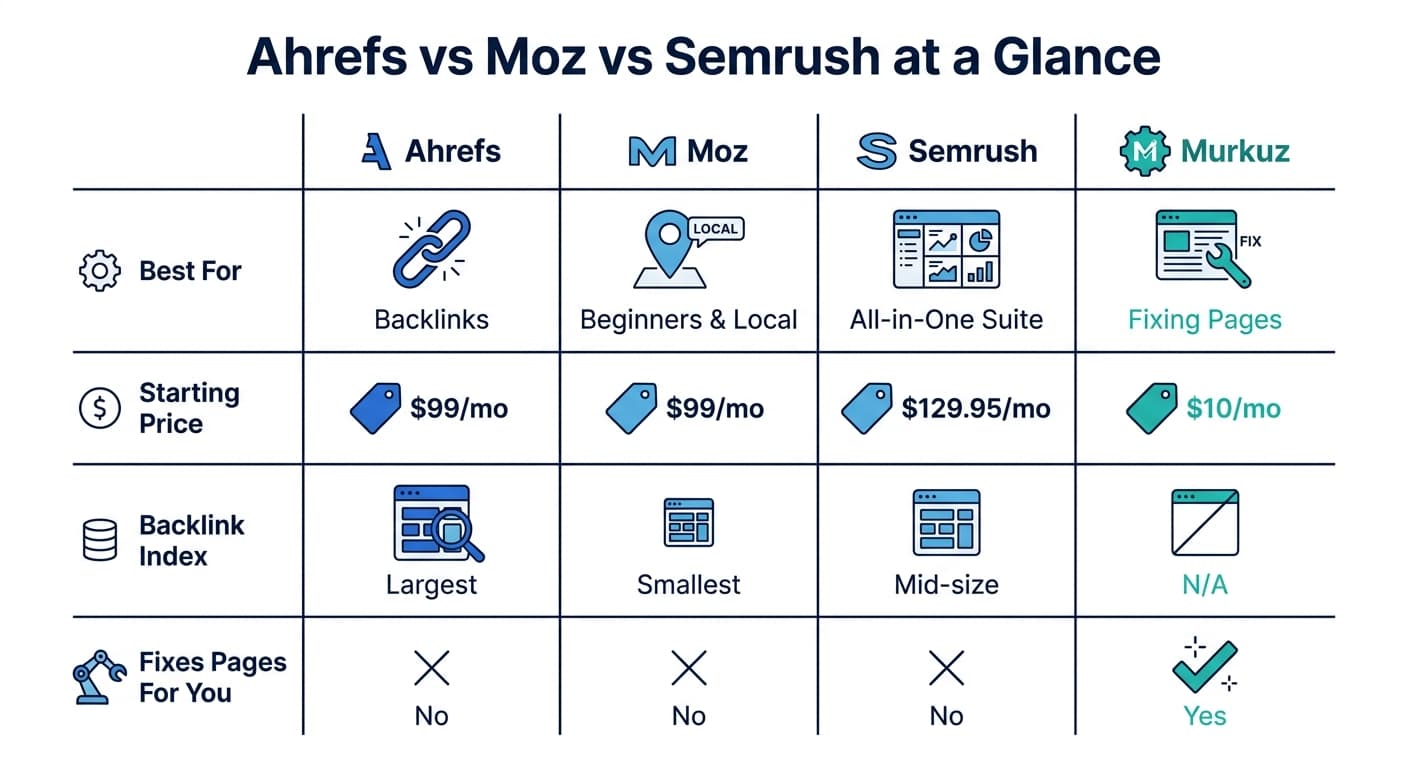
Ahrefs, Moz, and Semrush at a Glance
| Ahrefs | Moz Pro | Semrush | |
|---|---|---|---|
| Entry price (monthly billing) | From $129/mo (Lite) | From $49/mo (Starter) | From $139.95/mo (Pro) |
| Entry price (annual billing) | ~$108/mo | ~$39/mo | ~$117.33/mo |
| Backlink index | Largest, freshest crawl | Smallest of the three | Mid-size, smaller than Ahrefs |
| Keyword database | 20+ billion keywords | Leanest database, well-organized | 25+ billion keywords |
| Core focus | SEO only (backlinks, keywords, rank tracking) | SEO only, strongest at local + authority metrics | SEO plus PPC, social, content marketing |
| API access | Not included on lower tiers; limited even at Advanced | Included from Standard tier up | Full API from Business tier, units purchased separately |
| Free trial | No traditional free trial | 7 days (credit card required) | Available on select plans |
| Best known for | Domain Rating, Site Explorer, link building workflows | Domain Authority (DA), beginner-friendliness, local SEO | All-in-one marketing suite, AI Overviews visibility tracking |
Pricing above reflects publicly listed 2026 rates at the time of writing. All three vendors adjust pricing periodically and add usage-based add-ons (extra seats, extra projects, AI credit packs), so treat this as a snapshot and confirm current numbers before you buy.
Ahrefs: Best for Backlink Depth
Ahrefs built its reputation on one thing: link data. That reputation still holds up in 2026. Its backlink index remains the largest and most frequently refreshed of the three tools, which matters if any part of your job involves link building, competitor backlink audits, or disavow work. The Site Explorer interface is also the cleanest of the three for a quick "who links to this page" lookup.
Ahrefs' keyword database has crossed 20 billion keywords across more than 240 countries, and its Keyword Difficulty score is grounded in real link data rather than a purely algorithmic estimate, which many practitioners find more trustworthy. Its newer AI content grader compares a draft against top-ranking competitors and flags gaps, and it has added AI-assisted keyword clustering, though both feel like additions to an existing product rather than something built around AI from the ground up.
Where Ahrefs is weaker:
- No API on entry tiers. Direct API access does not show up until the Advanced plan, and even then it is metered. If you need to pull Ahrefs data into your own dashboard or internal tool, budget for a higher tier.
- Entry price. At roughly $129/month for the Lite plan (with report limits that fill up fast if you manage more than one or two sites), Ahrefs is the most expensive true entry point of the three when you exclude Semrush's higher-tier all-in-one plans.
- Data only. Ahrefs will tell you a page is losing rankings. It will not rewrite the page, and it cannot publish anything to your CMS. That part is entirely on you.
Ahrefs fits best if you are an agency or in-house SEO doing heavy link-building work, or if backlink data quality is simply non-negotiable for your workflow. If price is the main objection rather than the data itself, it is worth skimming our broader roundup of Ahrefs alternatives before committing to a plan.
Moz: Best for Beginners and Local SEO
Moz has taken a different path than the other two. Rather than trying to out-index Ahrefs or out-breadth Semrush, it has leaned into being the most approachable tool in the category and the strongest at local SEO specifically. Its local search features (citation tracking, local rank tracking, Google Business Profile insights) are genuinely well-regarded, and its interface is the easiest of the three to hand to someone new to SEO without a week of onboarding.
Moz's signature metric, Domain Authority (DA), remains the most widely recognized authority score in the industry, even outside SEO circles. It is worth remembering that DA is Moz's own metric, not something Google's algorithm uses directly, but it has become a shorthand that clients and stakeholders understand, which has real value when you are explaining SEO progress to a non-SEO audience.
Where Moz is weaker:
- Smaller data index. Moz's backlink and keyword databases are the leanest of the three. For competitive research on a well-linked domain, you will hit the ceiling of what Moz can show you faster than with Ahrefs or Semrush.
- Feature pace. Moz has been slower to ship AI-driven features than its two competitors. It offers some AI-assisted meta description generation and limited AI suggestions in keyword research, but nothing close to Semrush's AI Overviews tracking or Ahrefs' AI content grader.
- Same gap as the other two. Moz surfaces issues and opportunities. It does not write your fix or publish it for you.
Moz fits best for solo operators, small businesses, agencies focused on local clients, or anyone who wants a real SEO suite at the lowest entry price without a steep learning curve.
Semrush: Best for All-in-One Breadth
Semrush's pitch is different from the other two: it is not just an SEO tool, it is a full marketing suite that happens to include best-in-class SEO features. Alongside keyword research, site audits, and rank tracking, Semrush includes PPC campaign tools, social media scheduling and analytics, content marketing tools, and competitive intelligence across all of it. For an agency selling more than SEO, or an in-house team that owns SEO and paid search together, consolidating onto one platform is a real cost and workflow saving.
Semrush also currently has the largest keyword database of the three (25+ billion keywords) and the most consistent, granular search-intent classification (informational, navigational, commercial, transactional), which is genuinely useful when you are trying to prioritize a long keyword list by how close it is to converting. Its AI Overviews visibility tracking, showing which of your target queries now trigger an AI-generated answer instead of a normal result, is arguably the single most practically useful AI feature across all three tools right now, because it tells you where you need a different content strategy entirely, not just a better title tag.
Where Semrush is weaker:
- Backlink depth. Semrush's link index is smaller than Ahrefs', which matters if link building is a primary use case rather than a secondary one.
- Dashboard overload. With 50 or more tools and reports across SEO, PPC, social, and content, finding the specific insight you need can take longer than in a more focused product, especially for a new user.
- Price at scale. Entry pricing (from $139.95/month for Pro) is the highest of the three, and moving up to Guru or Business for team features or higher limits adds up quickly if you only need the SEO half of the suite.
- Still just a dashboard. Like Ahrefs and Moz, Semrush can tell you what changed and suggest what to do. Turning that suggestion into a published fix, and then proving that fix caused the recovery, is not something any of the three does natively.
Semrush fits best for full-service agencies, in-house teams managing SEO and paid search together, or anyone who wants the broadest platform and is willing to pay for the parts they will not use every day.
What All Three Have in Common (and Where They All Fall Short)
Read enough comparisons of these three tools and a pattern shows up: nearly every article ends with some version of "it depends what you need," and that is genuinely correct advice. Where the comparisons usually stop, though, is at the point that matters most for anyone actually running SEO day to day.
All three of these tools are detection and analysis platforms. They are excellent at telling you what is happening: which pages dropped, which keywords you are missing, which backlinks you gained or lost, which competitor outranks you and why. None of the three tools rewrites the underlying page for you. None of them publishes that rewrite to your CMS. None of them then tracks whether the specific fix you made is what caused the ranking to recover, as opposed to something else entirely (a competitor's page decaying, a seasonal search pattern, an algorithm update).
That gap, the space between "here is a report" and "here is a fix that is live and proven to have worked," is where a lot of SEO time actually goes. It is also, not coincidentally, the exact problem <mark class="km-highlight" style="--hl:#FEF08A;background:#FEF08A">Murkuz was built to close</mark>.
The Fourth Option: Where Murkuz Fits
To be direct about it upfront: Murkuz is not trying to out-index Ahrefs' backlink database, out-broaden Semrush's marketing suite, or out-simplify Moz's local SEO tools. If deep backlink data, an all-in-one marketing platform, or the friendliest possible entry point is what you actually need, one of the three tools above is the better fit, and this article has tried to say so honestly rather than talk you out of it.
What Murkuz does is start from a different question. Instead of "what does my keyword and backlink data show," it asks "which of my pages are losing rankings right now, and what am I actually going to do about it, today." Concretely, Murkuz connects to your Google Search Console data and runs five steps automatically, every day: it detects declining pages, positions-11-to-20 opportunities, and keyword cannibalization; turns each one into a task with the specific fix attached, rather than a vague alert; generates an AI content refresh that references a stored brand-voice knowledge base (Murkuz calls this HyBrain) so the rewrite does not read like generic AI copy; pushes that fix live to WordPress, Webflow, or Framer with one click, no export or copy-paste; and then tracks the ranking afterward through what Murkuz calls its Agentic Impact Scorecard, which ties a specific fix to a specific ranking change rather than showing a correlation-only traffic graph.
None of Ahrefs, Moz, or Semrush does that last part, the "did this specific action actually work" proof. All three are excellent at the first step (detection) and leave everything after it, the fix, the publish, and the proof, to you or your team.
On pricing, the comparison is not perfectly apples to apples, since Murkuz is not selling backlink index depth, it is selling the detect-to-fix-to-proof loop. Tiers are organised around how many sites you connect rather than how big a keyword index you get. You can see the full breakdown of what is included at each tier on the Murkuz pricing page.
If you want the fuller head-to-head on where Ahrefs specifically stops and where Murkuz continues (backlink analysis versus automated fixes, for instance, or "correlation, not causation" versus the Impact Scorecard), the Murkuz vs Ahrefs comparison walks through it feature by feature. There is a matching breakdown for Semrush's dashboard-heavy approach versus Murkuz's more focused loop on the Murkuz vs Semrush comparison page. Neither replaces this article's verdict on Ahrefs, Moz, and Semrush against each other; they are useful if your actual frustration is less "which tool has better data" and more "why is this declining page still declining three weeks after I found out about it."
Many experienced SEOs run more than one tool anyway, often pairing a data-heavy platform like Ahrefs or Semrush with something narrower for a specific job. If you already have Ahrefs or Semrush for research and keyword work, the question worth asking is not "should I replace it," it is "what closes the gap between what my dashboard tells me and what I actually ship."
How to Actually Decide
A short checklist, in the order most people should actually ask these questions:
- Is link building a core, daily part of your work? If yes, Ahrefs' backlink depth is hard to substitute. Start there.
- Do you need SEO, PPC, and social in one login? If yes, Semrush's breadth justifies its higher price. If you only need SEO, you are paying for tools you will not open.
- Are you new to SEO, or is local search your main battleground? Moz's lower learning curve and strong local tools make it the least intimidating way to get started.
- Is your actual bottleneck what happens after the report, not the report itself? If your team already knows which pages are declining and the real problem is getting fixes written, approved, and published before the ranking drops further, that is a different job than any of the three tools above are built for, and worth looking into separately.
- What is your budget, really, including add-ons? Factor in extra seats, extra projects, and AI credit packs. The advertised entry price on all of these tools is rarely the number you actually pay once a small team is using it.
None of these are wrong answers. They are different tools built for different first questions, and matching your actual daily bottleneck to the tool that solves it beats picking based on brand recognition alone.
Frequently Asked Questions
Is Ahrefs, Moz, or Semrush better for beginners?
Moz is generally the easiest to learn, with a simpler interface and a gentler onboarding curve than either Ahrefs or Semrush. Semrush's breadth and Ahrefs' data density both come with a longer ramp-up period.
Which tool has the best backlink data, Ahrefs or Semrush?
Ahrefs. Its backlink index is larger and refreshes more frequently than Semrush's, which matters most if link building or competitor link audits are a regular part of your work.
Do I need all three tools?
Almost nobody does. Most SEOs and agencies pick one as a primary tool based on their main use case (link building, local SEO, or all-in-one marketing) and occasionally supplement it with a narrower free or low-cost tool for a specific gap.
Which is the cheapest of the three?
Moz, with an entry price around $49/month, compared to roughly $129/month for Ahrefs and $139.95/month for Semrush at their respective entry tiers.
Do any of these three tools fix declining pages automatically?
No. Ahrefs, Moz, and Semrush all detect and report on issues, ranking drops, missing keywords, backlink changes, but none of them rewrites the page or publishes the fix for you. That is a separate category of tool, and it is the specific gap platforms like Murkuz are built to close.
Can I switch between these tools without losing my data?
Historical ranking and backlink data generally does not transfer between platforms, since each tool builds its index independently. If you switch, budget a few weeks for the new tool's crawler to build up a comparable picture of your site and competitors.
Junaid Khalid is the founder of Ertiqah and the builder of Murkuz. He has run SEO as the first growth channel across his own SaaS products, and built Murkuz around the belief that a tool should not stop at telling you a page is declining. It should help you fix it, publish the fix, and prove it worked.