Most "best AI SEO tools" lists are written for agencies managing thirty client accounts. You run one business. You don't need twenty tabs open, a rank-tracking dashboard you check twice a year, and a $500/month subscription stack. You need to know which of these tools actually does the work, and which one just tells you the work needs doing.
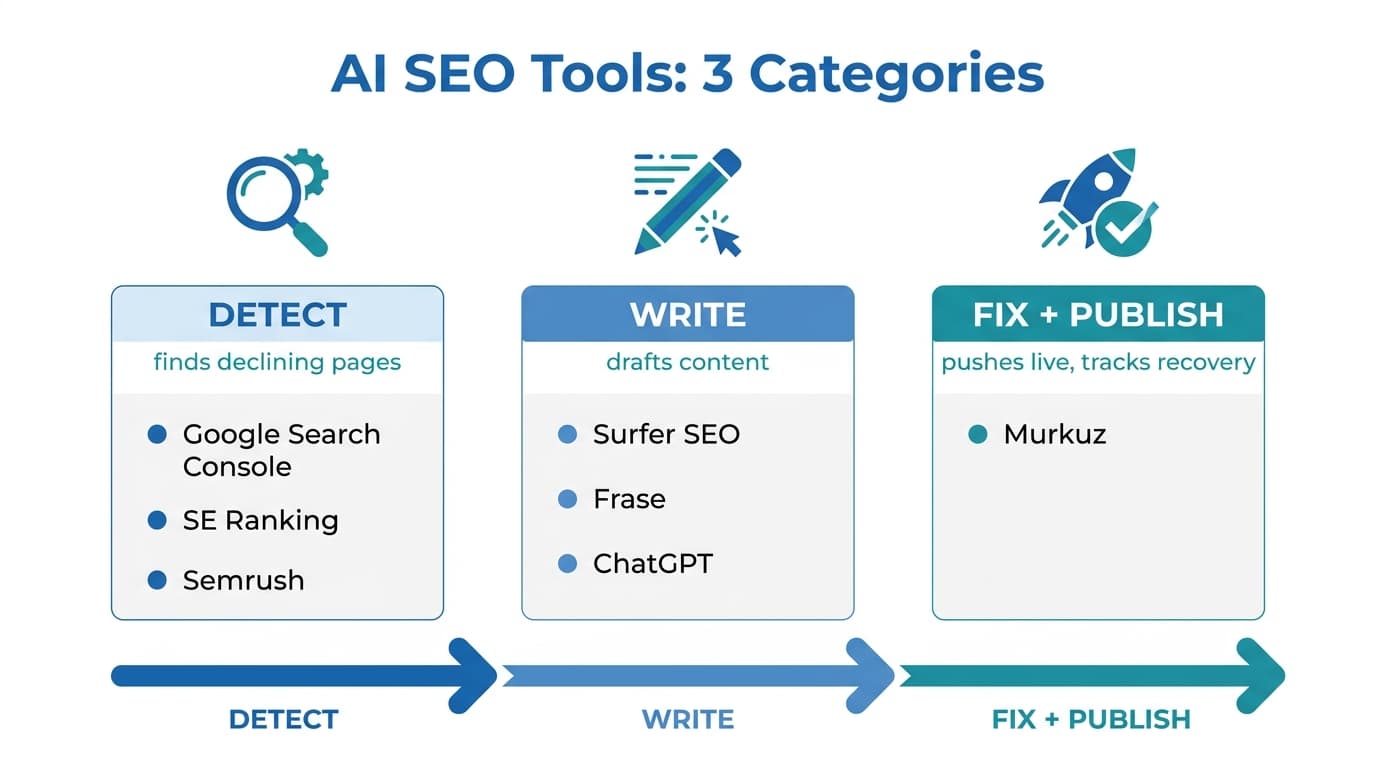
That distinction is the whole game. Every AI SEO tool on the market falls into one of three buckets: it finds problems, it writes content, or it fixes and republishes without you touching your CMS. Most small businesses only need the first bucket occasionally and the third bucket constantly, but most lists rank tools by feature count instead of by what a solo owner or one-person marketing team can realistically operate.
Here's the category broken down honestly, tool by tool, with what each one automates and what it still leaves on your plate.
What "AI SEO tool" actually means in 2026
Three years ago this meant a keyword suggestion widget bolted onto a spreadsheet. Today it means something closer to software that watches your Google Search Console data, flags pages that are losing ground, and in the more capable tools, drafts or pushes a fix without a human writing every word from scratch.
For a small business, the useful question isn't "does it use AI." Nearly everything does now. The useful question is: does it detect, does it write, or does it publish? Most tools do one of the three well. Very few do all three, which matters because a solo owner or a one-person marketing team can't afford to be the connective tissue between five different tools.
The AI SEO tools worth knowing, sorted by what they automate
| Tool | What it automates | What you still do manually | Starting price |
|---|---|---|---|
| Surfer SEO | Real-time content scoring against top-ranking pages as you write | Finding the decaying pages, publishing, and monitoring recovery | ~$89/mo |
| Frase | SERP-based content briefs and AI drafting | Detection, publishing, and ranking follow-up | ~$15/mo |
| Semrush | Competitive research, backlink audits, an AI visibility toolkit | Writing the fix and pushing it live | ~$165/mo (annual) |
| SE Ranking | Daily rank tracking, keyword research, site audits | Content generation and CMS publishing | ~$52/mo |
| ChatGPT / Gemini | Brainstorming, outlines, keyword clustering by intent | Everything else: detection, publishing, tracking results | Free to ~$20/mo |
| Google Search Console | Raw ranking, impression, and click data (free, essential) | Interpreting the data and acting on it | Free |
| Murkuz | Daily GSC scans for declining pages, AI-drafted fixes, one-click publish to WordPress, and ranking-recovery proof | Approving the fix (or letting it auto-execute) | See pricing |
A few honest notes on that table, because a comparison chart without context is exactly the shallow content this space is full of:
- Surfer and Frase are optimization tools, not detection tools. They make you better at writing a page once you already know which page needs work. Neither one tells you your "best local plumber" page dropped from position 4 to position 14 last month; you'd need to notice that yourself, in GSC, which most small business owners check rarely if at all.
- Semrush and SE Ranking are audit and tracking platforms first. They're built for someone who wants deep competitive intelligence and is willing to spend a few hours a week acting on it. That's a fit for a marketing-led SMB, less so for an owner who wants the tool to just handle it.
- ChatGPT and Gemini are free strategy assistants, not SEO systems. They're genuinely good for outlining content and organizing keyword ideas by search intent, which is why they show up in nearly every "best AI SEO tools" roundup right now. But they have no memory of your site's actual rankings and can't publish anything for you. A connector changes the first half of that: with your Search Console attached, you can use ChatGPT or Claude as an SEO agent that reads your real rankings.
- Google Search Console is the one non-negotiable. Every tool above either reads from it or should be paired with it. If you install nothing else, connect this.
The gap almost every list glosses over: detection versus doing
Here's what most of the roundups above skip: writing and optimizing content is not the bottleneck for most small businesses anymore. AI made writing cheap. The actual bottleneck is knowing which of your existing pages just quietly stopped working, and then getting a fix live without it sitting in a "to-do" folder for three months.
A location page that ranked well eighteen months ago doesn't stay ranked by default. Stats go stale, a competitor refreshes their page and takes the spot, a service you no longer offer is still the headline. Most small business owners find out only when a slow month makes them ask why the phone stopped ringing, and by then the decline has usually been running for weeks.
This is the part where <mark class="km-highlight" style="--hl:#FEF08A;background:#FEF08A">most AI SEO tools stop at the report</mark>: they'll tell you a page is declining, hand you a spreadsheet or a dashboard, and leave the writing, the CMS update, and the "did it actually work" check entirely to you. That handoff is exactly where things stall for a business with no dedicated marketing hire.
Murkuz was built around closing that specific gap. It connects to your Google Search Console and your WordPress site, scans daily for pages that are losing position, drafts the content fix, and pushes the update directly to your site without you copying and pasting between five tabs. You approve the fix or let it run on autopilot, and it monitors whether the ranking actually recovers afterward. For a business without an in-house SEO hire, that's the difference between a tool that adds a task to your list and one that removes one.
How to actually choose, in four questions
Skip the 20-tool comparison rabbit hole. Answer these in order:
- Do you already know which of your pages are losing rankings? If not, you need detection before you need a writing tool. A beautifully optimized new article means nothing if three of your existing pages are quietly bleeding traffic behind you.
- Who is going to do the actual publishing? If the honest answer is "nobody has time to log into WordPress and update a page," a tool that only hands you a Google Doc isn't solving your real problem, however good the doc is.
- How many pages does your site actually have? A five-page local business site and a 300-page SaaS blog have completely different needs. Don't pay for enterprise-grade competitive intelligence to manage a site with twelve pages.
- Can you read the output without an SEO background? A dashboard full of "domain authority" and "topical relevance scores" is noise if you can't act on it. Look for tools that translate findings into plain language and a next action, not just a score.
If your honest answers land on "I don't check rankings regularly, I don't have anyone to publish fixes, and I want this handled without needing to become an SEO," you're describing the audience Murkuz's /features page is built for: a single connected loop from detecting a drop to proving the fix worked, run mostly on autopilot. See pricing.
What none of these tools replace
Worth saying plainly, since every list in this space oversells: no AI tool replaces knowing your customers or writing with genuine expertise. AI can catch a declining page and draft a competent rewrite. It can't invent the specific detail that makes your plumbing company's page more credible than the one down the street, like the actual neighborhoods you serve or the licensing your customers ask about. The tools above shrink the mechanical work. The judgment about what makes your business worth choosing still has to come from you.
FAQ
Are AI SEO tools worth it for a small business?
Usually yes for detection and publishing automation, more situational for pure content-writing tools. If you have no system for noticing when a page's rankings drop, an AI tool that catches that automatically pays for itself in saved attention alone. If you already write consistently and just want writing help, a cheaper tool like Frase may be enough.
What's the difference between AI SEO tools and traditional SEO tools?
Traditional tools (classic Ahrefs, Moz) mostly report metrics and expect you to interpret them. AI SEO tools increasingly go a step further: drafting fixes, prioritizing what matters, and in the more automated ones, publishing the change themselves. The "AI" label covers a wide range, from a writing assistant to a fully closed detect-fix-publish loop.
Can AI SEO tools hurt my rankings?
Thin, unedited AI content published purely for volume can hurt you, same as thin human content always has. The safer approach is using AI to fix and refresh pages that are already underperforming, reviewing the output before it goes live (or letting a tool with a review step handle it), rather than mass-publishing unchecked pages.
Do I need a separate rank tracker if I already use an AI SEO tool?
Not if the tool already monitors ranking changes as part of its loop. Several tools on this list, including Murkuz, track position changes automatically after a fix goes live, which removes the need for a standalone tracker for most small sites.
How much should a small business budget for AI SEO tools?
Realistically $50 to $200 a month is enough to cover a genuinely useful setup: one detection-and-fix tool plus Google Search Console, which is free. You don't need the $500+/month stack aimed at agencies managing dozens of client sites.
Junaid Khalid is the founder of Ertiqah, the company behind Murkuz. He has run SEO as the first growth channel across his own SaaS products before building a tool to automate the parts of the process that used to eat his week.