Search "ai seo agent" and most of what you find is vendors describing their own product as the future of SEO. Almost none of them will give you a straight answer to the one question that actually matters: what makes something an agent instead of just another tool with a chatbot bolted on.
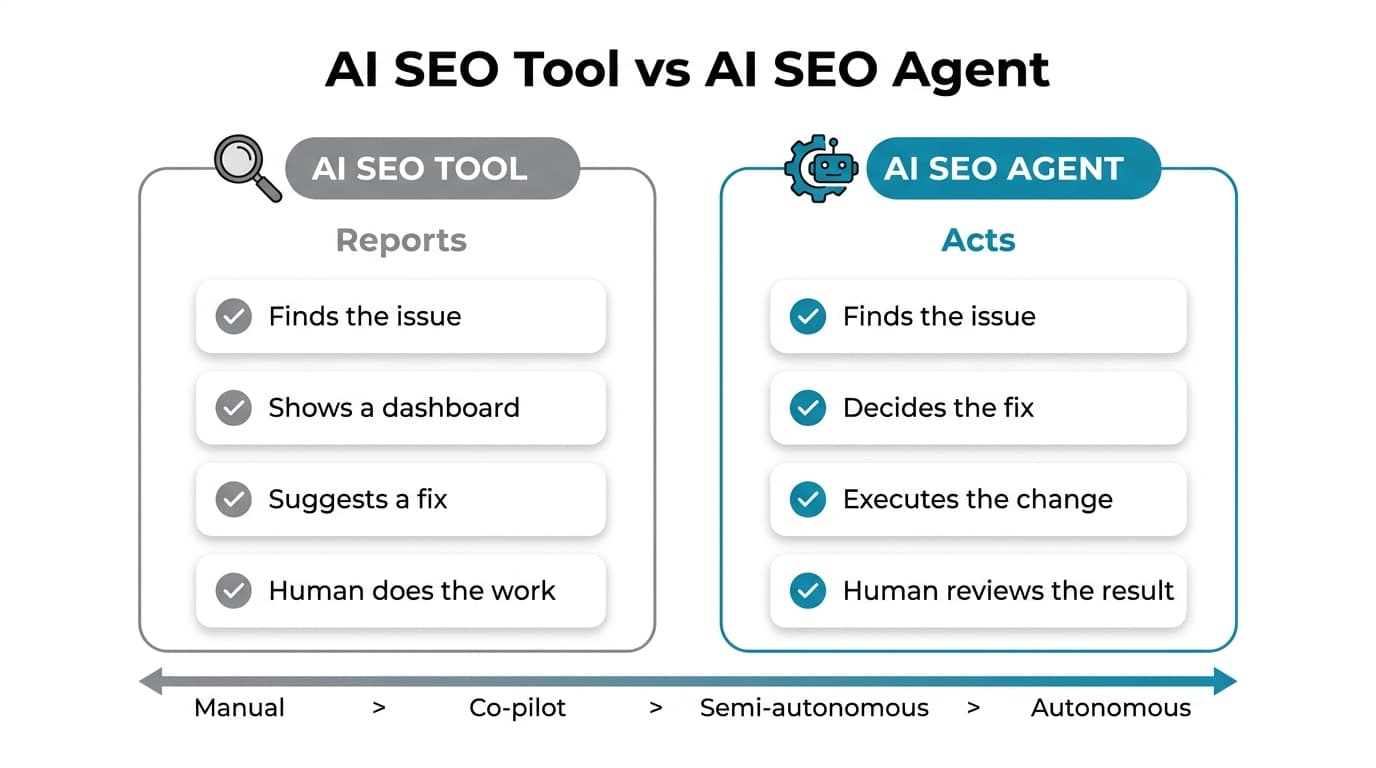
Here is the short answer. An AI SEO tool reports. It finds a problem, shows it to you on a dashboard, and maybe suggests a fix. You still have to do the work: write the new copy, open the CMS, publish it, and check back later to see if it helped. The current wave of LLM SEO tools sits squarely in this report-only camp: they tell you whether ChatGPT cites you, and stop there. An AI SEO agent acts. It finds the problem, decides on a fix, and executes it, whether that means publishing directly to your CMS or opening a change for you to approve. The tool ends its job at the recommendation. The agent's job is not done until the fix is live.
That distinction sounds small. It is not. It is the difference between a to-do list and someone who actually crosses items off it.
What "AI SEO Agent" Actually Means
An agent, in the technical sense, is software given a goal instead of an instruction. You do not tell it "write 500 words about content decay." You tell it "keep our rankings from decaying," and it figures out what data to pull, what to check, and what action to take, on its own, in a loop, without you writing a new prompt for every step.
That loop usually looks like four stages:
- Perceive. Pull real data: Google Search Console positions, click and impression trends, crawl results, competitor rankings.
- Reason. Decide what the data means: is this page actually decaying, or just seasonal noise? Is this a cannibalization problem or a genuine ranking drop?
- Act. Take the action itself: rewrite the thin section, update the outdated stat, fix the internal link, publish the change.
- Verify. Check whether the action worked, and feed that result back into the next cycle.
A chatbot answers a question when you ask it and stops. An agent keeps going, calling tools (a Search Console API, a crawler, a CMS connector) along the way, until the goal is met or it hits a point where it needs your approval.
AI SEO Agent vs AI SEO Tool: The Real Difference
This is the part most articles gloss over in a single sentence. It deserves more than that, because "agent" has become a marketing word slapped onto ordinary dashboards, and you need a way to tell the difference before you trust one with your site.
The clearest way to see it is side by side, using the same problem run through each:
| AI SEO Tool | AI SEO Agent | |
|---|---|---|
| Finds the issue | Yes, surfaces it in a dashboard | Yes, same detection |
| Explains the issue | Yes, a report or a score | Yes, plus root cause |
| Decides the fix | No, you decide | Yes, proposes or picks a fix |
| Executes the fix | No, you write and publish it | Yes, drafts and can publish it |
| Confirms it worked | No, you check back manually | Yes, monitors and reports the result |
| Your job afterward | Everything past the report | Review (or nothing, if fully autonomous) |
Take one concrete example. A page that used to rank at position 6 has slipped to position 19 over the last quarter.
- A tool flags it: "This page dropped 13 positions. Traffic is down 40%." It might even tell you the H1 no longer matches the primary keyword, or that a competitor published a more detailed guide. Useful. Also where the tool's job ends.
- An agent flags the same drop, but then pulls the current content, compares it against what is now ranking above it, drafts an updated version that closes the gap (fresher data, a missing subtopic, a clearer structure), and either publishes that fix to your CMS directly or puts it in front of you as a one-click approval. Then it watches the page for the next few weeks to see if the position actually recovers.
Same detection. Completely different amount of work left for you to do.
It Is a Spectrum, Not a Switch
Very few tools are purely one or the other. "Agent" versus "tool" is better understood as a spectrum of how much of the loop happens without you:
- Manual tool. You run the audit, you read the report, you do everything yourself.
- Co-pilot. The tool suggests specific fixes ("change this H1 to X") but writes nothing and touches nothing.
- Semi-autonomous agent. The agent drafts the fix and stages it. A human reviews and approves before anything goes live.
- Fully autonomous agent. The agent detects, drafts, and publishes without a human in the loop, then reports the outcome after the fact.
Most teams should not start at the fully autonomous end, and most serious platforms do not force you to. The safer, more common pattern is to run in a reviewed mode first, so you can see what the agent proposes before it touches anything live, and only loosen the leash on routine, low-risk fixes once you trust the pattern of what it produces.
What an AI SEO Agent Can Actually Do Today
Strip away the vendor language and the realistic capability list for a 2026-era SEO agent looks like this:
- Detect decay and drops. Continuously watch Search Console data for pages losing positions, impressions, or clicks, instead of waiting for a monthly audit.
- Spot the easy wins. Surface pages sitting at positions 11 to 20, the ones one solid push away from page one, and prioritize them by traffic potential rather than making you dig through a spreadsheet.
- Catch cannibalization. Notice when two of your own pages are competing for the same query and recommend a merge or a differentiation, not just report that it is happening.
- Refresh content. Rewrite the thin or outdated section, update the stats, tighten the structure, in your brand voice rather than generic AI copy.
- Publish the fix. Push the update straight to WordPress, Webflow, or another connected CMS, closing the gap between "the fix is ready" and "the fix is live," which is where most manual workflows stall for days or weeks.
- Measure whether it worked. Track the specific page after the specific fix and report the position, impression, and click change that followed, not just a traffic graph that could mean anything.
What it still cannot responsibly do alone: set your overall content strategy, make brand or legal judgment calls, or decide what is worth ranking for in the first place. That is still your call. The agent's job is to stop the mechanical grind of monitoring, writing, and publishing from eating your week.
The Part Nobody Talks About: What Happens When the Agent Is Wrong
This is the honest section most "AI agent" content skips entirely, and it matters more here than almost anywhere else, because the entire selling point of an agent is that it takes action on its own.
A tool that gives you bad advice costs you a few minutes of reading. An agent that takes a bad action can put something wrong on a live page. A rewrite that drifts from your brand voice. A stat that got hallucinated instead of pulled from a real source. A redirect or an internal link that points somewhere it should not. If nothing is reviewing that before it goes live, the "automation" can quietly do damage while you assume it is helping.
A responsible agent setup deals with this directly, not by promising it never happens:
- Start in reviewed mode. Every proposed fix sits in a queue for a human to approve or edit before it publishes, especially in the first few weeks while you learn what the agent tends to get right and wrong.
- Ground it in your own facts, not generic training data. An agent that references your actual brand voice, product facts, and writing rules before generating anything is far less likely to invent a claim than one working from a blank prompt.
- Keep an audit trail. You should be able to see exactly which fix was applied to which page and when, so a bad change can be identified and rolled back quickly.
- Attach real authorship. Content going out under your brand should carry real author credentials, not an anonymous AI byline, both for reader trust and for how AI search engines evaluate E-E-A-T.
- Only automate the routine. Loosen the leash on low-risk, repetitive fixes (an outdated stat, a missing internal link) before you ever let it touch anything strategic or brand-sensitive without a human checking first.
None of this is a reason to avoid agents. It is the checklist that separates a well-built one from a liability.
How to Evaluate an AI SEO Agent Before You Trust It With Your Site
If you are shopping in this category, ask each vendor these questions before you believe the word "agent" on their landing page:
- Does it actually publish, or just recommend? If the answer is "it gives you a suggestion you then implement," it is a tool wearing agent branding.
- Can you review before it goes live? A serious agent lets you choose reviewed mode versus autonomous mode. If everything ships with zero human checkpoint and no way to change that, treat it carefully.
- Does it show causal proof, or just a chart? A page's rankings moving is not proof a specific fix worked. Ask whether the product ties a specific action to a specific outcome, or just shows you a general traffic graph you have to interpret yourself.
- Does it know your brand, or does it write generically? Ask what it is grounded in: your actual style guide and product facts, or the model's default training data. Generic AI writing is a giveaway that nothing is feeding it real context.
- Where does the fix land? Does it integrate with your actual CMS (WordPress, Webflow, and similar), or does it stop at "here is a doc, go paste it in yourself"?
- What is the audit trail? Can you see, per page, which fix was applied and when, or is it a black box?
Where Murkuz Fits
We built Murkuz around this exact definition of agent, not tool. Its closed loop runs detect, then fix, then deploy, then prove: it scans your Search Console data to catch declining pages, positions-11-to-20 opportunities, and content cannibalization; it drafts the fix in your brand voice using a knowledge base of your own facts and style rules rather than generic AI output; and it pushes the approved change straight to WordPress, Webflow, or Framer so there is no gap between "the fix is ready" and "the fix is live." Then it tracks the specific page after the specific fix and shows you the position, impression, and click change that followed, the causal proof most tools never bother to close the loop on.
Most teams run it in reviewed mode at first: fixes sit in a task queue, you approve or edit before anything publishes, and you only turn on auto-execution for the routine, low-risk fixes once you have seen the pattern of what it proposes. That is the agent-not-tool distinction from this whole article, put into practice rather than just defined.
If you want a broader honest look at what agents can and cannot do across the category (not just ours), our companion piece on AI agents for SEO covers the full capability matrix, and our roundup of SEO automation tools compares where different products sit on the tool-to-agent spectrum.
FAQ
Is ChatGPT an AI SEO agent?
Not by itself. ChatGPT is a chatbot: you prompt it, it answers, the loop ends until you prompt again. It becomes agent-like only when it is connected to tools (a Search Console API, a CMS, a crawler) through something like the Model Context Protocol and given a standing goal instead of a one-off question. Used on its own for SEO tasks, it is closer to a very capable assistant than an agent that acts on your site.
Does AI SEO actually work?
The detection and drafting parts work well today: agents are genuinely good at spotting decaying pages, drafting a refresh, and catching cannibalization faster than a manual audit. Where it breaks down is unsupervised judgment: brand voice, factual accuracy, and strategic calls still need a human checkpoint, at least until you trust the pattern of what a specific agent produces on your specific site.
What is an example of AI SEO in practice?
A common one: an agent notices a page's rankings have slipped from position 8 to position 22 over six weeks, checks what is now outranking it, drafts an updated version that closes the content gap, and either publishes it or queues it for your approval. If it worked, you see the position recover over the following days or weeks, tied back to that specific fix.
What's the actual difference between an AI tool and an AI agent, in one line?
A tool ends at the recommendation. An agent's job is not finished until the fix is live and the result is measured.
Is an AI SEO agent safe to give CMS access to?
It can be, if it runs in reviewed mode first, keeps an audit trail of every change, and is grounded in your own brand facts rather than generating from scratch. Treat any agent that only offers "fully autonomous, no review option" with more caution than one that lets you dial the autonomy up gradually.
How is an AI SEO agent different from hiring an SEO agency?
An agency brings strategy, judgment, and relationships (outreach, PR, big-picture planning) that an agent does not replace. An agent replaces the repetitive mechanical layer underneath that strategy: the monitoring, the drafting, the publishing, the reporting. Many agencies now use agents internally to handle that layer so their strategists spend time on the parts that actually need a person.