Search "ai agent for seo" and you will mostly find vendors describing their own product as the future of the category. That is not what this article does. This is a plain accounting of what an AI agent can reliably do for SEO right now, in 2026, what it still gets wrong, and how to tell the difference before you hand it your site.
The short version: AI agents are genuinely good at the mechanical, repetitive parts of SEO, pulling data, drafting content, flagging problems, and pushing approved changes live. They are not good at judgment, and any vendor who tells you otherwise is selling you something.
What "AI Agent for SEO" Actually Means
A chatbot answers a question when you ask it. An agent is different: it is given a goal, it takes a sequence of actions on its own to get there, and it can call tools (a Search Console API, a CMS, a crawler) along the way instead of just producing text.
In practice, "AI agent for SEO" gets used to describe three very different things, and mixing them up is where most of the hype comes from:
- A single AI-assisted feature. A "generate meta description" button in a dashboard. Useful, but it is not an agent, it is a text generator wrapped in a UI.
- A workflow you build yourself. Chaining an LLM (Claude, ChatGPT) with a tool like n8n or Gumloop to watch a data source and take an action. This is a real agent, but you are the one building, debugging, and babysitting it.
- A packaged, closed-loop product. A platform where the detection, the drafting, and the publishing step are already wired together, with a review step in between, so you are approving fixes rather than assembling a pipeline.
Whichever type you are looking at, the honest question is the same: which specific tasks does it do without you, and which ones does it just make faster for you to do yourself?
What AI Agents Can Reliably Do for SEO Today
These are jobs where agentic tools are already doing real, unattended or lightly-supervised work, not hype.
- Rank and position monitoring. Pulling daily or weekly position data from Google Search Console and flagging movement is pure data retrieval. An agent can watch this continuously and never miss a day, which a person checking a dashboard weekly cannot match.
- Decline and opportunity detection. Scanning your own Search Console history to find pages that are losing positions, or pages sitting at positions 11 to 20 that are one push away from page one, is a pattern-matching job over numbers an agent handles well.
- Content cannibalization detection. Finding that two or three of your own pages are quietly competing for the same keyword is a matching problem across your site's own data. This is exactly the kind of thing that is tedious for a human to catch manually and mechanical for software to catch continuously.
- First-draft content generation. Drafting a content refresh, an outline, or a set of meta tags from a brief is now routine. The output still needs a human edit, but the blank-page problem is solved.
- Technical audits and crawling. Finding broken links, missing tags, and redirect chains across a large site is checklist work software has automated well for years, and agents now chain this into "detect issue, open a ticket" without a person doing the export-and-file step.
- Internal link suggestions. Recommending which existing pages should link to a new or updated one, based on topical relevance, is a job agents do reasonably well because it is a matching problem, not a judgment call.
- Publishing an approved change. Once a person has reviewed and approved a fix, pushing it live to WordPress, Webflow, or another CMS is mechanical. There is no real reason left for a person to be copy-pasting HTML into an editor in 2026.
The common thread: none of this requires understanding your brand, your customer, or the nuance of a specific competitive SERP. It requires consistency, and consistency is what these systems are actually good at.
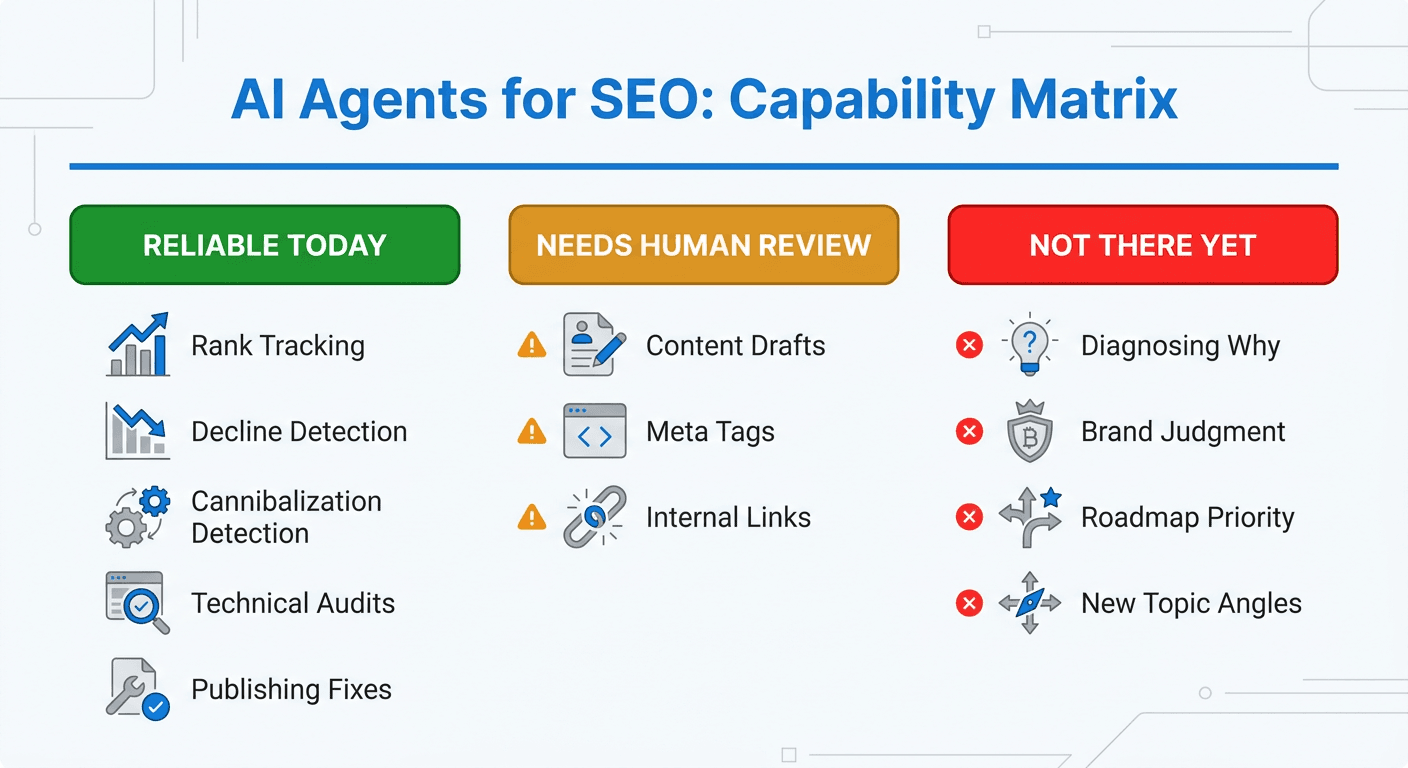
The Capability Matrix: What's Reliable, What Needs Review, What Isn't There Yet
This is the table most "AI agent for SEO" articles skip, because naming what does not work yet is bad for a sales pitch. Here it is anyway.
| SEO task | Status today |
|---|---|
| Rank and position tracking | Fully reliable |
| Search Console decline/opportunity detection | Fully reliable |
| Content cannibalization detection | Fully reliable |
| Technical crawl and broken-link audits | Fully reliable |
| Publishing an approved fix to a CMS | Fully reliable |
| Drafting a content refresh or outline | Needs human review |
| Meta title and description generation | Needs human review |
| Internal link suggestions | Needs human review |
| Diagnosing why a specific page dropped | Not there yet |
| Judging brand voice and factual accuracy at scale | Not there yet |
| Prioritizing a roadmap against business context | Not there yet |
| New topic and angle selection | Not there yet |
| Building real backlink relationships | Not there yet |
"Needs human review" means the agent produces a genuinely useful first pass, but publishing it unread is how sites end up with thin, off-brand, or quietly wrong pages. "Not there yet" means the task depends on judgment, context, or relationships a model does not reliably have access to, no matter how the demo is staged.
Where AI Agents Still Fall Short
This is the section most vendor content buries in a caveat or skips outright. It deserves to be its own section, because it is the difference between a tool that helps you and one that quietly damages your site.
They cannot reliably diagnose why a page dropped. An agent can tell you a page fell from position 6 to position 14. It cannot tell you, with real confidence, whether that happened because a competitor published something genuinely better, because your content went stale, or because Google reclassified the query's intent. That diagnosis still takes a person who can read the current SERP and understand the topic.
They do not reliably protect brand voice or factual accuracy. Left unsupervised, AI drafting tends to drift toward the same generically confident tone, and it can state things that are simply wrong with no hint of uncertainty. Any AI-drafted content needs a human review pass before it goes live. Every time. No exceptions.
They cannot prioritize your roadmap for you. An agent can rank tasks by estimated traffic impact using the data it has. It has no way of knowing you are launching a new product line next quarter and should already be building topical authority for it. That context lives with your team.
They are weak at judging E-E-A-T and trust signals. Deciding whether a page demonstrates real experience and expertise, not just keyword coverage, is a human editorial judgment. An agent can check whether an author bio exists. It cannot tell you whether the content behind that bio is actually credible.
They do not build real link relationships. Agents can find backlink prospects and draft an outreach email. They cannot replace the actual relationship-building, reputation, and judgment calls that earn a link from a site that matters.
<mark class="km-highlight" style="--hl:#FEF08A;background:#FEF08A">A useful rule of thumb: automate the steps before a decision (detecting, drafting) and after a decision (publishing, monitoring). Keep a human at the decision itself.</mark>
A Worked Example: Content Decay, Start to Finish
Here is what an honest agentic workflow looks like end to end, including where a human still has to step in.
- Detect. The agent scans Search Console data and flags a page that has dropped from position 8 to position 17 over six weeks, with a 40% impression drop.
- Draft. It generates a content refresh: updated stats, a rewritten intro, and two new subsections addressing gaps a competitor's page now covers.
- Human review. A person reads the draft. In a real run, this is where you catch the agent citing an outdated statistic it found in an old cached page, or writing in a tone that does not match the brand. This step is not optional.
- Publish. Once approved, the fix is pushed live to the CMS without anyone touching HTML.
- Monitor and prove. The agent tracks the page's position daily afterward and can show, with an actual before-and-after chart, whether that specific change is what moved the ranking, rather than a coincidental algorithm update.
Every step except review 3 can run with the agent doing the work. Step 3 is where the whole workflow either stays trustworthy or quietly goes wrong.
How Much Human Oversight Do You Actually Need?
There is no universal number, but a useful practitioner heuristic is that roughly a third of the workflow, the decision points, deserves dedicated human attention even once the rest is automated: what to fix, how to say it, and whether a suggested change is right for this specific page and audience. The other two-thirds, the finding, the drafting, the publishing, and the tracking, is where automation earns its keep with very little downside.
If your current setup has that ratio backwards, where you spend most of your week manually finding and reporting problems and almost none of your time on the actual judgment calls, that is the clearest sign an agent belongs in your stack.
Will AI Replace SEO Specialists?
No, and the reason is in the capability matrix above: the tasks agents cannot yet do (diagnosis, prioritization, judgment, relationships) are the tasks that actually require an SEO specialist. What changes is the shape of the job. Less time spent exporting spreadsheets and writing status reports, more time spent on the decisions that were always the real work. That is a shift in workload, not a replacement of the role. The same split is arriving in AI search: tools that track LLM citations handle the measuring, while the acting still needs an agent or a person.
Where Murkuz Fits
Murkuz covers the first rows of the matrix above and stops there on purpose. It is a connector that gives Claude, ChatGPT or any MCP client your own Search Console, Google Analytics 4 and Bing Webmaster Tools data, so the monitoring, decline detection and cannibalization rows come from your real numbers rather than from what the model remembers. It does not draft, publish or push anything to your site. The only write it can make is submitting a sitemap to Search Console.
That keeps the split this article argues for. Your agent pulls the rows and drafts the change in the chat, and you decide whether it is right and publish it. If you want to set up your own assistant as an SEO agent, that page lists the questions it can answer once Murkuz is connected, from traffic drops to pages competing for the same query.
If you are trying to decide between several agentic SEO products rather than build your own pipeline, our breakdown of SEO automation tools sorts the market by what each one actually automates, not by feature lists.
FAQ
Can I use AI to do my SEO?
Yes, for the mechanical parts: tracking rankings, detecting declines, drafting content, and publishing approved changes. No, for the judgment parts: deciding why something happened, choosing strategy, and catching factual or brand-voice errors before anything goes live.
Will SEO be replaced by AI?
No. The parts of SEO that are hardest to automate, diagnosing a ranking change, prioritizing against business context, and judging real expertise and trust, are also the parts that define the job. AI changes how much manual reporting the role requires, not whether the role exists.
Is SEO dead in 2026?
No. Search behavior has changed (more queries answered inside AI Overviews and chat interfaces), but ranking well, whether in classic search or an AI answer, still depends on the same fundamentals: genuinely useful content, technical health, and real trust signals. The tools have changed more than the underlying goal.
Can ChatGPT do SEO?
It can help with parts of it: drafting content, brainstorming topics, explaining concepts, and summarizing data you paste in. It cannot monitor your Search Console data on its own, detect a ranking drop while you are not looking, or publish a fix to your CMS without you building that connection yourself. That is the difference between a chat tool and an agent.
What's the difference between an AI SEO tool and an AI SEO agent?
A tool responds when you ask it something. An agent is given a goal and takes a sequence of actions toward it on its own, calling on data sources and publishing systems along the way. Most products marketed as "AI SEO agents" sit somewhere between the two, so it is worth asking a vendor exactly which steps run without you before you buy.
Are AI SEO agents worth it for a small team?
It depends on where your time actually goes. If you are spending hours a week manually checking Search Console and writing status updates, an agent that automates detection and reporting pays for itself quickly. If your bottleneck is deciding what to write about or how to position against competitors, no agent removes that work, because it is a judgment task.
Junaid Khalid is the founder of Ertiqah and the builder of Murkuz. He has run SEO as the first growth channel across his own SaaS products, and built Murkuz around the belief that the mechanical 80% of SEO should be automated so a person can focus on the 20% that actually requires judgment.