Key findings
1.01%
Of Search Console queries were written by an AI agent
At least. About 1 in 100, across 70,009 query rows
51%
Of queries 25 words or longer came from AI agents
173 queries of that length
0
Clicks on AI-written queries, bar one
341 queries, 2,501 impressions
3.2
Median Google position of AI-written queries
91% of their impressions were on page one
- At least 1.01% of Search Console queries were written by an AI agent: about 1 in 100. A rule-based classifier, run separately, put machine-shaped queries at 1.51%.
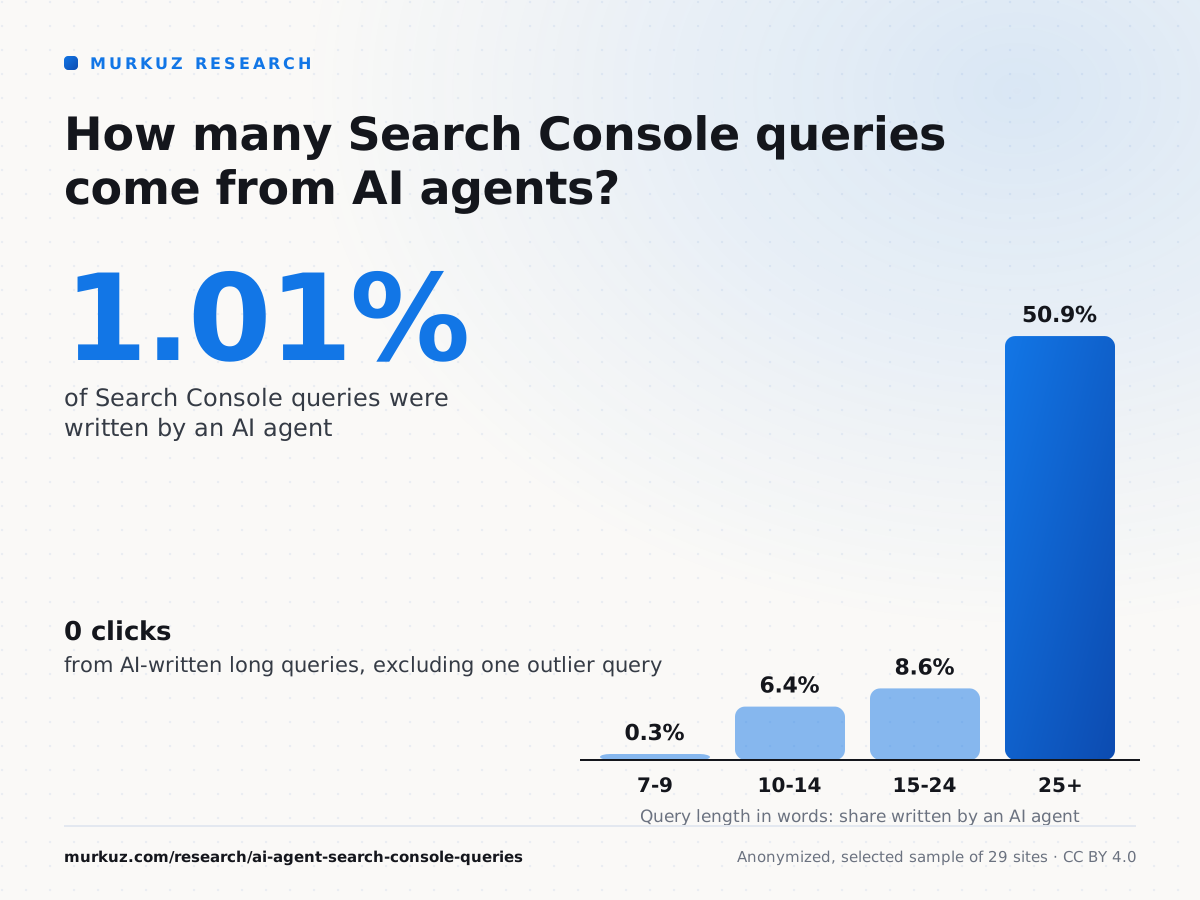
- The share rises with length: 0.35% of 7 to 9 word queries, 6.41% of 10 to 14 word queries and 51% of queries 25 words or longer.
- AI-written queries showed up on 11 of the 25 sites with query data.
- The most common shapes were output instructions, task commands, buyer persona briefs and location-scoped prompts.
- Bar one query, AI-written queries earned no clicks from 2,501 impressions. Long queries typed by people converted at 0.19%.
- They ranked high: median position 3.2, with 91% of their impressions on page one.
How many Search Console queries come from AI agents?
About 1 in 100, and that is a floor. We labelled every query by who most likely wrote it: a person, an AI agent, a rank tracker, or someone pasting text that is not a search. People wrote 97.51% of queries and 99.3% of impressions. AI agents wrote 1.01% of queries but only 0.42% of impressions, because each agent query tends to be seen once and never again.
The classifier we used is cautious. On a hand-labelled test set it got 17 of 22 right, and every miss was an AI-written query it called human: short chat follow-ups and polished research questions. The real share is likely higher than 1.01%.
Figure 1
Who wrote the queries that were not typed by a person
Long queries are where AI agents hide
People rarely type long searches. Agents do it all the time, because they pass along the whole task they were given. Up to 9 words, AI-written queries were rare: 0.35%. From 10 words up they jumped to 6.41%, and at 25 words or more, half of all queries came from an agent.
Figure 2
Share of queries written by an AI agent, by query length
That makes length the fastest filter you have. Sort your Search Console queries by length and the top of the list is mostly agent text.
What AI-written queries look like
They read like the inside of a prompt. We grouped the 342 AI-written queries of 7+ words by shape. Below are the shapes we saw on at least 5 sites, with the fixed wording they share. Text in square brackets varies.
Figure 3
Shapes of AI-written queries
Output instructions · 112 queries on 6 sites
…remember to only return the domain. / …description should be less than 500 charactersTask commands · 31 queries on 5 sites
create a… / write a… / find the phone number for… / perform the following task…Buyer persona briefs · 26 queries on 5 sites
i am a 25-34 year old in the [industry] industry… my main motivations… my main pain points…Location-scoped prompts · 25 queries on 6 sites
context: location: [country] (not for language). do not include location references in your response. question: …
The persona briefs stand out. They look like the output of tools that test how AI assistants talk about brands: a synthetic buyer description sent with every question, carried into a Google search. If you see “my main pain points” in your queries, someone is testing what an assistant says about your market.
Do AI agent queries get clicks?
No. The 342 AI-written queries of 7+ words earned 7,971 impressions and 50 clicks, and every one of those clicks came from a single query: a request to rewrite an email in a more persuasive tone, which plenty of people may have typed themselves. Without it, 341 queries and 2,501 impressions produced zero clicks.
Long queries typed by people converted at 0.19% over the same period. An agent reads the results page and moves on. If it visits your page at all, it does so as a crawler, which Search Console does not count.
Why AI queries rank so high
An agent’s query is so specific that almost nothing else matches it, so the pages that do appear rank near the top. The median AI-written query sat at position 3.2, and 91% of their impressions were on page one. Long queries typed by people averaged position 9.6 against 5.1 for agent queries.
This matters when you sort a report by position. Top-3 queries with no clicks look like a title problem. Many of them are agents, and no title will win that click. We measured the effect on click-through rates in a companion study, Google CTR by position in 2026.
What to do about AI queries in Search Console
- Filter them before judging CTR. Exclude queries of 10 or more words that read like instructions. Totals barely change; position and CTR tables get much cleaner.
- Read them for intent. A persona brief or a research sub-question tells you exactly what an assistant was asked about your market. That is free research on how buyers use AI.
- Make sure assistants can read your pages. An agent that finds you in Google still needs to fetch the page. Check your robots.txt with the AI crawler checker and your file with the llms.txt validator.
- Do not chase their rankings. A page at position 2 for a 30-word prompt is not a win to protect.
Murkuz connects Google Search Console, GA4 and Bing Webmaster Tools to Claude or ChatGPT, so you can pull this for every site you manage by asking:
List my Search Console queries of 10+ words from the last 90 days with impressions, clicks and position.Which of those read like prompts from an AI assistant rather than searches?Recompute my CTR by position without them.
Methodology
We selected 29 sites for this analysis. Selection criteria: small and mid-sized software, SaaS, review and content sites with Google Search Console data for the whole study window. Their data is anonymized.
Data
Google Search Console query rows (web search) pulled through the Search Console API for the 480 days from 29 June 2025 to 21 October 2026. The sites are small and mid-sized software, SaaS, review and content sites. 25 had query-level rows: 70,009 site and query pairs, 59,789 distinct queries, 2,266,411 impressions and 13,199 clicks. Search Console withholds rare queries for privacy, so the true number of one-off agent queries is higher still.
Labelling
Each query was labelled by TypeSafe’s Jev, a classifier that returns one choice with probabilities, asked who most likely produced the text: a person, an AI agent, a rank tracker or scraper, someone pasting non-search text, or unclear. Every one of the 14,044 distinct queries of 7+ words was labelled. For the 45,745 shorter queries we labelled a random sample of 2,000 and scaled the shares to the rest. On 22 hand-labelled queries it was right 17 times, and all misses undercounted AI. As a cross-check, Murkuz’s own rule-based query classifier flagged 1.51% of queries as machine-shaped.
Minimum group size
A query shape is named only if it appears on at least 5 sites. Examples show the fixed wording that repeats across sites, never a full query from one site. We do not publish per-site figures.
Download the data
The CSV and JSON hold the share of queries, impressions and clicks by who wrote them, the AI share by query length and the count of AI-written queries per shape. Reuse them under CC BY 4.0: credit Murkuz and link to this page. Spotted an error? Email [email protected] and we will correct it and note the change.
Frequently asked questions
Do AI agents show up in Google Search Console?
Yes. When ChatGPT, Gemini, Copilot or an agent built on them searches Google on someone's behalf, the text it sends is logged like any other query. In the Search Console data of the 29 sites we selected, at least 1.01% of queries over 480 days were written by an AI agent rather than typed by a person.
How can I tell if a Search Console query came from an AI?
Look at length and form. AI-written queries are long, often 10 words or more, and read like instructions rather than searches: they tell the reader what format to return, describe a buyer persona, scope the answer to a country, or ask a polished research sub-question. Very few people type 25 words into Google; in our data half of those queries came from agents.
Do AI agent queries bring clicks?
Almost never. Apart from one query, a request to rewrite an email in a more persuasive tone that earned 50 clicks, the 341 AI-written queries in our data got 2,501 impressions and no clicks. Long queries typed by people got a 0.19% click-through rate.
Why do AI-written queries rank so high?
Because they are so specific that few pages compete for them. The median AI-written query in our data ranked at position 3.2, and 91% of their impressions were on page one. Long queries typed by people averaged position 9.6. A high position on an agent's query says little about how the page ranks for real demand.
Should I filter AI queries out of my SEO reports?
Yes, when you judge CTR or pick queries to target. They are a small share of impressions, so totals barely move, but they sit at the top of query lists sorted by position and drag CTR toward zero. Filter queries of 10 or more words that read like instructions, then look again.
Is the share of AI queries growing?
We did not find a steady trend. Measured month by month with our rule-based classifier, the median site's share moved between 0.75% and 1.51% with no clear direction, so we make no growth claim. We will rerun the study and update this page.
Sources
- Search Console Help: What are impressions, position, and clicks?
- Search Console Help: Performance report (Search results)
- TypeSafe documentation: System One and the Jev model

About the author
Junaid K., SEO Specialist
I run SEO for 14 sites across eight products: 3,600+ published articles, 50M+ organic search impressions, and organic search as the first growth channel for every launch. Day to day that means Search Console and GA4 analysis, keyword and SERP research, content operations at scale, and catching ranking decay before it costs traffic. These articles are the notes from that work.