How fast do internal links move a page?
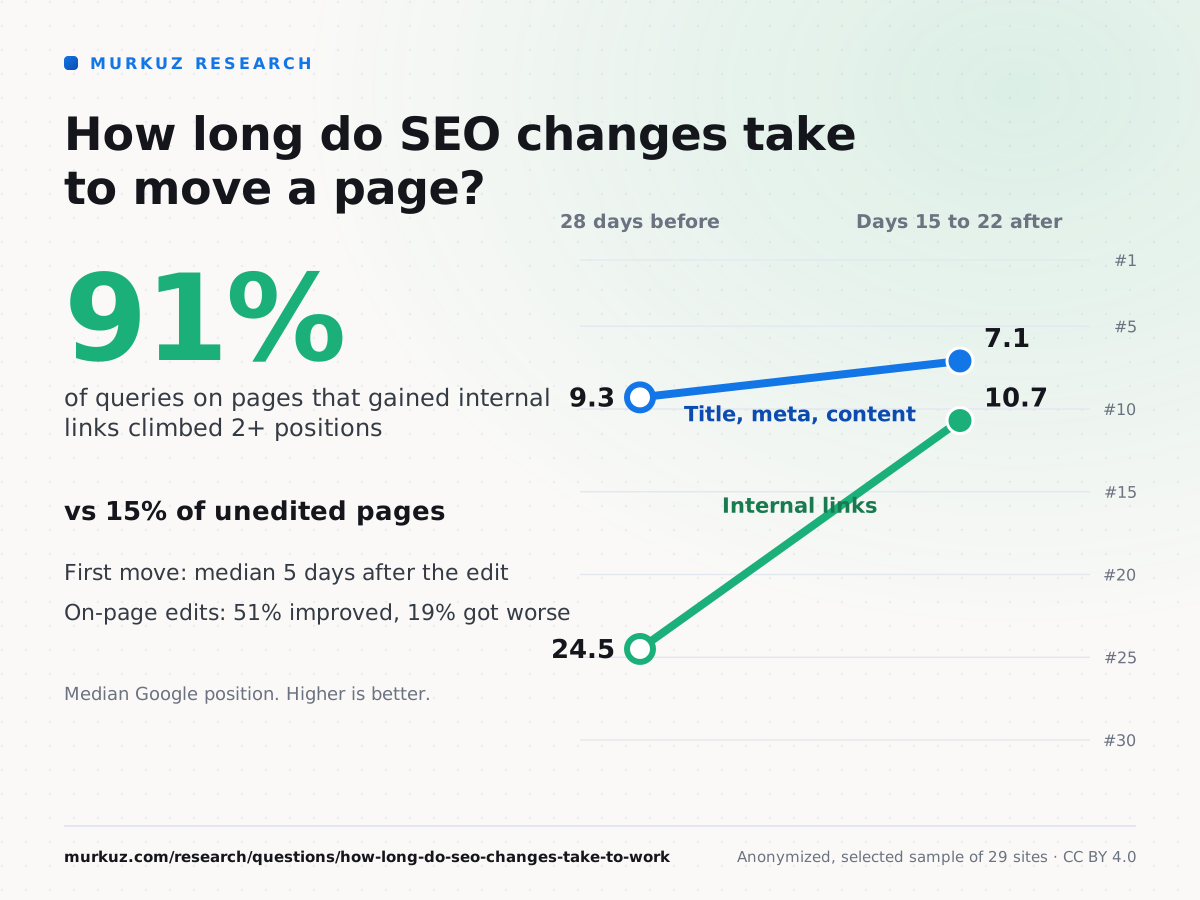
Faster and further than any other edit we logged. We added links pointing at a page from other pages on the same site, then watched the queries that page ranked for in positions 5 to 25. Across 75 queries on 6 sites, the median position went from 24.5 in the 28 days before to 10.7 in days 15 to 22 after.
91% of those queries improved by two positions or more and 4% got worse by that much. 92% had moved by two or more places at some point within 22 days, and the median first move came on day 5.
The starting point matters. These queries began around page three, where there is a lot of room to climb, so the size of the jump is larger than you would see on a page already in the top 10.
Median Google position before and after the edit
How fast do title, meta and content edits work?
More slowly, and less reliably. These edits were made to pages already ranking around the bottom of page one. Across 57 queries on 6 sites, the median position moved from 9.3 to 7.1, a median gain of 2.3 places.
51% improved by two or more positions, and 19% got worse by that much. On-page edits carry real downside: rewriting a title or a section can lose a query the page already held. The first measurable move still came after a median of 5 days.
Share of queries that moved 2+ positions by days 15 to 22
Would those pages have moved anyway?
Mostly not. We compared 1,254 page and query pairs on 10 sites that were not edited, over the same weeks. Their median gain was 0.4 positions. Only 15% improved by two or more places and 8% got worse.
The result also held site by site. 6 of the 6 sites saw a positive median gain from internal links, and 5 of 6 saw one from on-page edits. One site holds 85% of the internal-link queries and 75% of the on-page ones, which is why we show the per-site medians below.
Median position gain per site, by edit type
What to do about it
Start with internal links to pages on page two and three
Pick pages with queries sitting in positions 11 to 25, then add links to them from related pages that already get impressions. In our data this edit improved 91% of queries by two or more places.
Internal link briefTarget page: [URL] Queries in positions 11-25: [list from Search Console, last 28 days] Find 3-5 pages on the same site that mention the topic and have impressions Add one contextual link from each, anchor text = the target query or a close variant Note today's date. Check positions again on day 7 and day 22Wait 15 to 22 days before you judge an edit
The first move shows up after about 5 days, but the early days are noisy. Compare the 28 days before with days 15 to 22 after, the same windows we used.
Change titles and copy on top-10 pages with care
19% of on-page edits made the query worse. Keep the words the page already ranks for, change one thing at a time, and write down the date so you can roll back.
Log every edit with a date
Without the date you cannot tell an edit's effect from a Google update or a seasonal swing. A one-line changelog per page is enough.
Check this on your own site
Murkuz connects Google Search Console, GA4 and Bing Webmaster Tools to Claude or ChatGPT, so you can ask the same questions about every site you run and get answers from your real rows. Paste any of these into the chat:
Which of my pages have queries in positions 11 to 25 with the most impressions?Compare the average position of [URL] for its top queries in the 28 days before [date] and days 15 to 22 after.Find pages on my site that mention [topic] and already get impressions, so I can link from them.
- Murkuz MCP toolsFind the keywords you are nearly ranking for, then compare before and after any date.
- Keyword Clustering ToolGroup the queries a page ranks for before you edit it.
- Meta Description GeneratorDraft snippet variants when you do change on-page copy.
- Every MCP toolThe full list of questions the connector can answer, with what each one reads.
More free utilities on the tools page.
Methodology
We selected 29 sites for this analysis. Selection criteria: small and mid-sized software, SaaS, review and content sites with Google Search Console data for the whole study window. Their data is anonymized.
We logged edits made to existing pages with the date of each change. For every query a page ranked for at positions 5 to 25 before the edit, we compared its average Google position in the 28 days before the edit with its average in days 15 to 22 after. Gain is the drop in position number, so a positive gain means the query climbed.
Internal-link edits added links to the page from other pages on the same site. On-page edits changed the title, meta description or body copy. The control is every page and query pair on 10 sites that was not edited, measured over the same weeks.
Days to move is the first day after the edit when the query's position was two or more places better than its baseline. One site holds 85% of the internal-link queries and 75% of the on-page queries, so we publish per-site medians next to the pooled figures.
Sites are never named or described in a way that identifies them. We only publish a comparison when each group holds at least five sites. Data snapshot: 22 October 2026.
| Finding | Sites |
|---|---|
| Internal-link edits | 6 (75 queries) |
| Title, meta and content edits | 6 (57 queries) |
| Unedited control pages | 10 (1,254 page and query pairs) |
You can reuse the numbers, charts and infographic under CC BY 4.0: credit Murkuz and link to this page. Spotted an error? Email [email protected] and we will correct it and note the change.
Frequently asked questions
How long do SEO changes take to work?
Expect a first move within about a week and a clear result in about three weeks. In our data the first measurable move came after a median 5 days, and internal-link edits had moved queries from a median position 24.5 to 10.7 by days 15 to 22.
How long after changing a title tag will rankings change?
Usually within a week or two, but in either direction. Title, meta and content edits moved queries from a median 9.3 to 7.1, with 51% improving by two or more places and 19% getting worse.
Do internal links improve rankings?
In our data, yes, and more reliably than on-page edits. 91% of queries on pages that gained internal links improved by two or more positions, against 15% of unedited pages over the same weeks.
Should I keep editing a page if rankings do not move after a week?
Give it until day 22. The first move takes about five days, and positions bounce for the first two weeks. Editing again before then makes it impossible to tell which change did what.
Why did my rankings drop after I updated a page?
It happens: 19% of on-page edits in our data left the query two or more places worse. Check whether the new title or copy dropped words the page ranked for. If it did, put them back.

About the author
Junaid K., SEO Specialist
I run SEO for 14 sites across eight products: 3,600+ published articles, 50M+ organic search impressions, and organic search as the first growth channel for every launch. Day to day that means Search Console and GA4 analysis, keyword and SERP research, content operations at scale, and catching ranking decay before it costs traffic. These articles are the notes from that work.