Which positions bring the most clicks?
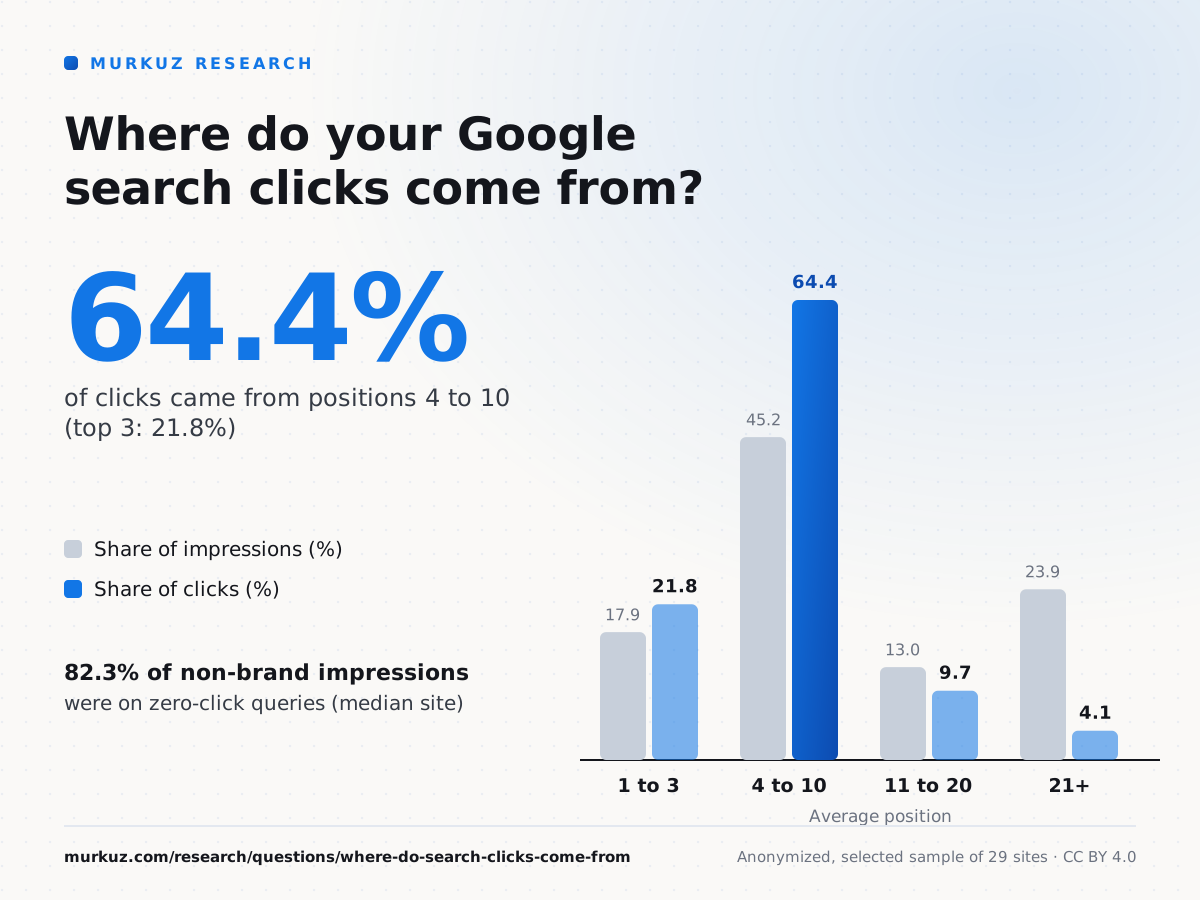
Positions 4 to 10, by a wide margin. Pooled over 90 days, queries with an average position of 4 to 10 had 45.2% of impressions and 64.4% of clicks. The top 3 had 17.9% of impressions and 21.8% of clicks.
On a single query, position 1 still tends to win. Across a whole site the middle of page one wins on volume: most sites hold far more queries there than at the top, and the top-3 queries they do hold are often questions answered on the results page.
Below page one, the clicks thin out fast. Positions 11 to 20 had 13.0% of impressions and 9.7% of clicks. Positions 21 and lower had 23.9% of impressions but only 4.1% of clicks.
Share of impressions and clicks by average position, 90 days
How much of your visibility never turns into a click?
Most of it. On the median site, 82.3% of non-brand impressions over 90 days were on queries that got no click at all (middle half of sites: 67.0% to 96.7%).
Some of that is low positions, and some is the results page answering the question first. Either way, impressions are a measure of reach. Count clicks, signups and sales to measure what the reach is worth.
Share of non-brand impressions on queries with zero clicks
How much of your search traffic is people looking for you?
A small part of what Google shows, a large part of what gets clicked. On the median site, brand queries were 9.7% of impressions (14 sites). On the 6 sites with enough brand clicks to measure, brand queries brought a median 61.7% of clicks.
Brand traffic is earned elsewhere: by the product, word of mouth and other channels. Split it out before you judge SEO, or a good month for the product will look like a good month for content.
Brand queries as a share of impressions and clicks, median site
What to do about it
Work the middle of page one first
Queries in positions 4 to 10 already bring 64.4% of clicks. A move from 8 to 4 on a query with real impressions is usually worth more than a new article.
Positions 4-10 shortlistSearch Console > Performance > Queries, last 90 days Filter: Position 4 to 10, exclude brand Sort by Impressions, keep the top 20 For each: which page ranks? Is the query in its title and first paragraph? Add 2-3 internal links to that page from related pagesReport brand and non-brand separately
Use a regex query filter with your brand name and its misspellings, then report the two lines side by side every month.
Brand filter (Search Console regex)(?i)(yourbrand|your brand|yourbrnad|yourbrand\.com)Stop counting page-two impressions as wins
Position 21 and lower had 23.9% of impressions and 4.1% of clicks. Treat them as a list of topics Google already associates with you.
Check this on your own site
Murkuz connects Google Search Console, GA4 and Bing Webmaster Tools to Claude or ChatGPT, so you can ask the same questions about every site you run and get answers from your real rows. Paste any of these into the chat:
Split my clicks over the last 90 days by position band: 1-3, 4-10, 11-20 and 21+.Which non-brand queries in positions 4 to 10 have the most impressions?What share of my clicks came from brand queries each month this year?
- Murkuz MCP toolsFind the keywords you are nearly ranking for and work out where effort would pay off most.
- Google Search Console MCPAsk for clicks by position band, brand and device in plain English.
- Keyword Clustering ToolGroup your page-two queries into topics worth a page.
- Every MCP toolThe full list of questions the connector can answer, with what each one reads.
More free utilities on the tools page.
Methodology
We selected 29 sites for this analysis. Selection criteria: small and mid-sized software, SaaS, review and content sites with Google Search Console data for the whole study window. Their data is anonymized.
Position bands use 90 days of Google Search Console query rows (web search) to 22 October 2026, grouped by each query's impression-weighted average position. Shares are pooled: each band's clicks divided by all clicks in the sample.
Zero-click share is per site: the share of a site's non-brand impressions that were on queries with no click in the window, reported as the median site and the middle half of sites.
Brand queries are queries that contain the site's own name. Brand impression share uses every site with brand impressions. Brand click share uses only sites with enough brand clicks for a stable share, so the two medians come from different groups.
Sites are never named or described in a way that identifies them. We only publish a comparison when each group holds at least five sites. Data snapshot: 22 October 2026.
| Finding | Sites |
|---|---|
| Top 3 band | 16 |
| Positions 4 to 10 | 23 |
| Positions 11 to 20 | 21 |
| Position 21 and lower | 24 |
| Zero-click share of non-brand impressions | 12 |
| Brand share of impressions | 14 |
| Brand share of clicks | 6 |
You can reuse the numbers, charts and infographic under CC BY 4.0: credit Murkuz and link to this page. Spotted an error? Email [email protected] and we will correct it and note the change.
Frequently asked questions
Which Google positions get the most clicks?
For a single query, position 1 usually gets the most. Across a whole site, positions 4 to 10 brought the most in our data: 64.4% of clicks against 21.8% for the top 3, because most sites have many more queries there.
Do page two rankings get any clicks?
A few. Positions 11 to 20 brought 9.7% of clicks in our data, and position 21 and lower 4.1%, despite 23.9% of impressions.
What is a zero-click search?
A search where the person sees results but clicks none of them, often because the answer is on the results page. On the median site in our data, 82.3% of non-brand impressions were on queries that got no click in 90 days.
How much of my organic traffic is brand?
It depends on how well known you are. On the median site with measurable brand clicks, brand queries brought 61.7% of clicks while making up 9.7% of impressions on the median site.

About the author
Junaid K., SEO Specialist
I run SEO for 14 sites across eight products: 3,600+ published articles, 50M+ organic search impressions, and organic search as the first growth channel for every launch. Day to day that means Search Console and GA4 analysis, keyword and SERP research, content operations at scale, and catching ranking decay before it costs traffic. These articles are the notes from that work.