Do questions get their share of clicks?
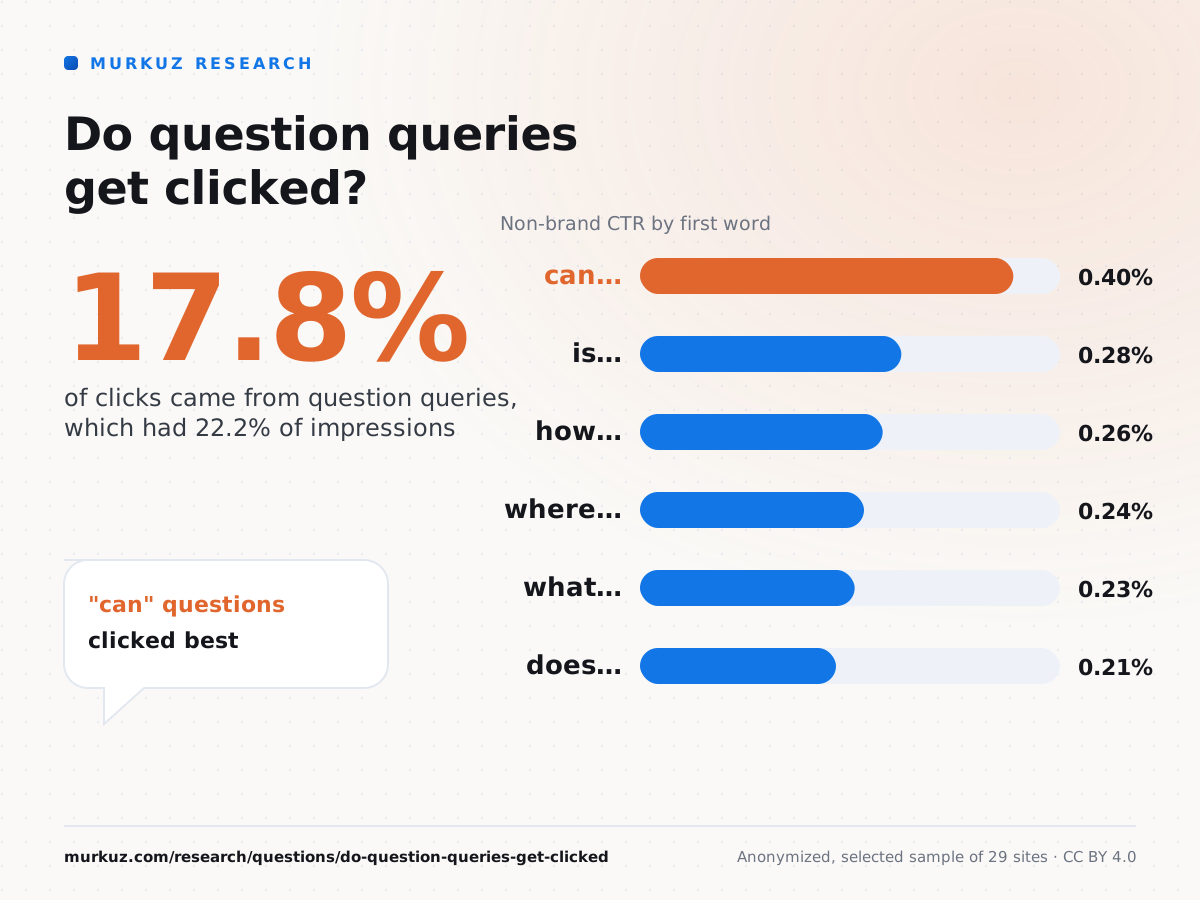
No. Questions, meaning queries that start with a word like how, what, can, is, where or does, made up 22.5% of non-brand queries and 22.2% of impressions over 90 days. They brought 17.8% of clicks.
A question is the easiest kind of search for Google to answer directly, with an AI Overview, a featured snippet or a People Also Ask box. So questions are a reliable way to be seen and a less reliable way to get visits.
Question queries as a share of non-brand queries, impressions and clicks
Which question words click best?
"can" questions had the highest CTR at 0.40% (405 queries on 12 sites). They tend to ask about a specific capability, such as whether a tool can do a job, and the answer often needs a visit to check.
"how" questions were by far the most common, 3,599 queries on 17 sites, at 0.26%. "what" questions clicked at 0.23%, and "does" questions were lowest at 0.21%. Definitions and yes-or-no facts are the easiest for the results page to settle.
Non-brand CTR by the query's first word
Do longer queries click more?
Not in a straight line. Non-brand CTR was 0.26% for one-word queries, rose to 0.38% at 4 words, then fell to 0.24% at 5 to 6 words.
Queries of 7 words or more are the odd group. They had the best average position of any length, 8.9, yet a CTR of only 0.30%. Long, specific searches are where a small site ranks well, and they are also where Google can answer from a single paragraph.
Non-brand CTR by query length
What to do about it
Answer the question in the first two lines
If Google is going to quote someone, make it you. A plain one or two sentence answer under the heading is what AI Overviews and featured snippets pick up.
Give a reason to click after the answer
Follow the short answer with what the results page cannot show: a worked example, a template, a calculator, a screenshot of the real setting.
Question section patternH2: [the question, in the searcher's words] Line 1-2: the direct answer, with a number or a clear yes/no Then: the worked example or steps Then: a template, checklist or tool the reader can use Close: link to the page that does the jobFavour "can" and capability questions on product pages
"can" questions clicked best in our data. Questions about whether something can be done map naturally to feature and integration pages.
Mark up your questions
Add FAQ structured data for the questions a page already answers in full, so the structure is clear to every engine and assistant.
Check this on your own site
Murkuz connects Google Search Console, GA4 and Bing Webmaster Tools to Claude or ChatGPT, so you can ask the same questions about every site you run and get answers from your real rows. Paste any of these into the chat:
List my non-brand queries that start with how, what, can or does, with clicks and CTR for the last 90 days.Which of my 7+ word queries rank in the top 10 but got no clicks?Group my question queries by the page that ranks for them.
- FAQ Schema GeneratorTurn the questions a page answers into valid FAQPage markup.
- SEO and GEO AnalyzerCheck whether your answers are easy for AI search to cite.
- Keyword Clustering ToolCluster question queries into sections and pages.
- Every MCP toolThe full list of questions the connector can answer, with what each one reads.
More free utilities on the tools page.
Methodology
We selected 29 sites for this analysis. Selection criteria: small and mid-sized software, SaaS, review and content sites with Google Search Console data for the whole study window. Their data is anonymized.
Non-brand Google Search Console query rows (web search) for the 90 days to 22 October 2026. A question query starts with a question word (how, what, why, can, is, where, does and similar). CTR is pooled: clicks divided by impressions in the group.
Query length is the number of words in the query. Average position is impression-weighted. Groups by question word are shown only when the word appears on at least 5 sites.
These are pooled across the sites with query data, which is why they differ slightly from the question-query CTR by position in our CTR by position study.
Sites are never named or described in a way that identifies them. We only publish a comparison when each group holds at least five sites. Data snapshot: 22 October 2026.
| Finding | Sites |
|---|---|
| Queries starting with "how" | 17 |
| Queries starting with "what" | 17 |
| Queries starting with "can" | 12 |
| Queries starting with "is" | 12 |
| Queries starting with "where" | 11 |
| Queries starting with "does" | 11 |
| CTR by query length | 21 to 23 per length band |
You can reuse the numbers, charts and infographic under CC BY 4.0: credit Murkuz and link to this page. Spotted an error? Email [email protected] and we will correct it and note the change.
Frequently asked questions
Do question keywords get clicks?
Fewer than their share of impressions. In our data, question queries had 22.2% of non-brand impressions and 17.8% of clicks.
Which question words get the highest CTR?
"can" questions did best in our data, at 0.40%. "how" questions clicked at 0.26% and "what" at 0.23%.
Do long-tail keywords have a higher CTR?
Up to a point. Non-brand CTR peaked at 4 words (0.38%). Queries of 7 or more words ranked best, at an average position of 8.9, but clicked at 0.30%.
Should I still target question keywords?
Yes, for visibility and to be the source AI answers cite. Measure those pages by impressions and position, and give the reader a reason to click beyond the answer itself.

About the author
Junaid K., SEO Specialist
I run SEO for 14 sites across eight products: 3,600+ published articles, 50M+ organic search impressions, and organic search as the first growth channel for every launch. Day to day that means Search Console and GA4 analysis, keyword and SERP research, content operations at scale, and catching ranking decay before it costs traffic. These articles are the notes from that work.