Where do people see these sites, mobile or desktop?
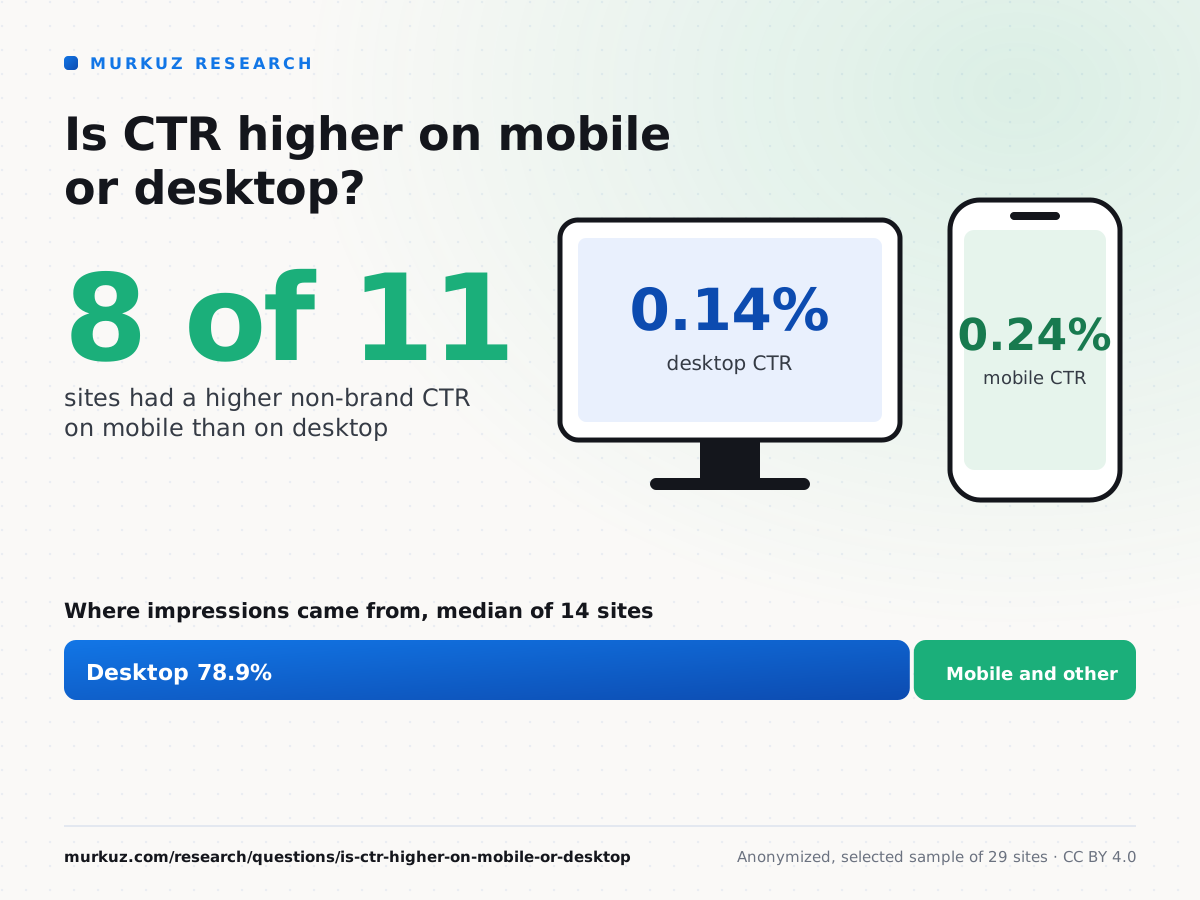
Mostly on desktop. On the median site, 78.9% of Google impressions came from desktop searches (middle half of sites: 71.3% to 82.8%).
That runs against the usual line that most search is mobile. It holds for search as a whole, but each site's own audience sets its split, and audiences that search from a work computer lean desktop. Check your own split before you assume the global number applies.
Desktop share of Google impressions
Which device clicks more often?
Mobile. The median site's non-brand CTR was 0.24% on mobile against 0.14% on desktop, about 1.7 times as high. Mobile was ahead on 8 of the 11 sites we could measure.
A likely reason: desktop impressions are counted for results far down a long page that nobody scrolls to, while a mobile searcher sees fewer results and taps one of them. So the low desktop CTR is partly a counting effect, and comparing the two side by side is more useful than either number alone.
Median non-brand CTR by device
What to do about it
Check your device split before choosing a design priority
If most of your impressions come from desktop, design the page for a wide screen first and make sure mobile still works well.
Device split checkSearch Console > Performance > Devices, last 3 months Desktop share of impressions = desktop impressions / total impressions Then filter Queries to exclude your brand and compare CTR by deviceCompare CTR within one device
Mixing devices hides changes. When you test a new title, compare desktop before with desktop after, and mobile with mobile.
Keep the mobile snippet short and specific
Mobile searchers click more often, and they see less of each title. Put the answer or the offer in the first 50 characters.
Check this on your own site
Murkuz connects Google Search Console, GA4 and Bing Webmaster Tools to Claude or ChatGPT, so you can ask the same questions about every site you run and get answers from your real rows. Paste any of these into the chat:
What share of my impressions came from desktop in the last 90 days?Compare my non-brand CTR on mobile and desktop by month.Which pages have a much lower CTR on desktop than on mobile?
- Meta Description GeneratorWrite snippets that work on small screens.
- Google Search Console MCPAsk for CTR by device, page and query.
- Murkuz MCP toolsCompare every site you run by device in one answer.
- Every MCP toolThe full list of questions the connector can answer, with what each one reads.
More free utilities on the tools page.
Methodology
We selected 29 sites for this analysis. Selection criteria: small and mid-sized software, SaaS, review and content sites with Google Search Console data for the whole study window. Their data is anonymized.
Google Search Console data (web search) split by device, for the 90 days to 22 October 2026. Desktop share is each site's desktop impressions divided by its total impressions. We report the median site and the middle half of sites.
CTR is each site's non-brand clicks divided by its non-brand impressions on that device. Brand queries (those containing the site's name) are left out, since they click at a far higher rate. Only sites with enough clicks on both devices are included.
These are per-site medians, which is why they differ from the pooled device figures in our CTR by position study.
Sites are never named or described in a way that identifies them. We only publish a comparison when each group holds at least five sites. Data snapshot: 22 October 2026.
| Finding | Sites |
|---|---|
| Desktop share of impressions | 14 |
| Non-brand CTR by device | 11 |
You can reuse the numbers, charts and infographic under CC BY 4.0: credit Murkuz and link to this page. Spotted an error? Email [email protected] and we will correct it and note the change.
Frequently asked questions
Is CTR higher on mobile or desktop?
In our data, mobile. The median site's non-brand CTR was 0.24% on mobile and 0.14% on desktop, and mobile was higher on 8 of 11 sites.
Why is my desktop CTR so low?
Desktop results pages are long and every result on the page counts as an impression, including ones nobody scrolls to. That inflates desktop impressions and lowers desktop CTR.
Is most search traffic mobile?
For search as a whole, yes. For the sites in our study, no: desktop had 78.9% of impressions on the median site. Business and software audiences often search from work computers.
Should I optimize for mobile or desktop first?
Look at your own device split in Search Console. Optimize the layout for the device with most impressions, and the snippet for the device with the higher CTR.

About the author
Junaid K., SEO Specialist
I run SEO for 14 sites across eight products: 3,600+ published articles, 50M+ organic search impressions, and organic search as the first growth channel for every launch. Day to day that means Search Console and GA4 analysis, keyword and SERP research, content operations at scale, and catching ranking decay before it costs traffic. These articles are the notes from that work.