Most B2B SEO strategy advice is a repackaged version of the same B2C playbook: pick a keyword, write a blog post, build some links. That approach breaks down fast in B2B, because the thing you are actually optimizing for is not a single click, it is a buying committee that can take months to reach a decision, with several people searching independently before anyone signs anything.
A working b2b seo strategy has to be built around that reality from the start: multiple stakeholders, long consideration windows, and content that has to hold up months after it was written because the sales cycle it supports has not closed yet. Here is a practical framework for doing that, plus where most B2B content programs quietly go wrong.
Why B2B SEO Behaves Differently Than B2C
There is no separate "B2B algorithm." Google ranks a B2B page with the same signals it uses for anything else: relevance, structure, authority, user experience. What is different is the market you are optimizing for, and that changes almost every practical decision you make.
Three structural differences matter most:
Lower search volume, higher stakes per query. A niche B2B category might have a few hundred monthly searches for its most important commercial terms, versus the tens of thousands a consumer category gets. That is fine. A keyword with 90 searches a month that matches real buying intent can outperform one with 9,000 searches that does not, because the buyer behind it is worth far more.
A real buying committee, not one visitor. Research consistently shows B2B purchases involve multiple stakeholders, not a single decision-maker clicking "buy." A technical lead searches for integration and security details. An economic buyer searches for pricing and ROI. An end user searches for how the tool actually works day to day. Procurement searches for compliance and vendor comparisons. Your content has to answer all of those searches, because losing any one stakeholder can stall the whole deal.
Content has a long shelf life, for better and worse. A B2B blog post published in January might still be the exact page a prospect reads during a demo scheduled in September. That is an asset if the page stays accurate. It is a liability if it quietly goes stale (an old pricing figure, a feature that shipped since, a competitor comparison that is no longer true) and nobody notices until a prospect points it out on a sales call.
Map Your Keywords to the Buying Committee, Not Just the Funnel
Standard funnel thinking (top, middle, bottom) is a reasonable starting point, but it misses who is actually searching. In B2B, the more useful lens is which stakeholder a keyword speaks to, because that determines both the content format and how close that search is to a closed deal.
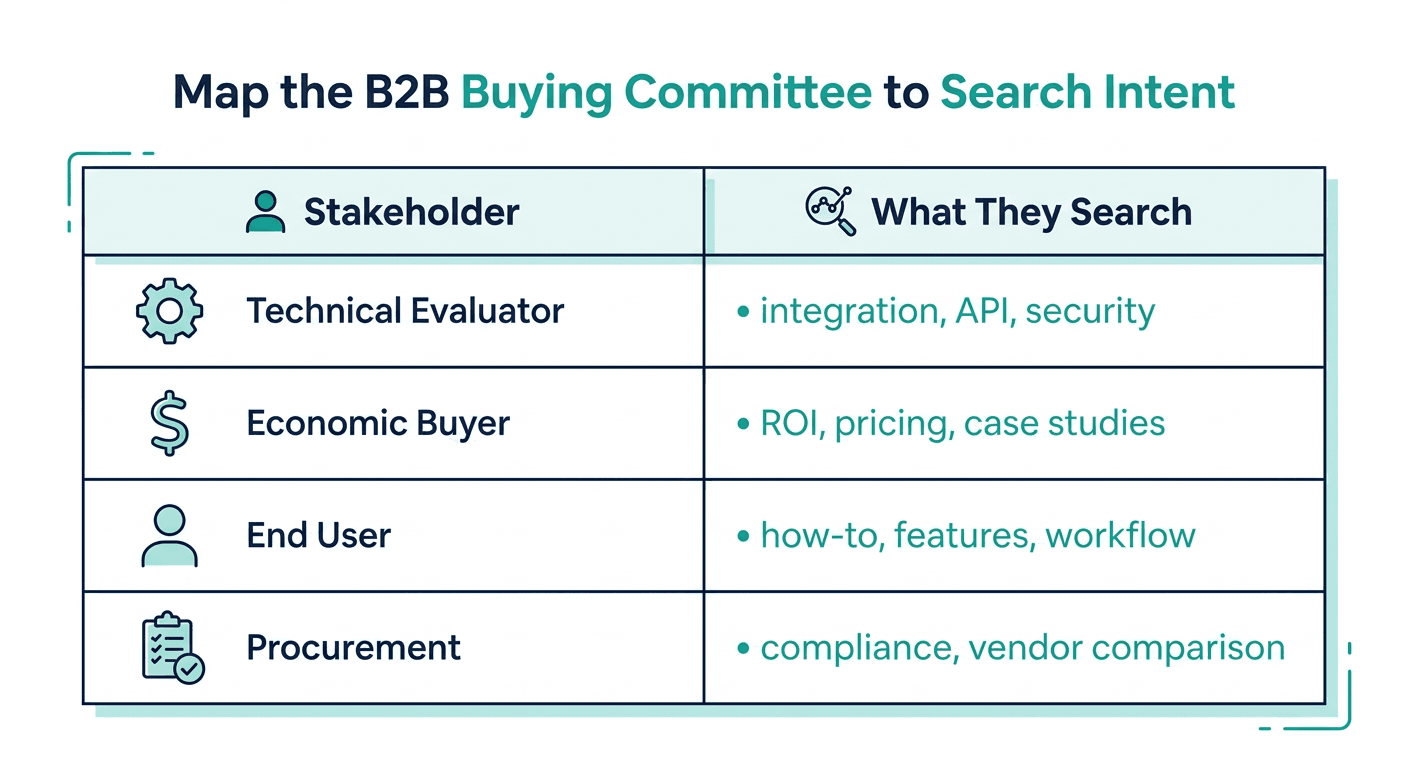
| Stakeholder | What they search | Content that answers it |
|---|---|---|
| Technical evaluator | Integrations, API docs, security, "[category] for [tech stack]" | Integration pages, technical documentation, security/compliance pages |
| Economic buyer | ROI, pricing, "[category] cost," case studies | Pricing page, ROI calculators, customer proof, comparison pages |
| End user | "How to [task]," feature walkthroughs, workflow guides | How-to guides, feature pages, in-app help content |
| Procurement / legal | Compliance, vendor comparison, "[competitor] alternatives" | Comparison pages, security/compliance documentation, vendor FAQs |
The practical takeaway: a single "B2B SEO content calendar" that only produces top-of-funnel blog posts is missing at least three of these four audiences. Before you write anything new, check whether you have at least one solid page each stakeholder could land on and get what they need.
<mark class="km-highlight" style="--hl:#FEF08A;background:#FEF08A">The keyword with the lowest volume in your list is often the one closest to a signed contract</mark>, because it is the exact phrase a procurement officer or technical evaluator types when they are actively vetting a vendor, not browsing.
Build Bottom-of-Funnel Pages First, Even Though They Have the Smallest Volume
This is the part B2B teams most often get backwards. Volume-first content calendars chase the biggest number in the keyword tool, which is almost always a broad, top-of-funnel term. But the pages that move a deal forward are usually the smallest-volume ones on your list:
- Named competitor comparisons ("[you] vs [competitor]"). Low volume, extremely high intent. Someone searching this has already shortlisted you.
- Alternatives pages ("[competitor] alternatives"). The person searching this has decided to switch vendors and is choosing between options right now.
- Integration and use-case pages ("[category] for [specific role or stack]"). These match a technical evaluator's exact question, and they rank more easily than a broad category term because fewer competitors bother writing them well.
Write these pages honestly. A comparison page that will not name a real tradeoff reads as marketing copy, and buyers doing due diligence notice immediately. Naming where a competitor genuinely fits better builds more trust, and trust is the actual currency in a considered B2B purchase.
Build Topical Authority, Not a Scattered Content Library
Search engines increasingly evaluate whether your whole site demonstrates real depth in the areas you want to rank for, not just whether any single page is well written. A site with twelve deep, connected pages on one subject tends to outperform a site with fifty shallow pages on unrelated topics, even if the shallow-page site technically has "more content."
In practice this means:
- Pick four to six pillar topics that map to your actual product categories, not generic industry buzzwords.
- Under each pillar, build out the full stakeholder map above (technical, economic, end-user, procurement angles) as its own set of pages.
- Link every supporting page up to its pillar and sideways to the pages for adjacent stakeholders, so a technical evaluator's page can point a reader toward the ROI page an economic buyer needs.
- Resist the urge to publish outside those pillars just because a keyword tool surfaced a high-volume term. A B2B site with narrow, deep authority in its actual category beats a broad site that never goes deep on anything a buyer cares about.
Maintain What You Already Publish (This Is Where Most B2B Programs Fail)
A B2B page can rank well for a year and still be actively hurting you, because nobody checks it after publishing. The pricing figure is out of date. The feature comparison no longer reflects what either company ships. The case study is from a customer who churned. None of that shows up in a traffic graph, because the page can keep ranking and keep getting clicks while quietly losing every deal it touches.
A simple maintenance cadence closes this gap:
- Quarterly, for anything a technical evaluator or procurement officer would read. Security pages, integration docs, and compliance pages change fast enough that a stale one is actively risky.
- Every six months, for comparison and pricing content. Competitors change their offers, your own pricing moves, and a comparison page that has not been checked in a year is a liability during due diligence.
- On every product change, for the pages that mention the affected feature. If sales or product tells you a feature shipped or changed, the pages describing it should update in the same week, not the next content sprint.
This is exactly the operational gap Murkuz is built to close. It scans your Search Console data to catch pages that are losing rankings or have quietly gone stale, generates the fix in your brand voice instead of a generic rewrite, and then proves whether that specific fix actually caused the ranking to recover, so a marketing team juggling dozens of B2B pages across multiple stakeholders is not relying on someone remembering to check the pricing page every quarter.
Measure Pipeline, Not Sessions
The biggest reporting mistake in B2B SEO is measuring the same way a content site would: sessions, pageviews, average time on page. None of that tells a CFO or a CMO whether SEO is contributing to revenue, and in a long sales cycle, the gap between "someone read the article" and "the deal closed" can be six months wide.
A workable measurement approach for B2B:
- Track by landing page, not just by channel. Which specific pages are the ones prospects visited before becoming a qualified lead or a closed deal? Attribution here will never be perfect in a multi-touch B2B journey, but landing-page-level tracking gets you far closer than channel-level reporting alone.
- Report in the terms your stakeholders already use. "This page influenced eleven pipeline opportunities this quarter" survives a board conversation. "Organic traffic is up 18 percent" does not, because it does not answer the only question that matters to revenue leadership.
- Treat the workflow as ongoing, not a one-time project. Detect what is declining, fix it, confirm the fix actually moved the ranking or the pipeline number, and repeat. A B2B content library is a maintained asset, not a stack of posts you publish once and never revisit.
If you are building this reporting muscle for the first time, start narrow: pick your five highest-intent pages (the comparison and pricing pages closest to revenue), track them at the landing-page level for one quarter, and use that as the proof point before you try to instrument the entire site.
A Simple B2B SEO Rollout Order
If you are starting from nothing, this is the order that gets results fastest without needing a large team:
- Audit existing pages ranking in positions 11 to 20. These are usually one solid refresh away from page one and faster than starting from scratch.
- Fill the stakeholder gaps in your current content: identify which of the four stakeholder types (technical, economic, end user, procurement) has no dedicated page yet.
- Write the highest-intent, lowest-volume pages first: named comparisons, alternatives pages, and integration pages.
- Set a maintenance calendar for anything already published, on the cadence above.
- Instrument landing-page-level reporting before your next stakeholder review, so the conversation is about pipeline, not sessions.
None of this requires a large budget. It requires treating B2B content the way you would treat any other pipeline-generating system: mapped to the actual buyers, prioritized by intent rather than volume, and maintained rather than published once and forgotten.
If most of your buying committee also happens to be evaluating you as a software vendor rather than a services firm, pair this framework with a saas-seo-strategy approach: the buying-committee mapping here still applies, but you will also want the SaaS-specific keyword tiers and product-data content sources covered there.
FAQ
What is a B2B SEO strategy?
A B2B SEO strategy is an approach to search engine optimization built around how business buyers actually research and purchase software or services: multiple stakeholders searching independently, longer consideration windows, and keywords that map to a buying committee rather than a single consumer. The core mechanics (keyword research, on-page optimization, content, links) are the same as any SEO strategy; what changes is prioritization and measurement.
How is B2B SEO different from B2C SEO?
B2C SEO usually optimizes for a single buyer making a relatively fast decision, often measured in a single purchase event. B2B SEO has to account for multiple stakeholders (technical, economic, end user, procurement) searching at different points in a sales cycle that can run for months, and it has to measure success in pipeline and closed revenue rather than sessions, because the "conversion" rarely happens on the page that ranked.
What are the best keywords to target for B2B SEO?
Start with the lowest-volume, highest-intent terms: named competitor comparisons, "[competitor] alternatives," and integration or use-case pages that match a specific technical evaluator's question. These convert at a much higher rate than broad, top-of-funnel terms, even though they show smaller search volume in a keyword tool.
How long does B2B SEO take to show results?
Because B2B sales cycles are long and search volume is lower, B2B SEO typically takes longer to show measurable pipeline impact than B2C or ecommerce SEO, often several months of consistent publishing and maintenance before results are clearly attributable. Bottom-of-funnel pages (comparisons, alternatives) tend to show impact faster than broad educational content because they intercept buyers closer to a decision.
Do you need technical SEO for B2B, or is content enough?
You need both. Content that ignores technical fundamentals (site speed, clean site structure, correct internal linking, mobile experience) will underperform even if it is well written, because buyers and search engines both expect a fast, well-structured site. Technical SEO without content that answers the buying committee's real questions will not generate pipeline on its own either.
How do you measure ROI from B2B SEO?
Track performance at the landing-page level rather than by channel alone, and report in pipeline or revenue terms your stakeholders already use, not sessions or pageviews. Start with your highest-intent pages (comparisons, pricing, alternatives) since they sit closest to a buying decision, and use that as your initial proof point before instrumenting the full site.
Junaid Khalid is the founder of Ertiqah, the company behind Murkuz. He has run SEO as the first growth channel across his own SaaS products, from mapping keywords to a buying committee to proving which fix actually moved a ranking.