Most affiliate SEO advice stops at "write good content and get backlinks." That is true and also useless if you already run a site with 50, 200, or 800 monied pages. The hard part of affiliate SEO is not writing the first review. It is keeping hundreds of them ranked, useful, and above the fold while Google reshuffles the results every few weeks and your competitors update their own posts.
This guide covers both halves: how to build an affiliate page that can rank in the first place, and how to run the ongoing maintenance loop that most guides skip entirely, because that second half is where the actual revenue either survives or quietly leaks away.
What makes affiliate SEO different from regular content SEO
Affiliate sites live and die on commercial and transactional intent. A blog chasing informational traffic can tolerate a page slipping from position 3 to position 7 with barely a dent in pageviews, because the value was always the ad impression or the email signup, not the click-through. An affiliate roundup does not get that grace. Position 2 to position 5 on a buyer's-intent keyword can cut clicks by more than half, and every one of those lost clicks was a person one tap away from your affiliate link.
Three things follow from that:
- Keyword selection has to skew bottom-of-funnel. "Best [product] for [use case]," "[Product A] vs [Product B]," and "[product] discount code" convert far better than "what is [product category]," even when the funnel-top term has ten times the search volume.
- Content quality is judged against a stricter bar. Google's product review and helpful content systems specifically target thin affiliate pages that reword a spec sheet and swap in an affiliate link. Since the 2021-2024 product review update rollouts, sites that publish surface-level "top 10" posts without hands-on testing or comparative detail have been some of the most visibly hit in ranking volatility reports.
- Decay is more expensive than on other site types. A dropped ranking on a commercial page is lost revenue every single day it sits unfixed, not just lost traffic. That is the gap this guide spends the most time on, because it is the gap the rest of the affiliate SEO content out there barely touches.
Step 1: Build keyword tiers around buyer intent, not just volume
Group every keyword you are targeting into three tiers before you write anything. This single step prevents the most common affiliate SEO mistake: burning your best writing on high-volume, low-intent terms that will never convert.
| Tier | Example query pattern | Search intent | Content type |
|---|---|---|---|
| Tier 1: Ready to buy | "best [product] 2026," "[product] vs [product]," "[product] discount" | Transactional | Roundup, comparison, review |
| Tier 2: Comparing options | "[product] alternatives," "is [product] worth it," "[product] pros and cons" | Commercial investigation | Deep single-product review, alternatives page |
| Tier 3: Still learning | "what is [category]," "how does [category] work" | Informational | Educational guide, glossary-style explainer |
Tier 1 and Tier 2 pages carry your affiliate links and deserve your deepest research, your own testing notes, and your fastest maintenance attention. Tier 3 content exists to build topical authority and internal-link equity into Tier 1 and Tier 2, not to carry commissions directly. If you only have bandwidth for one kind of page, it should always be Tier 1.
Keyword difficulty matters here more than most affiliate marketers admit. A term with 500 searches a month and a KD of 15 that you can rank for in 60 days is worth more to a new affiliate site than a term with 5,000 searches and a KD of 60 that will take a year and links you cannot get yet. Cluster your keyword list by topic and prioritize the cluster where you can realistically win a handful of Tier 1 terms within a quarter.
Step 2: Write review content that survives Google's product-review scrutiny
Google has been explicit for several years now that it wants to reward review content written by someone who has actually used the product, not content that repackages a manufacturer's spec sheet. For affiliate sites this is not optional polish, it is the difference between ranking and getting quietly filtered out during the next quality update. Practically, that means every Tier 1 and Tier 2 page needs:
- Evidence of hands-on use. Original photos, screenshots, screen recordings, or specific numbers you measured yourself (load time, battery life, price you actually paid) beat rewritten specs every time.
- Explicit trade-offs, not just praise. A review that only lists pros reads like an ad. State who the product is wrong for as clearly as who it is right for.
- Comparative context. Mention what else you tested or considered and why this pick won. A single-product review with zero comparison signals thin research to both readers and Google's classifiers.
- A visible author with real expertise. A named author bio with relevant credentials or experience in the niche is one of the simplest E-E-A-T signals you can add, and one of the most commonly missing on thin affiliate sites.
- Disclosed affiliate relationships. A short, honest disclosure near the top builds trust rather than costing you it, and it is required by the FTC in the US regardless of SEO impact.
None of this requires a huge production budget. A $40 product you bought and photographed yourself in your own kitchen outperforms a stock photo pulled from Amazon, both for conversion rate and for how Google's systems read the page.
Step 3: Structure and interlink your site like a topical authority, not a pile of posts
Affiliate sites that rank durably tend to share one structural trait: every review, comparison, and buying guide links to related pages in the same niche, and a handful of pillar pages tie the cluster together. This is the same topic-cluster logic that works for any content site, applied to a catalog of products instead of a catalog of ideas.
A simple structure that works at almost any scale:
- A category pillar page ("Best Standing Desks," "Best Project Management Software") that is a curated roundup linking out to every individual review in that category.
- Individual product reviews that link back up to the pillar and sideways to 2-3 close competitors ("if you're also considering X, read our comparison").
- Comparison pages ("Product A vs Product B") that link to both individual reviews and up to the category pillar.
- Supporting informational content (buying guides, "how to choose," glossary-style explainers) that links down into the commercial pages without carrying affiliate links itself.
This does two things. It spreads authority from your highest-traffic pillar pages down into new reviews so they rank faster, and it keeps a reader who lands on any one page inside your site instead of bouncing back to the search results after one click.
Step 4: Technical basics that matter more for affiliate sites specifically
Standard technical SEO applies (site speed, mobile usability, clean URLs, indexability), but two items deserve extra attention on affiliate sites because of how these sites are built and monetized:
- Redirect and cloak affiliate links properly. Route outbound affiliate links through a
/go/or/recommends/redirect path and mark themrel="sponsored"ornofollowper Google's guidance on paid links. This keeps your outbound link profile clean and makes broken or changed affiliate URLs a one-place fix instead of a site-wide find-and-replace. - Watch page speed on comparison tables and image-heavy reviews. Affiliate pages tend to be the most image- and script-heavy pages on a site (comparison tables, price widgets, multiple product photos), which makes them the most likely to fail Core Web Vitals. A slow-loading comparison table costs you both rankings and the conversions the table was built to drive.
The part most affiliate SEO guides skip: keeping pages ranked
Here is the uncomfortable truth about affiliate SEO: getting a page to position 3 is only half the job. Prices change, products get discontinued, competitors publish a better comparison, and Google reruns its quality systems on a cadence you do not control. A page that was excellent the day you published it can be stale within two quarters, and a stale affiliate page does not just lose traffic, it loses revenue from the moment the ranking slips until someone notices and fixes it.
Most affiliate marketers running 50 or more monetized pages find out about a ranking drop the same way: they notice the commission report looks light for a month, and the manual audit that follows takes hours to pinpoint which page and which changing detail (a lower price, a delisted product, a stale "as of 2024" line) caused it.
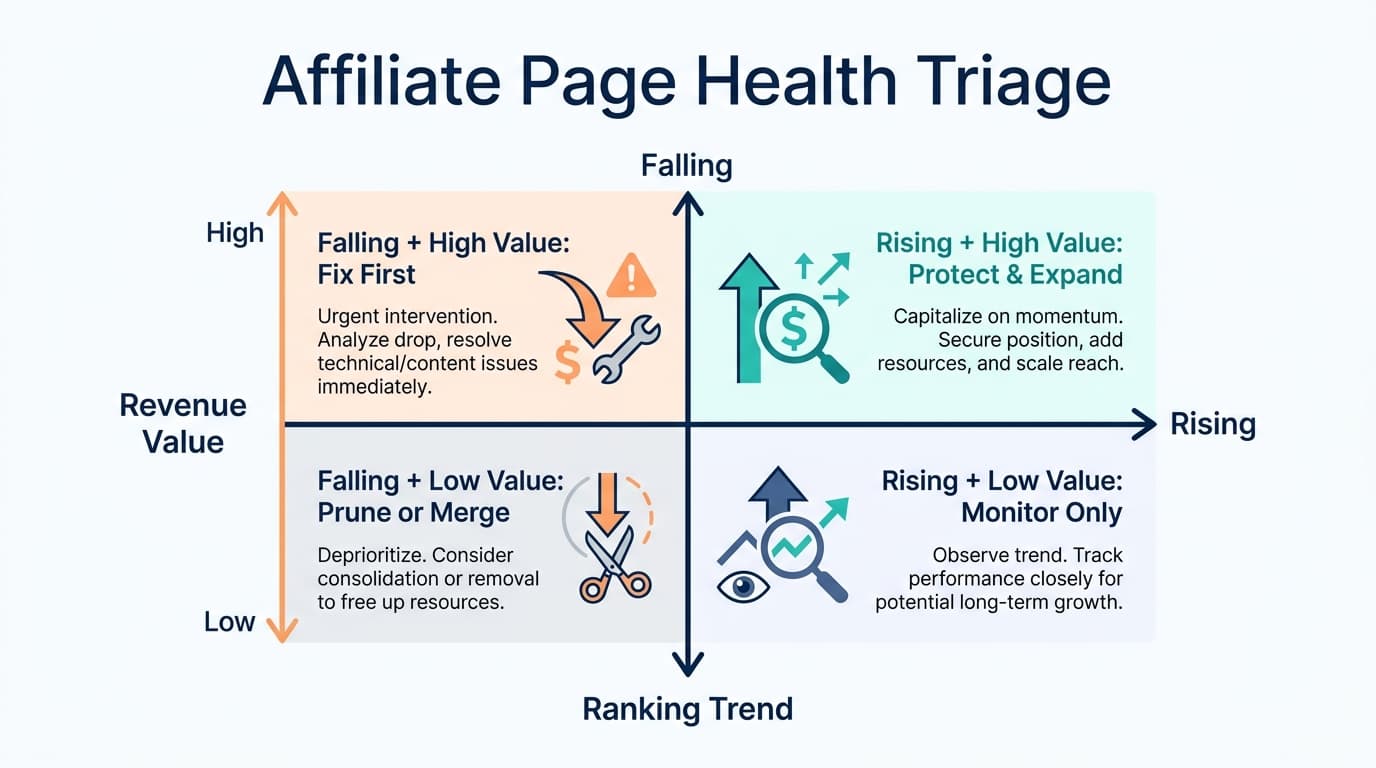
The triage above is the mental model worth running monthly, if not automatically: cross your page's revenue value against its ranking trend. A high-earning page that starts falling is the fire to put out first, not the low-earning page that has been flat for a year. Sorting your maintenance queue this way, instead of by "whatever I remember to check," is what separates affiliate sites that keep compounding from ones that quietly bleed out one dropped position at a time.
This is exactly the gap <mark class="km-highlight" style="--hl:#FEF08A;background:#FEF08A">Murkuz</mark> was built to close for sites with a large page count and real revenue on the line. It connects to Google Search Console, scans every page across every property daily, and flags a ranking drop like position 2 to 5 the same week it happens rather than the month a commission report reveals it. When it finds a decaying page, it drafts the content refresh, and a one-click approval pushes the fix straight to WordPress without you touching a spreadsheet or a CMS plugin. If you manage a portfolio of affiliate sites, Murkuz's tools for affiliate marketers are built around exactly this problem: catching the drop before a competitor's fresher comparison consolidates the position, and then proving with real position data which fix actually recovered the ranking.
A simple monthly maintenance checklist
Whether or not you automate it, this is the minimum cadence that keeps an affiliate site's rankings from decaying silently:
- Check Search Console for position drops on your top 20 revenue pages. Anything that fell more than 3 positions in the last 30 days goes to the top of the queue.
- Verify prices, availability, and discontinued products on every comparison table and roundup. A "best" list recommending a product that no longer exists is one of the fastest ways to lose both rankings and trust.
- Refresh the publish or updated date only when you have actually changed something meaningful. A cosmetic date bump with no real update is easy for both readers and Google's systems to spot.
- Re-check your internal links for reviews of products you have since stopped recommending, and update pillar pages when a new review should be added to the roundup.
- Scan for cannibalization between an older single-product review and a newer comparison page targeting an overlapping keyword, and consolidate if two of your own pages are competing for the same result.
FAQ
Is SEO still worth it for affiliate marketing in 2026?
Yes. Organic search remains one of the few channels where a page keeps earning without an ongoing ad spend, and buyer-intent keywords ("best X," "X vs Y") convert at high rates precisely because the searcher is already close to a purchase decision. The bar for ranking has risen, particularly for thin content, but that raises the ceiling for sites willing to do real product testing rather than lowering the value of ranking well.
How long does it take to rank a new affiliate site?
Most niche affiliate sites need three to six months before their first pages reach page one for low-competition, long-tail terms, and six to twelve months before higher-volume commercial terms become realistic. Sites that start with tightly clustered Tier 1 and Tier 2 keywords and genuine hands-on content tend to see traction earlier than sites that spread thin across broad, competitive terms from day one.
Are affiliate links bad for SEO?
No. Affiliate links themselves are not a ranking penalty as long as they carry the appropriate rel="sponsored" or rel="nofollow" attribute and the page provides real value beyond just hosting links. What actually gets penalized is thin content built solely to house affiliate links with no original insight, testing, or comparative value for the reader.
What is the biggest SEO mistake affiliate marketers make?
Publishing a large volume of thin "top 10" roundups without ever returning to update them. A site that publishes 200 shallow pages and never revisits them will lose ground to a site with 40 well-maintained, regularly refreshed pages, because Google's quality systems and readers both reward pages that stay accurate over time.
If you are building or already running an affiliate site, the highest-leverage habit you can adopt is treating rankings as something to actively protect, not something you set once and check on when revenue looks off. Pair that with the SEO for bloggers fundamentals if your affiliate content lives on a blog-style site, and revisit your maintenance queue on a real schedule rather than a gut-feel one.
Junaid Khalid is the founder of Ertiqah and the builder of Murkuz. He has run SEO as the first growth channel across his own SaaS products and built Murkuz specifically to close the gap between finding a ranking problem and proving it got fixed.