You do not need another explanation of what a low-competition keyword is. You need actual keywords to write about today. Below are 50 real keyword ideas, grouped into 10 niches, picked because the phrasing is specific enough that big publishers tend to skip it and the pages ranking for it are often forum threads, thin blog posts, or pages that half-answer the question. We also ran all 50 through a keyword tool in October 2026 and printed the numbers under the list, so you can see which ideas carry measurable search volume and which do not. Use the list as a starting point, not gospel: verify every one before you commit a writing day to it, using the two-minute check in the section right after.
Why These Ideas Work for a New Site
A keyword earns a spot on this list for one of three reasons: the phrase is specific enough that big publishers ignore it in favor of broader head terms, the current top results are visibly weak (old forum posts, listicles with no depth, pages targeting a slightly different intent), or the topic is niche enough that authority does not decide the outcome, genuine usefulness does. None of that guarantees a first-page ranking. Search results shift, and a keyword that was wide open last quarter can fill in fast once a few sites notice the same gap. Treat this as a curated seed list to verify, cluster, and prioritize, the same way you would treat any keyword tool's export.
The 50 Keyword Ideas, by Niche
SEO and Content Marketing
- how to find low competition keywords
- keyword cannibalization checklist
- content pruning checklist for SEO
- how to write meta descriptions that get clicks
- internal linking strategy for blogs
Personal Finance
- budgeting apps for irregular income
- how to negotiate medical bills
- best high-yield savings accounts for students
- side hustle tax deductions checklist
- how to build credit with no credit history
Health and Wellness (Non-Medical Advice)
- best stretches for desk workers
- how to build a home workout with no equipment
- sleep hygiene checklist for shift workers
- hydration tracker for beginners
- how to meal prep for one person
Remote Work and Productivity
- best noise cancelling headphones for open offices
- how to structure a 4-day work week
- async communication tools for remote teams
- home office setup checklist for small apartments
- how to avoid burnout working from home
Small Business Operations
- invoice templates for freelancers
- how to price a service business
- small business accounting software comparison
- client onboarding checklist template
- how to write a scope of work document
Pet Care
- best dog breeds for apartments
- how to introduce a new cat to a household
- homemade dog treat recipes vet approved
- puppy training schedule week by week
- signs of anxiety in dogs checklist
Home and DIY
- how to soundproof a bedroom on a budget
- best plants for low light apartments
- small kitchen organization ideas
- how to fix a running toilet yourself
- capsule wardrobe checklist for minimalists
Career and Job Search
- how to answer why did you leave your last job
- resignation letter template no notice
- how to negotiate a remote work arrangement
- career change at 30 checklist
- how to ask for a raise script
Travel Planning
- how to pack a carry-on for a week
- best travel apps for solo trips
- budget travel destinations for families
- how to find cheap flights without a VPN
- packing list for international travel first time
Parenting
- screen time rules by age chart
- how to handle toddler tantrums in public
- best books for reluctant readers age 8
- co-parenting communication apps comparison
- chore chart ideas by age
| Niche | Ideas | Typical intent |
|---|---|---|
| SEO and content marketing | 1-5 | Informational, some commercial |
| Personal finance | 6-10 | Informational, commercial |
| Health and wellness | 11-15 | Informational |
| Remote work and productivity | 16-20 | Informational, commercial |
| Small business operations | 21-25 | Commercial |
| Pet care | 26-30 | Informational |
| Home and DIY | 31-35 | Informational, commercial |
| Career and job search | 36-40 | Informational |
| Travel planning | 41-45 | Informational, commercial |
| Parenting | 46-50 | Informational |
What the numbers said when we checked all 50 (October 2026). We ran every idea through Murkuz's keyword metrics lookup (US, English). Difficulty is on a 0 to 100 scale, where lower is easier. 22 of the 50 returned measurable monthly search volume:
| Keyword idea | US searches per month | Difficulty |
|---|---|---|
| best dog breeds for apartments | 8,100 | 6 |
| invoice templates for freelancers | 1,300 | 4 |
| small kitchen organization ideas | 880 | 25 |
| how to negotiate medical bills | 720 | 4 |
| how to build credit with no credit history | 590 | 14 |
| how to pack a carry-on for a week | 390 | 0 |
| how to find low competition keywords | 140 | 13 |
| small business accounting software comparison | 110 | 38 |
| how to answer why did you leave your last job | 90 | 1 |
| how to meal prep for one person | 70 | 0 |
| client onboarding checklist template | 50 | 0 |
| homemade dog treat recipes vet approved | 50 | 5 |
| best stretches for desk workers | 30 | 23 |
| puppy training schedule week by week | 30 | 6 |
| how to ask for a raise script | 20 | 0 |
| best plants for low light apartments | 10 | 0 |
| chore chart ideas by age | 10 | 47 |
| how to avoid burnout working from home | 10 | 49 |
| how to negotiate a remote work arrangement | 10 | 53 |
| how to price a service business | 10 | 25 |
| how to write a scope of work document | 10 | not reported |
| resignation letter template no notice | 10 | 8 |
Seven ideas clear both bars a new site usually cares about, 100 or more searches a month and a difficulty under 30: best dog breeds for apartments, invoice templates for freelancers, small kitchen organization ideas, how to negotiate medical bills, how to build credit with no credit history, how to pack a carry-on for a week, and how to find low competition keywords. A tool difficulty score is still an estimate. The first one, at 8,100 searches and a difficulty of 6, is exactly the kind of number to check against the live results page before you trust it, because a big kennel club or pet publisher can own that page whatever the score says.
The other 28 ideas returned no measurable US volume, including several that sound popular, such as how to soundproof a bedroom on a budget and best travel apps for solo trips. That does not make them useless. Keyword tools regularly miss long-tail phrasing that Search Console later shows impressions for, so treat those 28 as wording to test against a broader parent topic, not as traffic you can count on. Volumes move month to month, so re-run any idea you shortlist.
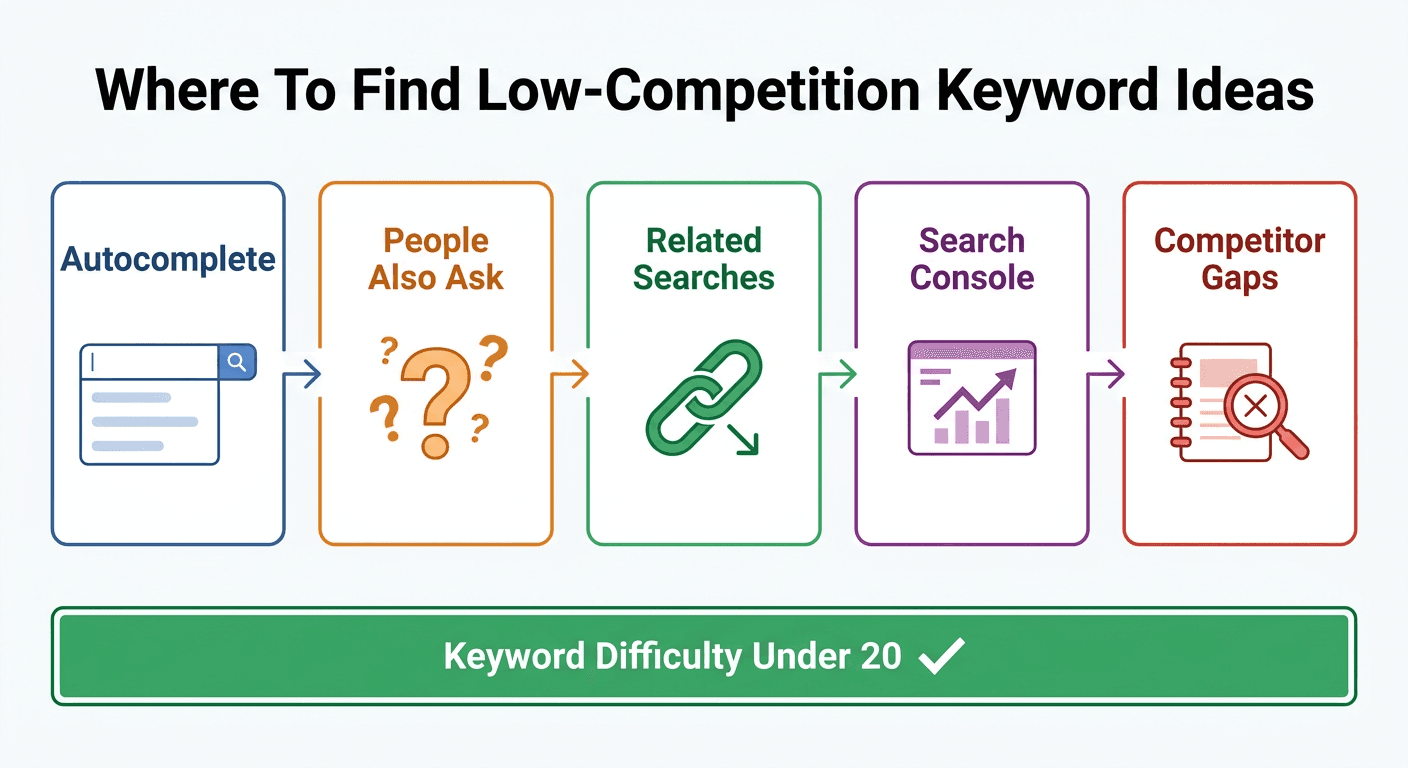
The Two-Minute Verification Check (Do This Before You Write)
A list like this one is a starting point, never a finished decision. Before you commit writing time to any keyword above, or one you found on your own, run this quick check:
- Google the exact phrase. Read the actual top 5 results, not just their titles. Look for forum threads, thin 300-word posts, or content answering a slightly different question. That is your opening.
- Check for a real Keyword Difficulty score. Free checkers (Ahrefs' one-off tool, Ubersuggest's daily lookups) work fine for a single lookup. <mark class="km-highlight" style="--hl:#FEF08A;background:#FEF08A">A KD under roughly 20 to 30</mark> is the practical threshold most practitioners use for a zero-authority site, though the right ceiling shifts slightly by niche.
- Confirm search intent matches what you can write. If the SERP is full of product comparison pages and you are planning an informational post, that mismatch means you will not rank no matter how weak the competition looks.
- Note whether volume is trending up or down. A keyword with 50 searches a month and a rising trend is often a better bet than one with 200 searches a month in steady decline.
For the full method behind this check, including exactly how to build your own list from scratch instead of borrowing someone else's, see our guide on how to find low-competition keywords.
What to Do Once You Have a Shortlist
Verifying keywords one at a time does not scale past a handful of ideas. Once you have narrowed this list (or your own longer export) down to the ones that pass the check above, the next problem is grouping them so you do not accidentally write three separate thin pages for what is really one search intent. Murkuz's free keyword clustering tool takes a pasted list of keywords, one per line, and groups them into clean clusters with a suggested pillar-and-spoke structure, entirely in your browser, no signup required. It is the fastest way to turn a raw list like this one into an actual content calendar instead of 50 disconnected ideas.
Common Mistakes When Working From a Keyword List
- Writing every keyword as its own page. Several ideas above overlap in intent (a budgeting app post and a side-hustle tax post both serve a "getting my finances organized" searcher). Cluster related ones onto a single, deeper page rather than splitting your own authority across near-duplicates.
- Skipping the verification step because the list looks curated. Search results move. A keyword that was wide open when a list was published can fill in within months. Always re-check the live SERP before writing.
- Chasing every niche at once. Picking five niches on this list and writing ten pages in each builds more topical authority than picking two per niche across all ten. Depth in a narrower set of topics beats breadth across all of them, especially in the first few months of a new site.
- Ignoring your own niche fit. A keyword being low-competition does not mean it fits your site. A finance blog writing about dog training will not build the topical authority a Google algorithm rewards, even if the keyword itself is easy.
FAQ
What are low-competition keywords?
Search terms where the current top-ranking pages are weak, thin, outdated, or a poor intent match, giving a genuinely better page a real shot at ranking regardless of the writer's domain authority. Competition is a separate measurement from search volume: a keyword can have real monthly demand and still be low-competition if nobody has answered it well.
How do I find low-competition, high-volume keywords on my own?
Start from People Also Ask boxes, Google Autocomplete, and the related searches module on a broad seed topic, then run every candidate through a Keyword Difficulty checker and a manual read of the actual top 10 results. Tools estimate difficulty; the live SERP is the only real proof.
What is a good example of high demand but low competition?
A specific, narrow phrasing of a broader topic that established sites have not bothered targeting directly, such as a niche use case, a specific audience segment, or a question phrased the way real searchers type it rather than the way a marketer would summarize it. The finance, pet care, and parenting ideas above follow this exact pattern.
Are these 50 keywords guaranteed to rank?
No keyword list guarantees a ranking. When we checked all 50 in October 2026, 22 showed measurable US search volume and 28 did not, and even the strong ones can change, because SERPs shift, and a term that was open last quarter can fill in as other sites notice the same opportunity. Always verify with a live Google search and a difficulty check before committing writing time, using the two-minute process above.
Turn the List Into a Content Plan, Not Just an Afternoon Project
A list of 50 ideas solves today's problem. The harder part is what happens six months in, when half of these keywords have climbed to position 8 instead of position 3, a competitor has noticed the same gap you did, or one of your own pages has quietly started slipping without anyone checking. That ongoing part, watching which pages are gaining ground and which need a second pass, is where most keyword research advice stops. Murkuz was built around exactly that gap: instead of a one-time keyword hunt, it treats your rankings as something to keep monitoring after you publish, so a page that starts sliding gets flagged with a scoped fix, not rediscovered by accident months later when the traffic is already gone. You can see how the full detect-to-prove loop works on the Murkuz features page.
I'm Junaid Khalid, founder of Ertiqah, the team behind Murkuz. I've run SEO as the first growth channel across every SaaS product I've built, and lists like this one are exactly where that process starts: a curated set of ideas, verified one at a time, clustered into a real plan, then tracked so the work compounds instead of evaporating after the first ranking check.