Most advice on finding low-competition keywords quietly assumes you already have a site with some rankings, some tracked history, maybe a Semrush project with a few months of data behind it. That advice is useless if you are starting from zero. This guide is not that. It is the method for finding keywords you can actually rank for when your domain has no authority, no backlinks, and no track record yet, using free tools, a defensible difficulty threshold, and a process you can repeat every time you need new topics.
This exact backlog you are reading right now (this article, the one about SEO workflows, the one about ranking drops) was built using this method. Nothing here is theoretical.
What a Low-Competition Keyword Actually Is
A low-competition keyword is a search term where the current top-ranking pages are weak enough, thin enough, or badly matched enough to search intent that a genuinely better page has a real shot at outranking them, regardless of your site's age or authority.
Notice what is missing from that definition: search volume. Volume tells you how many people search a term. Competition tells you how hard it is to show up when they do. Confusing the two is the single most common mistake in keyword research: chasing a 10,000-searches-a-month term that six established sites with decade-old backlink profiles already own, while ignoring a 140-searches-a-month term nobody has bothered to answer well.
Three signals combine to define "low competition" in practice:
- Keyword Difficulty (KD) below roughly 20. Different tools calculate this differently (some estimate backlinks needed, others estimate ranking-page strength), but a KD under 20 is a broadly reliable signal that you do not need years of authority to compete. This threshold matters enough that people search for it directly, it is one of the most common "how to find low CPC keywords" and difficulty-related questions people ask.
- Weak incumbents. The pages currently ranking are forum threads, thin blog posts, or content that answers a slightly different question than the one being searched. If the top 3 results are a five-year-old forum thread and two 400-word listicles, that is competition you can beat with genuine depth.
- Matched, achievable intent. The keyword's intent (informational, commercial, transactional) fits a page you can realistically write today, not a page that requires product reviews, pricing data, or years of case studies you do not have yet.
Low CPC (cost-per-click) is a useful secondary signal here too: a low CPC often correlates with low commercial competition, since advertisers are not fighting over the term in paid search either. It is not a perfect proxy for organic difficulty, but when KD and CPC are both low, that is a strong double-confirmation.
The 80/20 Rule for Keyword Research
The Pareto principle applies directly to keyword prioritization: roughly 20% of the keywords in any niche will be low-competition enough to rank quickly with a new site, and chasing those first produces the majority of your early traffic and authority gains. The other 80% (the broad, obvious, high-volume terms) are exactly the ones every competitor has already targeted for years. A new site fighting for those terms on day one is fighting the wrong battle.
The practical version: spend your first months of content entirely inside that winnable 20%, bank the rankings and the authority that comes with them, and only then start reaching for the harder, more competitive terms your site could not have won a year earlier. This is not a shortcut around hard work. It is sequencing the hard work so it actually compounds instead of stalling out on page four of Google for six months.
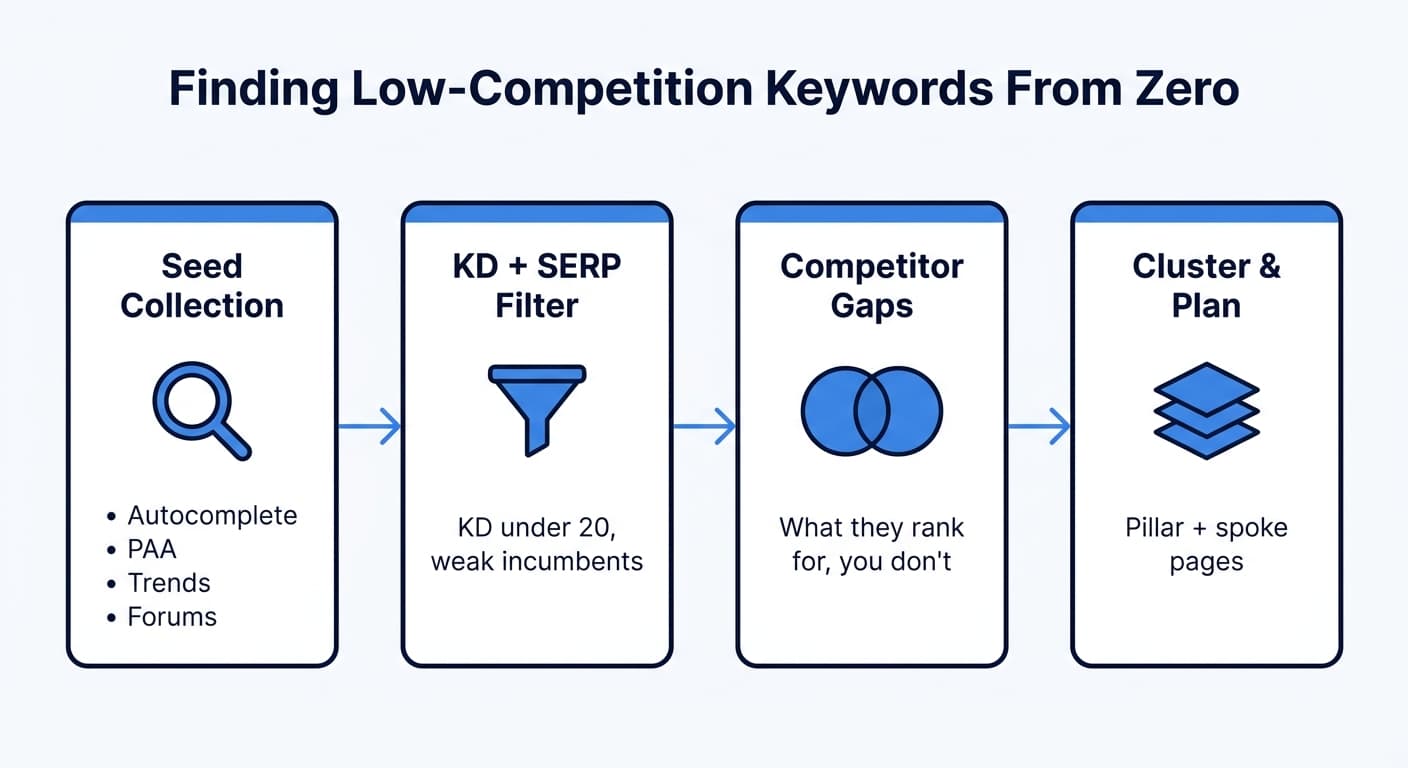
Step 1: Build a Raw Seed List (Free Tools Only)
Before you filter anything, you need volume. A short list filtered too early misses good keywords you never saw. Pull from every source below, and do not pre-judge any term yet; a bigger raw list produces better clusters and better final picks.
- Google Autocomplete. Type your seed topic into Google's search box and note every suggestion. These are real queries real people type, ranked roughly by frequency.
- People Also Ask (PAA). Search your seed term, expand every PAA box that appears, and keep expanding, each expansion reveals more related questions. This is one of the richest free sources of long-tail, low-competition questions, because PAA surfaces the exact phrasing people search, not a guess at it.
- Related searches. The "related searches" module at the bottom of the results page (and "searches related to" further down) surfaces adjacent terms Google already associates with your topic.
- Google Trends. Use the "Related queries" panel on a topic's Trends page to find rising, specific variations of a broader term, often before competition catches up to them.
- Google Keyword Planner. Free with a Google Ads account (no active campaign required). It will not give you precise volume without ad spend, but it gives volume ranges and, more usefully, dozens of related keyword ideas per seed term.
- Forums and communities. Reddit threads, niche forums, and Quora questions in your space show you the actual words your audience uses, not the words a keyword tool assumes they use. If a forum thread ranks on page one for your seed term, read it: the questions in the comments are often keywords nobody has written a proper answer to yet.
- Your own Search Console (if you have any history at all). Even a brand-new site accumulates impression data within weeks. Queries where you have impressions but near-zero clicks and a low average position are often keywords Google already thinks you are somewhat relevant for, frequently an easier lift than a cold keyword.
Do not filter by volume or difficulty during this step. Just collect. You want hundreds of raw terms before you start narrowing. If you want a test set to practice on, start with these 50 low-competition keyword ideas with real search volume and difficulty data: only 22 of the 50 had measurable US searches when we checked, which is exactly why Step 2 exists.
Step 2: Filter by Keyword Difficulty and Search Intent Together
This is where most guides stop at "check the KD score," which is half the job. Difficulty and intent have to be filtered together, because a low-KD keyword with the wrong intent is still a dead end.
- Run your raw list through any KD checker. Free options exist (Ubersuggest's free daily lookups, Ahrefs' free Keyword Difficulty Checker for one-off checks), paid tools go deeper (Semrush, Ahrefs full accounts) if you already pay for one. Keep anything under roughly KD 20 to 30 as your working set; adjust the ceiling upward slightly if your niche is genuinely obscure, since KD scores are relative to a topic's overall competitiveness, not an absolute scale.
- For every keyword that survives the KD filter, Google it and read the actual top 10. This step cannot be skipped or automated away. A KD score is a model's estimate; the real SERP is the ground truth. Look specifically for: forum threads or Q&A sites ranking in the top 5 (a strong signal of weak competition), pages that are clearly thin (short, generic, no original examples), and pages answering a slightly different question than the one you searched (an intent mismatch you can exploit).
- Confirm the intent matches a page you can actually write. If the SERP is packed with product comparison pages and you're building an informational blog, that keyword's intent does not match your page type, no matter how low the KD reads. Keep only keywords where the dominant SERP intent is something you can genuinely serve.
- Note the CPC. A near-zero CPC alongside a low KD score usually means the term carries little commercial pressure organically either, doubling down on the "genuinely low competition" read.
The keyword this exact article targets, "how to find low competition keywords" itself, is a working example: a KD around 11, roughly 140 searches a month, and a SERP where the top spots belong to a Reddit thread, a Quora question, and a LinkedIn post rather than an established SEO publication with a decade of backlinks. That is precisely the profile step 2 is designed to surface: real, if modest, demand and incumbents thin enough to beat with a genuinely better answer.
Difficulty scores are not interchangeable between tools either, so it helps to know whose model you are reading. Which of the big three suites to trust for difficulty scores covers how Ahrefs, Moz and Semrush each build theirs, and why the same keyword can come back easy in one and hard in another.
Step 3: Check for Competitor Keyword Gaps
Once your own seed-based list is filtered, add a second source: keywords your competitors already rank for that you do not. Most keyword research tools (Semrush's Keyword Gap, Ahrefs' Content Gap) let you enter your domain plus a handful of competitor domains and surface terms where they rank and you have nothing. Run the same KD-plus-SERP-read filter from Step 2 on whatever comes back. This does not replace seed-based research, it supplements it, since competitor gap tools only surface terms your competitors have already decided to target, which by definition excludes the genuinely untapped terms nobody has found yet.
Step 4: Cluster What Survives Into a Content Plan
By this point you have a filtered list of individually winnable keywords. The mistake here is treating each one as a separate article. Many of them are the same search wearing different words, and writing a separate thin page per keyword just splits your own rankings against yourself later (a problem called keyword cannibalization).
Group them instead. Keywords that share the same core meaning or the same searcher intent belong on one page, not several. There are three ways to do this grouping, each with a real tradeoff:
| Clustering method | How it works | Cost | Best for |
|---|---|---|---|
| Lexical | Groups keywords by shared words after stripping stop words | Free, instant, runs client-side | A fast first pass on any list size |
| Semantic | Groups by meaning using embeddings, catches synonyms with no shared words | Usually needs an API call, small cost | Question-heavy or paraphrase-heavy lists |
| SERP-overlap | Groups keywords that return the same URLs in Google's actual top 10 | Needs live SERP data per keyword, the most expensive | High-stakes clusters before committing real writing time |
For a first pass on a fresh keyword list, lexical clustering is enough, and it costs nothing. Murkuz's free keyword clustering tool does exactly this: paste your filtered list, one keyword per line, and it groups them into clean clusters plus a pillar-and-spoke plan (which keyword becomes the hub page, which become supporting spokes) entirely in your browser, no login required. When a list outgrows a free first pass, our keyword clustering tools comparison shows which SERP-based and semantic tools handle it at scale and what each one costs. If a grouping still feels ambiguous after either, the same trick from Step 2 settles it: Google the two keywords in question and see whether the actual results overlap.
A Worked Example, Start to Finish
Seed topic: "keyword research" for a brand-new SEO tool site.
- Seed collection turns up, among hundreds of terms, the long-tail variant "how to find low competition keywords" from Google Autocomplete, plus "easy keywords to rank for" and "low difficulty keywords" from related searches and PAA expansions.
- KD and intent filter: all three check in under KD 15, informational intent, and a quick SERP read shows a Reddit thread, a Quora thread, and a LinkedIn post occupying three of the top six spots, no major SEO publication owns this SERP outright.
- Competitor gap check confirms none of the three big-name SEO blogs the site would eventually compete with have a dedicated, deep page targeting this exact phrase, they cover it as a subsection of broader "keyword research" guides instead.
- Clustering groups all three variants into a single cluster, since they are the same search wearing different words, with "how to find low competition keywords" as the pillar (highest volume, broadest phrasing) and the other two folded in as supporting angles within the same page rather than split into separate thin articles.
That is the whole method, applied to the exact keyword this page targets.
Common Mistakes That Waste a Low-Competition Opportunity
- Trusting the KD score without reading the SERP. Every difficulty score is a model's estimate. The actual top 10 results are the only ground truth. Read them.
- Chasing volume over winnability. A 500-search-per-month term you can rank for in month two beats a 5,000-search term you will not crack for two years.
- Writing a thin page because the competitors were thin. Weak incumbents mean you have room to win with genuine depth, not permission to match their thinness. Outrank a 400-word forum answer with something comprehensive, not with another 400 words.
- Ignoring intent because the difficulty looked easy. A low-KD keyword with the wrong intent for your page type is still a keyword you will not rank for, no matter how weak the competition looks on paper.
- Treating every keyword as its own article. This is how sites end up with a dozen near-duplicate pages competing against each other months later. Cluster first, write second.
FAQ
How to find low-competition long-tail keywords?
Expand People Also Ask boxes repeatedly on your seed topic, and pull Google Autocomplete suggestions as you type increasingly specific phrases. Long-tail keywords surface fastest through these two free sources because they show you the exact, longer phrasing real searchers use, rather than the short head terms a keyword tool suggests by default.
How do I find low CPC keywords?
Run your keyword list through a tool that reports CPC alongside KD (Google Keyword Planner shows this for free). A low CPC combined with a low KD score is a strong double-signal: advertisers are not bidding hard on the term, and organic competition is thin too, both pointing to a genuinely low-competition opportunity rather than one that only looks easy on a single metric.
How do I find competitor keywords for free?
Without a paid gap-analysis tool, search site:competitor.com "your topic" variations in Google, check their sitemap or blog index for topic patterns, and read their published articles for the specific long-tail questions they answer in subheadings. It is slower than a dedicated tool, but it works and costs nothing.
What is the 80/20 rule for SEO keyword research?
Roughly 20% of the keywords in any niche are winnable enough for a low-authority site to rank quickly, and those produce the majority of a new site's early traffic and authority gains. Prioritizing that 20% first, rather than chasing the broad head terms everyone already owns, is what lets a new site's rankings actually compound instead of stalling.
Can a brand-new website really rank for anything?
Yes, specifically for keywords where the current top-ranking pages are weak: thin content, forum threads, or a mismatch between what is written and what the searcher actually wants. Domain authority matters far more once you are competing for keywords the strong incumbents have already targeted properly. A new site's real opportunity is finding the terms nobody has answered well yet.
Keep the List Alive, Not Just the First Pass
Finding low-competition keywords once is a good afternoon's work. The harder, ongoing part is what happens after you publish: today's winnable keyword gets more competitive as other sites notice the same gap, your own pages can start drifting into overlapping territory as you publish more, and a cluster that made sense at launch can quietly need revisiting six months later.
That ongoing maintenance, watching which pages are gaining ground, which are losing it, and which keywords are worth a second look, is the part most keyword research advice stops short of. It cuts both ways: a genuinely low-competition keyword you win today can, months later, settle into a page sitting just outside page one rather than falling off it entirely, a different and easier problem to fix than starting a fresh keyword hunt from zero. Murkuz's low-hanging-fruit workflow is built specifically around that adjacent case: pages already ranking positions 11 to 20 that need a smaller push, not a new topic. More broadly, instead of researching keywords once and never checking back, Murkuz treats your rankings as something to keep watching, so a page that starts slipping gets flagged with the fix already scoped, rather than discovered by accident three months later when the traffic is already gone.
I'm Junaid Khalid, founder of Ertiqah, the team behind Murkuz. I've run SEO as the first growth channel across every SaaS product I've built, and the method in this article, seed collection, KD-plus-SERP filtering, competitor gaps, then clustering, is the exact process behind this very content backlog. It works the same way whether you are researching your first ten keywords or your thousandth.