Most SaaS SEO strategies are traffic strategies wearing a pipeline costume. They chase keyword volume, publish a blog post a week, and report a rising sessions graph to a CEO who actually wants to know how many trials and dollars came out of it. That mismatch is why so many SaaS marketing teams can point to "SEO growth" charts that never show up in the revenue numbers.
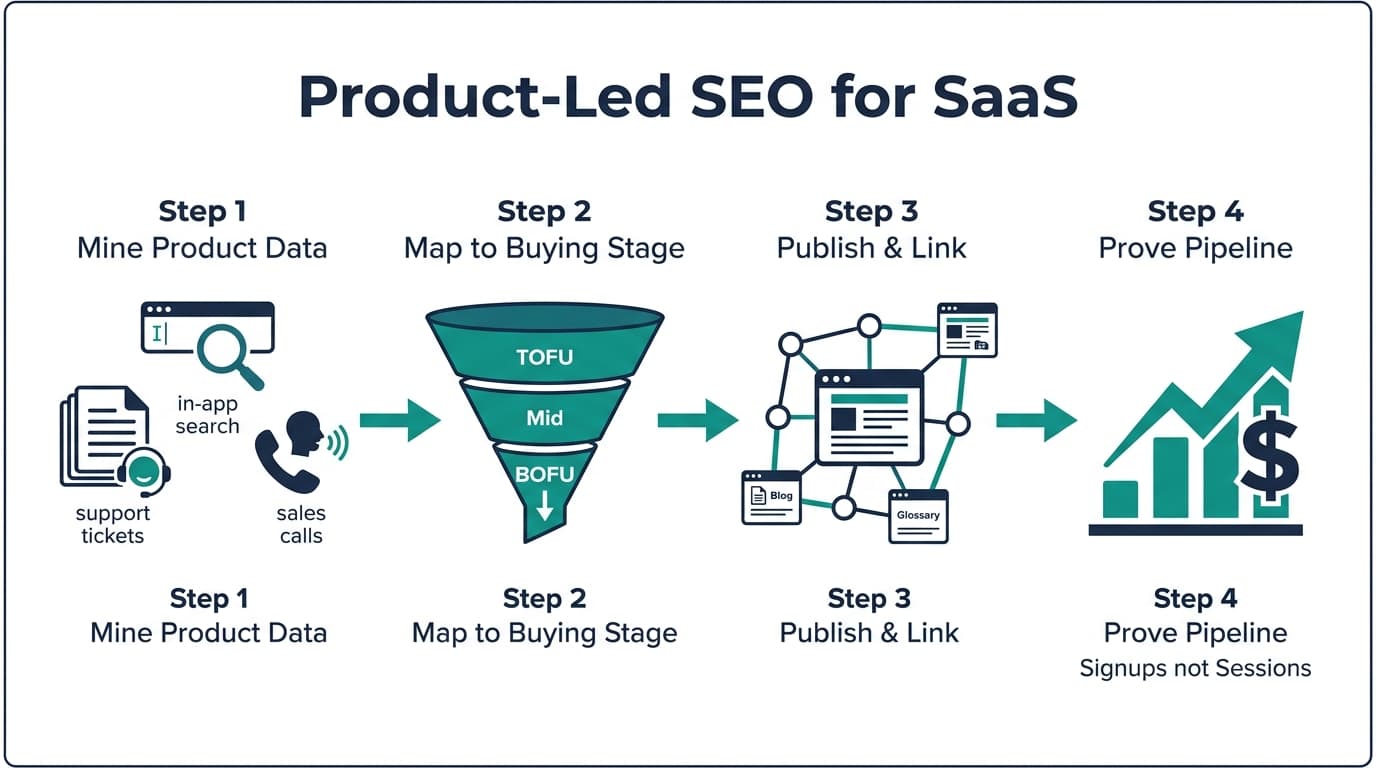
A real SaaS SEO strategy starts somewhere else entirely: inside your own product. The questions your users ask in-app, the features that convert trials and the ones that get ignored, the exact objections your sales team hears on every call. That data already exists. Most SaaS companies just never route it into content. This guide is a complete, practitioner-level SaaS SEO strategy built around that idea, sometimes called <mark class="km-highlight" style="--hl:#FEF08A;background:#FEF08A">Product-Led SEO</mark>: treat SEO as an engineering problem fed by product data, not a content calendar fed by a keyword tool, and measure it in pipeline, not pageviews.
Here is what that looks like in practice, from the keyword tiers that actually convert to the AI search tactics almost nobody is doing correctly yet.
Why Generic SEO Advice Fails SaaS Companies
Most SEO advice is written for content sites, ecommerce stores, or local businesses, and it gets applied to SaaS without adjustment. That is a mistake, for three structural reasons specific to software companies.
The buyer journey is long and mostly invisible. A B2B SaaS deal can take weeks or months from first visit to signed contract, crossing multiple sessions, multiple people, and often a free trial or demo in between. A single "conversion" rarely happens on the page that ranked. If your only measurement is last-click attribution on a blog post, you will systematically undercount SEO's real contribution and eventually get its budget cut for the wrong reason.
The product itself is the best source of content ideas, and almost nobody uses it. A SaaS company has direct access to signals that most industries never see: what people search for inside the app, which features get adopted versus ignored, what support tickets pile up around, what objections show up on every sales call. That is a content backlog no keyword tool can replicate, because it comes from people who already use the product, not people who searched Google for a generic phrase.
Churn and expansion mean SEO cannot stop at the signup. Ecommerce SEO cares about a purchase. SaaS SEO has to care about activation, retention, and expansion too, because a signup that churns in month one was not a real win. That means SEO content should serve existing customers looking for advanced use cases and integrations, not just prospects at the top of the funnel.
Build a Keyword Strategy Around Buying Stage, Not Just Volume
Keyword research for SaaS is not about finding the highest-volume terms. It is about mapping terms to where someone actually is in the decision to buy software, then matching content depth and format to that stage. Group the raw export first, so variants of one search land on one page instead of three; this comparison of free and paid keyword clustering tools covers the options at every budget.
| Tier | Example query pattern | Search intent | Content format |
|---|---|---|---|
| Bottom-of-funnel (BOFU) | "[competitor] alternatives," "[competitor] vs [you]," "best [category] software" | Ready to choose a tool | Comparison page, alternatives page, pricing page |
| Feature/JTBD | "[feature] software for [role]," "how to [specific outcome]" | Solving a specific job | Dedicated feature or use-case page |
| Mid-funnel | "how to [broader task]," "[category] checklist" | Evaluating approaches, not yet vendor-shopping | In-depth guide or template |
| Top-of-funnel (TOFU) | "what is [concept]," "[industry] trends" | Early research, building awareness | Educational blog post |
The BOFU tier deserves more of your time than most content calendars give it. These are the smallest-volume keywords in the table and the highest-intent, because the person searching "[competitor] alternatives" has already decided to switch software and is choosing between options right now. A thin, defensive comparison page that will not name a downside is worse than no page at all: buyers can tell, and they bounce to the competitor's honest one instead.
The mistake most SaaS teams make is spending 80 percent of their content budget on the TOFU tier because it has the biggest search volume, then wondering why the blog gets traffic but not signups. Volume is not the same as intent. A keyword with 200 monthly searches from people actively comparing tools will outproduce a keyword with 5,000 monthly searches from people who are nowhere near a purchase decision.
Turn Product Data Into Your Content Backlog
This is the part most SaaS SEO guides skip entirely, and it is the single highest-leverage move available to a software company that a content site or a local business simply cannot do.
Your product already generates a content roadmap. You just have to go looking for it:
- In-app search and help-center queries. What are your own users typing into your search bar or knowledge base? Those are real questions from real buyers and users, not guesses from a keyword tool.
- Support ticket themes. If the same confusion shows up across dozens of tickets, that is a page waiting to be written, and it will convert better than a cold blog post because it is answering a question your actual market has.
- Feature adoption data. A feature nobody uses might need a "how to" page more than a marketing push. A feature with high adoption and few support questions is proof of a strong use case worth a dedicated landing page.
- Sales call objections. Whatever your sales team hears most often on calls ("does it integrate with X," "how is this different from Y," "can it handle Z scale") is a comparison page or FAQ answer you have not written yet.
- Integration and API usage. If a specific integration is popular, a dedicated "[Your Product] + [Integration]" page captures a very specific, high-intent search with almost no competition.
This is the practical meaning of programmatic SEO for a SaaS product: not spinning up thousands of thin, auto-generated pages, but systematically turning structured product data (integrations, use cases, roles, industries) into a template that produces genuinely useful pages at scale. A directory of "[Your Product] for [industry]" pages, each populated with real, specific detail rather than mail-merged filler, is a legitimate content strategy precisely because it is grounded in real product structure, not just a spreadsheet of keyword variants.
Build Pages That Convert, Not Just Rank
Ranking is only step one. SaaS buyers do heavy research before they ever talk to sales, so your content has to do selling, not just informing.
A few rules that separate SaaS pages that convert from ones that only rank:
- Do not hide your pricing or your limitations. Buyers researching "[competitor] alternatives" want a page that names real tradeoffs, not marketing copy that pretends your product has no downsides. Authoritative, transparent comparison content wins trust, and trust is what converts a comparison-shopper.
- Put the product in the content, naturally. A feature page should explain the feature and show it solving the exact job-to-be-done in the query, not describe the category in the abstract and mention the product once at the bottom.
- Give every intent its own page. Do not try to rank one generic "features" page for ten different use cases. A dedicated page per job-to-be-done, per integration, per competitor comparison consistently outperforms one page trying to be everything to everyone.
- Build resource pages that are genuinely useful. A free calculator, template, or checklist tied to a specific action your buyer takes earns links and repeat visits in a way a blog post rarely does, because a useful tool is harder for a competitor to copy than an article.
Fix Internal Linking Before You Publish Anything New
Internal linking is the part of SaaS SEO strategy that almost every guide glosses over in a single bullet point, and it is often the fastest lever available on an existing site.
The architecture that works for SaaS specifically:
- Pillar pages link down to every cluster article, and every cluster article links back up. If you have a hub page like this one, every supporting article in its cluster should link to it, and it should link out to them. That tells search engines which page is the authority on the topic.
- Feature pages link sideways to comparison pages, and comparison pages link to feature pages. Someone reading "[Competitor] alternatives" who is not yet convinced should be one click from the specific feature page that addresses their actual concern.
- Blog content links down to product and pricing pages, not just to other blog posts. The whole point of content-led growth is passing authority and readers toward the pages that convert. A blog that only links to more blog posts is optimizing for time-on-site, not pipeline.
- Watch for cannibalization as the site grows. Two pages competing for the same query split ranking signal and confuse Google about which one to show. This gets worse, not better, as a SaaS content library scales, and it is one of the most common reasons an established page's rankings quietly slip even though nothing about it changed.
Optimize for AI Search Now, Not Later
Every SaaS SEO guide currently on page one mentions AI search in a paragraph or two and moves on. That is a gap worth exploiting, because AI answer engines are already sending real buyer traffic and most SaaS marketing teams have no concrete plan for it beyond "write good content."
Concrete tactics that actually move the needle here:
- Structure for extraction, not just readability. Put a direct, self-contained answer near the top of the page, in the first two or three sentences after the heading. AI systems tend to pull the passage that most cleanly answers the query, not the one buried under three paragraphs of throat-clearing.
- Use real comparison tables and bulleted breakdowns. Structured data is easier for an AI system to extract and cite accurately than a wall of prose making the same point.
- Answer the exact question in the exact words people ask it. A dedicated FAQ section, with the question as the heading and a tight, complete answer directly beneath it, is one of the most citable formats that exists right now.
- Track whether you are actually being cited. Search Google, ChatGPT, and Perplexity for your target queries periodically and note whether your brand shows up in the answer. Most teams have no idea whether this is working or not, because almost nobody is measuring it.
This is not a bolt-on to your SEO strategy. It is the same content, held to a higher structural bar, because the reward for getting it right is not a blue link ten results down a page, it is your product being the one AI systems recommend by name.
Measure Pipeline, Not Pageviews
If there is one line to take away from this entire guide, it is this: a rising traffic graph and a rising pipeline graph are not the same thing, and SaaS SEO has to be built, from day one, to prove the second one.
That means:
- Track signups, trial starts, and (where you can attribute it) closed revenue by landing page, not just sessions and pageviews.
- Report content performance in the same terms your CEO already thinks in. "This cluster of eleven pages drove 40 trial signups last quarter" survives a budget conversation. "Traffic is up 22 percent" does not.
- Treat existing pages as an asset that needs maintenance, not a permanent one-time investment. A page that ranked well a year ago and drove signups can quietly decay: competitors publish fresher content, the SERP shifts toward AI answers, your product changes and the page does not. The fix is rarely a rewrite from scratch. It is usually a refresh: update the stats, tighten the answer to the query, add the feature that shipped since you wrote it, and republish.
This is exactly the operational gap Murkuz is built to close for SaaS marketing teams: it scans your Search Console data to catch declining posts and content decay before they cost real signups, generates the fix with your brand voice attached instead of a generic rewrite, and then proves whether that specific fix actually caused the ranking recovery, so "what's the ROI of our blog" gets answered with a scorecard instead of a screenshot of a traffic graph. It also grades content for AI search readiness, which matters given the tactics above. None of that replaces the strategy in this guide. It replaces the manual, error-prone process of running that strategy by hand across a growing library of pages.
Where to Focus First
If you are starting from nothing, work in this order:
- Audit what you already have. Before writing anything new, find pages ranking on page two (positions 11 to 20). These are usually one solid refresh away from page one, and it is faster than starting from zero.
- Mine your product for the next 90 days of content. Pull the top recurring themes from support tickets, in-app search, and sales call objections. That is your backlog, not a keyword tool's suggestions.
- Build one BOFU page per real competitor and per major integration. These are small in volume and large in intent.
- Fix internal linking on what already exists before publishing more net-new pages into a structure that cannot pass authority around properly.
- Put an AI-search structure standard in your content template so every new page ships citable, instead of retrofitting it later.
- Set up pipeline-level reporting before the next board meeting, so the conversation is about signups and revenue, not sessions.
None of this requires a big team or a big budget. It requires treating SEO the way you would treat any other growth channel with a real number attached to it: instrumented, prioritized by actual buying intent, and maintained, not just launched once and left alone.
FAQ
What is a SaaS SEO strategy and how is it different from regular SEO?
A SaaS SEO strategy applies standard SEO principles (keyword research, technical optimization, content, links) but organizes everything around the SaaS buying journey and product usage data instead of generic topic volume. The biggest difference from ecommerce or content-site SEO is that the "conversion" is rarely a single transaction: it is a trial signup that then has to activate, retain, and expand, so the content strategy has to support the whole customer lifecycle, not just the first click.
What does a good SaaS SEO strategy example look like?
A strong example combines a small number of high-intent bottom-of-funnel pages (named competitor comparisons, specific feature-for-role pages, integration pages) with a systematic process for pulling content ideas from product data (support tickets, in-app search, sales objections), plus ongoing maintenance of existing pages so they do not quietly decay. The pattern that works is depth and intent-matching over publishing volume.
How is B2B SaaS SEO different from B2C or ecommerce SEO?
B2B SaaS deals typically involve a longer sales cycle, multiple stakeholders, and a trial or demo step before revenue, so attribution has to look beyond last-click sessions. Ecommerce SEO can often measure success in a single purchase event; SaaS SEO has to account for activation and retention too, since a signup that churns immediately was never really a win.
What should be on a SaaS SEO checklist before publishing?
At minimum: confirm the keyword's buying-stage intent matches the content format, check you are not creating cannibalization with an existing page, include a direct answer near the top for AI-search extraction, link the page both up to its pillar and sideways to relevant product or comparison pages, and set a review date so the page gets refreshed instead of forgotten.
How do you build a SaaS SEO strategy that drives signups, not just traffic?
Start by weighting your content calendar toward bottom-of-funnel and job-to-be-done keywords even though they have lower search volume, because that is where buying intent lives. Then measure success in trial signups and, where attributable, closed revenue by landing page, not in sessions or pageviews, so the strategy gets judged and funded on the metric that actually matters.
Is a SaaS SEO course worth it, or should you hire an agency?
It depends on team maturity. A course can be useful for building in-house understanding of the fundamentals, especially the SaaS-specific parts (buyer journey mapping, product-data-driven content). An agency makes more sense when you need hands-on execution at volume or specialized technical SEO work. Neither replaces having someone on your team who understands your product well enough to turn its data into content ideas nobody outside the company could produce.
What makes a good SaaS content marketing strategy?
The same principles as SaaS SEO: match content depth and format to buying stage, pull ideas from real product and customer data instead of only a keyword tool, and hold every piece to a "does this help someone about to become a customer" bar rather than a "does this hit a word count" bar.
Should SaaS companies optimize for AI search, and how?
Yes, and the how matters more than most guides admit. Structure content so a direct, complete answer appears in the first few sentences, use real tables and bullets instead of dense prose, answer FAQ-style questions in the exact phrasing buyers use, and periodically check whether your brand actually gets cited in ChatGPT, Perplexity, and AI Overviews for your target queries. Most SaaS teams write content that is easy for humans to read but nothing about it is structured for a language model to extract and cite cleanly. That gap is exactly where the opportunity is right now.
Junaid Khalid is the founder of Ertiqah, the company behind Murkuz. He has run SEO as the first growth channel across his own SaaS products, which is the reason Murkuz exists: to close the loop between finding an SEO problem and proving it got fixed.