If you just want the short answer: Surfer SEO and Clearscope are the two most widely used content optimization tools in 2026, Frase is the best value pick for briefs and drafting, and PageOptimizer Pro is the most affordable for solo SEOs who want granular on-page control. Below is the honest breakdown of what each one actually does, what none of them do, and a specific gap almost every "best content optimization tool" list skips over: a good score at publish time tells you nothing about whether that page is still ranking six months later.
That gap matters because content optimization tools were built to answer one question: does this draft cover the topic as well as what's already ranking? They are genuinely good at that question. What they don't answer is what happens after you hit publish, when the SERP shifts, competitors update their pages, and your once-optimized article quietly starts sliding from position 6 to position 14 with nobody watching.
What a Content Optimization Tool Actually Does
Every tool in this category runs roughly the same process: it scrapes the top-ranking pages for your target keyword, extracts the terms, subtopics, and structure those pages share, and scores your draft against that pattern. The output is usually a letter grade or numeric score, a list of terms to add, and a target word count.
That is genuinely useful for one specific job: making sure a new draft doesn't miss obvious topical gaps before you publish it. It is a pre-publish quality check, not an ongoing performance system. Once your score hits green, the tool's job is done, and so, in practice, is most people's attention to that page.
The Best Content Optimization Tools, Compared
Here is a straight comparison of the tools people mean when they search for this, based on their own published pricing and feature pages as of 2026.
| Tool | Best for | Starting price | What it does not do |
|---|---|---|---|
| Surfer SEO | Live editor, agencies with many writers | ~$79/month | No decline monitoring after publish |
| Clearscope | Editorial teams, readability-first workflows | ~$189/month | No publishing pipeline; grades but doesn't fix |
| Frase | Fast briefs plus AI drafting on a budget | ~$49.50/month | Shallower competitor depth than Surfer or Clearscope |
| PageOptimizer Pro | Granular, affordable on-page control | ~$37/month | Slower initial report generation |
| MarketMuse | Enterprise topical authority audits | Custom | Steep learning curve, built for strategy not single articles |
| SE Ranking (Content Marketing) | Teams that want optimization inside a full SEO suite | ~$75/month | Overkill if content is your only need |
Surfer SEO
Surfer's Content Editor is the closest thing this category has to an industry default. You write inside Surfer (or a Google Docs add-on) and watch a live score update as you add recommended terms, headings, and images. It also has a Content Audit that pulls Google Search Console data to flag existing pages worth revisiting, and an AI drafting layer called Surfer AI.
Where it stops: the audit tells you a page's score is stale, but nothing watches your rankings day to day and nothing pushes the rewritten content back to your CMS for you. You still open WordPress or your CMS of choice, paste in the fix, and hope you remember to check again next quarter.
Clearscope
Clearscope's Content Grade is the most recognizable score in the category: an A-F letter grade built from IBM Watson and Google NLP term analysis across the top 30 to 40 ranking pages. Its Content Inventory feature lets you monitor existing content for grade drift over time, which is more than most competitors offer for tracking aging pages.
Where it stops: Clearscope tells you a page's grade has slipped from A to C. It does not generate the rewritten section, does not publish anything, and does not tell you whether fixing the grade actually moved the ranking. You still need a writer, a CMS login, and a separate way to measure the outcome.
Frase
Frase earns its spot for speed and price. Give it a keyword and it scrapes the SERP to build a brief with headings, questions, and topics in minutes, then its AI Writing Assistant can draft sections directly from that brief. The Content Score updates in real time as you write, similar to Surfer and Clearscope.
Where it stops: its competitor and semantic analysis is shallower than Surfer or Clearscope on genuinely competitive keywords, and like the others, once the draft is done and scored, Frase's job ends. Nothing tracks it afterward.
PageOptimizer Pro (POP)
POP is built for people who want to see exactly which factor moved their score and why, processing over 100 on-page SEO factors per report rather than a single blended number. Its EEAT signal checklist and schema comparison against competitors are more granular than most tools in this list. A genuinely useful extra: POP Watchdog alerts you when a page you already optimized needs a refresh because a competitor changed or Google updated something nearby.
Where it stops: Watchdog tells you something changed. It does not draft the fix, publish it, or prove the fix worked once it's live, the same gap as everything else here.
The Question Every "Best Content Optimization Tool" List Skips
Read enough of these roundups and a pattern shows up: every one of them ends at "and then your content editor gives you a score." Nobody in this category answers what happens in month four, when the page that scored a 92 on launch day has drifted down eleven positions because three competitors refreshed their pages and yours sat untouched.
That's not a minor gap. <mark class="km-highlight" style="--hl:#FEF08A;background:#FEF08A">A content optimization score is a snapshot, not a guarantee</mark>. Google's own guidance on creating helpful, reliable, people-first content is explicit that content needs ongoing attention, not a one-time pass, because search results and competitor content are never static. A tool that grades your draft once and walks away is solving half the problem.
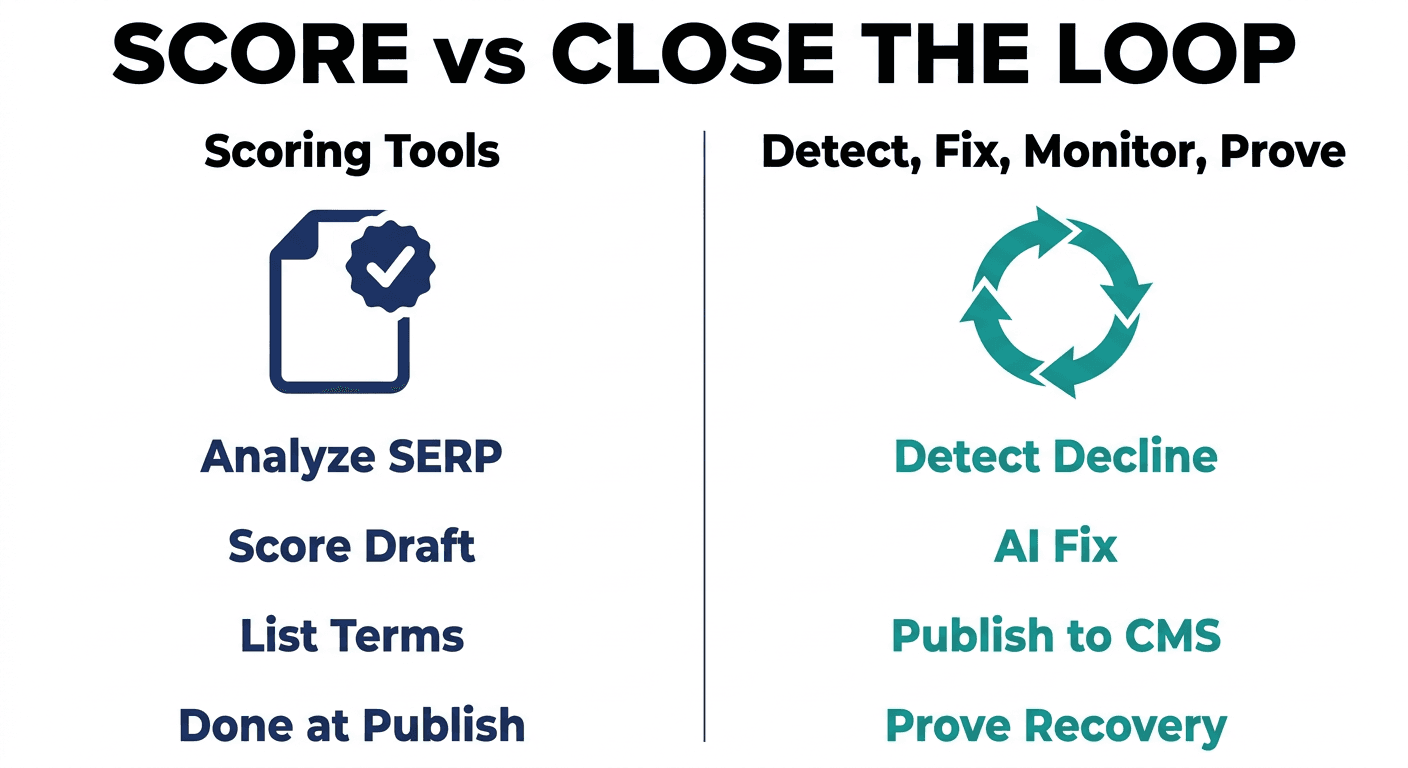
This is the real distinction worth making before you buy anything in this category:
- A scoring tool tells you how your draft compares to today's top results, one time, at the moment you check.
- A fix-and-monitor system watches the page after it's live, flags it when the ranking actually starts slipping, and closes the loop by proving whether the rewrite worked.
Every tool above is the first kind. That's not a knock on them; term-gap analysis genuinely helps new drafts. But if your real problem is a backlog of already-published pages quietly losing ground while nobody notices until the traffic graph confirms it three months later, a scoring tool was never built to solve that.
Where Murkuz Fits (and Where It Doesn't)
If what you need is a pre-publish scoring check on a brand-new draft, one of the six tools above is the right call, and Clearscope or Surfer are the two most proven options for that specific job.
Murkuz is built for a different, narrower problem: pages that are already live and already declining. It connects to Google Search Console and runs a daily scan across your whole site to catch pages losing rankings, sitting at positions 11 to 20 one push from page one, or quietly going stale, what Murkuz's product calls content decay. Each of those gets turned into a task with the specific fix attached, not just a flagged score. The AI-generated rewrite references a stored brand-voice knowledge base (Murkuz calls this HyBrain) so the fix reads like your writing, not generic AI copy, and a one-click approval pushes it live to WordPress, Webflow, or Framer. After that, Murkuz keeps tracking the page's position and uses what it calls an Agentic Impact Scorecard to show whether that specific fix is what actually moved the ranking, not just a traffic chart going up for unrelated reasons.
That is the head-to-head worth reading if content grading is currently where your workflow stops: see the full breakdown on how Murkuz compares to Clearscope and how it compares to Surfer SEO. Neither comparison argues you should throw out your scoring tool; they argue detection, fixing, and proof are a separate job that a scoring tool was never designed to do. You can see Murkuz's own plans and pricing here if that gap is the one costing you traffic right now.
How to Choose
Match the tool to the actual problem, not the most popular name on this list.
- Writing a brand-new article and want to make sure it's comprehensive before you publish: Clearscope or Surfer SEO, depending on whether readability grading (Clearscope) or a live in-editor workflow (Surfer) matters more to you.
- Tight budget, need briefs plus AI drafting help: Frase.
- Want granular control over exactly which on-page factors to fix, cheaply: PageOptimizer Pro.
- Managing a large site's topical authority across hundreds of pages: MarketMuse.
- Already inside an all-in-one SEO suite and don't want another login: SE Ranking's content marketing tools.
- The actual problem is a backlog of already-published pages slowly losing rankings that nobody is watching: that's the gap none of the six tools above close, and it's the specific problem Murkuz is built around.
Frequently Asked Questions
What is the best free content optimization tool?
There isn't a fully free tool that matches the paid options' depth, but Google Search Console (free) shows your real ranking and click data, and most paid tools above offer a trial: Clearscope and SE Ranking both run trials, and Frase's entry tier is inexpensive enough to test on a single article before committing.
What is the difference between a content optimization tool and an SEO plugin like Yoast?
An SEO plugin like Yoast or All in One SEO checks on-page basics (meta tags, keyword placement, readability) against a fixed rule set. A content optimization tool like Surfer or Clearscope instead compares your draft against what is actually ranking for that specific keyword right now, which is a more competitive, moving target than a static checklist.
Do content optimization tools actually improve rankings?
They improve topical coverage and relevance, which is one real ranking factor among many. Matching a competitor's term usage does not guarantee a ranking, and none of these tools account for backlinks, site authority, or what happens to the page after it's published, which is why a good score at launch can still decay over time.
Can I use more than one content optimization tool together?
Yes, and many practitioners do: a keyword research tool to find a winnable topic first, then a scoring tool like Frase or Surfer to build the brief and check the draft, is a common two-tool combination rather than relying on one platform for everything.
Is Surfer SEO or Clearscope better?
Surfer is generally preferred for a live, in-editor workflow and agencies running many writers at once; Clearscope leans toward editorial teams that want a simpler letter-grade system and stronger readability scoring. Both stop at the score; neither monitors the page after publish or fixes it automatically when it declines.
Junaid Khalid is the founder of Ertiqah and the builder of Murkuz. He has run SEO as the first growth channel across his own SaaS products, and built Murkuz around the belief that a tool should not stop at telling you a page's content score. It should help you fix the page, publish the fix, and prove it worked.