You have a few hundred product pages, a couple dozen category pages, and rankings that move around every time Google updates its algorithm. Somewhere in the last week you searched "ecommerce SEO agency," found a page of polished service pages promising 600% traffic increases, and closed the tab feeling no closer to an answer. Every agency site tells you to hire an agency. None of them tell you when you shouldn't.
This guide is the version nobody selling agency retainers will write: a straight comparison of what an ecommerce SEO agency actually costs and delivers versus what a capable in-house person (or founder) can do alone, the specific situations where each option wins, and the exact questions to ask a prospective agency before you sign a contract. If you finish this and decide an agency is right for you, great, you will know what to ask. If you decide to do it yourself, you will know exactly what tooling closes the gap that used to require a full-time hire.
What an Ecommerce SEO Agency Actually Does
Strip away the marketing language and an ecommerce SEO agency's retainer typically covers four buckets of work:
- Technical SEO. Crawlability, indexation, site speed, structured data (product schema, review schema), faceted navigation and filter URL management, and fixing duplicate content across variants and pagination.
- Content and on-page. Keyword research for product and category pages, writing or optimizing product descriptions and buying guides, title tags and meta descriptions at scale.
- Link building. Outreach for backlinks, digital PR, and sometimes guest posts, aimed at raising domain authority for competitive category terms.
- Reporting. Monthly calls and dashboards showing rankings, traffic, and (if you are lucky) revenue attribution.
The agencies ranking for "ecommerce SEO agency" right now describe this well. What they do not describe, because it is not in their interest to, is which parts of that list you can realistically do yourself with the right tooling, and which parts genuinely need a specialist.
It also helps to understand what a retainer is actually paying for underneath the four buckets above. Most of an agency's early months on a new account go toward things that are one-time or infrequent: a technical audit, an initial keyword map, a content gap analysis against your top competitors. That work is genuinely valuable and takes real expertise to do well the first time. But once that groundwork is done, a large share of the ongoing monthly retainer shifts toward monitoring: watching Search Console data, noticing when a category page slips from position 6 to position 14, and deciding what to do about it. That monitoring work is repetitive, rules-based, and exactly the kind of task that has historically eaten the most billable hours for the least differentiated value.
Ecommerce SEO Agency vs DIY: The Honest Comparison
Here is the comparison an agency's own website will never publish, because an agency's sales page has to sell agencies.
| Factor | Ecommerce SEO Agency | DIY (In-House or Founder-Led) |
|---|---|---|
| Typical monthly cost | $1,500 to $10,000+, depending on catalog size and competitiveness | Tooling cost only: often $50 to $500/month |
| Time to first results | 3 to 6 months, same as DIY (SEO has no shortcut around Google's own timelines) | 3 to 6 months |
| Who owns product knowledge | An outside team learning your catalog from scratch | You, on day one |
| Best for | Large catalogs (5,000+ SKUs), highly competitive categories, teams with zero internal bandwidth | Small to mid catalogs, teams with at least one person who can own SEO part-time, budget-constrained founders |
| Biggest risk | Paying for reporting on problems nobody fixes between calls | Falling behind because nobody is watching rankings daily |
| What replaces the gap | The agency's own tooling and staff hours | A platform that automates detection, task generation, and fix deployment |
The row that matters most is the last one. The traditional argument for hiring an agency was never really "SEO expertise is impossible to learn." It was "somebody has to watch this every day, and you don't have that somebody." That is a staffing problem, not a strategy problem, and it is exactly the kind of problem software has gotten much better at solving in the last two years.
When Hiring an Ecommerce SEO Agency Is the Right Call
Be honest with yourself about these four situations, because they are the ones where a specialist genuinely earns their retainer:
- Your catalog is genuinely large and technically complex. Tens of thousands of SKUs across multiple locales, a legacy platform migration in progress, or a technical SEO mess (duplicate content from faceted navigation, broken canonical tags across variants) that needs a hands-on audit and implementation, not just monitoring.
- You are entering a category with entrenched, well-funded competitors. Ranking for "running shoes" against Nike's SEO budget is a different problem than ranking for a niche product line, and competitive link building at that level takes real relationships an agency has already built.
- Nobody on your team has the bandwidth to own it, even part-time. If SEO would be the fifth priority for someone already juggling four other jobs, it will not get done, and an agency at least guarantees dedicated hours.
- You need specialized migration or international expansion work. A platform migration (Shopify to a headless setup, for instance) or a multi-country expansion with hreflang across thousands of URLs is a project, not an ongoing task, and benefits from someone who has done it before.
A fifth situation worth naming honestly: you have already tried DIY and it did not stick. Plenty of teams buy a tool, run one audit, fix a handful of pages, and then let it go quiet for three months because nobody owns the follow-through. If that is your actual track record, the problem was never expertise, it was accountability, and an agency retainer can function as a forcing mechanism even when the underlying work is not fundamentally beyond your team.
If none of these describe your situation, keep reading, because the case for doing it yourself has gotten considerably stronger.
When DIY Is the Better Call (and What Changed)
Two or three years ago, "just do your own SEO" was reasonable advice with an unreasonable catch: doing it well meant someone checking Google Search Console weekly, manually triaging which pages were losing rankings, briefing a writer, getting the fix live, and then remembering to check again in a month to see if it worked. Most founders and small marketing teams tried this for one month and quietly gave up, which is exactly why the agency pitch worked.
What changed is that the manual, tedious middle of that process, detecting decay, generating a prioritized task, drafting the fix, and confirming it worked, is no longer something only a human team can do well. That is the specific gap Murkuz is built to close for ecommerce catalogs: it monitors every product and category URL against your Google Search Console data, catches pages declining in position before the drop shows up in your revenue numbers, and generates a prioritized, contextual task instead of a spreadsheet of URLs nobody triages. When a fix is approved, it pushes straight to your CMS, then tracks whether the ranking actually recovers and shows the causal link between the fix and the result, the same kind of proof an agency would charge you to compile manually into a monthly report.
DIY is the right call when:
- Your catalog is small to mid-sized (roughly under a few thousand SKUs) and not fighting the most competitive head terms in your category.
- At least one person, even part-time, can own the process of reviewing and approving fixes.
- You want to keep the product and brand knowledge in-house instead of re-explaining your catalog to a new agency team every quarter.
- Budget matters more than having someone else to blame when rankings dip.
What to Ask Before You Hire an Ecommerce SEO Agency
If you have weighed the above and still want a specialist, ask these questions before signing anything. The answers separate agencies that will move your rankings from agencies that will send you a nice-looking PDF every month.
- "Show me a client with a catalog similar in size to mine, and the actual ranking movement, not just traffic." Traffic charts go up for a hundred reasons unrelated to SEO. Ask for keyword position data specifically.
- "What is your process for catching a page that starts losing rankings mid-month, not just at the next audit?" If the answer is "we review quarterly," you are paying for a report card, not active management.
- "Who owns the relationship if my main point of contact leaves the agency?" Agency churn is common, and losing your account manager six months in often means starting over.
- "What exactly do you need from my team each month, and how many hours will that take?" An agency that "handles everything" but actually needs your team to approve every content change, provide every product detail, and manually push updates to your CMS is not saving you as much time as the pitch implied.
- "How do you prove a specific fix caused a specific ranking change, versus just correlating with a general upward trend?" Most agencies cannot answer this cleanly, because most reporting is correlation dressed up as causation.
- "What is included past month three, when the initial audit and quick wins are done?" The first ninety days of any engagement look productive because there is a backlog of easy fixes. Ask what the ongoing, month-twelve work actually looks like.
A Simple Framework for Deciding
If you want a rule of thumb rather than a full weighing exercise, use this:
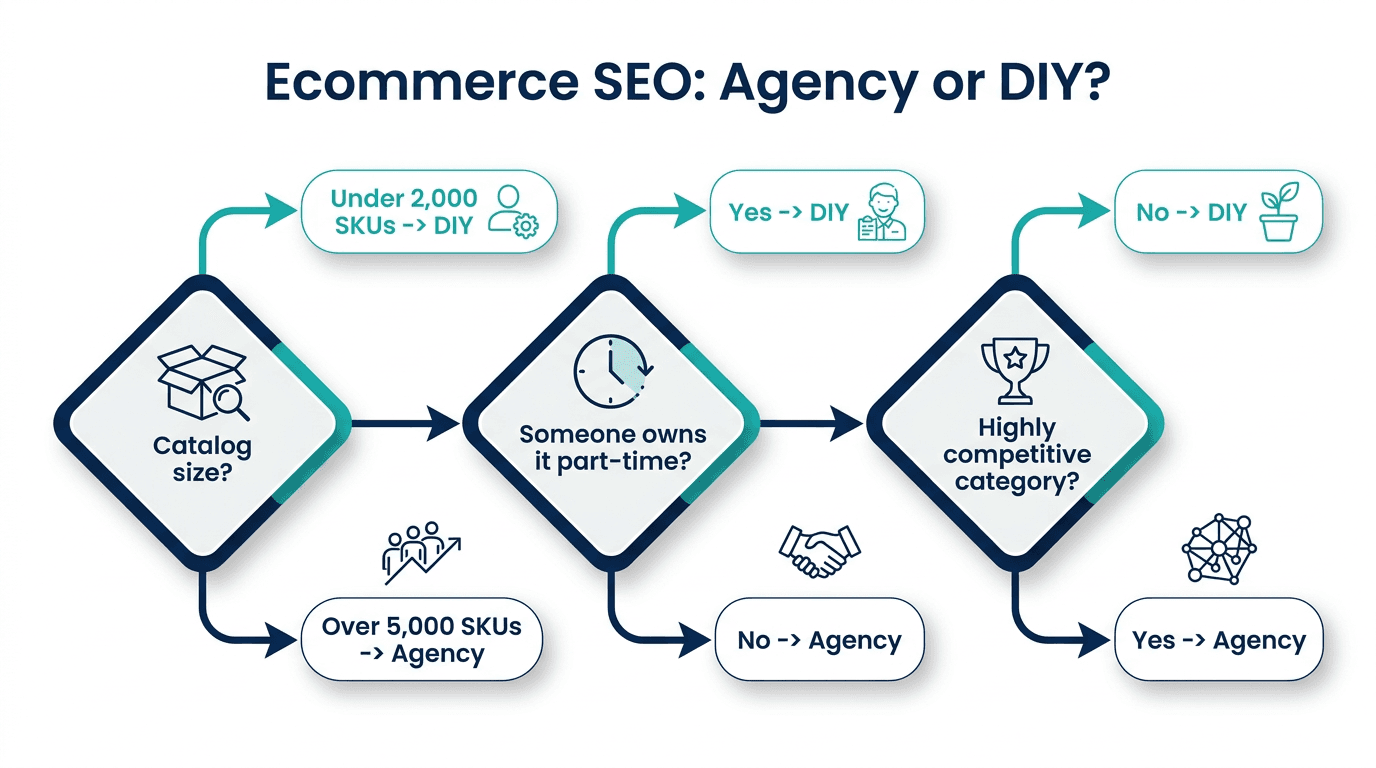
- Catalog under 2,000 SKUs, one person can own it part-time, budget matters: DIY, with tooling that automates the monitoring and task-generation grind.
- Catalog over 5,000 SKUs, or entering a highly competitive category, or a major platform migration in progress: Hire a specialist, and use the question list above to pick a good one.
- Somewhere in between: Start with DIY and revisit in two quarters. You lose nothing by trying the lower-cost path first; a good agency will still be available later if the results genuinely require more hands than you have.
The honest answer for most small and mid-sized ecommerce brands is that the agency was never buying you expertise you couldn't learn. It was buying you the discipline of someone checking rankings every week and acting on what they found. That discipline is now something a platform can run for you at a fraction of retainer cost, which is why this decision looks different in 2026 than it did five years ago.
FAQ
How much does an ecommerce SEO agency typically cost?
Most ecommerce SEO agency retainers run from around $1,500/month for smaller catalogs to $10,000/month or more for large, competitive catalogs with dedicated technical and content teams. Project-based work like a technical audit or platform migration is usually quoted separately.
How long does it take to see results from ecommerce SEO?
Whether you hire an agency or do it yourself, expect 3 to 6 months before meaningful ranking movement on competitive terms, and longer for highly competitive head terms. Anyone promising results in weeks is either targeting extremely low-competition keywords or overselling.
Can I do ecommerce SEO myself without hiring anyone?
Yes, particularly for small to mid-sized catalogs. The parts of ecommerce SEO that used to require a dedicated team, mainly the constant monitoring and triage of which pages are declining, can now be handled by software that detects the decline and generates the fix task for you to approve.
What size catalog needs a dedicated SEO agency?
There is no hard line, but catalogs above roughly 5,000 SKUs, or those competing directly against large, well-funded brands for head terms, typically benefit most from a specialist's hands-on technical and link-building work.
Is an ecommerce SEO agency worth it for a small Shopify store?
Usually not as a first move. A small Shopify store with a few hundred products can typically handle its own SEO with the right monitoring tooling, and should only consider an agency once the catalog or competitive pressure grows enough to strain internal bandwidth.