A content brief is the document you hand a writer, or yourself, before a single word gets typed: the keyword, the search intent, the subtopics competitors already cover, and the gaps you're going to fill that they didn't. Skip it and you get a draft that technically answers the topic but misses why a reader searched it in the first place. Get it right and the writer (even an AI one) produces something close to publishable on the first pass.
Most guides on this topic hand you a template and stop there. That's a start, but a template with empty fields does not tell you how to fill them in a way that actually changes whether the page ranks. This guide walks through the brief-writing process itself: how to pull real subtopics out of the pages already ranking, how to turn that research into instructions a writer can act on, and where most briefs quietly fail even when they look complete.
What a Content Brief Actually Needs to Contain
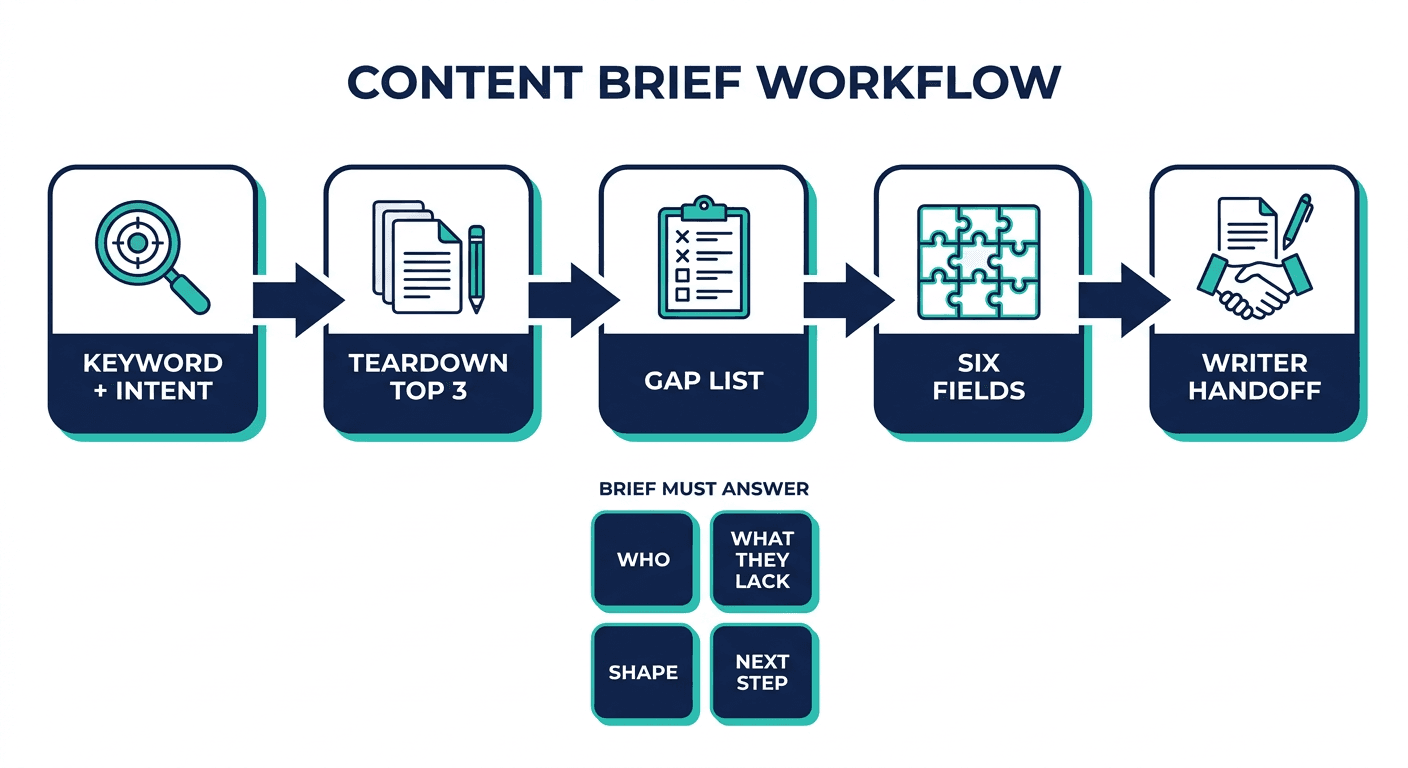
Strip away the jargon and a working SEO content brief answers six questions. If any of these six is missing, the writer is guessing, and guessing is where thin, generic content comes from.
- What is the target keyword, and what is the reader actually trying to do? Not just the phrase, the intent behind it. Someone searching "content brief template" wants a document to fill in today. Someone searching "how to write a content brief" wants to understand the process. Same topic, different job.
- What do the top-ranking pages already cover? The subtopics, headings, and examples that show up across multiple competitors are table stakes. Leave one out and you look thinner than the pages already ranking.
- What are the competitors missing? This is the part most briefs skip, and it's the part that actually earns a ranking instead of just matching one. A gap might be a missing worked example, an outdated stat, no comparison table, or an angle nobody else took.
- Who is this for, and what do they already know? A brief for a beginner audience and a brief for practitioners produce completely different drafts from the same keyword.
- What is the shape of the finished piece? Rough word count, the heading structure, whether it needs a table, an FAQ, a downloadable asset. Not a rigid outline the writer copies verbatim, a scaffold they build inside.
- Where does this page point the reader next? The internal links and the call to action. A brief that stops at "write good content" leaves free conversions on the table.
Everything else, tone notes, brand voice, style guide links, is useful, but those six are the load-bearing parts. A brief can be short and still work if it nails these six. A brief can be five pages long and still fail the writer if it skips even one.
Step 1: Pin Down the Keyword and the Real Search Intent
Start with the exact phrase you're targeting, then spend five minutes actually reading what Google is showing for it before you write a single instruction. Search the keyword yourself. Look at:
- The result types. Is Google showing a mix of guides, a shopping carousel, video results, a featured snippet? That tells you the format Google has decided readers want.
- The top 3-5 organic titles. Are they mostly "how-to" guides, listicles, tool pages, or comparisons? Match the dominant shape unless you have a specific reason to break the pattern.
- The "People Also Ask" box. These are the exact follow-up questions real searchers have. Every one of them is a candidate H2, H3, or FAQ entry in your brief.
- The "Related searches" at the bottom. These surface the adjacent phrases and subtopics you should at least mention, even if they're not your primary target.
Write the intent down in one plain sentence at the top of the brief: "reader wants a repeatable process for writing a brief, not just a definition." That sentence becomes the test every later instruction has to pass. If a subtopic doesn't serve that sentence, it doesn't belong in the brief.
Step 2: Reverse-Engineer the Top-Ranking Pages
Open the top three to five organic results and read them the way an editor would, not the way a reader would. For each one, note:
- Approximate word count and depth (skim vs. genuinely thorough)
- The heading structure: what H2s and H3s do they use, in what order
- Any tables, checklists, templates, or worked examples they include
- The angle: are they vendor content pushing a tool, a practitioner sharing process, or a thin listicle
- What they're missing: outdated information, no real example, no FAQ, weak structure, or a subtopic they never address
Combine what you find into two lists. The first is the union of everything the top results cover, the topics you cannot skip without looking thinner than what's already ranking. The second is the gap list: everything they're missing that you can add to earn the ranking instead of just tying it. A brief built only from the first list produces a page that's merely adequate. The second list is where the actual competitive edge lives.
Step 3: Turn the Research Into Instructions, Not Just Notes
This is the step that separates a genuinely useful brief from a pile of research a writer has to interpret themselves. Convert what you found in Step 2 into direct instructions:
- Instead of "competitors cover X, Y, and Z," write "cover X, Y, and Z, and go deeper on Z since none of the top three explain it well."
- Instead of listing PAA questions, write "answer these five questions somewhere in the body, and put the three shortest ones in a dedicated FAQ section since they're likely snippet targets."
- Instead of "add a table," specify what the table compares and why a table is the right format here rather than a bulleted list.
A content brief that reads like a research dump forces the writer to make the same judgment calls you already made during research, except with less context than you have. Make the calls yourself and write them as instructions. That is the entire value a brief adds over handing someone a keyword and a Google Doc.
A Practical Content Brief Template
Here is a lightweight structure that covers the six required fields without turning into a ten-page document nobody reads before writing.
| Field | What goes here | Example |
|---|---|---|
| Target keyword + intent | The exact phrase and one sentence on what the reader wants | "how to write a content brief" — reader wants the process, not just a definition |
| Audience | Who is reading, and their existing knowledge level | Solo marketers and freelance writers who already know what a brief is, want the "how" |
| Table stakes (from competitors) | The subtopics every top result covers | Six-field structure, why briefs matter, who uses them |
| Gaps to fill | What competitors miss that you will add | A real filled-in example, a reusable template table, a decay/refresh use case |
| Structure | Rough heading plan, format notes | 6-8 H2s, one table, short FAQ, 1,500-2,200 words |
| Links + CTA | Internal links to include, where the reader should go next | Link to the tool or page that helps them act on this immediately |
Copy this into a spreadsheet or a doc and reuse it for every piece. The specific answers change every time; the six rows almost never need to.
Common Content Brief Mistakes That Waste a Writer's Time
- Writing the brief before checking the SERP. A brief based on assumptions instead of what's actually ranking sends the writer in the wrong direction from word one.
- Listing competitor subtopics without the gap analysis. A brief that only says "cover what they cover" produces a page that ties the competition at best. It never explains why yours should outrank them.
- No stated intent. "Keyword: content brief. Word count: 1,500" tells a writer nothing about what shape the piece should take. Intent is the single highest-leverage line in the whole document.
- Treating the brief as a rigid outline. A good brief gives a writer (or an AI system) the research and the constraints, not a fill-in-the-blank outline that produces the same generic structure every time.
- No refresh trigger. Most briefs are written once for a new page and then forgotten. Pages decay: competitors publish something newer, stats age out, the SERP shifts. A brief that never gets revisited becomes a stale instruction set for a page that quietly falls out of position 5 into position 14 over a few months.
That last point matters more than it looks. A content brief isn't only a document for the first draft. The same six fields, reworked with a fresh SERP check, are exactly what you need when a ranking page needs a refresh instead of a first draft. If you are tracking which of your published pages have started slipping, Murkuz will flag the exact pages losing position and can generate a fresh content brief for the missing topics and thin sections automatically, so the refresh brief takes minutes instead of a re-run of the whole research process.
When a Brief Should Become a Full Workflow
For a one-off blog post, the template above is enough. It gets more valuable once you're producing content on a schedule, across multiple writers, or across a team where the person doing keyword research isn't the person writing the draft. At that point the brief becomes the single source of truth that keeps everyone aligned on what "done" looks like before anyone starts typing, and it is the artifact that gets reused when that same page needs a refresh six months later. If you want to see how brief creation fits into a full detect-fix-publish-prove cycle rather than a one-time research exercise, the Murkuz workflow walks through how the same research that builds a brief for a new page also flags and re-briefs a page that's started to decay.
FAQ
What is the difference between a content brief and a creative brief?
A content brief is built for a specific piece of written content, usually SEO-driven: a blog post, guide, or landing page, with keyword and search-intent instructions baked in. A creative brief covers a broader range of marketing work, including ad campaigns and design projects, and usually skips the keyword-level detail a content brief needs.
How long should a content brief be?
Long enough to cover the six required fields, short enough that a writer actually reads it before starting. For most blog posts, one to two pages is enough. Ten-page briefs tend to get skimmed, not followed.
Who should write the content brief: the strategist or the writer?
Whoever does the keyword and competitor research should write the brief, since the instructions only work if they're grounded in what was actually found. On a team with a dedicated strategist, that's them. Working solo, you're both roles, and the brief still earns its keep because it forces you to finish the research before you start writing.
Do I need a content brief for every single piece of content?
Any piece with more than one person touching it benefits from a brief, since it prevents the miscommunication that causes rewrites. Working entirely alone on a short piece, a lighter version, just the keyword, intent, and gap list, is often enough.
Should I use AI to help write the content brief itself?
AI can speed up the competitor teardown and PAA extraction, but the intent sentence and the gap analysis are worth doing yourself, since that judgment call is exactly what separates a brief that produces a ranking page from one that produces content that merely exists.
Junaid Khalid is the founder of Ertiqah and the builder of Murkuz. He has run SEO as the first growth channel across his own SaaS products, which is why the tool is built to close the loop most SEO software stops halfway through: not just telling you what's wrong, but fixing it and proving the fix worked.