Is AI content bad for SEO?
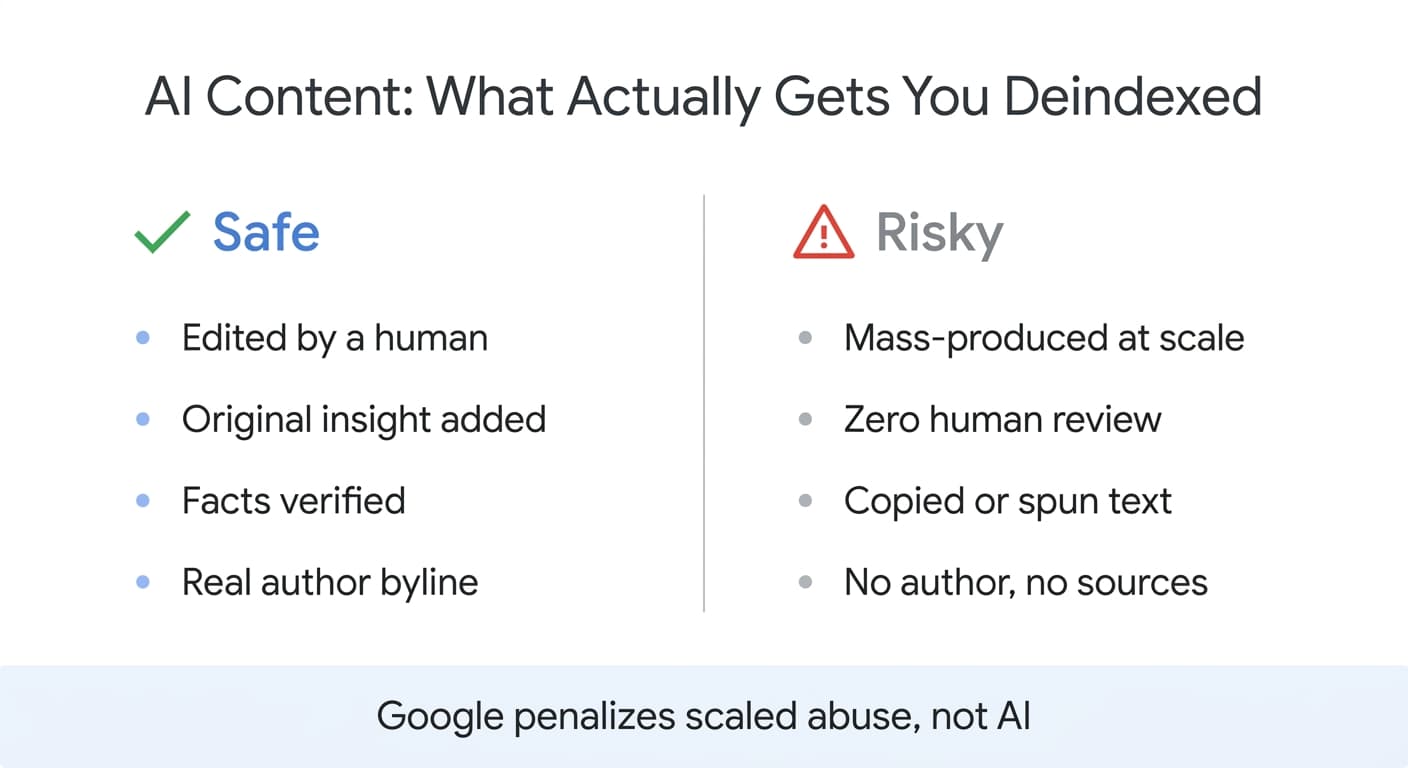
No. Google has said directly that "appropriate use of AI or automation is not against our guidelines." What gets pages penalized or deindexed is not the fact that AI touched the words. It is publishing unedited, unreviewed, mass-produced pages that add no value, the same thing that has always gotten low-quality human content buried too.
That single distinction explains almost every confusing case study you have read. A blogger publishes 500 AI articles in a month and gets wiped from the index. A SaaS company runs every product page through an AI editor with a human reviewing each one and keeps climbing. Same tool, opposite outcome, because Google's ranking systems were never built to detect "AI." They were built to detect scaled, low-value content, and AI just made that pattern easier to produce at volume.
This article walks through exactly what Google's own policy says, the real mechanism that gets sites penalized (it has a name: scaled content abuse), the specific signals that separate a page that ranks from one that gets nuked, and a practical checklist you can run before you hit publish.
What Google actually says about AI-generated content
Google's clearest statement on this is a 2023 Search Central post that is still the canonical reference, titled "Google Search's guidance about AI-generated content." The key line:
"Using automation, including AI, to generate content with the primary purpose of manipulating ranking in search results is a violation of our spam policies... This said, it's important to recognize that not all use of automation, including AI generation, is spam."
Google draws the same comparison the post makes explicitly: about a decade ago there was a wave of mass-produced human-written content, and Google did not respond by banning human writers. It responded by improving its systems to reward quality regardless of who or what produced it. AI content gets the identical treatment. The company's own FAQ on the topic asks "Will AI content rank highly on Search?" and answers:
"Using AI doesn't give content any special gains. It's just content. If it is useful, helpful, original, and satisfies aspects of E-E-A-T, it might do well in Search. If it doesn't, it might not."
That is the whole myth, busted in one sentence. There is no AI penalty. There is a quality bar, and AI content is judged against the same bar as everything else.
The real mechanism: scaled content abuse
If AI itself is not the trigger, what is? Google's spam policies name the actual violation: scaled content abuse. Per Google's own definition, this is "when many pages are generated for the primary purpose of manipulating search rankings and not helping users," typically producing large volumes of unoriginal content with little to no value, regardless of the production method.
Google explicitly lists the patterns that count as scaled content abuse, and every one of them is a workflow failure, not a tool choice:
- Using generative AI (or any other tool) to generate many pages without adding value for users
- Scraping feeds, search results, or other content to spin out pages, including through synonym-swapping or auto-translation
- Stitching or combining content from different pages without adding anything original
- Creating multiple sites to hide how much of the content is scaled and templated
- Publishing pages where the text makes little sense to a human reader but is stuffed with target keywords
Read that list again: none of it says "written by AI." It says produced at volume, without editorial judgment, to occupy search real estate rather than answer a question. A single AI-assisted article that a subject-matter expert edited, fact-checked, and improved fails zero of those tests. Five thousand unedited AI articles published in a week to farm long-tail keywords fails all of them, and that is what actually gets a site deindexed.
The 4 signals that separate "ranks fine" from "gets penalized"
Reverse-engineering the cases that go wrong, four variables decide the outcome more than anything else.
1. Human review and editing. Did a person read the draft, correct it, and add something the AI could not have known? Google's guidance points reviewers toward asking "Who, How, and Why" about content: who created it, how, and why. An AI first draft that a knowledgeable editor reworks passes that test easily. A draft published verbatim usually does not, because it tends to read exactly like every other AI draft on the same topic.
2. Original insight versus recycled summary. AI models are trained on existing web content, so an unedited AI draft is structurally a remix of what already ranks. If your only contribution is a prompt, you have added nothing a searcher could not already find. The fix is cheap: one real example, one number you actually measured, one opinion informed by having done the work, changes the piece from a summary into a source.
3. Factual accuracy. AI models confidently state wrong statistics, misattribute quotes, and invent sources that do not exist. Every specific claim, number, or citation in an AI draft needs a human to verify it against a real source before publishing. This is not optional diligence, it is the single most common reason AI content damages a brand's trust signals, independent of whether it also affects rankings.
4. Publishing volume relative to review capacity. This is the one that actually maps to "scaled abuse." If your review process can realistically vet 10 articles a week and you are publishing 200, the math tells Google's systems (and any human reader) everything they need to know. Volume is not the violation by itself, but volume without proportional review is exactly the pattern the spam policy names.
E-E-A-T is where AI content quietly loses points
Even AI content that clears the spam bar can still underperform because it is thin on E-E-A-T: Experience, Expertise, Authoritativeness, and Trustworthiness. This is the part most teams skip, because it is invisible in the text itself. It shows up in the page's metadata and structure instead.
The most common gaps:
- No author byline, or a generic "Team" or "Admin" credit with no real person attached
- No credentials connecting the named author to the topic (a security article with no security background listed anywhere)
- No last-updated date, so readers and crawlers cannot tell if the facts are current
- No sources cited for claims that should have one, especially in health, finance, or legal content where Google's own guidance says it applies extra scrutiny
None of this is about detecting AI. It is about a page looking credible to a reader and to Google's quality systems at the same time. A fully human-written article with no author, no date, and no citations has the exact same E-E-A-T problem as an AI one. AI just makes it more tempting to skip these steps because the draft "already looks finished."
Quick checklist before you publish AI-assisted content
| Check | Why it matters |
|---|---|
| A person edited the draft, not just skimmed it | Separates "helpful content" from a scaled template in Google's own framing |
| At least one original example, data point, or opinion added | Turns a remix into something worth ranking |
| Every stat, quote, and claim verified against a real source | AI hallucination is the top cause of factual errors in published AI drafts |
| A real named author with visible credentials | Direct E-E-A-T signal Google's quality raters are trained to look for |
| Last-updated date is accurate and current | Signals trustworthiness, especially for anything time-sensitive |
| Publishing volume matches your realistic review capacity | The actual line the scaled content abuse policy draws |
| Content answers the search intent, not just the keyword | Google's helpful content system targets pages written for rankings over readers |
Where teams get this wrong in practice
The failure pattern is rarely "we used AI." It is "we used AI to skip the parts of publishing that used to force quality control." Before AI writing tools, producing 50 articles required 50 rounds of research and drafting, which naturally throttled output to something a small team could review. AI removed that throttle on the writing side but not on the review side, so the review step is the one that gets quietly dropped under deadline pressure.
The same applies to a different, less obvious failure: teams write one solid article, then use AI to spin it into a dozen "unique" variants targeting nearby keywords. That is synonym-swapping at scale, one of the patterns Google names explicitly. It looks efficient. It is the fastest way to get a whole content type flagged.
The pages that hold up under this scrutiny share one habit: someone treats content decay as seriously as content creation. A page written well in January can lose rankings by June because a competitor published something more current, a stat went stale, or search intent shifted, whether the original draft was AI-assisted or not. Catching that decay early, and refreshing the page with a real update rather than a full AI rewrite, is a better long-term strategy than treating publishing as a one-time event. This is one of the places Murkuz focuses: it scans Google Search Console data daily to catch declining pages and thin, stale sections before the traffic drop is visible in your analytics, and turns each one into a specific task instead of a vague "audit your content" reminder.
How to use AI content safely (without slowing down)
You do not need to choose between "no AI" and "AI without a safety net." The workable middle ground looks like this:
- Draft with AI, edit with a human who knows the topic. The AI handles structure and a first pass; the editor adds the one thing AI cannot: real judgment about what is actually true and useful.
- Attach a real author to every page. A name, a bio, and credentials relevant to the topic. This is the fastest E-E-A-T win available and it costs nothing but discipline.
- Verify facts against a primary source before publishing, not after a reader points out the error in the comments.
- Keep your brand voice and factual context in one place so every AI draft starts from the same accurate foundation instead of generic training data. Murkuz calls this its HyBrain knowledge base: you store your product facts, tone, and writing rules once, and AI-generated drafts reference it on every generation instead of guessing.
- Throttle publishing volume to what your review process can actually handle. If you cannot review it properly this week, it should not publish this week.
- Audit for E-E-A-T gaps on a schedule, not just at launch. Missing author info, stale dates, and uncited claims accumulate quietly across a site as it grows, which is the exact problem Murkuz's E-E-A-T compliance tooling is built to catch: it scans for missing trust signals across every page and turns each gap into a task, rather than requiring someone to manually re-check hundreds of pages one at a time.
None of this requires abandoning AI as a drafting tool. It requires treating the publish button as a quality gate, which is exactly what separates the sites that scaled successfully with AI from the ones that got cleaned out of the index.
FAQ
Does Google penalize AI content?
No, not for being AI-generated. Google penalizes content, AI or human, that violates its spam policies, most relevantly scaled content abuse: many pages produced primarily to manipulate rankings rather than help users.
How much AI content is acceptable for SEO?
There is no percentage threshold in Google's guidance. The real test is whether each page is edited, accurate, and adds value versus being published unedited at a volume beyond what your team can realistically review.
Can Google detect AI-generated content?
Google has stated it does not need a dedicated "AI detector" for ranking purposes. Its existing helpful-content and spam systems, including SpamBrain, evaluate quality and manipulation patterns regardless of how the content was produced.
Should I add an AI disclosure to my content?
Google's guidance says AI or automation disclosures are useful when a reader might reasonably wonder "how was this created," and recommends adding them in those cases. It does not require a blanket disclosure on every AI-assisted page, and it advises against listing AI itself as the author byline.
Is SEO obsolete because of AI content?
No. If anything, the bar rose: with more mass-produced content in search results, original insight, verified facts, and clear authorship stand out more, not less. The mechanics of ranking (relevance, quality, trust) have not changed.
Junaid Khalid is the founder of Ertiqah, the company behind Murkuz, and has run SEO as the first growth channel across his own SaaS products before building a platform to automate the parts of the process that do not need a human every time.