The SEO ROI formula
Here is the whole formula, no preamble needed:
SEO ROI = ((SEO Value − SEO Cost) / SEO Cost) × 100
SEO Value is the revenue (or assigned lead value) you can reasonably attribute to organic search over a given period. SEO Cost is everything you spent to earn it: tools, content, an agency retainer, or your own time. Plug both numbers in, multiply by 100, and you have a percentage you can put in front of a CFO.
A quick sanity check before you use it: if you spent $4,000 on SEO this quarter and organic search drove $18,000 in attributed revenue, your ROI is (($18,000 − $4,000) / $4,000) × 100 = <mark class="km-highlight" style="--hl:#FEF08A;background:#FEF08A">350% ROI</mark>. That means for every dollar spent, you got $3.50 back on top of it.
The formula itself is not hard. The two inputs are where almost every calculation quietly breaks, so that is where this article spends its time, along with a full worked example, a benchmark table, and the mistakes that make people distrust a number that is actually fine.
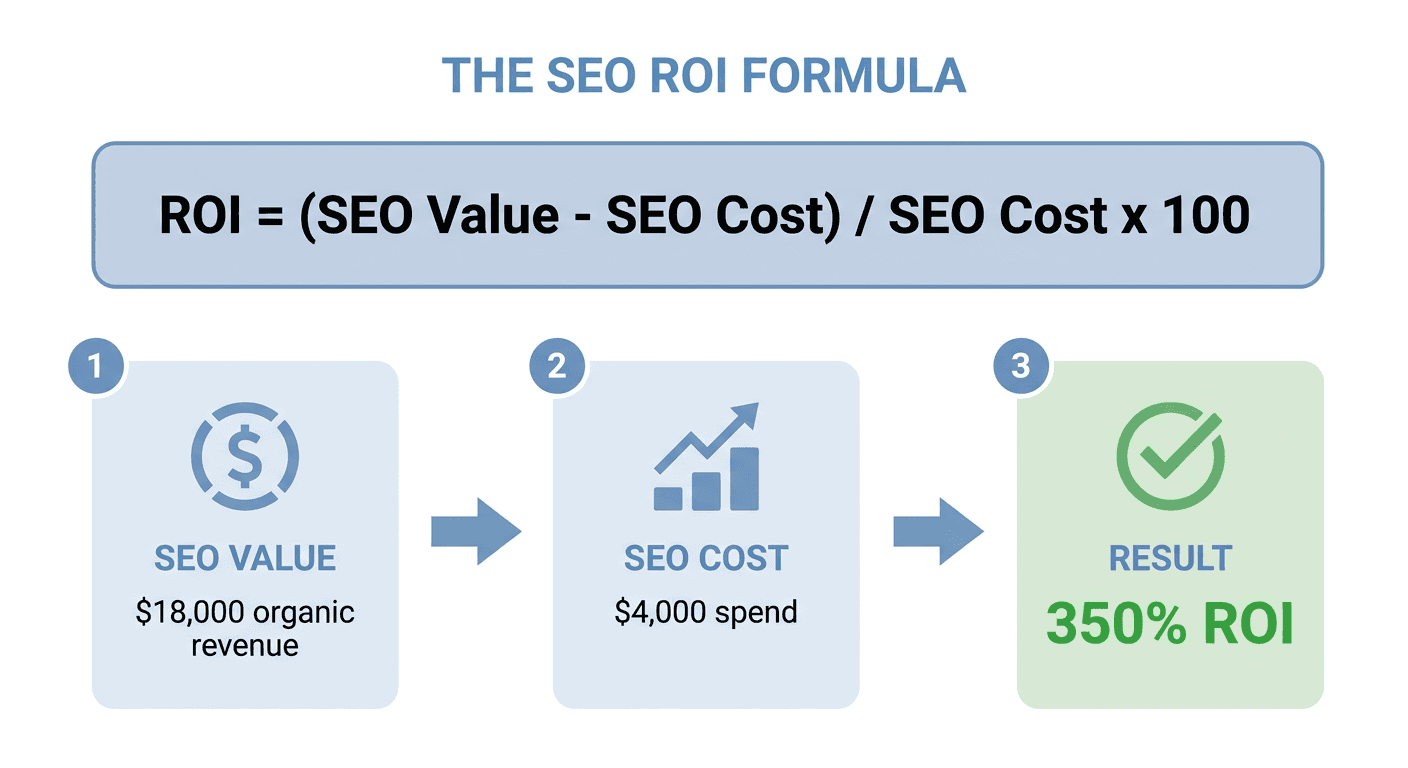
Where each number in the formula actually comes from
SEO Cost: add up everything you'd stop paying if you quit SEO tomorrow
Total every real, incremental cost for the period you're measuring (a month or a quarter, whichever matches your reporting cadence):
- Tools. Your rank tracker, keyword research subscription, or all-in-one SEO platform.
- Content production. Freelance or agency writing fees, or your own hours at a fair internal rate if you write in-house.
- Technical work. Developer time spent specifically on SEO fixes (page speed, schema, redirects, migrations).
- Links or PR, if you run either as a distinct budget line.
Leave out costs you'd keep anyway, like hosting or your CMS license, unless SEO is the actual reason you upgraded them. The goal is a number that represents money you could cancel, not your entire marketing overhead.
SEO Value: revenue, or a defensible stand-in for it
If you sell directly online, this is easy: filter Google Analytics 4 to the "Organic Search" channel and pull ecommerce revenue for the period. If you're B2B or SaaS and don't have a shopping cart, assign a fixed dollar value to your lead-generating events instead:
Assigned lead value = Average deal size × Close rate
So a $2,000 average deal with a 20% close rate makes each demo request worth $400. Multiply that by how many demo requests came from organic search that period, and you have a legitimate revenue figure, even without a single ecommerce transaction. The key is picking one method and using it consistently every period, so the trend line means something.
A full worked example
Here is the calculation end to end, for a small SaaS site over one quarter.
| Line item | Value |
|---|---|
| SEO tool subscription (3 months) | $600 |
| Freelance writer, 8 articles | $2,800 |
| Developer time (schema + page speed) | $600 |
| Total SEO cost | $4,000 |
| Organic sessions this quarter | 11,200 |
| Demo requests from organic sessions | 45 |
| Close rate × average deal size | 25% × $1,600 = $400/demo |
| Attributed SEO value | 45 × $400 = $18,000 |
| SEO ROI | (($18,000 − $4,000) / $4,000) × 100 = 350% |
Two things worth noticing. First, nothing here required an ecommerce cart, an enterprise attribution platform, or a data analyst; it required a cost total, a session count, a close rate, and a deal size, all of which most teams already have somewhere. Second, this is a trailing number. It tells you what already happened last quarter. The leading indicator that this quarter would look good was ranking movement on specific pages weeks earlier, which is why pairing ranking recovery with the revenue formula matters more than checking either one alone.
Three mistakes that quietly wreck the calculation
Measuring too soon. Content published this month rarely ranks, let alone converts, within 30 days. Running the formula on a one-month window almost always understates ROI and convinces teams SEO "isn't working" when it just hasn't had time to. Give a real content change 8 to 12 weeks to settle before you read much into its revenue contribution.
Crediting the wrong channel. Standard last-click attribution in GA4 can hand a conversion to "Direct" or "Referral" even when organic search is what put the page in front of the buyer weeks earlier. Segment by the "Organic Search" default channel group specifically, not a raw source/medium string, so branded search and other traffic doesn't quietly inflate or dilute the number.
Comparing SEO ROI to PPC ROI like they're the same kind of number. PPC ROI is close to arithmetic because you're buying a known price per click. SEO ROI has to be assembled from time, tools, and content spend, and the payoff compounds instead of stopping the moment you stop paying. A 150% SEO ROI and a 150% PPC ROI are not the same asset: one keeps paying next quarter with no added spend, the other resets to zero.
What counts as a "good" SEO ROI
There is no single industry benchmark worth chasing, because deal sizes, sales cycles, and cost structures vary too much between businesses. What matters more is direction: is your ratio of SEO value to SEO cost improving quarter over quarter? As a rough sanity check on your own math:
| ROI range | What it usually means |
|---|---|
| Below 0% | Cost is outpacing attributed value; check timing before assuming SEO failed |
| 0% to 100% | Break-even to modest return; common in the first two to three quarters of a new push |
| 100% to 300% | Healthy, sustainable return once content has had time to mature |
| 300%+ | Strong return, often seen when older pages are recovered rather than built from zero |
That last row matters more than it looks. <mark class="km-highlight" style="--hl:#BBF7D0;background:#BBF7D0">Recovering a page that already ranked is almost always cheaper than building a new one from nothing</mark>, which is why the highest ROI in most accounts comes from fixing what is already halfway there.
The fastest ROI in most accounts: pages stuck on page two
If your ROI number looks flat, it's rarely because organic search "doesn't work" for your business. More often, budget keeps going into brand-new content while pages already sitting in positions 11 to 20, page two of Google, get ignored. Those pages already have some relevance and backlink signal in Google's eyes; a comparatively small update (a missing subtopic, fresher data, better internal links) is often enough to push them onto page one, where click-through rates jump sharply for very little added spend.
That is the cheapest ROI available to most sites, because you're improving an asset you already own instead of starting from zero. Murkuz's low-hanging-fruit workflow scans your Google Search Console data specifically for positions 11 to 20 and ranks them by how much traffic a small push could recover, which turns "which page do I fix first" from a guess into a prioritized list.
Proving the ROI on that kind of fix is the other half of the loop. Murkuz's features include an Agentic Impact Scorecard that ties a specific content fix to the specific ranking change it caused, and connecting Google Analytics (GA4) layers traffic and conversion movement on top of that ranking recovery, so the ROI formula above stops being a spreadsheet you rebuild every quarter and becomes something the numbers do automatically. If you're deciding between doing this by hand and automating it, the pricing page breaks down what's included at each tier.
FAQ
Is there a formula for SEO ROI?
Yes: SEO ROI = ((SEO Value − SEO Cost) / SEO Cost) × 100. SEO Value is the revenue or assigned lead value attributable to organic search for the period; SEO Cost is everything spent to earn it, including tools, content, and labor.
What is the average ROI of SEO?
There isn't one reliable industry-wide figure, because cost structures, deal sizes, and measurement windows vary too much between businesses to average meaningfully. A more useful question is whether your own ROI is trending up quarter over quarter using a consistent method.
How do you calculate ROI for SEO without ecommerce revenue?
Assign a fixed dollar value to lead-generating conversions, such as demo requests or trial signups, using your close rate multiplied by your average deal size. Use that assigned value as the "SEO Value" side of the formula, and keep the underlying assumptions the same every period so the trend is comparable.
How long before an SEO investment shows a positive ROI?
Most sites need one full quarter before the number is stable enough to trust, and 6 to 12 months before the compounding effect of published content and recovered rankings shows up clearly. A 30-day window almost always understates real ROI.
Junaid Khalid is the founder of Ertiqah and the builder of Murkuz. He has run SEO as the first growth channel across his own SaaS products and built Murkuz around the belief that proving a fix worked matters as much as making the fix in the first place.