Surfer SEO is a good content-optimization editor: it scores a draft against the top-ranking pages for a keyword, suggests terms to add, and gives writers a number to chase. But it is still just an editor. It does not tell you when a page you optimized six months ago starts sliding, and it will not publish the rewrite for you. If either of those is the actual reason you are looking around, that changes which alternative on this list is the right one.
This guide covers eight real Surfer SEO alternatives, sorted by what each is actually best at, with current pricing and no invented numbers. It also covers the one gap none of them close: what happens to a page after you optimize it.
Why People Look for a Surfer SEO Alternative
Most people searching this are not unhappy with Surfer's scoring engine. They are running into one of four specific limits:
- Price at scale. Surfer's per-seat and per-project costs add up fast for an agency running content across a dozen client sites, or a team that wants Content Editor access for more than one or two writers.
- One-time optimization, not ongoing monitoring. Surfer scores a page when you write it. It does not watch that page afterward, so nobody notices when the same page decays eight months later, the exact opposite problem to the one Surfer was bought to solve.
- No content generation. Surfer's Content Editor tells a writer what terms to add; it does not draft or rewrite a section for you. You still need a writer, or a separate AI tool, to do the actual writing.
- Workflow gaps. After optimizing in Surfer, someone still has to copy the final draft into WordPress or Webflow, format it, and publish it by hand. Surfer's job ends at the editor.
Here is the honest map of what covers each of those gaps.
Best All-Around Content Optimization Alternatives
These tools do the closest thing to what Surfer does: score a draft against the SERP and tell a writer what to add.
1. Clearscope
Clearscope is the alternative most content teams compare Surfer against first, largely because of its Google Docs integration: writers get a live content score and term suggestions inside the doc they are already writing in, rather than a separate editor tab. It uses term-frequency (TF-IDF-style) analysis of top-ranking pages to generate its keyword and topic suggestions, and its reports are generally considered the most polished-looking of any tool in this category, which matters if you are sharing scorecards with clients or stakeholders. The trade-off is that Clearscope, like Surfer, stops at the grade: it will not draft the rewrite, publish it, or tell you if the page it graded six months ago has started slipping.
2. Frase
Frase leans harder into AI drafting than Surfer does. It pulls SERP data, builds a content brief automatically, and can generate a first-pass draft or outline from that brief, which shortens the gap between research and a writable draft. Its "Answer Engine Optimization" features (structuring content to get pulled into featured snippets and AI answers) are also more developed than Surfer's out of the box. It is a reasonable pick if brief-building and first-draft speed matter more to you than Surfer's polish as a pure editor.
3. MarketMuse
MarketMuse is built around topic modeling and content strategy rather than single-page scoring: it maps your entire site's topical coverage, flags content gaps versus competitors, and can prioritize which pages to write or rewrite based on projected difficulty and opportunity. That makes it a stronger fit for planning a content roadmap across dozens or hundreds of pages than for optimizing one article at a time. Pricing sits at the higher end of this list, which is the trade-off for the strategic layer Surfer does not attempt.
4. NeuronWriter
NeuronWriter covers the same core job as Surfer (SERP-based content scoring, term suggestions, an editor) at a noticeably lower price point, which makes it the most direct budget swap on this list for a solo writer or small team who mainly used Surfer's Content Editor. It also includes basic rank tracking and internal linking suggestions bundled into the same plan, features Surfer charges for separately or does not offer at all.
Best for Content Briefs and Team Handoffs
5. Content Harmony
Content Harmony is built specifically around the brief-and-handoff workflow: it pulls competitor research, "questions people ask," and recommended content formats into a structured brief a writer can work from directly, rather than a raw content score. If your actual friction with Surfer is writers not knowing what to do with the score once they have it, Content Harmony's brief format solves a different, earlier part of that problem.
6. WriterZen
WriterZen combines keyword research and topic clustering with a content-writing workspace, aimed at teams that want keyword discovery and content planning in the same tool rather than importing a keyword list from somewhere else. It is priced as a one-time or lifetime purchase in some tiers rather than Surfer's pure subscription model, which can work out cheaper for a solo operator who does not need continuous updates to the underlying keyword database.
Best Budget and Bundled Alternatives
7. Semrush SEO Writing Assistant
If you already pay for Semrush, its SEO Writing Assistant is bundled into most plans at no extra cost and covers the same basic job as Surfer's editor: readability, tone, originality, and SEO scoring against the target keyword. It is noticeably shallower than Surfer's SERP-based term analysis, so it is not a like-for-like replacement, but if your Semrush seat already includes it, it removes the need for a second subscription for basic on-page checks.
8. Scalenut
Scalenut bundles SERP-based content briefs, an AI writing assistant, and a content optimization score into one workspace, positioned as a single tool covering research through a publishable draft. It is a reasonable pick if you specifically want AI drafting and optimization scoring in the same subscription rather than stitching Surfer together with a separate AI writer.
Surfer SEO Alternatives at a Glance
| Tool | Best for | Core approach | Publishes for you? |
|---|---|---|---|
| Clearscope | Google Docs workflows, polished client reports | Term-frequency content grading | No |
| Frase | Brief-building plus first-draft AI generation | SERP brief + AI draft | No |
| MarketMuse | Site-wide topic strategy, not single pages | Topic modeling | No |
| NeuronWriter | Budget-friendly like-for-like Surfer swap | SERP scoring + editor | No |
| Content Harmony | Structured briefs for writer handoffs | Competitor research briefs | No |
| WriterZen | Keyword research plus writing workspace | Clustering + editor | No |
| Semrush Writing Assistant | Teams already paying for Semrush | Basic on-page scoring | No |
| Scalenut | AI draft plus optimization in one workspace | Brief + AI writer + score | No |
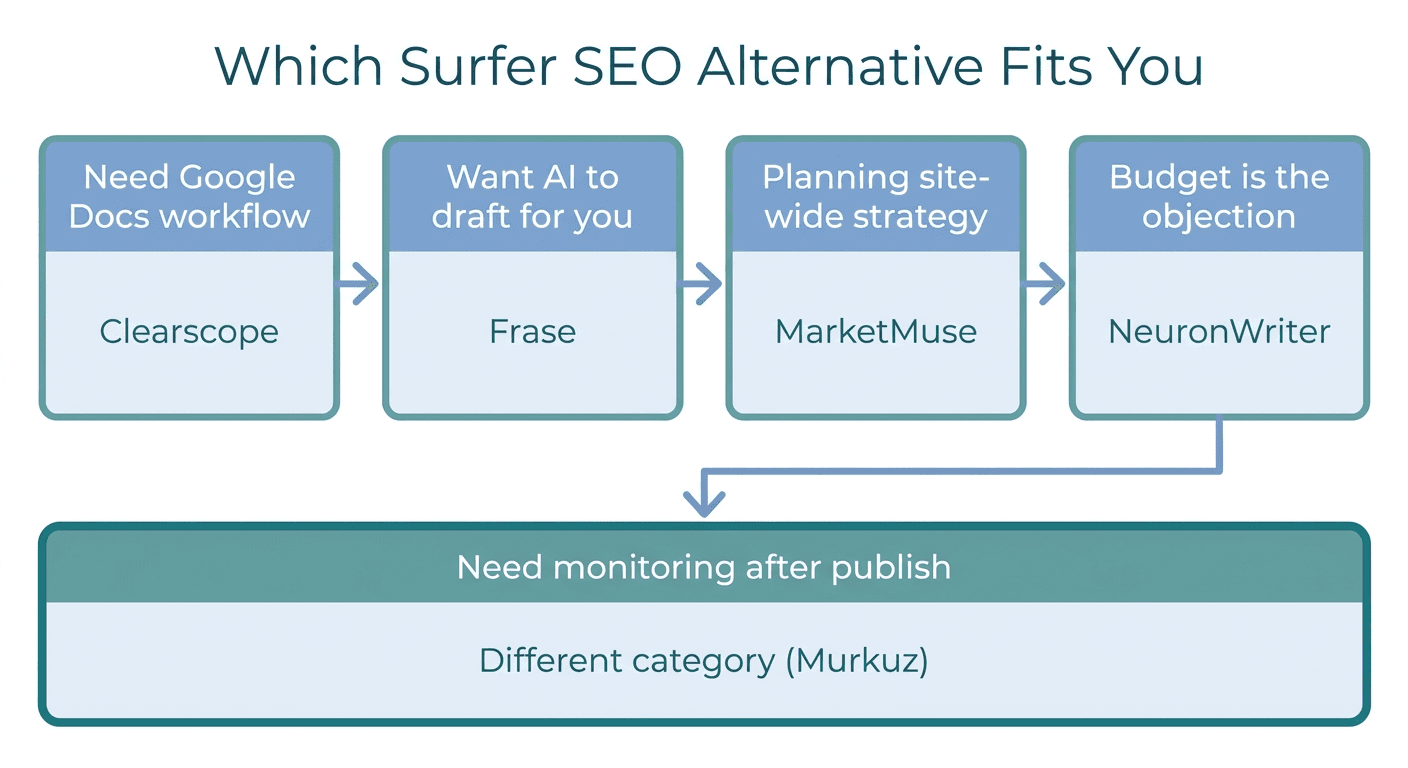
How to Actually Choose
Match the reason you are looking, not the name you have already heard the most.
- If Google Docs integration and polished reporting matter: Clearscope is the closest, most direct swap.
- If you want AI to draft, not just grade: Frase or Scalenut save the most time between research and a writable draft.
- If you are planning content across a whole site, not one article: MarketMuse's topic modeling is built for that scope; Surfer and the others above are built for one page at a time.
- If price is the actual objection: NeuronWriter and WriterZen do most of the same job for meaningfully less.
- If your real problem is what happens after publish: none of the eight tools above solve this, because none of them are built to. A content score, however accurate, does not tell you six months from now that the page it graded has quietly slipped from position 6 to position 17. That is a different category of problem, and it is worth reading how Murkuz compares to Surfer SEO on that specific point.
Where a Tool Like Murkuz Fits (and Where It Doesn't)
To be direct: Murkuz is not a content editor, and if a better scoring interface or a faster AI draft is genuinely what you need, one of the eight alternatives above is the better fit today. Murkuz starts from a different question. Instead of "how do I score this draft before I publish it," it asks "which of my already-published pages are losing rankings right now, and what do I do about that."
Concretely, Murkuz connects to your Google Search Console data and runs five steps automatically: it detects declining pages, positions-11-to-20 opportunities, and content cannibalization every day; turns each one into a task with the specific fix attached; generates an AI content refresh that references a stored brand-voice knowledge base (Murkuz calls this HyBrain) so the rewrite doesn't read like generic AI copy; pushes that fix live to WordPress, Webflow, or Framer with one click; and then tracks the ranking afterward, attributing the recovery to the specific fix through what Murkuz calls its Agentic Impact Scorecard, rather than a correlation-only traffic graph.
<mark class="km-highlight" style="--hl:#FEF08A;background:#FEF08A">None of the eight alternatives above monitor a page after you optimize it, generate the rewrite for you, or publish it to your CMS</mark>. They all stop at the score or the draft, the same place Surfer stops. If your actual Surfer frustration is scoring content well and then watching it decay anyway because nobody circles back, that is the specific, narrow problem Murkuz is built to close, and the full breakdown of what that costs is on the pricing page.
Frequently Asked Questions
Is there a free alternative to Surfer SEO?
Not one that fully replaces its SERP-based scoring, but Semrush's SEO Writing Assistant is included at no extra cost if you already have a Semrush seat, and several of the tools above (Frase, NeuronWriter) offer limited free trials rather than an ongoing free tier.
What is the closest alternative to Surfer SEO?
Clearscope and NeuronWriter are the two most direct like-for-like competitors: both score a draft against top-ranking pages and suggest terms inside an editor, the same core workflow Surfer uses.
What is the cheapest Surfer SEO alternative that's still good?
NeuronWriter is generally the most-cited budget swap, covering the same SERP-scoring workflow at a noticeably lower monthly price than Surfer or Clearscope.
Does Surfer SEO have a free trial?
Surfer offers a limited trial period rather than an ongoing free tier; check its current pricing page for the exact terms, since trial length and structure change periodically.
Can I use more than one of these tools instead of Surfer?
Yes. A common setup is a cheaper scoring tool like NeuronWriter for day-to-day optimization, paired with MarketMuse or a similar tool only when planning a larger content strategy, which can cost less combined than one higher-tier Surfer seat.
Do any of these tools monitor a page after it's published, not just before?
Not the eight above; all of them, like Surfer, stop once the draft is scored or written. That gap, optimizing a page once and never checking on it again, is what platforms like Murkuz are built to close, connecting an ongoing decline check directly to a published fix and then proving whether it worked.
Junaid Khalid is the founder of Ertiqah and the builder of Murkuz. He has run SEO as the first growth channel across his own SaaS products, and built Murkuz around the belief that a tool should not stop at scoring a page. It should tell you when that page starts slipping, help you fix it, and prove the fix worked.