A content brief is a short written document that tells a writer exactly what to create before they write a single word: the target keyword, the audience, the search intent, the structure, and the goal the piece has to hit. It exists so the writer doesn't have to guess, and so the person who assigned the piece doesn't have to rewrite it.
That's the textbook answer, and most articles on this topic stop right there. But if content briefs were really that simple, teams wouldn't still be shipping first drafts that miss the point, get rejected, and cost a full revision cycle to fix. The problem usually isn't a missing brief. It's a brief that lists the right fields but never tells the writer why any of it matters.
The actual definition
A content brief is a planning document, usually one to two pages, that translates a content goal into instructions a writer can act on without asking follow-up questions. It sits between "we need an article about X" and the first draft, and its entire job is to remove ambiguity before time gets spent writing.
Three things separate a real content brief from a Slack message or a verbal ask:
- It's written down. A brief that lives in someone's head, or in a scattered thread of comments, isn't a brief. It's a source of rework.
- It's specific to one piece of content. A style guide or brand voice doc applies across everything you publish. A brief applies to this one article, this one keyword, this one reader.
- It exists before writing starts, not after. A brief written after the first draft is a revision list wearing a brief's name.
<mark class="km-highlight" style="--hl:#FEF08A;background:#FEF08A">A content brief's real purpose is to move the thinking that normally happens during a revision cycle to before the first draft gets written.</mark> Every field in a good brief exists to prevent one specific kind of rewrite.
What does a content brief include
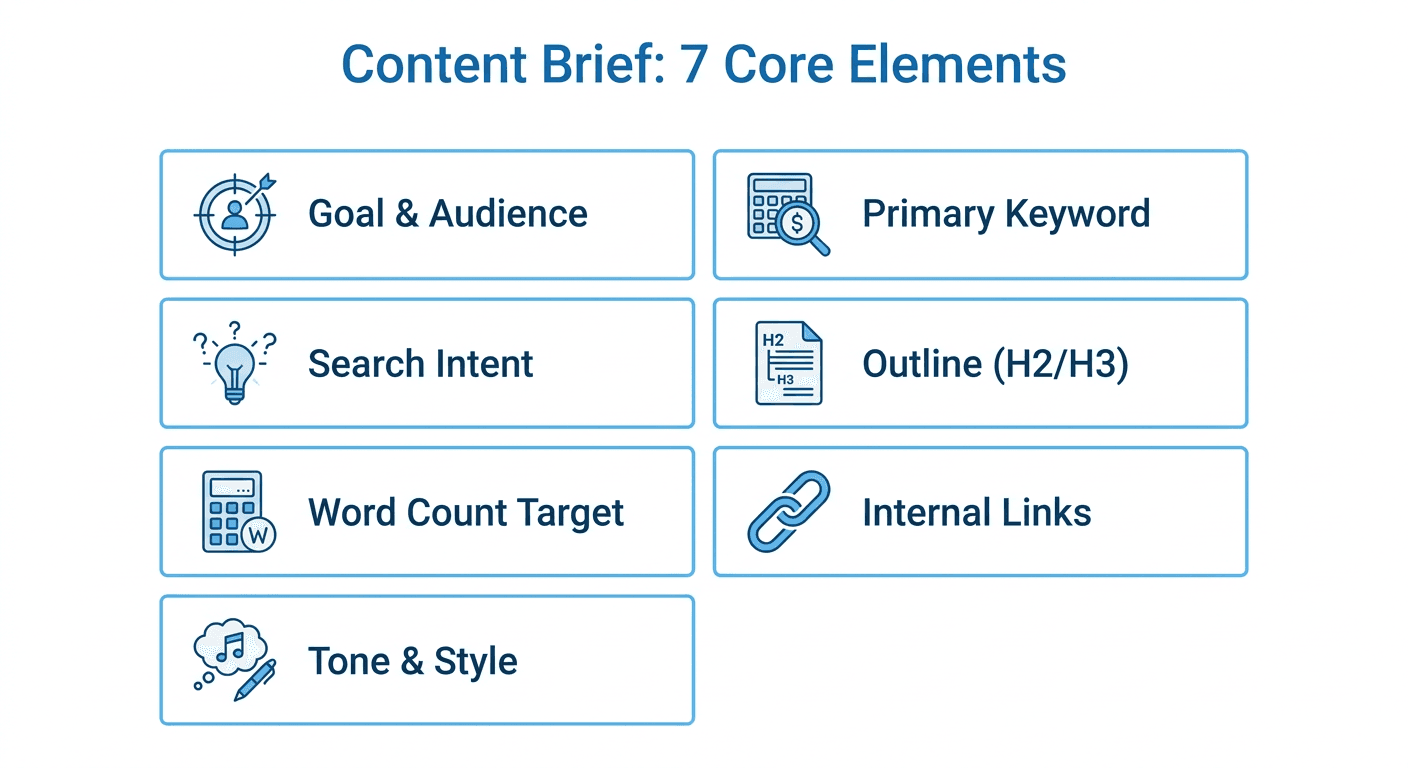
Strip away the templates and the jargon, and every content brief that actually works answers seven questions. Miss any one of these and you'll feel it in the first draft.
| Element | What it answers | What happens if you skip it |
|---|---|---|
| Goal and audience | Who is this for, and what should they do or feel after reading it | Writer defaults to a generic tone that fits no one |
| Primary keyword and supporting terms | What phrase is this page trying to rank for | Draft targets the wrong intent or wanders off-topic |
| Search intent | Is the reader trying to learn, compare, or buy | Informational query gets a sales pitch, or vice versa |
| Outline (H2/H3s) | What subtopics and questions must be covered | Draft misses the sections competitors already rank for |
| Word count / depth target | How thorough does this need to be to compete | Draft is too thin to rank or padded with filler |
| Internal and external links | What should this page point to, and what should link back | Orphaned page with no path into the rest of the site |
| Tone, style, and constraints | House style, banned phrases, formatting rules | Draft reads off-brand and needs a full copy edit |
Notice what's not on that list: a fully written outline the writer just fills in, or a set of "SEO best practices" copy-pasted from a template. A brief that hands a writer a skeleton to flesh out isn't saving time, it's just moving the same decisions earlier without making them any clearer.
Why most content briefs are missing the point
Here's the pattern behind almost every underperforming content brief: it lists fields instead of answering questions.
A brief that says "Primary keyword: keyword clustering tool" tells the writer what to type into the title tag. A brief that says "the reader just typed 'keyword clustering tool' because they're staring at 200 keywords in a spreadsheet with no idea how to group them, and they want a tool that does it for them right now, not a 3,000-word explainer" tells the writer what to actually write.
The difference is search intent made concrete instead of labeled. Most briefs get intent right as a category (informational, commercial, transactional) but never translate it into what the reader is actually trying to do in that exact moment. That gap is where thin, generic drafts come from, even when every field in the brief got filled in correctly.
The second common failure is treating the outline as decoration. An outline copied from what already ranks doesn't tell the writer anything new. A useful outline names the specific gap: "competitors 1 through 3 all define this term but none of them explain why teams still get it wrong, that's the angle."
How a content brief differs from an outline or a creative brief
These three get used interchangeably, and that's part of why briefs go wrong.
- A content brief is about one specific piece of written content: keyword, intent, structure, audience, constraints. It's the input to a first draft.
- An outline is a subset of a content brief: just the heading structure and the order of sections. Useful, but it doesn't carry the "why," which is the part that actually prevents rewrites.
- A creative brief is broader and often not SEO-specific at all. It can cover a campaign, a video, a landing page, and a blog post at once, with shared messaging and visual direction, but rarely gets into keyword-level detail.
If you only have an outline, you have half a brief. If you only have a creative brief, you have direction but not enough specificity for a writer to hit search intent on the first pass.
Where the brief actually comes from
A brief is only as good as the research behind it, and that research starts with knowing which keyword this piece is even supposed to own. Trying to write a brief before you've grouped your keywords into topics just moves the guesswork from the writer to whoever wrote the brief.
This is the step most teams skip, and it's the one that actually determines whether the brief has anything useful to say about search intent, subtopics, or which article should even get written. If you're staring at a spreadsheet of keywords and trying to figure out which ones belong in the same brief and which ones deserve their own page, Murkuz's free keyword clustering tool groups them into topic clusters and hands back a pillar-and-spoke content plan, so the brief starts from a real map of the topic instead of a single keyword picked at random.
A brief is not the finish line
Even a well-written brief only prevents the mistakes you can predict at the planning stage. It won't catch that a competitor published a better version of your article last month, or that the page you wrote six months ago from a perfect brief has quietly slipped from position 4 to position 14 because the SERP moved on without it.
That's a different problem than briefing, and it's the one Murkuz is actually built around. Instead of stopping at "here's a brief for a new article," Murkuz scans your Google Search Console data daily, flags the gaps in your content map where competitors rank and you don't, and auto-generates new content briefs for those gaps directly from the detection engine, so the brief itself is grounded in a live ranking gap instead of a hunch. On the Growth plan, that same workflow can auto-execute the fix once a brief is approved, rather than leaving the brief as a document someone still has to act on manually.
A content brief written in isolation is a bet on what will rank. A content brief generated from an actual detected gap in your rankings is closer to a diagnosis. Both are still "content briefs" by definition. Only one of them is grounded in what's actually happening in the SERP right now.
FAQ
What is a content brief in simple terms?
It's a short document, usually one to two pages, that tells a writer the keyword, audience, search intent, structure, and goal for one specific piece of content before they start writing.
What does a content brief include?
At minimum: the goal and target audience, the primary keyword and supporting terms, the search intent, an outline of required subtopics (H2/H3s), a word count or depth target, internal/external link guidance, and tone or style constraints.
What is the difference between a content brief and a creative brief?
A content brief is specific to one piece of written content and gets into keyword-level detail. A creative brief is broader, often covering a whole campaign across formats (video, landing pages, ads) with shared messaging, and usually doesn't specify things like target keywords or word count.
Who is responsible for writing the content brief?
Usually a content strategist, SEO specialist, or marketing manager, sometimes the writer themselves if they're also doing the keyword research. Whoever owns the outcome (rankings, conversions) should own the brief, since they're the one who has to live with a draft that misses the point.
Do I need a content brief for every piece of content?
For anything meant to rank in search, yes. Skipping the brief on SEO content usually means the intent gets guessed at draft stage instead of decided at planning stage, and that's a more expensive mistake to fix.
Junaid Khalid is the founder of Ertiqah, the company behind Murkuz. He has run SEO as the first growth channel across his own SaaS products, which is the belief behind Murkuz: that a ranking drop should trigger a fix, not just a report.