Every agency hits the same wall. You sign client six, revenue goes up, and so does everything else: the GSC tabs you have to check, the reports you have to write, the hours you spend on work that has nothing to do with why the client hired you. White label SEO exists to solve exactly that problem, but most explanations of it stop at the definition and never get to the part that actually matters: which model fits your agency, what it does to your margins, and how you avoid becoming the thing white label SEO was supposed to save you from, a delivery bottleneck with your name on it.
This guide covers all of it. What white label SEO actually is, the three models agencies use to deliver it (reseller, software, hybrid), the real math behind each one, how to vet a white label partner if you go that route, and the client-reporting problem that quietly kills more agency-client relationships than bad rankings ever do.
What White Label SEO Actually Means
White label SEO is any arrangement where the work behind an SEO deliverable is not performed directly by the agency's own staff under the agency's own name, but the client only ever sees your brand. A specialist provider (an agency, a freelancer network, or a software platform) does the audits, the content, the technical fixes, or the reporting. Your agency reviews it, wraps it in your branding, and delivers it to the client as your own work.
The client relationship stays yours. The account management, the strategy calls, the invoice, all of it carries your logo. What changes is who is actually doing the SEO work behind the curtain.
This matters because "white label SEO" gets used loosely to describe three genuinely different operating models, and conflating them is where a lot of agencies make the wrong call for their situation.
The Three Models, and Who Each One Actually Fits
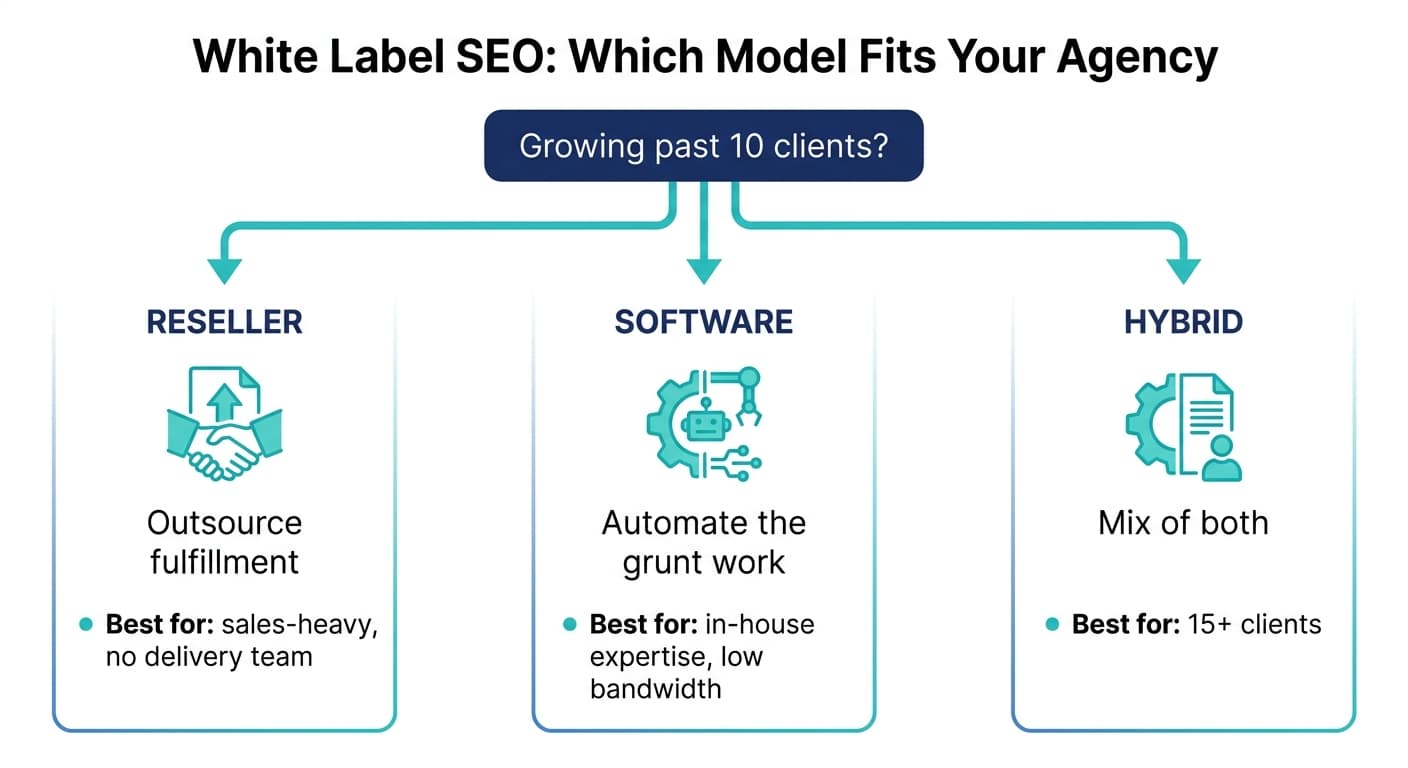
1. Reseller (outsourced fulfillment)
You buy pre-packaged or custom SEO services from a provider like a link-building shop or a full-service white label agency. They do the work, you mark it up, and you present it as your own. This is the oldest and most common model, and it is what most "white label SEO" search results assume you mean.
Fits you if: you have sales capacity but not delivery capacity, your clients need standard SEO work (content, links, technical audits) rather than a bespoke strategy, and you would rather pay a margin for done-for-you fulfillment than hire and manage a delivery team.
Does not fit you if: your clients expect a genuinely custom strategy, you want direct control over quality and turnaround, or your margin math cannot absorb a middleman's cut on top of your own.
2. Software (you deliver, a platform does the grunt work)
Your team still does the SEO work and owns the strategy, but a software platform automates the parts that do not require a strategist's judgment: detecting what is wrong across every client site, generating the reporting, sometimes even publishing the fix. You are not outsourcing the thinking, you are outsourcing the manual labor around it.
Fits you if: you already have SEO expertise in-house and the bottleneck is not knowledge, it is hours: too much time spent checking Google Search Console across a dozen accounts, building reports nobody reads, and manually pushing updates to five different client CMSes.
Does not fit you if: you have no in-house SEO capability at all and need someone else to actually do the strategic thinking, not just the busywork around it.
3. Hybrid
Most agencies that scale past 15 to 20 clients end up here without planning to: outsourced fulfillment for the commodity work (bulk content, link building), software for monitoring and reporting across the whole portfolio, and in-house staff focused on strategy, client relationships, and the accounts that need real attention. It is less a deliberate choice than a natural landing point once pure reseller margins get thin and pure in-house delivery gets unmanageable.
Why Growth Without This Feels Like a Trap
Here is the pattern almost every agency owner recognizes once client count creeps past ten or fifteen: revenue goes up, and so does everything that eats into the margin on that revenue.
- Manual monitoring becomes a full-time job. Checking Google Search Console for 15-plus client sites every week, by hand, is not a task you can keep doing as you add clients six through twenty.
- Context switching kills output. Jumping between a dozen GSC accounts, a dozen CMSes, and a dozen task boards costs real hours that never show up as billable work.
- Reports stop retaining clients. "Rankings improved" is not proof of anything a client can point to. Without evidence that your specific work, not a Google algorithm update, caused the improvement, clients start asking what they are paying for.
- Churn follows within two quarters. Agencies that cannot show causal proof of impact lose clients after three to six months, right when the relationship should be maturing into expansion revenue, not ending.
None of this is a strategy problem. It is an operations problem, and it is the specific problem white label SEO, in whichever model fits you, is supposed to solve.
The Real Margin Math (Not the Marketing Version)
Reseller pricing pages rarely show you the number that matters: your margin after the provider's cut, your account management time, and your quality-control overhead. A rough way to think about it, per client, per month:
| Model | What you pay for | What eats your margin |
|---|---|---|
| Reseller | Provider's fee per deliverable | The provider's markup, plus your own QA time reviewing their work before it goes to the client |
| Software | A flat platform fee, usually per seat or per client-site tier | Your team's time still doing the strategic and execution work, just faster |
| Hybrid | A mix of both | Coordination overhead between the outsourced piece and the in-house piece |
The pattern that catches agencies off guard: <mark class="km-highlight" style="--hl:#FEF08A;background:#FEF08A">reseller margins look great on client one and thin fast by client eight</mark>, because the markup is roughly constant per client while your account-management and QA time per client does not shrink. Software-based costs tend to behave the opposite way. A flat platform fee gets cheaper per client as you add more sites to it, which is why agencies that outgrow pure reselling often shift toward a software-plus-strategist model instead of a bigger provider markup.
There is no universally "best" model here. A five-client agency doing local SEO for restaurants has a completely different calculation than a twenty-client agency serving SaaS companies, and the honest answer is to run your own numbers on a couple of real clients before committing to one model across your whole book.
How to Vet a White Label Provider (If You Go the Reseller Route)
If reseller fulfillment fits your agency, the provider you pick determines whether this scales you or embarrasses you in front of a client. A short, practical checklist:
- Ask to see a real deliverable, not a demo. A sample audit or content piece for an actual (even if anonymized) client tells you more than any sales page.
- Confirm the turnaround time in writing. "Fast" means nothing. Get a number, and get what happens when they miss it.
- Understand exactly what is white-labeled. Some providers only strip their logo from a PDF; others give you a fully brandable client portal. Know which one you are buying before your client asks a question the provider's brand shows up in the answer to.
- Check what happens on a bad month. Every provider has an off month. Ask what their remediation process looks like, not just their guarantee copy.
- Price the QA time into your own margin. Even the best provider's work needs a review pass before it reaches your client under your name. If you skip that step to save time, the first mistake that reaches a client is the one that costs you the account.
Quality Control Is the Part Most Agencies Skip
The single biggest risk in any white label arrangement, reseller or otherwise, is that the client thinks they hired your agency's judgment, not a third party's output. Every deliverable that goes out under your name needs a human on your side who actually reads it before it ships: does this content sound like something your agency would write, does this technical recommendation make sense for this specific client, does this report actually say something the client can act on.
This is the step agencies cut when they are stretched thin, and it is exactly the wrong one to cut, because it is the only thing standing between <mark class="km-highlight" style="--hl:#BBF7D0;background:#BBF7D0">"we outsource fulfillment intelligently"</mark> and "we forward emails." Build the review step into your process from day one, even if it is fifteen minutes per deliverable, rather than treating it as optional overhead you will add later.
The Reporting Problem Nobody Talks About
Ask any agency owner why a client left, and "rankings didn't improve" is rarely the honest answer. More often, rankings improved and the client left anyway, because nothing connected that improvement to the agency's actual work. A page moving up during the same month Google pushed a core update looks identical to a page moving up because of a specific fix your team shipped, unless you can show the difference.
This is the gap that white label SEO software is best positioned to close, and it is worth naming directly because it is where reseller-only agencies tend to underinvest. A branded PDF that says "your rankings went up 12%" is not proof of anything. A report that says "we rewrote this specific section on March 3rd, and this specific keyword moved from position 19 to position 11 over the following two weeks" is the kind of evidence that survives a budget review.
If you are already running client sites through the tools stack most agencies use for monitoring and reporting, the honest next question is whether that stack actually proves causation, or just shows a line trending upward that could be explained by a dozen other things.
Where a Detect-Fix-Prove Platform Fits (and Where It Does Not)
Most SEO tools, white label or not, stop at detection. They tell you a page is losing rankings, and then it is on your team to build the ticket, brief a writer, get the fix into whatever CMS each client uses, and eventually try to explain to the client why it mattered. That handoff chain is where agency hours disappear, and it is a different problem than "we need more SEO work done."
Murkuz was built around exactly this gap, closing the loop from detection through proof rather than stopping at the report. For agencies specifically, that means one dashboard across every client site instead of a dozen separate Search Console tabs, automated daily detection per client so nobody is manually auditing 15-plus accounts every week, and an Agentic Impact Scorecard that ties a specific fix to the specific ranking change it caused, which is the retention proof a branded PDF alone cannot provide. Fixes publish straight to WordPress, Webflow, or Framer without anyone touching a CMS by hand, and white-label branding (custom domain, your logo, branded client portals) means the client never sees the platform underneath your delivery.
This is the software model described earlier in this guide, not a replacement for having actual SEO judgment on staff. If your bottleneck is knowledge, not hours, a platform like this will not fix that. But if you already know what good SEO looks like and the thing killing your margins is the manual work of watching a dozen accounts and proving your impact on each one, that is precisely the operational gap it closes. You can see how the full workflow maps to agency operations specifically on the agency operations page, or go straight to what Murkuz offers agencies if you want the specifics.
FAQ
Is white label SEO ethical to offer clients?
Yes, as long as your agency stands behind the quality of the work and remains the point of accountability. Clients are paying for a result and a relationship they trust, not necessarily for every task to be performed by a full-time employee. The ethical line is not who does the work, it is whether you reviewed it, stand behind it, and would defend it if the client asked hard questions.
How much does white label SEO cost?
Reseller pricing typically runs from a few hundred dollars a month for basic content or link packages to several thousand for full-service campaigns across multiple deliverables. Software platforms usually price per seat or per client-site tier rather than per deliverable. The honest comparison is not the sticker price, it is your all-in cost per client once you add your own QA and account management time on top.
Can a small agency use white label SEO, or is it only for larger shops?
Smaller agencies often benefit the most, because they are the ones without the headcount to build a delivery team. A two-person agency using reseller fulfillment for execution and their own strategy for client relationships can credibly serve clients that would otherwise require a much bigger team.
What is the difference between white label SEO and an SEO reseller program?
"Reseller" almost always refers to the outsourced-fulfillment model specifically. "White label SEO" is the broader category that also includes software platforms and hybrid setups where your own team does the work with automated tooling behind it. Every reseller arrangement is white label; not every white label arrangement is reselling.
How do I switch from a reseller model to running more in-house with software?
Most agencies do this gradually rather than all at once: keep the reseller relationship for existing clients mid-campaign, bring new clients onto the in-house-plus-software model, and migrate existing accounts as contracts renew. Trying to switch every client's delivery model in the same month is where the quality control step gets skipped, and that is the mistake that costs you an account.
Junaid Khalid is the founder of Ertiqah and the builder of Murkuz. He has run SEO as the first growth channel across his own SaaS products before building tooling to automate the parts of that work that do not need a human's judgment.