Most "best SEO tools for agencies" lists hand you 13 to 15 tools and leave you to figure out which ones you actually need. That is not a stack, it is a shopping cart, and if you tried to buy all of it you would be paying for three tools that do the same job before you have onboarded your second client.
This is not that list. It is a curated stack: one tool per real job an agency has to do, chosen for what agencies specifically need (client-facing reporting, multi-site management, margins that survive adding a fifth client), with real pricing and no invented reviews. If a category has a free option that genuinely covers the job, it is here instead of a paid one. If two tools do the same thing, only the better one made the cut. Where a detect-fix-prove platform like Murkuz fits into that stack, and where it does not, gets an honest answer near the end.
What an Agency Actually Needs From Its Tool Stack
Before the list, it helps to separate what a solo blogger needs from what an agency needs, because most roundups do not.
An agency's tooling problem is not "which tool has the biggest keyword database." It is:
- Client-facing reporting. Whatever you use has to produce something you can hand a client without editing it into a real report first.
- Multi-site management. Checking 15 separate dashboards is not a research problem, it is a scaling problem, and it is the one most "best tools" lists never mention because they are written for a single site.
- White-label options. Your invoice says your agency's name. Ideally your dashboard does too.
- Margin, not just capability. A $500/month suite that does everything is worthless if it eats the margin on your smallest client.
Every tool below is here because it clears at least one of those bars for an agency specifically, not because it topped a generic best-of list.
The Curated Stack
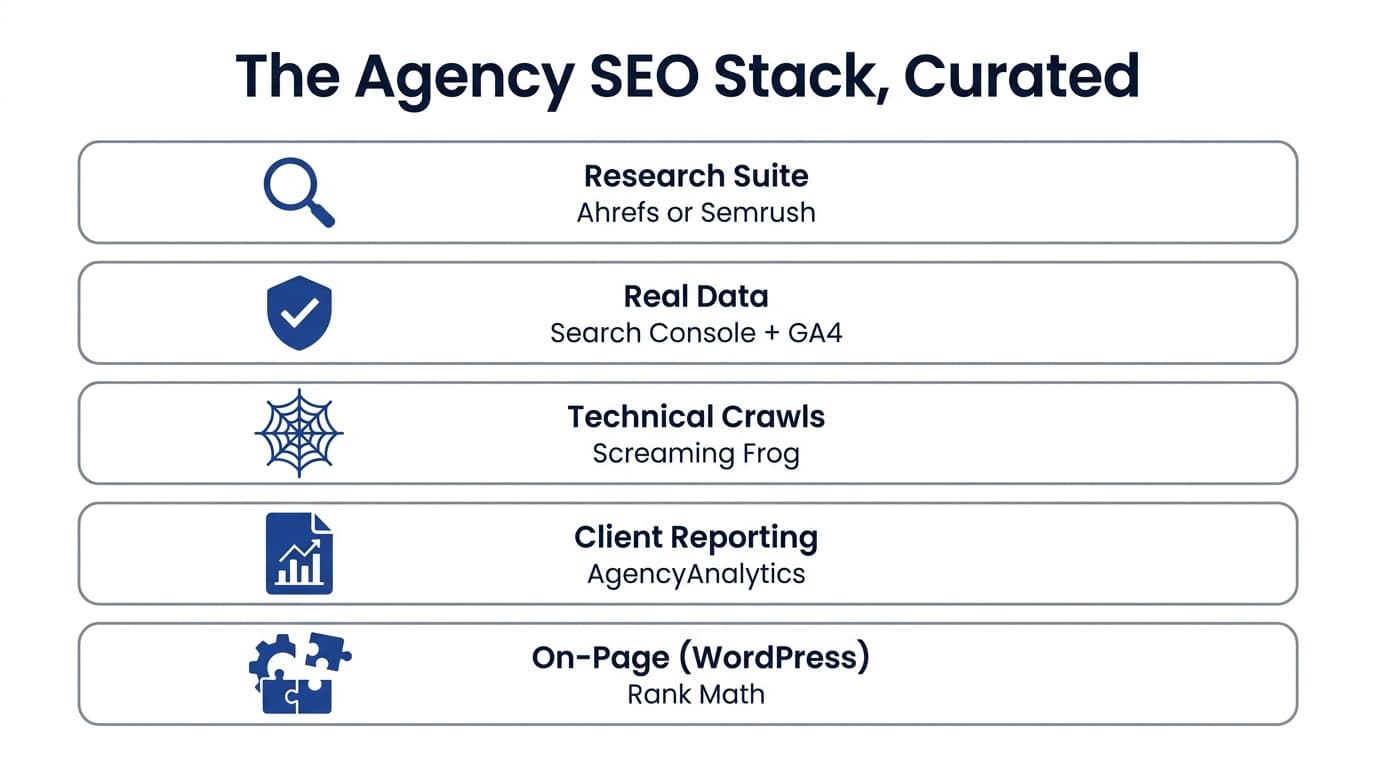
1. Semrush or Ahrefs, pick one, not both
Every agency needs one all-in-one research suite for keyword research, competitor analysis, and backlink audits. The honest agency advice is to pick one, not run both, because the overlap in what they do is close to total and the cost of both is rarely justified.
Ahrefs has the larger, generally regarded as more precise backlink index and is the tighter pick if link building and competitor backlink audits are the bulk of your work. Plans run from roughly $129/month (Lite) up to $449/month (Advanced) for individual seats, with agency-tier plans priced separately.
Semrush covers the same core ground (keyword research, site audits, rank tracking, backlinks) and adds tools for paid search, social, and content, which matters if your agency sells more than SEO. Plans run from about $139.95/month (Pro) to $499.95/month (Business).
Pick Ahrefs if backlinks are the job. Pick Semrush if you are selling a broader marketing retainer and want fewer logins.
Deciding which one to standardise the agency on is easier with the numbers side by side, and our head-to-head on Ahrefs, Moz and Semrush sets out entry pricing, index size, and the job each suite is genuinely built for.
2. Google Search Console and Google Analytics 4, non-negotiable, always free
This is the tool every other tool on this list is estimating. Ahrefs, Semrush, and every rank tracker infer your rankings from sample data; GSC reports what Google itself saw: real impressions, real clicks, real average position, per query, per page. GA4 adds what happened after the click. Every client engagement should start with both connected, and neither costs a cent.
If your agency's reporting stops at "here is a rank tracker screenshot," that is a client retention risk. Clients increasingly ask why a number moved, and GSC plus GA4 is the only data source that can actually answer that, because it is the source Google itself uses.
3. Screaming Frog, for technical crawls
Screaming Frog SEO Spider remains the standard downloadable crawler for broken links, redirect chains, missing meta tags, and duplicate content. The free version covers up to 500 URLs, which handles most small client sites outright. A paid license (roughly $259 to $279/year) removes the cap, and for an agency running crawls across a dozen client sites regularly, that is one of the cheapest line items in the whole stack relative to how often you will open it.
4. AgencyAnalytics or Whatagraph, for client reporting
This is the category most generic "best SEO tools" lists skip, because they are written for someone with one site, not fifteen clients. An agency needs a reporting layer that pulls GSC, GA4, and rank data into a single branded PDF or live dashboard, because rebuilding that report by hand every month for every client is exactly the kind of manual work that kills agency margins.
AgencyAnalytics is built specifically for agencies: white-label dashboards, automated report scheduling, and integrations across the major marketing channels, not just SEO. Pricing starts around $20 to $30/month per client site on annual billing, scaling with the number of client campaigns.
Whatagraph covers similar ground with a stronger focus on cross-channel reporting (SEO plus paid plus social in one report), which suits agencies selling broader retainers rather than SEO-only engagements.
Either is a reasonable pick. The point is that some dedicated reporting layer belongs in the stack, because "we will just export a CSV" does not survive past your third client.
5. Rank Math or Yoast, if you manage WordPress client sites
If your clients run WordPress, an on-page SEO plugin that handles meta tags, schema markup, sitemaps, and basic technical checks at the CMS level saves you from managing that manually across every site. Rank Math has the deeper free tier (its free version includes schema markup and basic content analysis that Yoast reserves for its paid tier) and pricing that runs roughly $8 to $55/month depending on tier for its Pro features. Yoast is the more established name with a simpler interface, priced similarly. Pick whichever your team already knows; switching an established client site's SEO plugin is rarely worth the migration risk.
Agency Tool Stack at a Glance
| Job | Tool | Starting price | Free option |
|---|---|---|---|
| All-in-one research suite | Ahrefs or Semrush | ~$129 to $140/mo | Limited free tools, no full trial |
| Real ranking + traffic data | Google Search Console + GA4 | Free | Fully free |
| Technical site crawls | Screaming Frog | Free up to 500 URLs | Fully free (capped) |
| Client-facing reporting | AgencyAnalytics or Whatagraph | ~$20 to $30/mo per client | Free trial, no permanent free tier |
| On-page SEO (WordPress) | Rank Math or Yoast | Free to ~$55/mo | Yes, generous free tier |
What Every One of These Tools Has in Common (and Where the Gap Is)
Look at the five jobs above and a pattern shows up: every tool on this list, including the big paid suites, stops at telling you something. Ahrefs tells you a page's rankings dropped. Screaming Frog tells you a page has a broken link. AgencyAnalytics tells your client what happened last month. None of them do anything about it. The fixing, publishing, and re-checking is still a human, on your team, doing it by hand, for every client, every week.
That is the specific gap where agency margins actually get squeezed. It is not that agencies lack data. Between GSC, Ahrefs or Semrush, and a rank tracker, most agencies are drowning in data about what is wrong. The expensive part is turning "page 5 declining, positions 5 to 14" into a rewritten section, published to the client's CMS, and then proven to have worked, multiplied across fifteen client sites.
Murkuz is built around exactly that gap, and it is worth being direct about what it is and is not. It is not a bigger keyword database or a better backlink index than Ahrefs or Semrush; if that is your bottleneck, one of the tools above already solves it. What Murkuz does instead is connect to each client's Search Console data and run five steps automatically: detect declining pages, positions-11-to-20 opportunities, and cannibalization issues every day across your entire client portfolio from one dashboard; turn each into a task with the specific fix attached; generate an AI content refresh that references a stored brand-voice knowledge base so the fix does not read as generic AI copy; push that fix live to the client's WordPress, Webflow, or Framer site with one click; then track whether the ranking actually recovered and show that specific fix caused that specific recovery, through what Murkuz calls its Agentic Impact Scorecard, rather than a correlation-only chart.
For an agency specifically, two things matter beyond the automation itself. The dashboard is white-label (your logo, your domain, your branded client reports), and it works across every client site your agency runs from one login instead of fifteen separate ones, which is the actual agency operations problem: adding a client should not mean adding headcount just to keep watching their GSC data.
This will not replace the research suite in position 1, the crawler in position 3, or your reporting layer in position 4. It replaces the two to four hours per client per week that currently goes into manually turning "we found a problem" into "we fixed it and can prove it," which is the part none of the other tools on this list touch. Full plan details, including where agency and white-label features sit in the tiers, are on the pricing page.
How to Actually Build Your Stack
Do not buy all five categories on day one if you are a smaller agency. Sequence it against what is actually costing you time or clients right now:
- If you are pre-revenue or running one or two clients: GSC and GA4 (free) plus Screaming Frog's free tier will cover real work. Add a paid research suite once you have the budget and the client roster to justify it.
- If clients are churning and you cannot prove your work moved the needle: the reporting layer (position 4) is the highest-leverage fix, because "rankings improved" without attribution is the single most common reason agencies lose accounts after a few months.
- If you are stuck at around 10 to 15 clients and cannot add more without hiring: that is a detection-and-execution bottleneck, not a research-tool bottleneck, and it is the specific problem a closed-loop platform is built to solve.
- If backlinks and competitive research are your actual bread and butter: spend your budget on Ahrefs before anything else on this list; nothing here replaces deep link research.
Frequently Asked Questions
What is the single most important SEO tool for an agency?
Google Search Console, because it is free, and it is the only tool reporting Google's own data rather than an estimate. Every agency should have it connected on every client site before adding anything paid.
How many SEO tools does an agency actually need?
Fewer than most lists suggest. One research suite (Ahrefs or Semrush), GSC and GA4, a crawler, a reporting layer, and an on-page plugin if you manage WordPress sites covers the real jobs. Five categories, not fifteen individual tools.
Is Semrush or Ahrefs better for agencies?
Ahrefs generally has the edge for backlink depth and link-building work. Semrush covers more ground beyond SEO (paid search, social, content), which suits agencies selling broader retainers. Most agencies do not need both.
What is the best free SEO tool for agencies?
Google Search Console and GA4 together, since they are the source-of-truth data every paid tool is estimating from. Screaming Frog's free tier (up to 500 URLs) is the best free technical crawler.
Do agencies need a separate tool for client reporting?
Once you pass two or three clients, yes. Manually exporting and formatting a report every month does not scale, and clients increasingly expect a live, branded dashboard rather than a monthly PDF someone assembled by hand.
What tool actually fixes SEO problems instead of just reporting them?
Most of the market, including every tool in positions 1 through 5 above, stops at detection and reporting. Platforms built around detecting, fixing, publishing, and proving the result, like Murkuz, are a newer and smaller category built specifically to close that gap.
Junaid Khalid is the founder of Ertiqah and the builder of Murkuz. He has run SEO as the first growth channel across his own SaaS products, and built Murkuz around the belief that an agency's tool stack should not stop at telling you a client's page is declining. It should help you fix it, publish the fix, and prove it worked.