Most content optimization advice is written for a page that does not exist yet: pick keywords, plan headers, write clean copy. That is not your problem. Your problem is a page that already ranked, already earned backlinks and clicks, and is now sliding down the results page for no reason anyone flagged in time. Optimizing a page that stopped ranking is a different job from optimizing a new one, and it needs a different strategy.
This guide is that strategy: how to diagnose why a specific page slipped, which fix actually matches that cause, how to sequence the work so you fix the highest-value pages first, and how to confirm the fix worked instead of just hoping the graph goes back up.
Why "just update it" is not a strategy
The default instinct when a page drops is to open the editor, swap a few sentences, update the year in the title, and republish. Sometimes that works. Often it does not, because a content optimization strategy for a page that already ranked has to start with diagnosis, not editing.
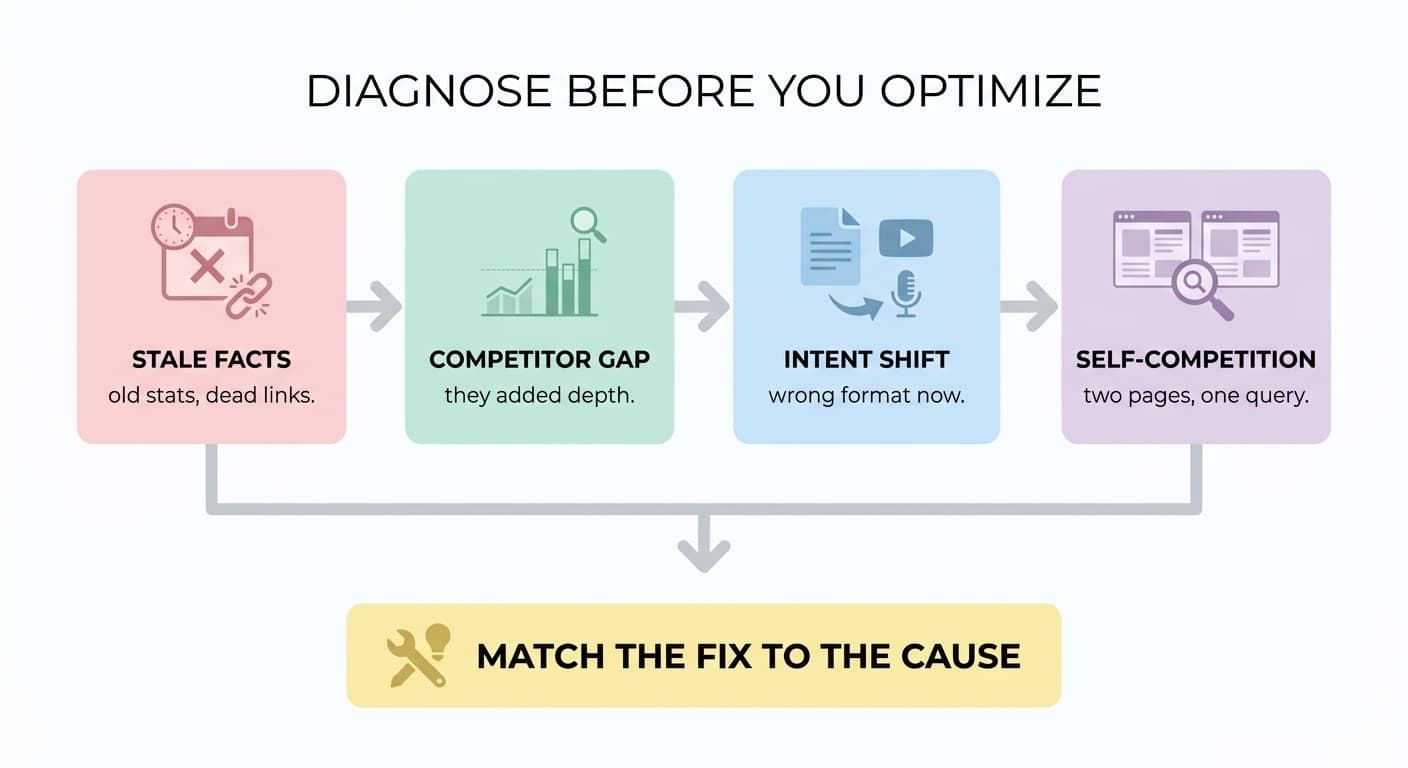
A page can lose rankings for at least four distinct reasons, and each one needs a different fix:
- The content went stale. Statistics, screenshots, or examples are out of date, and a fresher competitor now looks more current for the same query.
- A competitor closed the gap. Someone published something more thorough, better structured, or with a worked example you do not have, and Google now prefers their page.
- Search intent shifted. The query used to want a definition; now it wants a comparison, a tool, or a how-to. Your page still answers the old intent.
- Your own pages are competing with each other. Two articles on your site target the same query, split the clicks and links between them, and neither one wins.
Rewriting the copy fixes the first cause and does nothing for the other three. That is why a real content optimization strategy always opens with a diagnosis step before anyone touches a word of the page.
Step 1: Find out which pages actually need attention
You cannot optimize your whole site at once, and you should not try. Pull Google Search Console data (impressions, clicks, and average position over the trailing 90 to 180 days) and sort your pages into three groups:
- Falling - position has dropped five or more spots, or impressions are declining while the page is otherwise unchanged.
- Stuck - sitting steadily at positions 11 to 20, never quite breaking onto page one.
- Stable - no decay signal at all. Leave these alone; touching a page that is not broken risks introducing an error for zero upside.
The falling group is your priority, and within it, prioritize by traffic and business value, not by how long it has been since you last touched the page. A page that dropped from position 4 to position 9 and used to bring in 4,000 monthly clicks is worth fixing before a page that dropped from position 40 to position 55 and never had meaningful traffic. Calendar age is a weak signal; ranking trajectory combined with the traffic already at stake is the real one.
Step 2: Diagnose the specific cause before you write anything
For every page in your falling group, spend ten minutes answering these four questions before opening the editor:
Is the content stale? Check the publish or last-updated date, scan for statistics tied to a specific past year, and click every external link to confirm none are dead. Stale facts are the easiest cause to confirm and the easiest to fix.
Did competitors get better? Search the exact target query and read the current top three results. Note what they cover that you do not: a comparison table, a worked example, a section answering a question your page skips entirely. If the incumbents added real depth since you last wrote the page, that is very likely your answer.
Did intent shift? Look at the format of what is now ranking. If your page is a long-form explainer but the results are now dominated by tool pages, listicles, or short direct-answer content, the query's intent moved and no amount of rewriting the same format will fix it.
Are you competing with yourself? Search site:yourdomain.com "your target phrase" and see if more than one of your own URLs shows up. If two pages are chasing the same query, that alone can explain a stall that looks like decay but is actually self-inflicted competition.
<mark class="km-highlight" style="--hl:#FEF08A;background:#FEF08A">Matching the fix to the actual cause is the single biggest difference between a content optimization strategy that works and one that just produces a longer page</mark>. A stale-facts problem needs updated statistics. A competitive-gap problem needs new depth and structure. An intent-shift problem needs a different content format entirely, not a longer version of the same one. A cannibalization problem needs consolidation, not another rewrite of either page.
The fix matched to the cause
| Diagnosis | What actually fixes it | What does NOT fix it |
|---|---|---|
| Stale facts, dead links, old screenshots | Update every stat and reference, replace dead links, refresh examples | A new introduction with the same stale body |
| Competitor added depth you lack | Add the missing table, worked example, or subtopic; close the gap point by point | Making the existing sections slightly longer |
| Search intent moved to a different format | Rebuild the page in the format now ranking (tool, comparison, listicle, how-to) | Editing sentences while keeping the old format |
| Two of your own pages compete for the same query | Merge into one page, redirect the weaker URL, consolidate links and authority | Optimizing both pages separately |
| Position 11-20, no clear decay, just under-optimized | Tighten headings, add the missing subtopics, strengthen internal links | Waiting for it to "settle" on its own |
Step 3: Do the actual optimization work
Once you know the cause, the work itself follows a consistent sequence regardless of which row in the table above applies:
- Reverse-engineer the current top three to five results for your target query, even if you ranked well before. Rankings are relative to what else exists right now, not to some absolute quality bar.
- Close every real gap you found, whether that is a missing comparison table, an outdated statistic, or a subtopic the competition covers and you do not. Depth that answers the query is what moves rankings, not word count for its own sake.
- Rebuild the format if intent has shifted. If the query now wants a tool or a short direct answer, restructuring beats rewriting.
- Consolidate if you are cannibalizing yourself. Pick the stronger page, fold in the unique value from the weaker one, and 301 redirect the loser so its authority transfers instead of splitting.
- Tighten the on-page basics on the way through: title tag and meta description that match current intent, a clean H2/H3 hierarchy, short paragraphs, and internal links pointing both to and from the page.
- Keep the URL. A page that already ranked has backlink equity and indexing history built up. Optimizing is not relaunching; change the slug only if you are deliberately abandoning the old address, which you rarely should be.
- Republish and set a 30 to 60 day check-in. A short dip in the first week or two while Google recrawls is normal. Judge the fix at the 30 to 60 day mark, not the day after you hit publish.
How this is different from optimizing new content
Writing a brand-new page and optimizing an existing one share some mechanics (keywords, structure, links) but the strategy is not the same job:
- New content starts from zero trust with Google. You are betting on quality and relevance to earn a first ranking.
- Existing content being optimized already has trust, backlink equity, and an indexing history. The bar is not "convince Google this page deserves to exist"; it is "close the specific gap that made a page Google already trusted start losing to something else."
That distinction matters because it changes what "good" looks like. A brand-new page can win by being comprehensive. A page that is losing rankings usually needs a surgical fix aimed at the exact cause, not a ground-up rewrite that risks losing whatever was already working.
Why this keeps happening if you do not build a repeatable process
A one-time optimization pass fixes the pages you looked at today. It does not stop the same four causes from creating a new batch of falling pages next quarter, because competitors keep publishing, statistics keep aging, and search intent keeps shifting under queries that felt settled a year ago. Every piece of content decays eventually; the teams that stay ahead of it are the ones who catch the decline early, not the ones who write the best possible article once and never look at it again.
The part that is genuinely hard to do by hand is the ongoing detection: someone has to be pulling Search Console data on a regular cadence and flagging pages the moment they cross a decay threshold, not three to six months after traffic has already cratered. This is the exact gap Murkuz is built to close. It scans your Google Search Console data every day and automatically surfaces declining pages, positions 11-20 opportunities, and keyword cannibalization, the same four causes in the diagnosis table above, before you have to go looking for them yourself. Each flagged page arrives as a task with the problem data and a recommended fix attached, so the diagnosis in Step 2 is already mostly done before a person opens it. When a fix is approved, Murkuz can push it straight to WordPress, Webflow, or Framer, and its Impact Scorecard then tracks whether the specific fix caused the specific ranking recovery, so you are not left staring at a traffic graph trying to guess what worked.
If you want to see this in the context of the full detect-and-recover workflow rather than a single page fix, the content decay guide walks through why decay is so hard to catch manually in the first place. And once you have optimized the pages you already have, the free keyword clustering tool is a natural next step for deciding what new content is actually worth building.
FAQ
What is a content optimization strategy?
A content optimization strategy is a repeatable plan for deciding which existing pages need work, diagnosing why each one is underperforming, and applying the fix that matches the actual cause rather than a generic rewrite. For pages that already ranked and are slipping, the strategy centers on diagnosis first: stale facts, a competitor gap, a shift in search intent, or self-competition between your own pages, each of which needs a different fix.
How do I know if a page needs optimization or a rewrite from scratch?
If the page still holds a reasonable position, has backlinks, and the topic still matches what people are searching for, optimize it rather than starting over. A full rewrite from a new URL only makes sense when the page's core premise no longer matches current intent at all, or when the existing content is so thin that there is genuinely nothing worth preserving.
How often should I optimize existing content?
There is no fixed universal schedule. Review your highest-traffic and highest-value pages monthly for early decay signals, run a full triage across your content library quarterly, and act immediately, outside the normal cadence, if a revenue-driving page suddenly drops rather than waiting for the next scheduled review.
Does optimizing old content actually work better than writing something new?
Usually yes, when the page already has some ranking and backlink history, because you are improving a page Google already trusts rather than asking it to evaluate an unproven URL from nothing. It is not guaranteed: results still depend on how thoroughly you close the actual gap against current competitors and whether the underlying search intent still matches your page at all.
What is the biggest mistake in content optimization?
Rewriting a page without first diagnosing why it dropped. Editing sentences on a page that lost rankings because of a competitor's new comparison table, or because two of your own pages are cannibalizing each other, produces a longer page that solves nothing. The fix has to match the cause, which means diagnosis always comes before editing.
Junaid Khalid is the founder of Ertiqah and the builder of Murkuz. He has run SEO as the first growth channel across several of his own SaaS products and built Murkuz around the belief that SEO should be treated as an engineering problem: detect what is decaying, fix it, ship the fix, and prove it worked.