Ahrefs and Semrush both do keyword research, rank tracking, and site audits well. The real difference is narrower than most comparison pages admit: Ahrefs wins on backlink depth and interface speed, Semrush wins on breadth (PPC, content, local, daily rank updates by default), and neither one touches your CMS to actually fix what it finds.
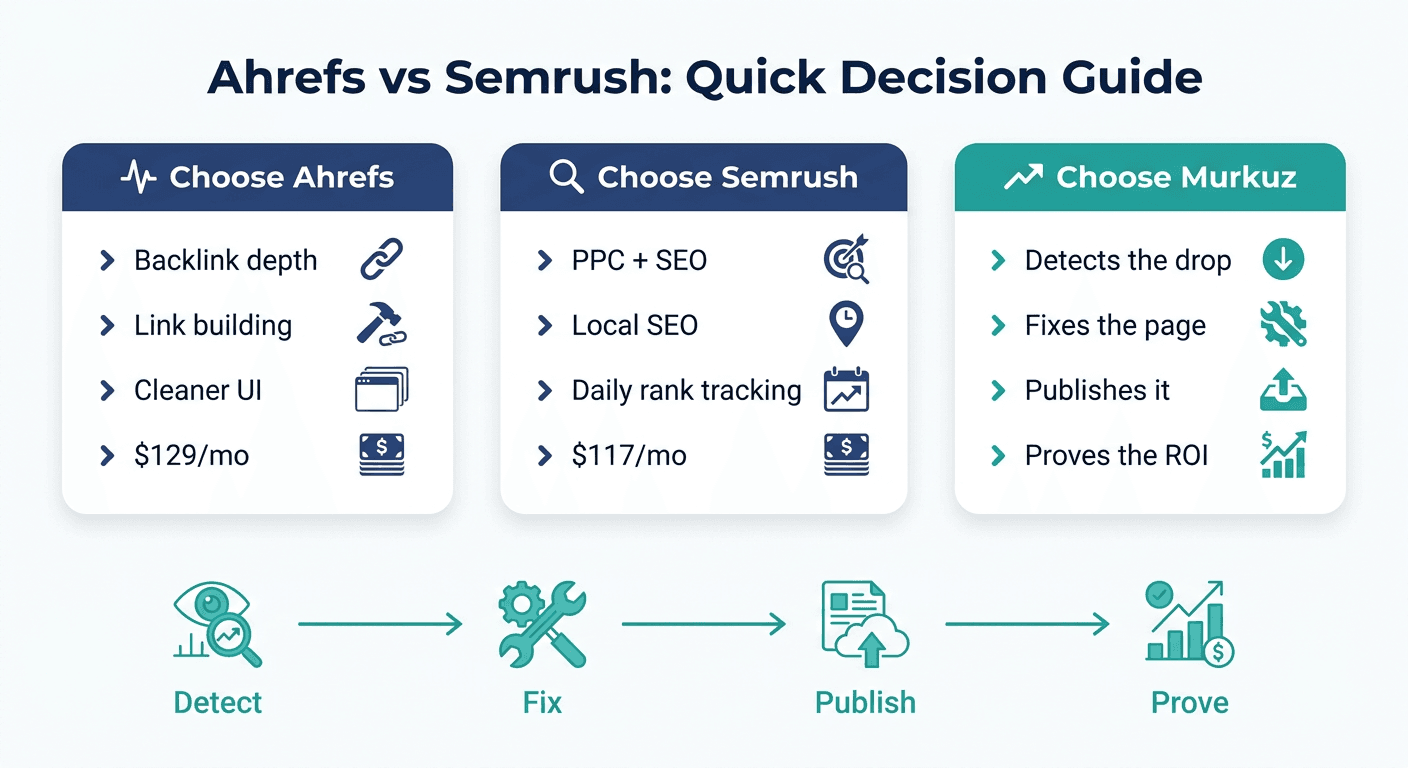
If you only have thirty seconds: pick Ahrefs if your job is mostly SEO and backlinks and you want a clean, fast tool. Pick Semrush if you run PPC, social, or content marketing alongside SEO and want one dashboard for all of it. Below is the full breakdown, current 2026 pricing, and where both tools stop short of finishing the job.
Ahrefs vs Semrush at a glance
| Category | Ahrefs | Semrush |
|---|---|---|
| Starting price (annual) | $129/mo (Lite) | $117.33/mo (SEO plan) |
| Core strength | Backlink analysis, crawler speed | Breadth across SEO, PPC, content, social |
| Rank tracking | Included, add-on for daily granularity on lower tiers | Daily updates included by default |
| Keyword database | Ahrefs Keywords Explorer, strong international coverage | Semrush Keyword Magic Tool, similar scale |
| Content tools | Content Explorer (research-first) | SEO Writing Assistant, AI content tools (production-first) |
| PPC / paid search | Not offered | Full paid search toolkit |
| Local SEO | Keyword research only | Full local SEO toolkit (listings, map tracking) |
| AI visibility tracking | Brand Radar (prompt tracking) | AI visibility reports, sentiment, custom prompts |
| Agency/white-label reporting | Report Builder | Native, more automated |
| Best fit | Freelance SEOs, link builders, lean in-house teams | Marketing teams running SEO + PPC + content together |
Prices above are current list prices for each vendor's entry-level annual plan as of this writing; check the vendors' own pricing pages before you buy, since tiers and credits change often.
Where Ahrefs wins
Ahrefs built its reputation on one thing: crawling the web and indexing backlinks faster and more accurately than almost anyone else. That focus still shows up in three places.
Backlink and link-intersect data. Ahrefs' crawler updates its link index on a tight cycle, and its backlink gap and link-intersect reports are still the fastest way to find "sites that link to my three competitors but not me." If link building is a real line item in your work, this is the single biggest reason people choose Ahrefs.
Unlimited verified domains, even on lower tiers. Ahrefs lets you add and verify as many of your own sites as you want on every plan; you only pay more for higher keyword-tracking and crawl-credit limits. For an agency running a dozen small client sites, that changes the math versus a competitor that prices per project.
A faster, simpler interface. Reviewers across Reddit, G2, and comparison sites consistently rate Ahrefs as the easier tool to learn. Site Explorer and Keywords Explorer answer "who ranks for this, and who links to them" in two or three clicks, without wading through fifty other tools you don't need.
Traffic Potential. Ahrefs' Traffic Potential metric estimates the total organic traffic a page could earn for ranking #1 for its main keyword, not just the raw monthly search volume for one query. That is a genuinely useful nuance most keyword tools skip.
Where Semrush wins
Semrush's pitch has always been breadth: one login for SEO, PPC, content, social, and now AI visibility.
Daily rank tracking by default. Semrush includes daily position updates on its base plans. Ahrefs supports frequent tracking too, but you often need a higher tier or more credits to get the same cadence, which matters if you report on rankings weekly.
PPC and paid search data. This is the cleanest differentiator on the list: Ahrefs has no paid search toolkit at all. If you manage Google Ads alongside SEO, or you pitch clients on both, Semrush is the only one of the two that covers it natively.
Content production tools. Ahrefs' Content Explorer is built for research (find what already ranks, find link prospects). Semrush leans further into production: an SEO Writing Assistant, AI-assisted briefs, and on-page optimization checks that plug directly into the writing process, not just the research phase.
Local SEO. If any part of your work touches local rankings, Semrush has a dedicated local toolkit (listings management, map-pack tracking, review monitoring). Ahrefs stops at local keyword research.
Broader agency and reporting features. Semrush's white-label reporting and client-dashboard options are more built-out and more automated than Ahrefs' Report Builder, which matters once you are managing several client accounts and need to hand off polished reports without manual formatting.
The part both tools leave you to do yourself
Here's the pattern that shows up in almost every Ahrefs vs Semrush review, including this one: both tools are exceptionally good at telling you something is wrong. A page dropped from position 8 to 14. A competitor picked up 40 new referring domains. A crawl found 200 broken links. Then the report ends, and the actual work starts.
Someone has to open the page, decide what to rewrite, brief a writer (or write it themselves), get it approved, log into WordPress or Webflow, publish it, and then remember to check back in three weeks to see if the ranking actually recovered. That gap between "the tool flagged it" and "the fix is live and proven" is where most SEO backlogs quietly die. It is not a knock on either tool; detection and analysis is what they were built to do, and they do it well.
<mark class="km-highlight" style="--hl:#FEF08A;background:#FEF08A">Neither Ahrefs nor Semrush publishes a fix to your CMS or proves that the fix caused the recovery.</mark> That is a separate step, done manually, in a separate tool, usually days or weeks after the report first flagged the problem.
This is the specific gap Murkuz was built to close. Instead of stopping at detection, Murkuz auto-detects declining pages and low-hanging-fruit opportunities from your Google Search Console data every day, generates a content fix that matches your brand voice, and publishes it directly to WordPress, Webflow, or Framer with one click. Then it tracks the ranking afterward and attributes the recovery back to the specific fix, which is the piece most stakeholder reports are missing. You can see the full workflow end to end, from detection through proof.
If you want the longer, feature-by-feature version of that comparison against each tool specifically, see Murkuz vs Ahrefs and Murkuz vs Semrush.
How to actually decide
Work through these four questions in order. Whichever tool wins the most, buy that one.
- Do you run paid search (Google Ads) alongside SEO? If yes, Semrush is the only one of the two with a native PPC toolkit. This alone settles it for a lot of in-house marketers.
- Is link building a core, ongoing part of your work? If yes, Ahrefs' backlink index and link-intersect tooling are still the sharper instrument.
- How many of your own sites do you need to track, and at what budget? Ahrefs' unlimited-verified-domains model on lower tiers tends to work out cheaper for agencies managing many small sites. Semrush's per-project limits on lower plans can force an upgrade sooner.
- Do you need local SEO or heavier content production tooling in the same login? If yes, Semrush's local toolkit and AI writing tools are more built-out than anything comparable in Ahrefs.
If you land on "both, roughly," that's common, and it's also worth asking a fifth question most people skip: do you actually need a third detection tool, or do you need the fix published? If it's the latter, that's the whole reason Murkuz exists, and you can compare pricing directly against what you're paying for Ahrefs or Semrush plus everything else in your stack today.
Where Moz fits into this comparison
If you're weighing a third option, Moz is worth a look too, mostly for its more forgiving learning curve and lower entry price. We cover the three-way breakdown, including where Moz's Domain Authority metric fits next to Ahrefs' Domain Rating and Semrush's Authority Score, in our Ahrefs vs Moz vs Semrush comparison.
FAQ
Is Ahrefs or Semrush better for beginners?
Most reviewers rate Ahrefs as the easier interface to pick up, since it has fewer tools and a more focused workflow (search, find backlinks, track ranks). Semrush has a steeper learning curve because it covers more ground, but it also means you won't need a second tool once you're past the basics.
Which is cheaper, Ahrefs or Semrush?
As of this writing, Semrush's entry SEO plan runs about $117/mo billed annually and Ahrefs' Lite plan runs about $129/mo billed annually, so Semrush is slightly cheaper at the entry tier. The gap narrows or reverses depending on how many keywords, projects, or users you need, so compare the specific tier you'd actually use, not just the sticker price.
Can I use Ahrefs and Semrush together?
Yes, and a meaningful number of agencies do, usually Ahrefs for backlink work and Semrush for everything else. It's a valid setup if budget allows, though at that point it's worth asking whether a chunk of that spend would be better used on a tool that also executes the fixes both platforms surface.
Does either tool fix SEO problems automatically?
No. Both are analysis and monitoring platforms: they surface data (rankings, backlinks, audit issues) and leave the content rewrite, the publish, and the follow-up entirely to you. If closing that loop automatically is what you're after, that's a different category of tool.
Which tool is better for agencies?
Semrush's white-label reporting is more automated out of the box, but Ahrefs' unlimited-verified-domains pricing on lower tiers is often cheaper across many small client sites. Agencies running dozens of accounts frequently end up choosing based on reporting workflow rather than raw data quality, since both tools' data is strong enough for client work.
Junaid Khalid is the founder of Ertiqah, the company behind Murkuz, and has run SEO as the first growth channel across his own SaaS products before building a platform to automate the parts of that process that don't need a human.