Most "AI content workflow" guides stop at drafting. Brief in, draft out, maybe a human skim before it publishes. That is why so much AI content reads the same: the same rhythm of short punchy sentences, the same "it's not just X, it's Y" construction, the same three-bullet list appearing in every section whether the topic needs it or not. The workflow was never built to catch that. It was built to produce words fast.
A workflow that actually holds up needs one more stage than the ones most teams run: a quality-control checkpoint that specifically hunts for AI tells before anything ships, plus the brand and evidence inputs that make a first draft sound like your team instead of a template. Below is the six-stage version, what to feed each stage, and the exact markers to check for at the gate that most workflows skip.
Why AI content workflows produce generic output by default
Large language models are trained to produce statistically likely text. Likely text, by definition, sounds like everyone else's text. Without deliberate inputs to push against that, an AI workflow converges on the same tics regardless of topic:
- Rhythm sameness. Short declarative sentences back to back, then a longer one for contrast, on a loop.
- Hedge-then-pivot phrasing. "It's not just about X, it's about Y" shows up whether or not the contrast is real.
- Symmetrical lists. Three bullets, three examples, three steps, even when the actual answer has two or five.
- Vague authority. "Studies show" and "many experts agree" instead of a named source or a specific number.
- Flat confidence. No hedging where hedging is honest, no strong opinion where one is warranted, because the model is optimizing for inoffensive plausibility, not a point of view.
None of this is a model failing. It is a model doing exactly what it was asked: produce plausible text fast. The fix is not a better prompt alone, it is a workflow that supplies the missing ingredients (real brand voice, real specifics, a real point of view) and then checks for the tells before publishing.
The six-stage workflow
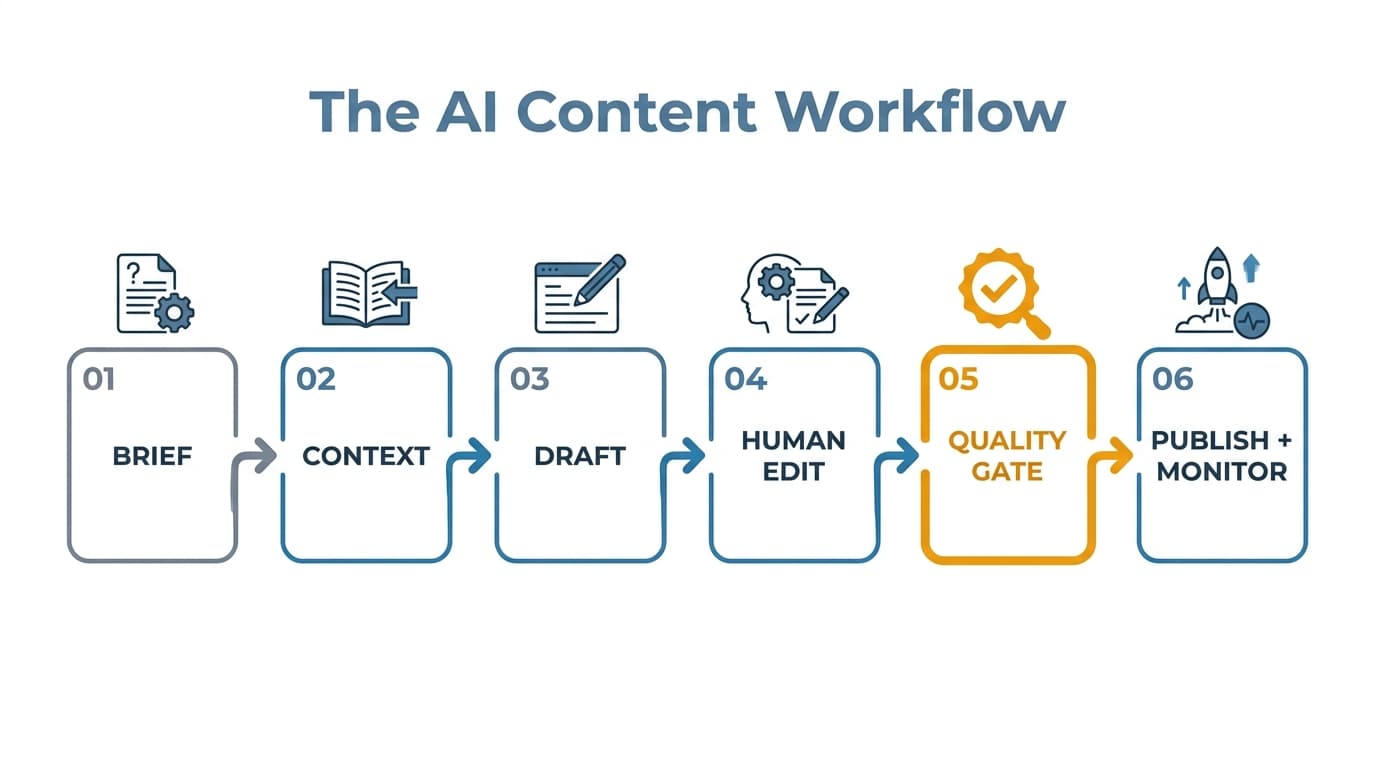
| Stage | What happens | Who or what owns it |
|---|---|---|
| 1. Brief | Define the query, the reader, the angle, and 2-3 concrete facts or examples the draft must include | Editor or strategist |
| 2. Context | Feed the model your style guide, past top-performing pieces, and product facts, not just the topic | Editor, fed to the AI tool |
| 3. Draft | Generate the first pass against the brief and context, not a bare prompt | AI tool |
| 4. Human edit | Rewrite for voice, cut hedge-and-pivot phrasing, replace vague claims with specifics | Editor or writer |
| 5. AI-tell quality gate | Scan specifically for the markers below before anything is scheduled | Editor, checklist-driven |
| 6. Publish and monitor | Ship it, then watch how it actually performs and whether it needs a refresh | Whole team |
Most teams run stages 1, 3, and 6. The stages that separate readable AI-assisted content from obviously-AI content are 2, 4, and 5, so treat those as non-negotiable, not optional polish.
Stage 1: Brief before you prompt
A brief is not the keyword. It is the angle, the reader's actual question, and at least two or three concrete details the draft has to include, a real number, a named tool, a specific scenario. If the brief only has a topic and a keyword, the model has nothing to be specific about, so it defaults to generic phrasing to fill the space.
Stage 2: Feed it context, not just instructions
"Write in a friendly, professional tone" is not context, it is a vibe. Actual context is a short style document with example sentences the model can pattern-match against, three to five of your best existing pieces to establish rhythm and vocabulary, and the product or subject-matter facts a generic model would never know. Without this step, the model has no anchor to your voice and reverts to its training-average tone, which is the generic AI voice everyone recognizes.
Stage 3: Draft against the brief
This is the step most guides only cover. Generate against the brief and the context, not a one-line prompt. A model given a real brief and real examples produces a rougher but more specific draft. That roughness is a feature at this stage: it is easier to edit specificity into a plain sentence than to strip the varnish off an overly polished, over-generalized one.
Stage 4: Edit for voice and specifics, not just grammar
This is a rewrite pass, not a proofread. The editor's job is to replace "many businesses struggle with this" with the actual struggle, cut any sentence that could appear unchanged in a competitor's article on the same topic, and read it aloud. If it sounds like a keynote speech, it needs another pass.
Stage 5: The quality gate most workflows skip
Before anything publishes, check the draft against a short, specific list, not a vague "does this sound human" gut check:
- Count instances of "it's not just X, it's Y" or close variants. More than one in an article-length piece is a tell.
- Scan for em dashes used as a rhythm crutch rather than genuine parenthetical asides.
- Check whether every section has exactly three bullets or three examples. If so, that symmetry is the model's default, not a deliberate structure.
- Look for at least one specific number, named source, or concrete example per major section. If a section is all generalities, it has not been edited yet.
- Read the opening and closing sentence of each section. If they rhyme in structure with every other section's opening and closing sentence, that is templated cadence.
A draft that fails two or more of these needs another editing pass before it ships, not a publish-and-fix-later approach.
Stage 6: Publish and monitor, because the job is not done at "it sounds good"
Content that reads well on day one can still be thin, or can still decay as the topic moves and competitors update. Whether a piece is AI-assisted or fully human, the workflow does not end at publish. Someone, or some system, needs to track whether it is actually ranking and holding, and flag it when it starts slipping, the same as any other page on the site.
A worked example: before and after the quality gate
Here is a single sentence from a first AI draft on a b2b SaaS blog, and the same sentence after stage 4 and 5:
Before: "It's not just about writing content faster, it's about building a repeatable process that scales with your team's needs."
After: "The point isn't speed. It's that a three-person marketing team can now maintain the same output as a five-person team did two years ago, because the drafting bottleneck is gone."
The "after" version drops the hedge-then-pivot structure, adds a specific and checkable claim (three people vs. five, a concrete timeframe), and reads like someone actually thought about the tradeoff instead of restating the premise back at the reader.
What to automate and what to keep human
Not every stage benefits from the same amount of automation. As a rough guide:
- Safe to largely automate: first-draft generation against a solid brief, formatting, meta tag drafts, internal link suggestions, translation of an already-approved piece.
- Needs a human in the loop every time: the brief itself, the context and examples fed to the model, the voice edit, and the final quality-gate scan.
- Never fully automate: the decision to publish. Even a fast review beats an unreviewed auto-publish, because the failure mode of skipping review is not "slightly worse content," it is publishing something that reads like a template with your logo on it.
This matters more, not less, as volume grows. A single AI-assisted article with a skipped review step is a bad page. The same gap multiplied across fifty or two hundred programmatically generated pages is a pattern Google's ranking systems and human raters are both built to notice, which is the real risk with AI content at scale, not the AI itself.
Keeping the workflow consistent as you scale
The stages above work for one article written by one person. The harder version of this problem is keeping stage 2 (context) and stage 5 (the quality gate) consistent when five writers, or an AI tool generating dozens of pages from a template, are all producing content at once. That is where a shared, structured knowledge base earns its keep: a single place holding your brand voice, tone, and product facts that every generation references, rather than five different people each guessing at "sounds like us" from memory. Murkuz's AI content workflow works this way, referencing a shared knowledge base (HyBrain) so drafts stay in voice whether one page is being generated or a hundred are being produced from a single template, and it still runs the generated content through per-page monitoring afterward so a page that starts decaying gets flagged rather than quietly losing rankings. If you are producing pages at that scale, this is also the exact problem programmatic SEO is built to solve: unique, brand-consistent content generated from a template and data, not thin pages with swapped variables.
Whatever tools sit in your stack, the workflow itself does not change: brief, context, draft, edit, quality gate, publish and monitor. Skip the middle three stages and you get fast, generic content. Run all six and AI becomes a genuine force multiplier for a small team instead of a way to publish more of the same thing everyone else is publishing.
FAQ
How do I make ChatGPT or Claude sound less like AI?
Feed it real context, your style guide, example sentences from pieces you already trust, and specific facts, rather than only a topic and a tone instruction. Then edit the output for voice and run it through a quality-gate check for hedge-then-pivot phrasing, symmetrical bullet lists, and vague claims before it ships. The model alone cannot fix this; the workflow around it has to.
What is the "30% rule" people mention for AI content?
There is no single official rule, but the idea behind it, that a meaningful share of any AI-assisted draft should be substantively rewritten or added to by a human before publishing, matches the stage 4 and stage 5 gates above. Treat it as a floor, not a target: a draft that only needs light copyediting was probably already given strong brief and context inputs.
Can you tell if content was written by AI?
Often, yes, from the patterns listed in the quality-gate section: hedge-then-pivot phrasing, unusually even sentence rhythm, generic claims with no specific source, and symmetrical list structures repeated across sections. None of these are proof on their own, but several together are a strong signal, which is exactly why the quality gate checks for them before publish rather than relying on an AI-detector tool afterward.
Does using AI for content hurt SEO rankings?
Google's own guidance is that it evaluates content on quality and helpfulness, not on how it was produced. The risk is not the tool, it is unedited, generic, low-effort output at scale. A workflow with a real editing and quality-gate stage produces content that meets the same bar as fully human-written work.
How much should a human edit an AI first draft?
Enough that the specifics, the examples, the numbers, the named sources, are no longer generic, and enough that reading it aloud does not sound like a template. In practice this is usually a meaningful rewrite of at least a third of the draft, not a light proofread, particularly on the opening and closing lines of each section where AI tics cluster most.
Junaid Khalid is the founder of Ertiqah, the company behind Murkuz. He has run SEO as the first growth channel across several of his own SaaS products, including the AI content workflow this article describes.