Most client SEO reports get opened once, skimmed for thirty seconds, and never clicked again. Then, three or four months later, the client asks what they are actually paying for, and the answer sitting in your reporting tool is a wall of charts nobody remembers reading. That is not a template problem. It is a trust problem, and the fix is a report structure built to answer one question every single time: did the work we did actually cause something to happen?
This is the client SEO report template that answers that question, section by section, with the exact order and the exact sentences to write in each one. It is built around retention, not decoration, because a report a client stops opening is the first quiet sign of a contract that will not renew.
Why Most Client SEO Reports Fail to Prevent Churn
Every major guide to client SEO reporting lists roughly the same metrics: organic traffic, keyword rankings, conversions, backlinks, site health. That part is genuinely settled and none of it is wrong. The problem is what happens after the metrics get listed: the report becomes a data dump, and a data dump does not retain a client. A client renews because they believe, in plain language, that the money they are spending is causing a specific result. A dashboard full of accurate numbers can still fail to make that case.
Three failure patterns show up across almost every agency's reporting, and each one quietly erodes the relationship long before the client says anything:
- Too many metrics, no verdict. The report shows everything and argues nothing. A client has to do the interpretation themselves, and most will not.
- Correlation dressed up as proof. Traffic went up this month, so the report implies the SEO work caused it. Sometimes it did. Sometimes a competitor's page dropped, or Google ran a core update, or a different page you fixed eight months ago finally caught momentum. A client who later realizes the report oversold its own certainty stops trusting the next one.
- No honesty about the bad months. A report that only ever shows good news reads as marketing, not measurement, and clients can tell the difference. The month rankings dip is the month a real report earns the client's trust, if it explains why plainly instead of burying the dip in a chart nobody is meant to read closely.
<mark class="km-highlight" style="--hl:#FEF08A;background:#FEF08A">A client renews because they believe the report proves cause, not because the report has more charts than last month's.</mark> Everything below is built around that one distinction.
The Client SEO Report Template, Section by Section
Use this exact order every time. Consistency in structure is what lets a client compare month to month without relearning your report from scratch, and it is one of the simplest retention levers available: a predictable report feels like a system; an unpredictable one feels like it is being assembled from scratch each month, which quietly signals the account is not a priority.
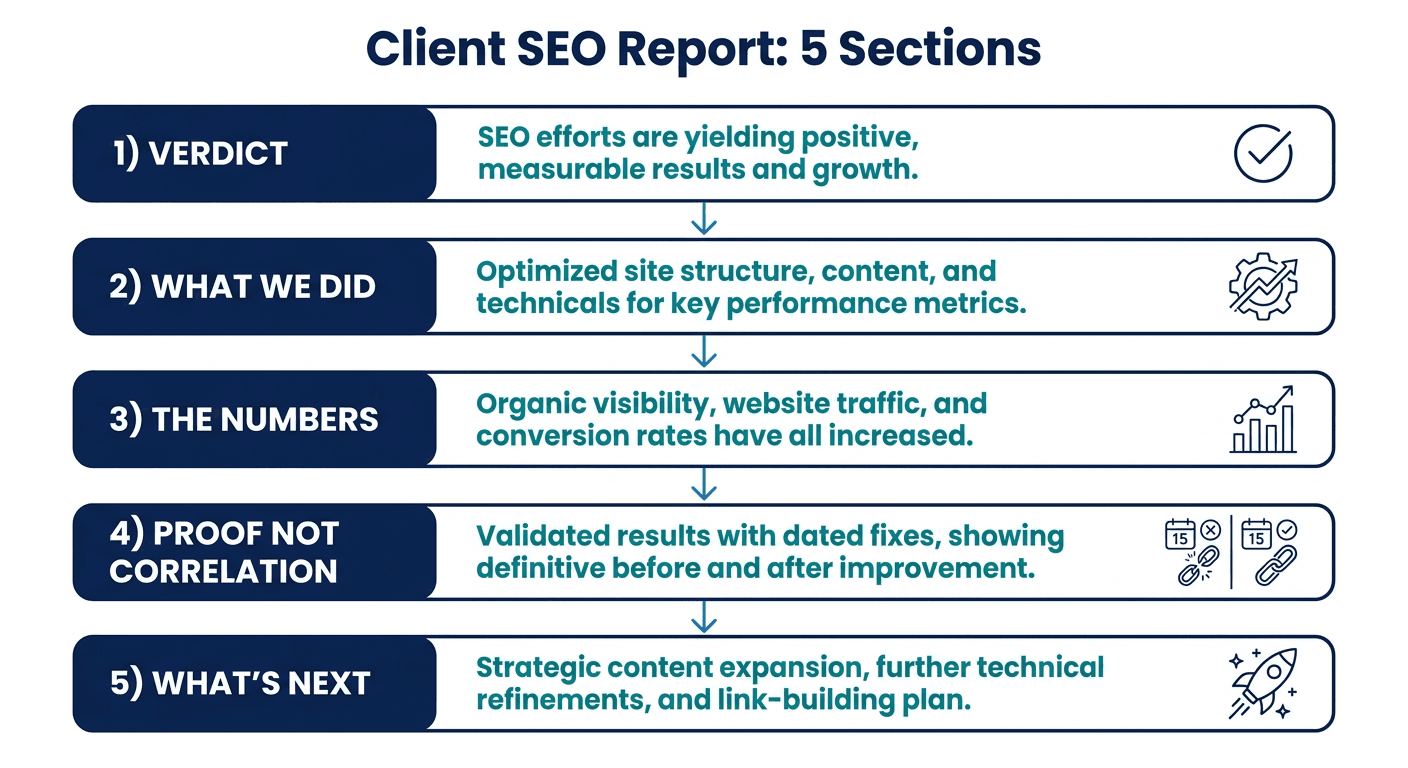
1. The One-Line Verdict
Before any chart, write one sentence in plain English: "Organic traffic is up 14 percent this month, driven by the pricing page recovery we shipped in week two." No jargon, no hedging. If a busy stakeholder reads nothing else in the report, this sentence should still tell them whether the month was good, and why.
If you cannot honestly write this sentence, that is information about the month's actual results, not a sign the report format failed.
2. What We Did (Tied to What It Was Meant to Move)
List the specific work completed this period: pages refreshed, technical fixes shipped, new content published, links built. Each item gets one line connecting it to the metric it targeted. "Refreshed the /integrations page (was losing rank to a competitor update)" tells a client something a generic "content updates: 4" line never will.
This section is also where you set up the proof in section 4. A report that lists work without a timestamp cannot later prove that work caused anything.
3. The Numbers (Visibility, Traffic, Conversions, in That Order)
Every competitor's guide agrees this core set belongs in a client report, and they are right:
- Visibility: keyword rankings (especially page-one and top-3 counts), search impressions, and average position from Google Search Console.
- Traffic: organic sessions, split from branded search where possible, since a rising branded-traffic line reflects awareness, not SEO work, and reporting it as an SEO win overstates the case the moment a sharp client checks.
- Conversions: leads, signups, or revenue attributable to organic traffic, tied to the specific pages earning them, not the site's organic total as an undifferentiated number.
Keep this section to what a non-SEO stakeholder can process in under a minute. Backlink counts, raw keyword-position tables with hundreds of rows, and generic "SEO health scores" that map to no client decision belong one click deeper, in a detail view, not on the page a CMO skims before a budget meeting.
4. Proof, Not Correlation
This is the section almost no client SEO report gets right, and it is the one most directly responsible for renewals. Showing a metric moved is easy. Showing your specific work caused it to move is the actual job, and it requires more than a trend line:
- Log the exact date each fix went live and the exact page or keyword set it targeted.
- Pull the ranking and traffic trend for that specific page in the weeks immediately after, not a site-wide average that dilutes the signal.
- Compare against that page's own baseline in the weeks before the fix, and against similar untouched pages over the same window, to rule out a site-wide or seasonal effect.
- Only then state it plainly: "this fix caused this recovery," in those words, not the vaguer "traffic is trending up."
A worked example makes the difference concrete. A SaaS client's pricing page slides from position 4 to position 11 over four months, a routine content decay pattern. The team refreshes it: updated screenshots, an expanded FAQ, two stale statistics replaced. Two weeks later the page recovers to position 6.
Reported the ordinary way: "organic traffic up 9 percent this month." True, but it buries the actual story and gives a skeptical stakeholder nothing to repeat to their own boss.
Reported the proof way: "pricing page, refreshed March 14, position 11 to 6 in two weeks, sessions on that URL up 40 percent." Same event. One version is a data point a client forgets by lunchtime. The other is a sentence they can repeat verbatim in their next budget meeting, which is the actual test of whether a report did its job.
This is also the exact gap a tool that only reports, and never touches the page itself, cannot close on its own: it can chart the traffic, but it was never the system that made the fix, so it can only ever show you correlation. This is where Google Search Console matters more than most reports use it for. Murkuz pulls GSC data daily, watches every page's ranking trajectory against its own baseline, and because the same system also shipped the fix, it can log the exact date and page a change went live and then verify afterward whether rankings actually recovered on that specific page, producing what it calls an Agentic Impact Scorecard: a record built to say "this fix caused this ranking change," not a chart that merely happens to point up around the same time.
5. What's Next
Close with the two or three things being worked on next period. This turns the report from a one-off snapshot into a continuation the client is already partway through, which is a quieter but real retention lever: a client who can picture next month's report before it arrives is a client who is still thinking in terms of an ongoing relationship, not a decision they have to make fresh every renewal cycle.
How Often to Send It, and Why More Isn't Better
Monthly is the standard cadence, and for good reason: ranking and traffic movement need at least a few weeks to separate real signal from ordinary noise. A report sent weekly on a dataset that only meaningfully changes monthly does not build more trust, it just adds more noise for the client to sift through, and more chances for a report to say nothing new. Agencies running fast-moving campaigns sometimes add a lighter biweekly check-in, but the core proof-bearing report should match the pace the data can actually support.
The Report vs. the Dashboard
A report and a dashboard solve different problems, and conflating them is a common reason reports feel bloated. A dashboard is a live, always-current view a client can check anytime; useful for the client who wants to peek in on a Tuesday afternoon. A report is a point-in-time narrative, usually monthly, that leads with the verdict and lets the reader stop there if they want to. Most agencies need both, but they should not be the same document: a dashboard crammed with a verdict paragraph gets ignored by the client who wants a quick check-in, and a report cluttered with every live widget defeats the plain-language promise that keeps a client actually reading.
FAQ
What should be in a client SEO report?
At minimum: a one-line verdict stating whether the month was good and why, the specific work completed tied to what it targeted, core visibility and traffic and conversion metrics, and a section proving that specific work caused a specific outcome rather than merely coinciding with one. Technical detail like raw backlink counts or full keyword-position tables belongs one click deeper, not on the main view.
How often should you send an SEO report to a client?
Monthly, for most retainers. Ranking and traffic changes need at least a few weeks to separate real movement from noise, so reporting more often than that usually adds volume without adding insight. Larger accounts sometimes add a lighter biweekly check-in alongside the monthly report.
How do you prove SEO is working to a client?
Tie a specific action, a page refresh, a new page, a technical fix, to a specific, measurable outcome on the specific page or keyword set it targeted, in the weeks immediately following the change, compared against that page's own baseline before the fix. A site-wide traffic chart alone cannot separate your work from a core update, a competitor's misstep, or ordinary seasonality; a dated, page-level, before-and-after comparison can.
What is the difference between an SEO report and an SEO dashboard?
A report is a point-in-time summary, usually monthly, that opens with a plain-language verdict before any chart. A dashboard is a live view a client can check whenever they want. Most agencies need both, kept as separate documents rather than merged into one, so each serves the reader who wants it without burying the other's purpose.
How do you stop clients from churning over SEO reporting?
Stop reporting activity and start reporting proof. Clients rarely churn because rankings had one bad month; they churn because they stop believing anyone can explain why. A report that states its verdict plainly, is honest about slow months, and ties specific fixes to specific, dated outcomes gives a client a reason to keep believing the work is causing something, which is the actual thing a renewal depends on.
Junaid Khalid is the founder of Ertiqah and the builder of Murkuz. He has run SEO as the first growth channel across his own SaaS products, and has sent enough client reports that got skimmed once and forgotten to build a tool where the reporting and the fix that caused it are produced by the same system.