Featured snippet optimization is a formatting exercise, not a content exercise. Google already knows what it wants to show for your query; a paragraph, a list, a table, or a video. Your job is to match that format so tightly that lifting your passage into the box is the obvious choice. Most pages that fail to win a snippet already rank on page one. They just answered in the wrong shape.
This guide skips the "what is a featured snippet" throat-clearing and goes straight to the mechanics: how Google actually selects a snippet, the exact structure that wins each format, a repeatable workflow for finding your best opportunities, and how to stop losing snippets you already won.
What a featured snippet actually is (and isn't)
A featured snippet is a single page's content, pulled out and placed above the ten blue links, with the source URL shown beneath it. Google extracts a paragraph, a list, a table, or a short video clip directly from a page already ranking in the top 10 and elevates it.
Two things trip people up:
- It replaces your listing, it doesn't add to it. Since Google's 2020 deduplication update, a page promoted to the snippet is removed from the regular organic results below. The snippet counts as your position one. You don't get a bonus slot; you get a reformatted one.
- It's not the same as an AI Overview. A featured snippet pulls one exact passage from one page. An AI Overview generates a multi-source summary and cites several pages at once. They overlap on some query types and compete for the same real estate on others, but they are not interchangeable targets.
Google's own guidance is blunt about how selection works: there is no tag, schema, or setting that requests a snippet. Google's ranking systems decide a page "would make a good featured snippet" purely from the content and formatting already on the page. You influence this only by making your answer easier to extract than anyone else's.
Why bother, if you already rank
Three reasons this is still worth the effort in 2026:
- Selection is decoupled from rank. A well-formatted page sitting at position 4 can leapfrog the page-one result into the box, because Google is judging the passage, not the ranking. This is one of the only SERP features where a mid-pack page can out-format a #1 result.
- It's a cheap win on pages you already have. You are not building new authority or earning new links. You are rewriting one section to match a shape Google is already showing.
- The same structure compounds across surfaces. A tightly formatted, question-headed answer block is the same structure that wins People Also Ask citations and AI Overview citations. Build the section once and you are eligible for all three.
The trade-off worth knowing: a snippet is a strong position, but not always a bigger one. Independent large-scale click studies put the snippet box at roughly single-digit-percent of clicks, with the organic result directly below it often capturing a larger share, and a clean #1 with no snippet present capturing more still. Winning the box is usually a net gain if you were sitting at #4 to #10. If you already hold a clean #1, formatting for the snippet is a much smaller marginal win, and sometimes a wash.
How Google picks a format, and how you match it
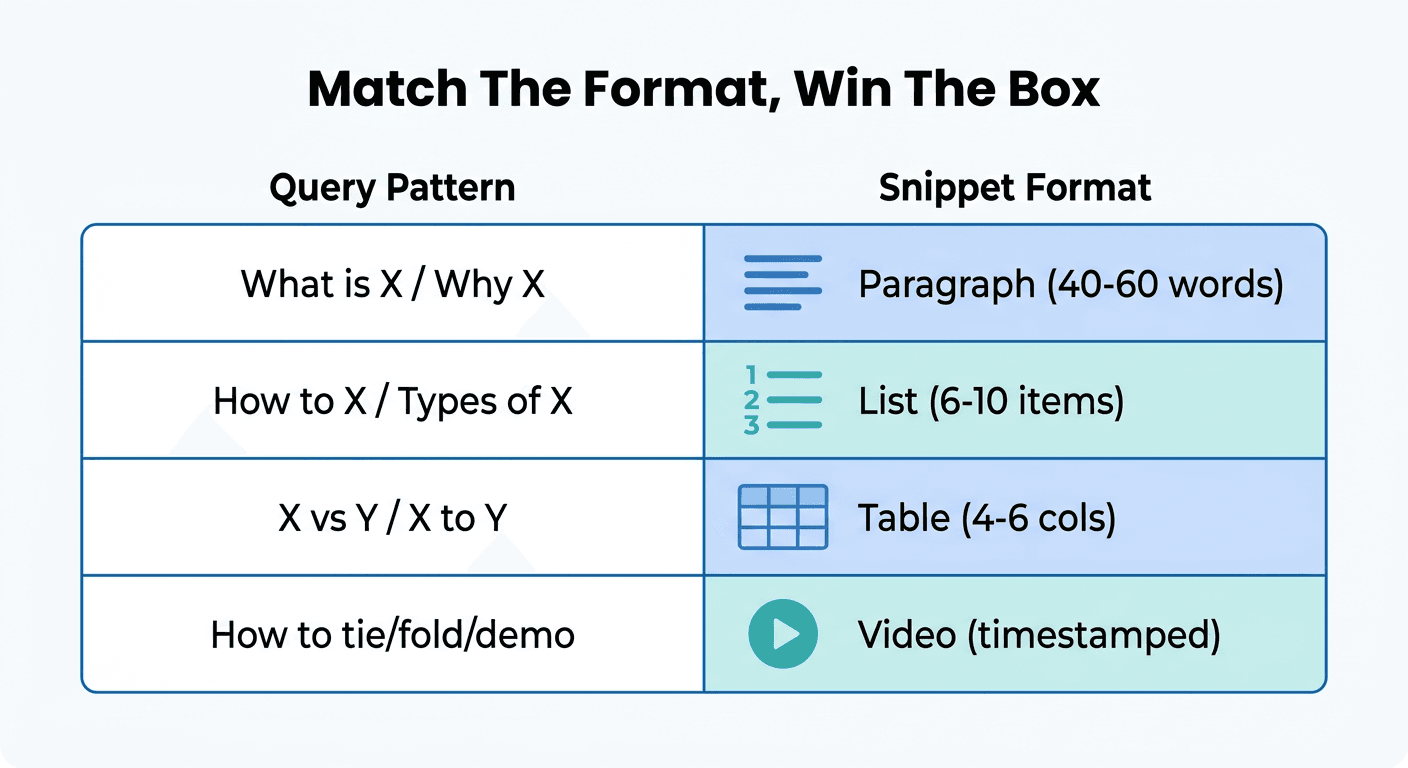
Google reads the SERP it's already showing for a query and picks a source that fits the format it has settled on. Match that format or you're competing with one hand tied.
| Query pattern | Format Google shows | What your page needs |
|---|---|---|
| "What is X", "why does X" (definitional, explanatory) | Paragraph | A 40-60 word answer in a <p> directly under an H2 that matches the query wording |
| "How to X", "types of X" (procedural, enumerative) | List (ordered or unordered) | 6-10 concise items under a matching H2, each starting with an action word |
| "X vs Y", "X to Y" (comparative, conversion) | Table | A clean table, 4-6 columns, 5-10 rows, with a header row Google can parse |
| "How to tie a tie", demonstrative tasks | Video | A YouTube video with timestamped chapters covering the query |
The rule that trips up the most writers: check the current SERP before you write. If Google is showing a numbered list for your target query, a beautifully written 200-word paragraph will not win it, no matter how good the writing is. Format mismatch loses to format match almost every time.
The pattern that wins a paragraph snippet
- Heading: phrase it as close to the exact query as you can. Google does fuzzy matching, but exact wording wins ties, and ties are common.
- First sentence: a complete, standalone answer. Someone (or something) reading only that sentence should understand the answer with no lead-in.
- Length: stop at 60 words. Google truncates over-length answers mid-sentence rather than showing the whole thing, so a tight 40-60 word answer beats a sprawling "comprehensive" paragraph that says more but says it slower.
- Everything else: push additional context, caveats, and depth into the paragraphs after the cited block. Google rarely pulls past the first one.
The pattern that wins a list snippet
Write the heading as the question ("How to X"), then present 6-10 items as a real <ol> or <ul>, not a paragraph pretending to be a list. Start each item with an action verb and keep the description to roughly 10-15 words. Google can also assemble a list snippet by pulling your H2/H3 subheadings across a page, so a clean, parallel heading structure helps even outside a single explicit list.
The pattern that wins a table snippet
Use an actual HTML table (or Markdown table that renders as one), 4-6 columns, 5-10 rows, with a clear header row. Keep cell contents short: a price, a spec, a yes/no, not a sentence. Comparison and conversion queries are the highest-yield table targets.
Featured snippets vs AI Overviews: what actually changed
AI Overviews didn't erase the opportunity, but they did reshape it. Tracking through 2025 showed AI Overview presence swinging widely across the year, and featured snippets appearing less often on queries where an AI Overview now shows. The queries where snippets still hold up well:
- Procedural queries ("how to X"). Google still favors a clean list snippet over an AIO summary here more often than not.
- Video and demonstrative queries. Video snippets remain largely untouched by AI Overviews.
- Conversion and reference lookups (units, currency, quick facts). Table snippets stay stable.
- Long-tail informational queries below whatever confidence threshold triggers an AI Overview for that topic.
Practically: build the section for the format Google is showing today. If Google later flips that query to an AI Overview, the same tightly structured, question-headed answer is exactly what makes a page eligible to be cited inside the AI Overview too. You are not choosing between optimizing for snippets or for AI Overviews; the same work qualifies you for both.
A workflow for finding your best opportunities
Don't start by writing new content. Start by auditing what you already have, ranked by leverage.
1. Pages already ranking top-10 that don't own the snippet. This is your highest-yield source. You already have the ranking; you're missing the formatting. Pull your top-ranking keywords, check whether a competitor holds the snippet for each, inspect their format and word count, then rewrite your existing section to match: same format, exact-match heading, target length. This is mechanical, repeatable work, and it converts a real share of attempts within a few weeks because the winner is usually just whoever formatted for extraction first.
2. Queries with a weak existing snippet. Some snippets are held by a thin, outdated, or barely-relevant page, because Google didn't have a strong option when it picked one. These cluster on long-tail queries. A single well-headed, tightly-formatted section will often displace a weak incumbent, because you're not fighting an entrenched, well-optimized competitor, you're beating a default.
3. PAA questions without snippet ownership. Some "People Also Ask" questions trigger their own snippet when searched directly. If you've already mapped the PAA questions around your topic (see our guide on how to rank in People Also Ask), promote the strongest answers into standalone, question-headed sections. You can pick up the PAA citation and the standalone snippet from the same block of content.
This same logic, treating "you already rank, you just need a formatting push" as a distinct category of opportunity, is exactly the low-hanging fruit idea: pages sitting at positions 11-20, or already on page one without the snippet, are the cheapest wins in SEO because the ranking work is already done.
Measuring whether it's actually working
Winning a snippet once is not the job. Snippet ownership rotates as competitors reformat, and Google occasionally flips a query's format entirely (a paragraph snippet becomes a list, and your old formatting silently stops working). Track three things on a schedule, not as a one-time audit:
- Ownership. For each target query, who holds the box this week: you, a competitor, or no one.
- Format drift. Has Google changed which format it's showing for a query since you last checked. A silent format change is the most common reason a page that used to win a snippet quietly stops.
- Before-and-after CTR. Winning a box that replaces your existing position-one listing without moving clicks isn't a win; you want to confirm the snippet actually changed traffic, not just relabeled it.
This is the same discipline behind Murkuz's approach to content decay generally: detection has to be continuous, because a page that's formatted correctly today can lose the box next month when a competitor reformats or Google changes what it's showing. Murkuz's daily scan of your Search Console data surfaces exactly this kind of drift, positions 11-20 pages one push from page one, and pages that have quietly slipped, so the fix list is a standing routine instead of a quarterly scramble. The same workflow that flags a declining page also flags a page worth reformatting for a snippet it doesn't yet own.
Common mistakes that lose a snippet you should have won
- Format mismatch. Writing a paragraph for a query Google is showing as a list, or vice versa. Always check the live SERP first.
- Over-length answers. A 200-word "thorough" answer gets truncated, not rewarded. Lead with the 40-60 word version; put depth after it.
- Keyword-stuffed or brand-flavored headings. "The Complete Guide to Featured Snippet Optimization in 2026" loses to "What is a featured snippet?" because the heading has to match the query, not your marketing voice.
- Chasing markup instead of structure. There is no schema tag that requests a snippet. The heading and the answer are the entire lever; spend your effort there.
- Treating it as a one-off project. Ownership rotates. A snippet audit needs a repeat cadence, not a single sprint.
FAQ
Do featured snippets still matter with AI Overviews everywhere?
Yes, for a large share of query types. Procedural, video, and conversion/reference queries still show snippets reliably, and the same structure that wins a snippet also makes a page eligible for AI Overview citation, so the work isn't wasted even where Google has shifted a specific query to an AIO.
Can I mark up my page to request a featured snippet?
No. There is no schema, meta tag, or setting that requests a snippet. Google's systems select the source automatically based on content and formatting. You can opt out (via nosnippet or max-snippet), but you cannot opt in beyond formatting your answer well.
Do I need to be ranked #1 to win the snippet?
No, and this is the most useful fact in the whole topic. Selection is decoupled from exact rank: the large majority of snippets come from top-10 pages, but only a minority come from the #1 result specifically. A well-formatted page at #4 to #10 can leapfrog the top result into the box.
Does winning a featured snippet hurt my click-through rate?
It replaces your existing organic listing rather than adding a second one, so if you already held a clean #1 with strong CTR, the net gain from also winning the snippet is smaller. If you were sitting anywhere from #2 to #10, the snippet is close to a straight upgrade in visibility.
How long does it take to win a snippet after reformatting?
There's no fixed timeline since it depends on how often Google recrawls the page and how contested the query is, but reformatting an already-ranking page is one of the faster SEO changes to see reflected, often within days to a few weeks once the page is recrawled.
Junaid Khalid is the Founder of Ertiqah, the company behind Murkuz. He has run SEO as the first growth channel across several of his own SaaS products and built Murkuz around the belief that SEO should be treated as an engineering problem: detect what's slipping, fix it, ship it, and prove the fix worked.