Why People Also Ask Is the Cheapest Ranking Win in SEO
The People Also Ask (PAA) box shows up on the vast majority of Google searches, sitting right in the middle of page one, above half the organic results most searchers will ever scroll to. Getting your page into one of those boxes puts you in front of searchers before they even reach position 1. And unlike ranking a whole page from nothing, winning a PAA slot is often a content edit, not a content project.
Here is the part most guides skip: you do not need a new page to win a PAA slot. You need a page that already ranks somewhere on page one or two for a related query, and a section that answers one specific question better than whatever thin, outdated, or badly-formatted page currently holds that slot. That is a much smaller job than "write content that outranks everyone," and it is why PAA is one of the few remaining near-free wins left in SEO.
This guide covers exactly how PAA selection works, the content pattern Google pulls from, a worked example you can copy, and the mistakes that keep good content out of the box.
What the People Also Ask Box Actually Is
PAA is the expandable "People also ask" module that shows related questions under or beside the organic results. Click one, and it expands to reveal a short answer plus a source link, then dynamically loads two or three more questions.
It is easy to confuse with two other features:
- People Also Search For (PASF): related search terms shown at the bottom of the results page, not answers pulled from content.
- Featured snippets: a single answer box pinned above all organic results (position zero). PAA answers are pulled using a similar extraction method, but PAA sits mid-page and shows multiple questions, not one.
The mechanics matter because they explain the opportunity: Google is not writing these answers. It is extracting them from existing pages that already rank for the underlying query, then re-surfacing the best-formatted, most direct answer it can find. If nobody has answered a question well, the box either doesn't appear or gets filled by a mediocre source that a better page can displace.
How Google Actually Picks a PAA Source (The Part Most Guides Skip)
Every PAA guide tells you to "answer the question clearly." Almost none explain the actual selection pattern, which is closer to this:
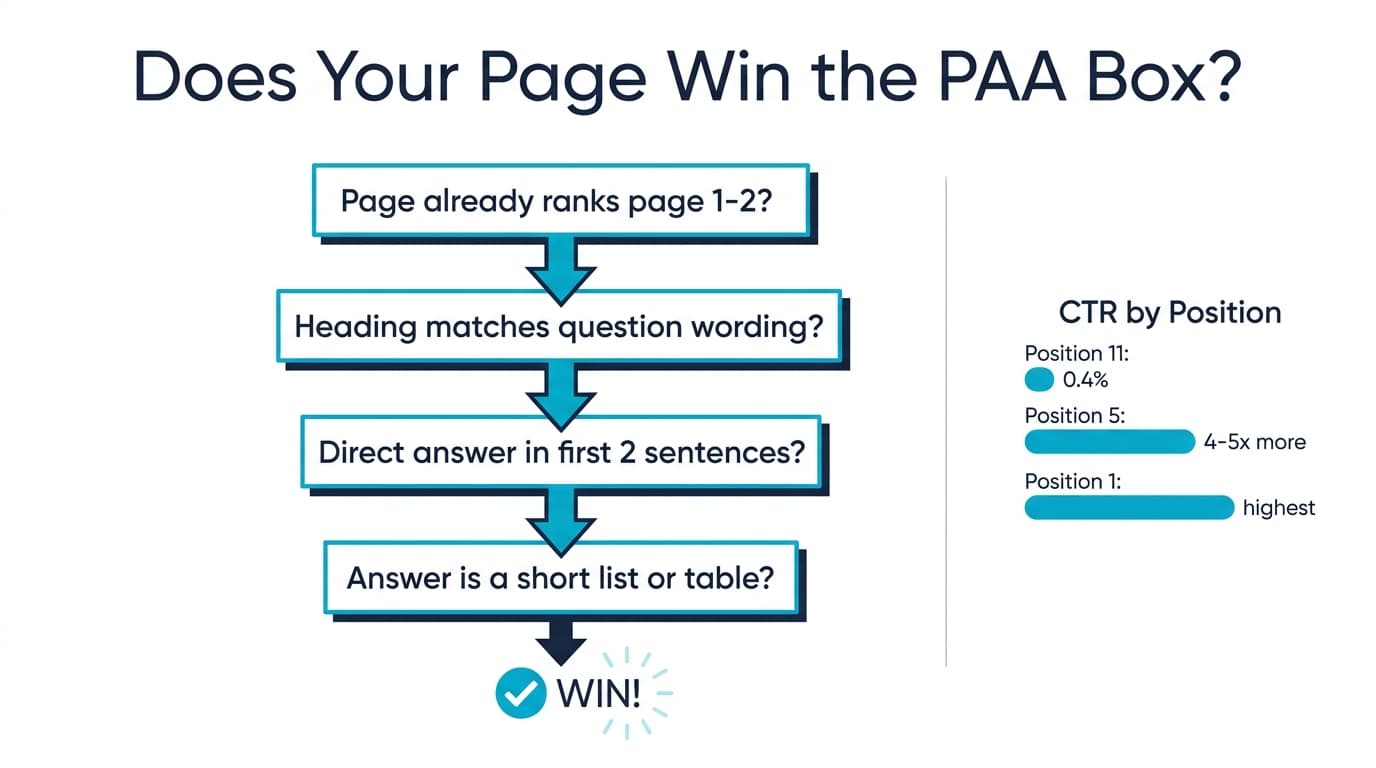
- The page is already ranking. Google pulls PAA answers overwhelmingly from pages already placing in the top 20 for a closely related keyword. A page with zero visibility for anything nearby has almost no shot at a PAA slot, no matter how well the answer is written.
- The question is answered in the searcher's own phrasing. Google matches the PAA question's exact wording (or a very close paraphrase) against a heading or opening sentence, not against content that answers the same idea in different words.
- The answer is extractable. A direct 40-60 word answer, sitting immediately under a heading that mirrors the question, in plain prose or a short list, is what the extraction algorithm can lift cleanly. Answers buried three paragraphs deep, or wrapped in marketing language before the actual point, rarely get pulled even when the underlying information is correct.
This reframes the whole tactic. You are not writing new content and hoping Google notices. You are finding the specific questions tied to pages you already rank for somewhere on page one or two, and adding a clean, directly-extractable answer for each one.
The Content Pattern That Gets Pulled Into PAA
Every page that wins a PAA slot follows a version of this same structure:
- Heading matches the question. Use the PAA question's exact phrasing (or close to it) as an H2 or H3. If the question is "How long does it take to rank in Google," your heading should read close to that, not "Ranking Timeline Factors."
- Answer comes first, in 1-3 sentences. State the direct answer immediately after the heading, before any caveats, context, or examples. This is the part extraction pulls.
- Format supports scanning. A short paragraph, a 3-6 item bulleted list, or a small table. Long unbroken paragraphs rarely get lifted cleanly.
- Depth follows the direct answer. After the extractable answer, expand with detail, examples, and nuance. This serves the reader who clicks through and satisfies the "comprehensive content" signal Google increasingly rewards, without hurting extractability.
- The page is fundamentally about the topic, not a passing mention. A page centered on the subject at hand will out-rank a longer page that mentions the topic in passing, because relevance and focus outweigh raw length for PAA extraction.
A Worked Example
Say you run a project management SaaS blog and you already rank position 9 for "project management software for remote teams." Checking the PAA box on that exact query (or a DataForSEO / SERP tool pull of it) surfaces: "What is the best free project management tool for remote teams?"
Your existing article mentions free tools in passing, in paragraph four, without a heading. Here is the fix:
- Add an H2 that mirrors the question: "What Is the Best Free Project Management Tool for Remote Teams?"
- Answer it directly in the first two sentences: name the actual best free option and the one-line reason, no preamble.
- Follow with a short 4-5 item bulleted comparison (tool name, free tier limit, best for) for readers who want more than the headline answer.
- Leave the rest of the article untouched. You are not rewriting the piece, you are adding one clean, extractable section to a page that already has ranking authority for the topic.
That is the entire mechanic. <mark class="km-highlight" style="--hl:#FEF08A;background:#FEF08A">No new domain authority required, no backlink campaign</mark>, just matching an existing ranking page to a real question it was already positioned to answer.
Finding the Right Questions to Target
You cannot optimize for a PAA question you have not identified. Three ways to find them, roughly in order of effort:
- Manual search. Google your target keyword, expand two or three PAA questions (each expansion loads more), and note the exact phrasing. Free, but slow if you are doing this across dozens of pages.
- SERP data tools. Ahrefs, Semrush, or a SERP API pull returns the PAA questions attached to a keyword in bulk, alongside the pages currently answering them, so you can see what you are displacing.
- Search Console. Filter your existing queries by pages ranking positions 4-20, and cross-reference against a PAA pull for those same terms. This tells you which of your ALREADY-RANKING pages have a PAA opportunity sitting on top of them right now, which is the highest-probability target because you have already cleared the hardest bar (ranking at all).
That last method is the one most guides never mention, and it is the most efficient: instead of guessing at questions in the abstract, you start from pages you already rank for and ask "what PAA question is sitting on this exact query, and does my page answer it cleanly?"
Why This Belongs in Your Low-Hanging-Fruit Pass, Not a Separate Project
PAA optimization is not really its own initiative. It is one of the highest-leverage fixes inside a broader pattern: pages ranking positions 11 through 20 are already proven relevant to Google, already indexed, already carrying some authority, and usually just need a specific, scoped improvement rather than a rewrite.
The data on why this range matters is stark: roughly 71% of all search clicks go to page-one results, and average click-through for position 11, one spot below the fold, is around <mark class="km-highlight" style="--hl:#BBF7D0;background:#BBF7D0">0.4%, versus the roughly 10x traffic jump available by climbing from position 11 to somewhere in the top five</mark>. A page sitting at position 11-20 with a matching, unaddressed PAA question is often a single scoped edit away from both a PAA box AND a page-one position. That is the best effort-to-reward ratio in SEO, and it is exactly the range Murkuz's low-hanging-fruit workflow is built to surface: it scans your Search Console data for pages in that 11-20 band, scores each one by impression volume and estimated traffic gain, and generates the specific fix needed, including, explicitly, "question targeting: add FAQ sections for related People Also Ask queries" as one of its named fix types, alongside content depth, freshness, internal linking, and featured-snippet structuring.
The point is not that you need a tool to do this once. Doing it once, on your best few pages, is a spreadsheet and an afternoon, using the manual or Search-Console method above, and if you are still building that keyword list from scratch, how to find low-competition keywords covers the free method for finding winnable targets in the first place. The point is that content decays and new PAA questions surface constantly, so a page that wins a PAA slot this quarter can lose it next quarter to a competitor's better-formatted answer. Treating this as a recurring scan across your whole site, rather than a one-time audit, is what keeps the wins compounding instead of eroding back down.
Common Mistakes That Keep Good Answers Out of the Box
- Answering the question, but not in the question's words. If the PAA question is "does X expire," and your heading says "Validity and Renewal Considerations," you have made the extraction job harder for no reason. Match the phrasing.
- Burying the direct answer under three paragraphs of setup. Say the actual answer first. Context and nuance come after, not before.
- Targeting a question on a page that does not rank for anything nearby. No amount of perfect formatting overcomes zero underlying relevance signal. Fix the page's overall ranking position first, or pick a different page that already has some.
- Treating every question as equally winnable. A question currently answered by a major publisher's dedicated, well-structured page is a much harder displacement than one answered by a thin forum post or an outdated listicle. Check who currently holds the slot before investing effort.
- Writing one giant FAQ block disconnected from the rest of the page. A bolted-on FAQ section with generic questions rarely performs as well as a heading placed naturally within the content, phrased as the actual question, answered where a reader would expect it.
- Never revisiting a win. PAA slots rotate as Google finds better-matching content elsewhere. A question you won six months ago is worth rechecking, not assumed permanent.
This is the kind of scoped, question-level fix that is easy to describe and easy to let slip once you have more than a handful of pages to watch. I write from having run SEO as the first, and often only, growth channel across several of my own SaaS products, which is the same reasoning behind building Murkuz: the audit part of SEO was never the hard part, following through on the fix was.
FAQ
How long does it take to rank in People Also Ask after making changes?
There is no fixed timeline, but because PAA extraction works off pages Google has already crawled and indexed, changes to an already-ranking page are typically reflected faster than a brand-new page would be, often within days to a few weeks once the page is recrawled.
Do I need schema markup to appear in People Also Ask?
No. FAQ and How-To structured data can help search engines parse Q&A content, but PAA pulls from ordinary page content that matches a question closely and formats the answer clearly. Schema is a helpful signal, not a requirement.
Can a page rank in People Also Ask without ranking well organically?
It is rare. PAA answers are pulled overwhelmingly from pages that already have some ranking relevance for the surrounding topic. A page with no visibility for anything related to the question has very little chance, regardless of how well the specific answer is written.
Is People Also Ask worth optimizing for if it sends less traffic than a top organic result?
Yes, for two reasons. It costs far less effort than winning position 1, since you are usually editing a page you already have rather than building new authority. And a PAA citation still earns visibility and clicks from searchers who never scroll further, particularly for the increasing share of queries where the PAA box sits above several organic results.
What is the difference between PAA and a featured snippet?
A featured snippet is a single answer box pinned above all organic results (position zero) for one specific query. PAA is a set of multiple related questions, each expandable, typically appearing mid-page. Both reward the same content pattern (a direct, well-formatted answer near a matching heading), so optimizing for one often helps the other.