Most local SEO advice for attorneys reads like it was written for a pizza shop and then relabeled for lawyers. Swap "menu" for "practice areas," add a line about Avvo, done. That approach misses what actually decides who shows up in the map pack for "personal injury lawyer near me": a law firm's site is usually a pile of practice-area and location pages built once, three years ago, and never touched again.
This guide is for the attorney or firm marketer who already has a website and a Google Business Profile and still isn't showing up. Not the firm starting from zero. If that's you, here's the order that actually moves rankings, the part every other guide skips (your own pages quietly rotting), and a self-audit you can run in twenty minutes.
Why local SEO works differently for law firms
Google ranks local results on three signals: relevance (does this business match what was searched), distance (how close is it to the searcher or the area they specified), and prominence (how well-known and trusted is it). For law firms, all three get distorted by two things generic local SEO guides don't deal with:
- High stakes, low trust by default. Nobody hires a lawyer on impulse. Reviews, credentials, and a Google Business Profile that looks actively maintained carry more weight than they do for a coffee shop, because the searcher is nervous and looking for reasons to rule someone out.
- Practice areas multiply pages, and pages compete with each other. A firm with five practice areas across three offices can end up with 15+ landing pages all trying to rank for overlapping terms ("Dallas personal injury lawyer," "personal injury attorney Dallas TX"). Nobody planned this. It just accumulated. Two of those pages competing for the same query is a problem Google resolves by ranking neither well, and almost no local SEO guide for lawyers even names this.
The four things that actually move your map pack ranking
In order of leverage, based on what separates firms that rank from firms that don't:
1. Google Business Profile, kept current, not just set up
Every guide tells you to claim your GBP. Fewer tell you what "optimized" means past month one:
- Primary category matches your main practice area exactly (
Personal Injury Attorney, notLawyer). Secondary categories cover the rest. - Services listed match what's on your website, word for word where possible.
- Photos added quarterly, not just at setup. Stale profiles with a 2023 photo as the newest one signal inactivity to both users and Google.
- Q&A section seeded with the 3-4 questions prospective clients actually ask ("do you offer free consultations," "do you handle cases outside [county]").
- Posts published monthly. Most firms do this for two months and stop. Consistency is the differentiator, not the content quality.
2. Reviews, with a system, not a one-time push
A burst of 20 reviews in one week followed by silence looks exactly like what it is. Google and prospective clients both read velocity as a trust signal. Build a simple ask into your intake or case-closing workflow (a templated text or email at the natural moment, right after a good outcome) so reviews trickle in steadily instead of arriving in spikes.
Respond to every review, including the one-star ones. A firm that responds professionally to a bad review often looks more trustworthy to the next prospective client than a firm with a spotless but response-free profile.
3. Location and practice-area pages, built to not compete with each other
This is where most firms get it wrong, and where the fix is mechanical once you see it:
- One page per practice area, per office location, never one page trying to cover both a practice area and a city generically.
- Each page needs distinct content: the office's actual attorneys, actual case types handled there, actual local courts or jurisdictions referenced. Templated pages that swap only the city name are the single most common reason multi-location firm pages don't rank; Google can tell.
- Internal links between a location page and its matching practice-area page, and from both to the relevant blog content, so authority flows to the pages that convert.
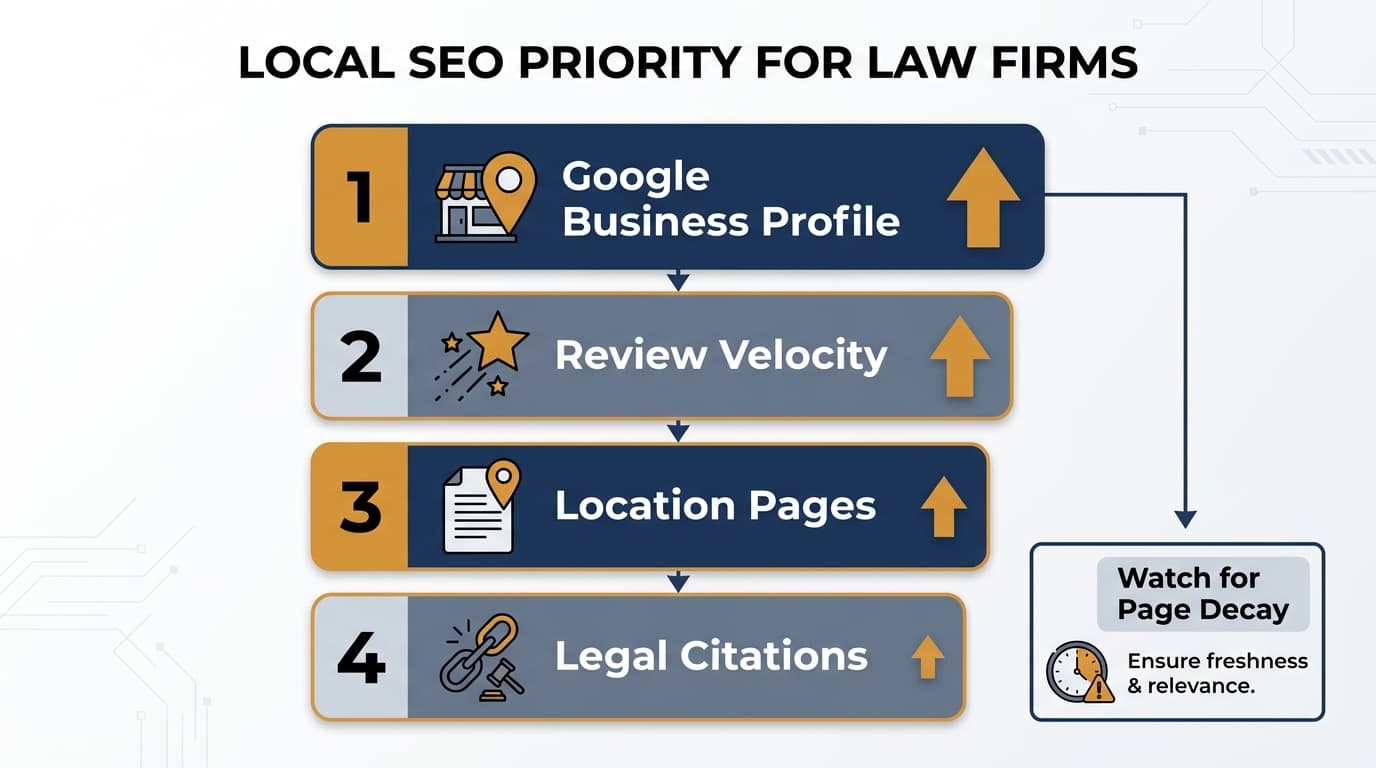
4. Citations and links, but only the ones that matter for legal
General local SEO advice says "build citations." For law firms specifically, the highest-value citations are legal-specific: Avvo, Justia, FindLaw, Martindale-Hubbell, and your state bar directory. NAP (name, address, phone) consistency across all of them matters more than volume. Ten consistent, accurate legal directory listings outperform fifty generic business directories with your old suite number still listed.
Local link-building for a law firm looks different from a typical local business too. The links that move the needle tend to come from genuinely relevant local sources: a quote in a local news story about a case, a sponsorship of a community event with a link back, a guest contribution to a local bar association newsletter. A single link from a relevant local news site usually outweighs a dozen generic directory submissions, because it signals the same thing a good review does: a real, active, locally-known practice.
A worked example: two-office firm, three practice areas
Take a firm with offices in Austin and San Antonio, handling personal injury, family law, and criminal defense. Built naively, that's a page for each combination: six pages, several of them thin because the firm might only have one attorney covering criminal defense in San Antonio.
Applied against the decision framework below, the fix is straightforward: build all three practice-area pages for the office with full attorney coverage (Austin), and only build San Antonio pages for the practice areas that office actually has capacity for. If San Antonio only has meaningful capacity in personal injury and family law, that's two pages, not three. The firm ends up with five real pages instead of six, and the five rank better because none of them are diluting the signal of a location the firm can't fully back up. This is the point most local SEO advice glosses over: more pages is not the goal, matched pages are.
The part every other guide skips: your pages are decaying right now
Here is what almost nothing written on this topic mentions: a location page that ranked well eighteen months ago does not stay ranked by default. Google reprocesses relevance and freshness signals continuously, and a law firm page is especially exposed to quiet decay because:
- Attorney bios go stale (someone left the firm two years ago and is still listed).
- "Recent case results" sections stop getting updated, so the newest result on the page is from 2023.
- A competitor down the street refreshes their page and picks up the ranking your firm used to hold, and nothing on your end changed to alert you.
Most firms find out their local rankings dropped when a partner asks why the phone stopped ringing, months after the actual decline started. That's the gap this article exists to close: local SEO for attorneys isn't just a setup checklist, it's an ongoing maintenance problem, and maintenance is the part firms skip because nobody's watching for it.
This is also the exact problem Murkuz is built around. Murkuz connects to your Google Search Console and flags the location and practice-area pages that are losing position before the phone stops ringing, not after. It's one real example of the broader shift: SEO tools that only report a ranking drop leave you to notice, diagnose, and fix it yourself; tools built to close that loop flag the page, help you fix the section that's gone stale, push the update, and confirm the ranking recovered. For a solo or small-firm marketer without a dedicated SEO hire, that difference is the whole ballgame.
A 20-minute self-audit you can run today
- Search your own map pack terms ("[practice area] lawyer [your city]") in an incognito window. Note your position and who's above you.
- Open your GBP and check: is the newest photo more than 90 days old? Are there unanswered reviews? Is a Q&A sitting empty?
- List every location and practice-area page on your site. For any two pages targeting the same city, check whether they're actually differentiated or just city-name swaps of the same template.
- Check your three newest legal directory listings (Avvo, Justia, FindLaw) for NAP consistency against your website footer.
- Look at your oldest ranking page's "last updated" content. If the newest case result, testimonial, or stat on the page predates last year, that page is a decay risk, not a asset you can assume is still working.
A quick decision framework: how many location pages do you actually need
| Firm situation | Recommended page structure |
|---|---|
| Single office, single practice area | One strong page. Do not split it by neighborhood; that dilutes signal instead of adding it. |
| Single office, multiple practice areas | One page per practice area, all linking back to a firm-overview or about page. |
| Multiple offices, single practice area | One page per office location, each with unique local content (attorneys, courts, testimonials specific to that office). |
| Multiple offices, multiple practice areas | One page per practice-area-per-office combination, but only where there's a real attorney and real capacity there. Do not create a page for a combination the firm can't actually service; thin, unsupported pages drag down the pages that matter. |
Where AI search fits into this
Prospective clients increasingly ask ChatGPT or Google's AI Overviews questions like "what should I look for in a personal injury lawyer" or "how much does a divorce lawyer cost in [city]" before they ever search a firm name. Getting cited in those answers relies on the same fundamentals as ranking well in the map pack: clear, current, well-structured content with real credentials attached, not a separate strategy bolted on top.
A firm that keeps its practice-area pages current, lists real attorney credentials, and answers the questions clients actually ask (fees, timelines, what to bring to a consultation) is already doing the groundwork AI search rewards. A firm with stale, templated pages and no author credentials attached is effectively invisible to both. This is one more reason page maintenance matters more than a one-time build: AI systems re-crawl and re-evaluate content on their own schedule, and a page that was accurate when it was built two years ago may be quietly wrong today, whether or not anyone at the firm has noticed.
FAQ
How long does local SEO take to work for a law firm?
Most firms see initial movement in the map pack within 60-90 days of consistent GBP activity and review velocity, with meaningful ranking gains for competitive practice areas taking 4-6 months. Firms in less competitive practice areas or smaller markets often move faster.
Is local SEO worth it for a solo attorney?
Yes, often more than for a large firm. A solo practitioner competing for a specific practice area in a specific city has a narrower, more winnable target than a national brand competing broadly, and the map pack rewards a focused, accurate, active profile over sheer size.
Do I need a page for every city I serve, even if I don't have an office there?
No. A page for a city with no real physical presence or attorney capacity there is a thin page that Google and prospective clients can both spot, and it tends to hurt the pages that are legitimate rather than adding new rankings.
How much does local SEO cost for a law firm?
It ranges widely: a solo attorney doing GBP maintenance and citation cleanup themselves spends time, not money; hiring an agency for ongoing local SEO typically runs from a few hundred to a few thousand dollars a month depending on market competitiveness and number of locations. The bigger cost most firms don't budget for is the ongoing maintenance after the initial setup, which is where rankings quietly slip.
What's the single biggest local SEO mistake law firms make?
Treating it as a one-time setup instead of an ongoing maintenance task. GBPs go stale, location pages accumulate outdated case results and departed attorneys, and firms usually only notice once a competitor has already taken the spot.
Junaid Khalid is the founder of Ertiqah, the studio behind Murkuz. He has run SEO as the first growth channel across his own SaaS products and built Murkuz around the same lesson this guide covers: ranking once isn't the hard part, staying ranked is.