Perplexity does not show you ten blue links. It reads the web, picks a handful of sources it trusts, and writes you an answer with citations attached. If your page is not one of those citations, you do not exist in that answer, no matter how well you rank on Google.
That is the entire game of Perplexity SEO: earning a spot in the citation list, not a spot in a results page. This guide covers how Perplexity actually decides what to cite, the specific technical and content changes that move the needle, how to check whether you are already being cited, and a realistic first-90-days plan.
What is Perplexity SEO?
Perplexity SEO is the practice of structuring, sourcing, and maintaining your content so that Perplexity's answer engine selects it as a citation when it answers a user's question. It is a form of Answer Engine Optimization (AEO): instead of optimizing for a ranking position, you optimize for the probability that an AI system quotes and links to you as a trusted source.
The mechanics are different enough from classic SEO that the same page can rank on page one of Google and never get cited by Perplexity, or vice versa. Perplexity runs its own crawler (PerplexityBot), blends that with data from search indexes like Bing, and re-crawls frequently to keep answers current. It is not just re-ranking Google's results: it is assembling an answer from whichever sources look most authoritative, current, and easy to extract a clean claim from.
How Perplexity actually picks what to cite
Four things consistently separate cited pages from ignored ones.
Extractable answers. Perplexity's model has to pull a clean, quotable claim out of your page. A page that buries its answer under three paragraphs of throat-clearing is harder to extract from than a page that states the answer in the first sentence of a section, then supports it.
Verifiable, specific facts. Vague claims ("many businesses see results") get skipped in favor of specific ones ("checkout abandonment drops when the page loads in under two seconds"). Perplexity is graded on accuracy by its own users, so it favors sources that let it make a confident, checkable statement.
Freshness. Perplexity re-crawls active pages far more often than Google re-crawls a typical blog. A page with a stale "as of 2019" statistic loses to a competitor that updated the same claim last month, even if the older page has more backlinks.
Author and site authority signals. Clear authorship, a real bio, and a site that already gets cited or linked by other trusted sources all raise the odds Perplexity treats you as a credible source rather than just another page that happens to mention the topic.
None of this is exotic. It is what good SEO has always rewarded: clarity, specificity, freshness, and credibility. Perplexity just weighs them differently and checks them constantly, not once a quarter.
Step 1: Let PerplexityBot in
Before anything else works, confirm the crawler can actually reach your content.
- Check
robots.txtfor aUser-agent: PerplexityBotblock. If it is disallowed, none of the rest of this matters. - Confirm the page is not gated behind JavaScript that only renders after a client-side fetch. If your content only appears after user interaction or a slow client render, treat it the same as you would for any crawler: server-render or pre-render the primary content.
- If you use a CDN or bot-management layer (Cloudflare, etc.), verify it is not blanket-blocking AI crawlers under a generic "block bots" rule. Some teams turn this on to stop scraping and accidentally block the same crawler they are trying to get cited by.
This step alone explains a surprising share of "why am I never cited" cases. Sites do not get skipped because the content is bad, they get skipped because the crawler never successfully read it.
Step 2: Structure the page for extraction, not for scrolling
Rewrite your on-page structure so an AI system (and a skimming human) can lift a complete answer from a single section.
- Lead with the answer. Open each H2/H3 with a direct, declarative sentence that answers the implied question, then explain it. Do not build up to the answer at the end of the paragraph.
- One idea per section. A section that answers three different questions at once gives the model nothing clean to extract. Split it.
- Use real headings as questions where it fits. "How long does X take" as an H3, followed immediately by a direct answer, is far easier to lift than a heading like "Timing Considerations."
- Favor lists and short paragraphs over dense blocks. Numbered steps, short bullet points, and 2-4 sentence paragraphs all extract cleanly. A 300-word unbroken paragraph does not.
- Add structured data where it is genuinely accurate. FAQ schema, HowTo schema, and Article schema with author markup all give machine-readable signals about what the page is and who wrote it. Do not add schema that misrepresents the page just to game a signal. If you need a starting point, Murkuz has a free FAQ schema generator that outputs valid markup from a plain list of questions and answers.
Step 3: Make the facts checkable
Perplexity favors content it can verify against other sources. Two changes matter most.
Cite your own sources. If you state a statistic, link to where it came from. A claim with a visible source is more citable than the same claim floating unsupported, because it gives the model (and the reader) a way to confirm it.
Replace vague claims with specific ones. "This significantly improves performance" tells a reader and a model nothing they can check. "This cut load time from 4.2s to 1.8s" is a fact that can be verified, quoted, and trusted. Go through your existing pages and hunt down every unquantified claim; either quantify it or cut it.
Step 4: Build real authorship
Perplexity, like Google, weighs who wrote the content. A page with no byline, or a generic "Team" byline, gives an AI system no authority signal to key off. A page with a named author, a real bio, and credentials relevant to the topic gives it one.
This is also one of the more mechanical fixes available: attach a genuine author profile (name, role, relevant experience, links to other work) to every piece of content you want cited, and keep that profile visible on the page, not buried in a separate about page nobody links to. Murkuz's grading tooling checks for exactly this kind of E-E-A-T signal (structure, authority signals, citation potential, and freshness) and scores pages A through F against it, which is a fast way to see which of your existing pages are missing the basics before you rewrite from scratch.
Step 5: Keep it current, on a schedule, not a whim
Perplexity re-crawls active pages aggressively. That means a page you wrote once and never touched again slowly loses ground to competitors who update theirs. Treat your highest-value pages the way you would treat a living document:
- Re-check statistics and pricing figures on a fixed cadence (quarterly at minimum for anything volatile).
- Update the visible "last updated" date when you make a substantive change, not a typo fix.
- Watch for citations you have lost. If a page that used to get cited stops appearing, that is usually a freshness or accuracy signal, not bad luck.
How to check if you are already being cited
You do not need an enterprise tool to start. Open Perplexity and run your actual target queries, the same way a prospective customer would phrase them, and read who gets cited. Do this for every keyword you care about, not just your brand name. Note which domains show up repeatedly. Those are your real competitors for this channel, and they are frequently not the same sites that outrank you on Google.
For a repeatable version of this instead of a one-off manual check, this is exactly what an AI-search-readiness process should be doing continuously: grading pages for AI-citation readiness, flagging which are invisible to ChatGPT, Perplexity, and Google AI Overviews, and generating the specific fix for each one. That is the kind of thing our AI search readiness tooling exists to automate, but you can run the manual version above for free today and get real signal from it.
Perplexity vs. Google AI Overviews vs. ChatGPT: what actually differs
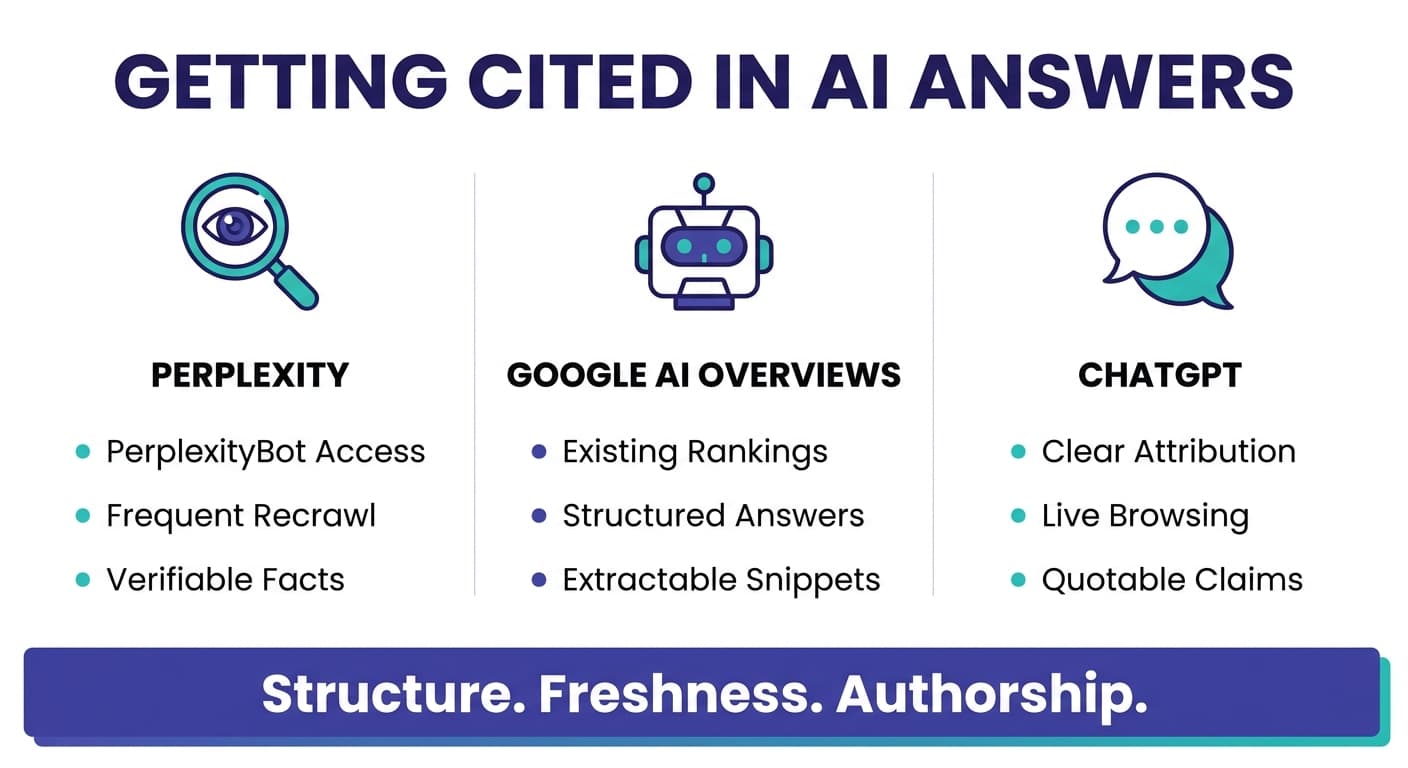
Treating "AI search" as one undifferentiated target is a common mistake. The three surfaces behave differently enough that a page tuned for one is not automatically tuned for the others.
| Signal | Perplexity | Google AI Overviews | ChatGPT (browsing) |
|---|---|---|---|
| Primary crawler | PerplexityBot + Bing data | Googlebot (existing index) | OAI-SearchBot / live browsing |
| Recrawl frequency | Very frequent on active topics | Tied to normal Google crawl budget | Varies, often real-time at query time |
| What it rewards most | Freshness, verifiable specifics, clear authorship | Existing Google ranking signals plus structured, extractable answers | Structured, factual content with clear attribution |
| Citation style | Numbered inline citations to sources | Linked snippets under the AI-generated answer | Inline links when browsing is used |
| Best lever if you do only one thing | Update stale facts and add a real author byline | Strengthen the underlying SEO the AI Overview is drawing from | Make the core claim quotable in one sentence |
The overlap is real: clear structure, verifiable facts, and authorship help across all three. But if you are optimizing for Perplexity specifically, freshness and crawler access deserve more of your attention than they would if you were purely chasing a Google AI Overview. If Google's AI answers are your bigger traffic source today, see how to rank in Google AI Overviews for the surface-specific version of this playbook.
A realistic first 90 days
Week 1 to 2: audit crawler access (robots.txt, JS rendering, bot-management rules) and pick 10 to 20 pages that answer questions your buyers actually ask.
Week 3 to 6: rewrite those pages for extraction (answer-first sections, FAQ schema, quantified claims, real author bylines). Run your target queries in Perplexity before and after to see if citations start appearing.
Week 7 to 12: put a freshness cadence in place for the pages that got cited, so you do not lose the spot to a competitor who updates more often than you do. Expand the same treatment to the next tier of pages.
This is slower than a paid-ads campaign and faster than most people expect once the crawler access and structure basics are fixed. Most of the "no one gets cited overnight" complaints trace back to step 1 or step 2 never actually being done.
FAQ
Is Perplexity good for SEO?
Yes, in the sense that being cited in Perplexity answers puts your brand in front of a growing pool of research-stage searchers. It will not replace Google traffic for most sites yet, but it is a real, separate channel worth optimizing for, especially since competition for citations is still thin in most niches.
Is SEO dead because of Perplexity and other AI search tools?
No. Traditional SEO fundamentals (clear structure, real authority, useful content) are the same fundamentals that get you cited in AI answers. What changed is that there is now a second, related outcome to optimize for alongside a ranking position: a citation.
Why is Perplexity controversial?
Perplexity has faced public criticism and legal challenges from publishers and media organizations over how it sources and attributes content it summarizes. That is a separate issue from the SEO question of how to get your own content cited, but it is worth knowing if you are researching the platform.
Is Perplexity better than ChatGPT for search?
They serve overlapping but different needs. Perplexity is built specifically as a citation-first answer engine, so its citation behavior is more central to the product. ChatGPT's browsing and search features are one part of a much broader assistant. For the specific goal of getting your content cited with a visible source link, treat them as two separate optimization targets rather than assuming one strategy covers both.
Which AI is best for SEO?
There is no single winner. Perplexity, ChatGPT, and Google AI Overviews each reward slightly different signals, and the highest-value citations across all three come from the same underlying work: clear, current, well-attributed, specific content. Optimize the fundamentals once and adjust the freshness and structure emphasis per platform, per the comparison table above.
Junaid Khalid is the founder of Ertiqah and the builder of Murkuz, the SEO platform that closes the loop from detecting a ranking or citation problem to proving the fix worked. He has run SEO as the first growth channel across his own SaaS products, including the shift from chasing rankings to chasing AI citations.