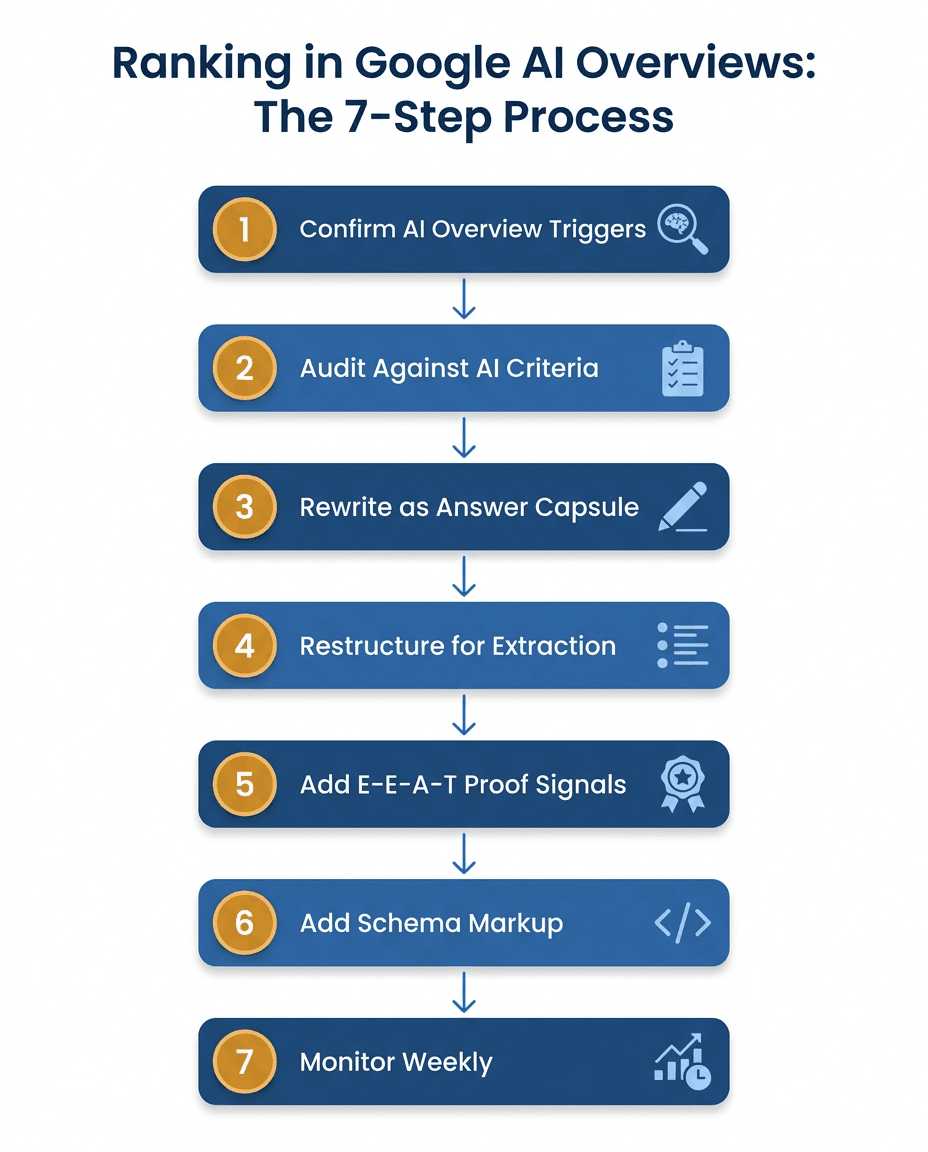
Most "how to rank in Google AI Overviews" articles give you a list of principles: be authoritative, be clear, be fresh. True, and useless. You cannot open your CMS and "be more authoritative" this afternoon. This guide skips the theory and gives you the actual sequence of steps to run on a real page, in order, starting today.
Google has said there is no separate algorithm to game here. AI Overviews pull from the same index as regular Search, then a language model selects, synthesizes, and cites from the pages that already rank well and are structured for extraction. So "ranking in AI Overviews" is really two jobs stacked on top of each other: earn a place in the eligible pool (normal SEO), then win the synthesis step (structure and extractability). Below is the step-by-step for both.
Step 1: Confirm the Keyword Even Triggers an AI Overview
Before you touch a single page, check whether Google shows an AI Overview for your target query at all. Not every search does, and optimizing a transactional or purely navigational query for AI Overviews wastes effort.
- Search the exact phrase in an incognito window, signed out, from the country you are targeting.
- Note whether an AI Overview appears above the organic results.
- Check 3 to 5 close variants of the query (the singular, the plural, "how to X" vs "X guide"). AI Overviews are query-sensitive: a variant with different wording can trigger or suppress the overview entirely.
- Read which domains are cited inside the overview itself. These are your real competitors for this feature, and they are often not the same sites ranking at position 1 to 3 in the blue links below.
Research on hundreds of thousands of queries found that <mark class="km-highlight" style="--hl:#FEF08A;background:#FEF08A">roughly half of AI Overview citations also rank in the top 10 organic results</mark>, which means ranking well traditionally still matters, but it is not sufficient on its own. The other half of the picture is what the rest of this guide covers.
Step 2: Audit the Page Against What AI Engines Actually Reward
Google's own developer guidance is blunt: there are no special technical requirements to appear in AI Overviews beyond the normal Search Essentials. But "normal SEO" plus a few extraction-specific factors is what separates cited pages from ignored ones. Run this checklist against your target page:
- Direct, self-contained answer near the top. Does the first 100 to 150 words actually answer the query, or does it warm up with a story first?
- Clear structural signals. Descriptive H2s and H3s, ideally phrased as the question a reader would type.
- Extractable facts. Specific numbers, named entities, dates, and named methods, not vague claims like "many experts agree."
- Freshness. A visible last-updated date and content that reflects the current state of the topic, not a page frozen in a previous year.
- Named authorship. A real author byline with credentials, not "Admin" or no byline at all.
- Schema markup that matches the visible page. Article, FAQPage, or HowTo schema where it genuinely fits the content, not bolted on for the sake of it. Google has been explicit that structured data must reflect what a reader actually sees on the page.
- Clean, crawlable HTML. No content locked behind JavaScript rendering that a crawler has to execute first, no aggressive interstitials blocking the main content.
Grade the page honestly on each line above before writing a single new word. This is the same audit an SEO tool would run to flag "AI Search Gaps," and doing it by hand for one page takes about fifteen minutes.
Step 3: Rewrite the Opening as an "Answer Capsule"
This is the single highest-leverage change and the one most guides skip. AI Overviews favor pages where the answer can be lifted in one or two sentences without the model having to do interpretive work.
Take your existing intro and rewrite it in this order:
- Sentence 1: State the direct answer or the core mechanism, in plain language, no preamble.
- Sentence 2 to 3: Add the one qualifying detail that keeps the answer accurate (a condition, a number, a timeframe).
- Sentence 4 onward: Now you can build context, examples, and narrative.
Compare a common failure pattern to the fix:
Before: "In today's fast-changing digital landscape, businesses are constantly looking for ways to improve their online visibility. One increasingly important factor is how content performs in AI-powered search experiences..."
After: "To rank in Google AI Overviews, a page needs to already be eligible for standard Search, then structured so a language model can extract a direct answer. Google reports no separate ranking requirements beyond its usual Search Essentials, but structure and extractability decide which eligible pages actually get cited."
The "after" version could be lifted as a citation almost verbatim. The "before" version cannot, because there is no discrete claim to extract until three sentences in.
Step 4: Restructure the Body for Extraction, Not Just Reading
Once the opening answers the query, the body needs to make every sub-claim independently extractable. AI systems pull individual facts and short passages out of context, so each section should stand on its own.
- Break long paragraphs into 2 to 4 sentence blocks. A wall of text forces the model to guess where one idea ends and the next begins.
- Use bulleted or numbered lists wherever you are listing steps, factors, or comparisons. The majority of AI Overview citations pull directly from list-formatted content, because lists are the easiest structure to parse and quote cleanly.
- Add a comparison table when the topic genuinely involves comparing options. Tables are dense, extractable, and rare enough in most content that they stand out.
- Repeat the target entity by name in each major section instead of relying on pronouns. "Google's system does X" reads worse to a human editor but parses far better for a model trying to resolve what "it" refers to three paragraphs later.
Here is how the three major AI answer engines differ in what they weight most when selecting a source, which changes where you should invest first if you only have time for one engine:
| Engine | What it weights most | Practical implication |
|---|---|---|
| Google AI Overviews | Authoritative, well-structured pages already competitive in organic Search | Fix ranking fundamentals first; structure decides citation among eligible pages |
| ChatGPT (browsing/search) | Structured, factual content with clear attribution | Prioritize schema markup and explicit sourcing of claims |
| Perplexity | Recent, well-sourced content with named expert authorship | Prioritize visible publish/update dates and real author bylines |
Step 5: Add Real Proof Signals (E-E-A-T, Not Just Words)
AI Overviews and chat-based engines both lean on trust signals to decide which of several similar pages to cite. This is where thin content gets filtered out even when the writing quality is fine.
- Attach a real author name and a short bio with actual credentials relevant to the topic, linked to a bio page or social profile.
- Cite primary sources and data, and link to them, rather than repeating a stat you saw on another blog with no attribution.
- If your organization has direct experience with the topic (you ran the test, built the tool, worked the cases), say so explicitly in the first-person somewhere in the piece. "We tested this across 40 client sites" is a stronger citation candidate than "many marketers recommend this."
- Keep the schema markup honest: an
Articleschema withauthor,datePublished, anddateModifiedfilled in correctly, matching what a visitor actually sees.
Step 6: Add Schema Markup Deliberately, Not Generically
Schema is one of the few genuinely technical levers in this whole process, and it is worth doing correctly rather than pasting a generic template.
- Use
FAQPageschema only on a page with real, visible Q&A content, matching word-for-word what is on the page. - Use
HowToschema for genuine step-by-step processes, like this one. - Use
Articleschema on standard posts with correctauthor,headline,datePublished, anddateModified. - Validate every schema block with Google's Rich Results Test before publishing. Broken or mismatched schema is worse than none, since it signals sloppiness rather than trustworthiness.
Step 7: Publish, Then Monitor for AI Overview Presence Specifically
Standard rank tracking will not tell you whether you are appearing inside AI Overviews, because that surface is not a normal ranking position. A purpose-built tracker will: see our comparison of tools that measure your AI visibility across AI Overviews, ChatGPT, and Perplexity. After publishing or updating the page:
- Re-run the incognito search from Step 1 weekly for the first month. AI Overview inclusion can shift faster than traditional rankings as Google's citation pool updates.
- Watch Google Search Console's Performance report, filtered to the page, for impression and click patterns that do not match a normal ranking change (a click-through-rate drop with stable impressions is a common signature of appearing in an AI Overview instead of, or alongside, the organic listing).
- Track brand mentions across the web generally, not just backlinks. Studies of AI Overview citations have found unlinked brand mentions correlate with citation likelihood even more than traditional links do, because the model is picking up on where a source is discussed, not only where it is hyperlinked.
- If the page stops appearing in the overview after a period of inclusion, re-run the Step 2 audit. AI Overviews reshuffle their citation pool as fresher or better-structured competing pages get indexed.
The Part Everyone Skips: Doing This at Scale
The seven steps above take roughly an hour per page done properly. The real problem is not knowing the steps, it is that most sites have hundreds of pages that could plausibly earn an AI Overview citation, and manually auditing each one against every checklist item above does not scale past a handful of pages before it becomes someone's full-time job.
This is the exact gap Murkuz was built to close. Instead of manually running Step 2's checklist page by page, Murkuz connects to your Google Search Console and grades every page A through F for AI search readiness, then generates the specific recommendation for each one (add FAQ schema here, rewrite this intro as an answer capsule, add an author profile there). The same platform that flags the gap can also draft the fix through its content engine, and because it is tied to your GSC data, you can watch the actual ranking and citation behavior change afterward rather than guessing whether the rewrite worked.
That said, everything in Steps 1 through 7 above works by hand with nothing but a browser, a text editor, and Search Console. The tool exists to do it across an entire site without the manual audit becoming a second job. If you are experimenting with GEO more broadly and want to understand where it overlaps with and diverges from traditional SEO, the GEO vs SEO breakdown covers that distinction in more depth.
FAQ
Do I need to write different content for AI Overviews than for regular Google Search?
No. You need the same page to do double duty: rank well by normal SEO standards, and be structured so the relevant answer can be extracted cleanly. It is one page, optimized for two consumption modes (a human scanning results, a model synthesizing an answer), not two separate pieces of content.
Can I trick the Google AI Overview into citing my page?
Not reliably, and attempting to (keyword stuffing FAQ schema onto content that does not actually answer questions, fabricating author credentials, cloaking content differently for crawlers) risks manual action or filtering, and Google has explicitly said the same policies that govern regular Search apply to AI features. The steps above work because they make genuinely useful content easier to extract, not because they exploit a loophole.
How long does it take to start appearing in AI Overviews after making these changes?
There is no fixed timeline, because it depends on how quickly Google re-crawls and re-indexes the page and how competitive the citation pool is for that query. Some pages shift within days of a structural rewrite; others take several weeks. Re-checking weekly, as in Step 7, is the practical way to know rather than guess.
Does losing organic clicks to an AI Overview mean I should stop trying to rank there?
Not necessarily. Being cited in the overview is still visibility, and Google's own data shows AI Overviews surface a wider and more varied set of links than a standard results page, which can be a discovery channel even when the click-through behavior looks different from a traditional blue link.
What is the single highest-impact change from this list if I can only do one thing?
Rewrite the opening as a genuine answer capsule (Step 3). Coverage of citation patterns consistently shows that pages leading with a direct, extractable answer outperform pages that build up to the point, regardless of how strong the rest of the page is.