Most "programmatic SEO examples" lists are a company logo, one guessed page count, and a one-line pattern like "[City] + [Service]." That tells you what the page looks like. It does not tell you what data feeds it, why the pattern earns a click instead of a bounce, or how to build the same thing with the data you already have sitting in a spreadsheet or a database table.
Below are 12 real programmatic SEO examples, each with the exact template, the data source behind it, and the one thing worth stealing for your own site. Then a plain rundown of how to build a batch like this without publishing the thin, swapped-variable pages that get sites hit by Google's scaled content abuse policy.
What Counts as Programmatic SEO (Quick Definition)
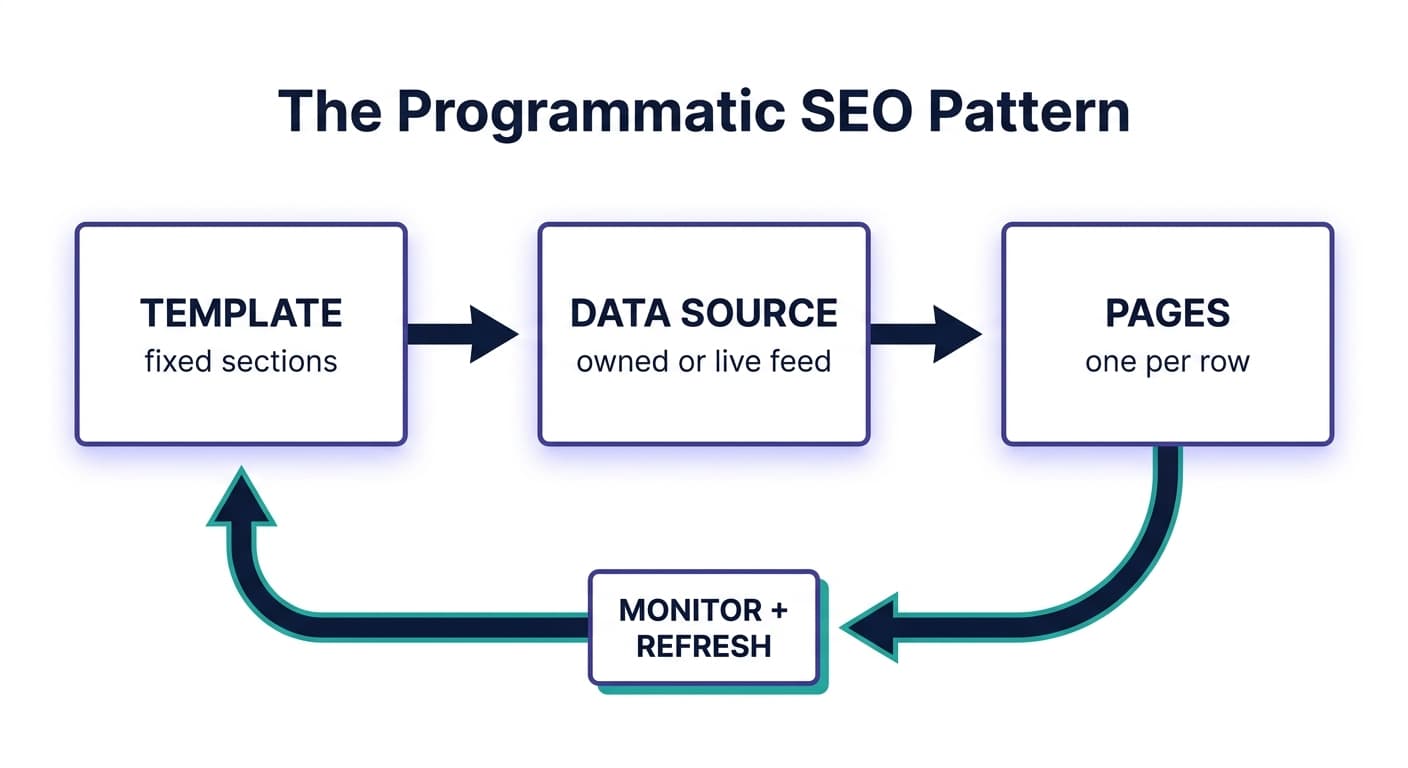
Programmatic SEO is generating a large set of pages from one content template plus a structured data source, where each row of data becomes one page targeting one long-tail keyword variant. "Best [tool] for [industry]," "[city] [service] near me," and "[currency A] to [currency B]" are all the same idea: one template, hundreds or thousands of data rows, each one a page.
It is different from a normal blog post in two ways. First, the content is templated: the sections, structure, and logic repeat across every page, only the variables change. Second, it only works at the keyword level Google actually searches: real long-tail queries with real, if small, individual search volume, aggregated across hundreds of pages into meaningful total traffic.
The 12 Examples
1. Zapier: App + App Integration Pages
Pattern: [App A] + [App B] Integrations
Data source: Zapier's own catalog of connected apps (7,000+), cross-multiplied against each other.
Steal this: Each page shows the specific triggers and actions available between those two exact apps, pulled straight from Zapier's own integration data, not generic "how to integrate" copy. The page is only possible because the product itself generated the data. If your product already tracks structured relationships between two things (apps, features, plans), that dataset is sitting in your own database before you write a word of content.
2. Nomad List: City Data Pages
Pattern: [City] (cost of living, internet speed, safety, weather)
Data source: Aggregated, continuously updated city-level data (cost indices, connectivity, climate).
Steal this: Every page answers the same underlying question ("should I live/work here") using metrics scored the same way across every city. That consistency is what makes 1,000+ pages feel like one product instead of 1,000 disconnected articles.
3. TripAdvisor: City x Cuisine x Neighborhood Pages
Pattern: Best [Cuisine] Restaurants in [City] / Best Restaurants in [Neighborhood]
Data source: User-generated reviews and ratings, aggregated per location.
Steal this: Layering three variables (city, cuisine, neighborhood) instead of one multiplies the addressable long-tail keyword set without touching the core template. If your dataset has more than one dimension, template all of them before assuming you only have one page type to build.
4. G2: Software Comparison Pages
Pattern: [Software A] vs [Software B]
Data source: G2's own review and feature database for every listed product.
Steal this: The page works because G2 already collects structured feature and review data for every product in the category; it is a repackaging of data it owns, not new research per page. Comparison pages are the most common programmatic pattern in B2B SaaS for exactly this reason: most tools already have their own feature list and a competitor's public pricing page to pull from.
5. Wise (formerly TransferWise): Currency Conversion Pages
Pattern: [Currency A] to [Currency B]
Data source: Live exchange rate feed.
Steal this: The page updates itself: no manual refresh cycle, because the underlying number changes automatically. If part of your product's data is time-sensitive (a live rate, a live price, a live count), that freshness becomes the ranking advantage. Google and readers both prefer pages that are demonstrably current over static ones.
6. Canva: Design Template Pages
Pattern: [Design Type] Templates / [Design Type] Maker
Data source: Canva's own template library, tagged by category.
Steal this: Each page is also a working tool, not just a description of one, so it ranks and converts in the same motion. If you have a free tool or calculator, the programmatic page and the tool should be the same page, not a page that links off to the tool elsewhere.
7. Glassdoor: Salary and Company Review Pages
Pattern: [Job Title] Salary / [Company] Reviews
Data source: Crowdsourced salary and review submissions, aggregated per job title and per employer.
Steal this: The dataset compounds. Every new submission makes existing pages more accurate and harder for a competitor to replicate, because they would need the same volume of contributions, not just the same template.
8. Yelp: Category x City x Service Pages
Pattern: [Category] in [City] (layered with sub-service filters)
Data source: Local business listings, categorized and geotagged.
Steal this: Yelp's real advantage is the taxonomy, not the template: a consistent category and location hierarchy built over years, with the pages simply that hierarchy rendered as pages. Invest in a clean, consistent taxonomy before generating pages; a messy one produces overlapping pages that cannibalize each other instead of each ranking for its own slice.
9. ProductHunt: "[Product] Alternatives" Pages
Pattern: [Product] Alternatives
Data source: ProductHunt's own product directory and tagging.
Steal this: "Alternatives" pages capture buyers actively comparing options, about as close to commercial intent as a keyword gets. Any product with named competitors can build this from a spreadsheet of competitor names and three or four differentiators per row; it does not need a large dataset, just an accurate one.
10. Booking.com and TripAdvisor: Adjective + City Hotel Pages
Pattern: [Adjective] Hotels in [City] (cheap, luxury, pet-friendly, family)
Data source: Property listings tagged by attribute and location.
Steal this: Layering an attribute on top of location turns one city into five or six distinct, non-cannibalizing pages instead of one crowded page fighting itself for every modifier. The same move works for any product with a location component: "[attribute] [service] in [city]" beats one generic page trying to rank for every variant at once.
11. Veed.io: Feature x Use Case Landing Pages
Pattern: [Feature] for [Use Case] (500,000+ pages)
Data source: Product's own feature list crossed with a curated list of use cases and industries.
Steal this: This is the purest product-led example on the list: pages generated directly from what the product already does, matched against who already uses it for what. No external dataset, no scraping, no licensing. A feature list and a customer base spanning a few verticals is both halves of this template, already sitting in your admin panel and CRM.
12. Pipedrive: "[Us] vs [Competitor]" Pages
Pattern: Pipedrive vs [Competitor]
Data source: Publicly available competitor pricing and feature pages, refreshed on a schedule.
Steal this: This pattern needs ongoing maintenance, not a one-time build, because competitor pricing and features change. The versions that work long-term treat "vs" pages as a page type refreshed on a cadence, like a changelog, rather than a set-and-forget batch.
The Pattern Behind the Pattern
Every example above reduces to the same shape once you strip the industry away.
| Ingredient | What it looks like across the examples |
|---|---|
| One repeatable template | Sections, structure, and logic that hold constant across every page |
| A structured data source | Something you own (product data, CRM, catalog) or something public and stable (exchange rates, competitor pricing) |
| A real long-tail keyword per row | Each data row maps to a query with actual, if small, individual search volume |
| A reason the page deserves to exist | Live data, a working tool, or unique aggregated insight, not just swapped variables over generic copy |
| A refresh mechanism | Pricing changes, exchange rates move, competitors update; someone or something has to keep pages current |
Miss the last two ingredients and you get the failure mode Google explicitly targets: pages that exist to rank rather than to help, with no meaningful content difference between them beyond the placeholder variable. Google's spam policies call this "scaled content abuse," regardless of whether the content was written by a person or generated by AI. The examples above survive that scrutiny because the data itself is the differentiator, not the sentence structure wrapped around it.
How to Build Your Own Batch Without Publishing Thin Pages
- Start with data you already own. Before looking for an external dataset, check your product's own database, CRM, or catalog. Veed's feature list and Zapier's app catalog both existed before either company turned them into pages; the SEO work was templating what already existed, not researching new content per page. This is also where deciding what to automate and what to keep hands-on matters most: the data pull can be fully automated, the taxonomy and quality bar cannot.
- Define the template's fixed sections, not just its variable slots. Decide what every page always includes (a summary stat, a comparison table, a specific use case) so the template forces genuine variation, not just a swapped noun in an otherwise identical paragraph.
- Check your taxonomy before you generate a single page. A clean, non-overlapping set of categories (like Yelp's) prevents two pages from competing for the same query. Overlapping variables is the single most common cause of programmatic pages cannibalizing each other.
- Publish in controlled batches, not all at once. Pushing thousands of new URLs live in one day is a common signal reviewers and algorithms both treat with suspicion. Stagger publication over days or weeks and watch how the first batch performs before committing to the rest.
- Monitor every page, not just the template. A programmatic set is not "done" at publish. Individual pages will decay, get outranked, or need a data refresh (a competitor changed pricing, an exchange rate moved) on different schedules from each other.
- Build in a refresh mechanism before you launch, not after. Decide up front whether a page updates automatically (live data), on a fixed schedule (quarterly pricing checks), or only when it starts losing rank. Murkuz's programmatic SEO workflow is built around exactly this gap: it generates unique, non-templated-sounding content per row using its HyBrain knowledge base for brand consistency, publishes pages to your CMS in paced batches instead of one large dump, and then keeps monitoring every generated page individually so an underperforming row gets flagged and refreshed instead of quietly decaying.
If you are choosing between building this by hand in a spreadsheet-plus-CMS-plugin setup or using a platform that handles the full loop end to end, the deciding factor is usually less about page one and more about page 400: can you tell, three months in, which of your generated pages are actually working, and does anything act on that signal, or does it just sit in a dashboard.
Programmatic SEO Examples: Quick Comparison
| Example | Template pattern | Data source type |
|---|---|---|
| Zapier | App + App | Owned product data |
| Nomad List | City | Aggregated public data |
| TripAdvisor | City x Cuisine x Neighborhood | User-generated |
| G2 | Software vs Software | Owned review database |
| Wise | Currency A to Currency B | Live external feed |
| Canva | Design type template/maker | Owned template library |
| Glassdoor | Job title / Company | Crowdsourced |
| Yelp | Category x City x Service | Owned listings + taxonomy |
| ProductHunt | Product Alternatives | Owned directory |
| Booking.com / TripAdvisor | Adjective + City hotels | Owned listings, tagged |
| Veed.io | Feature for Use Case | Owned product + customer data |
| Pipedrive | Us vs Competitor | Public competitor data |
FAQ
What is an example of programmatic SEO?
Zapier's app-to-app integration pages are one of the clearest examples: a single template combined with its catalog of connected apps generates one page per app pairing, each targeting a specific "[App A] + [App B]" search query.
What is programmatic SEO?
Programmatic SEO is the practice of generating a large number of web pages from one content template plus a structured dataset, where each data row becomes one page targeting a distinct long-tail keyword, instead of writing each page manually.
What is the difference between programmatic SEO and regular SEO?
Regular SEO typically means writing and optimizing individual pages one at a time. Programmatic SEO builds a template and a dataset once, then generates many pages from that single setup, trading manual, page-by-page effort for a data pipeline that produces pages at scale.
Does programmatic SEO still work in 2026?
Yes, but only the version that produces genuinely useful, non-duplicative pages. Google's scaled content abuse policy specifically targets low-value, templated pages with no real content difference between them. The examples in this guide work because the underlying data (live rates, unique reviews, owned product data) gives each page something real to say, not because the template alone is enough.
Junaid Khalid is the founder of Ertiqah, the company behind Murkuz, and has run SEO as the first growth channel across several of his own SaaS products before building a platform around the parts of that process worth automating.