SEO content automation is the practice of using software and AI to handle the repeatable parts of content production, research, drafting, on-page optimization, publishing, and monitoring, so a small team can produce and maintain far more pages than they could by hand. Done right, it multiplies a good editor's output. Done wrong, it produces exactly the kind of thin, interchangeable pages Google's spam policies exist to catch.
That tension is the real question behind this topic. Not "can content be automated," which is settled, but "how do you automate it without your site turning into the kind of scaled content Google is actively watching for." This guide answers that with a concrete framework: what to hand to software, what to keep human, and the specific quality gates that separate automation done well from automation that gets a domain penalized.
What SEO content automation actually covers
SEO content automation is not one tool doing one job. It is a pipeline, and each stage carries a different amount of automation risk:
- Research and briefing: pulling search volume, keyword difficulty, competitor headings, and PAA questions into a structured brief.
- Drafting: generating a first-pass draft from that brief, usually with an LLM.
- On-page optimization: title tags, meta descriptions, header structure, internal links, schema.
- Publishing: routing a draft through review and pushing it live on the CMS.
- Monitoring and refresh: watching how a page performs after publish and flagging it when rankings slip.
The first and last stages (research and monitoring) are where automation is nearly risk-free: software is genuinely faster and more thorough than a human doing the same data-gathering by hand. The middle stages (drafting and optimization) are where quality actually gets lost, because that is where judgment, originality, and brand voice live. Publishing risk depends entirely on what review gate sits in front of it.
What to automate and what to keep human
Treat this as the default split, then adjust for your team's editorial standards:
| Task | Automate | Keep human | Why |
|---|---|---|---|
| Keyword and topic research | Yes | Prioritization call | Volume, difficulty, and clustering are data problems; deciding which topics fit your business isn't. |
| Competitor gap analysis | Yes | Interpretation | Scanning competitor headings and PAA at scale is pure pattern-matching. |
| First-draft generation | Partial | Full edit pass | A draft from a good brief saves time, but it's a starting point, not a finished page. |
| Facts, stats, claims | No | Yes, always | An LLM will confidently state a number that doesn't exist. Every claim needs a human check against a real source. |
| Brand voice and original insight | No | Yes, always | This is the actual product you're selling readers: your take, not generic phrasing. |
| Meta titles/descriptions at scale | Yes | Spot-check | Rule-based generation across hundreds of URLs is a legitimate time-saver if a human samples the output. |
| Internal linking | Yes | Final review | Software can map relevant pages faster than a manual audit; a human should still sanity-check anchor text. |
| Publishing to CMS | Yes | Approval gate | Automate the mechanics (formatting, scheduling), never the decision to go live. |
| Decay detection and refresh triggers | Yes | Fix approval | Watching hundreds of pages for ranking drops is exactly what software should be doing daily. |
The pattern: automate anything that is fundamentally a data or mechanics problem. Keep a human on anything that is a judgment, originality, or accuracy problem. Teams that blur this line are the ones who end up with generic-sounding pages that rank for a month and then fade.
The four guardrails that keep automated content out of spam territory
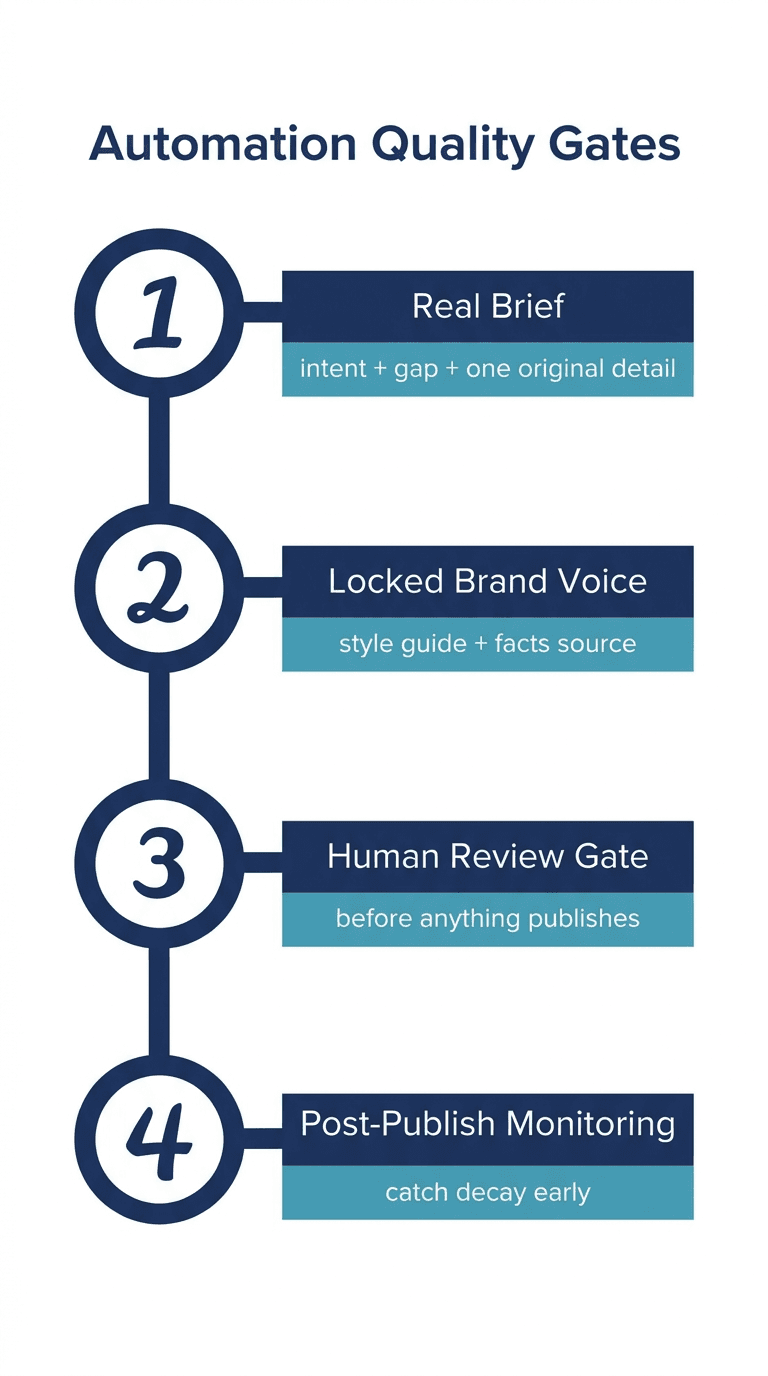
Google's own spam policies define "scaled content abuse" specifically as content generated at volume, by any method including generative AI, that provides "little to no value to users." It is not the automation itself that triggers this; it is the absence of real value per page. Four guardrails keep automated production on the right side of that line.
1. A real brief, not a bare prompt
Generic prompts produce generic output; that is the most consistent finding across every team that has scaled AI-assisted content. A usable brief includes the actual search intent, the gaps in what already ranks, and at least one concrete detail a competitor's page doesn't have (a real example, a specific number, an internal data point). If your brief is just the keyword and a word count, the draft will read like everyone else's draft.
2. A brand voice and fact source the model can't drift from
The single biggest quality failure in automated drafting is voice drift: page 40 sounds nothing like page 4, because there was no persistent reference for tone, terminology, or facts. Feeding a model your style guide, past top-performing pages, and your actual product or business facts before generation (not just once, but as a standing reference) is what keeps hundreds of pages sounding like one brand instead of one hundred strangers.
3. A human review gate before anything publishes
Every credible framework for scaling content agrees on this even as they disagree on almost everything else: automation should never auto-publish without a review checkpoint, at least until a team has enough runway of clean output to trust the pipeline for routine categories of content. Skipping this step is how factual errors and off-brand tone reach a live URL.
4. Monitoring after publish, not just before
Automating production and stopping there is only half the job. A page that ranked on publish day can quietly decay six months later: a competitor updates their guide, a stat goes stale, a section thins out relative to what's now ranking above it. If nothing is watching your published pages for that decline, the pipeline is producing content, not maintaining rankings, and the gains erode without anyone noticing until traffic already dropped.
Scaled templates deserve a specific mention here, because they're the fastest way to trip the guardrails above. Generating hundreds of pages from one template ("[Service] in [City]," "[Tool] for [Industry]") is a legitimate strategy, and it lives or dies entirely on whether each generated page clears the same bar as a one-off article: a real detail, not just swapped variables. If you're building that kind of page set, see the programmatic SEO use case for how to keep hundreds of pages unique instead of interchangeable.
A practical automation workflow
Here is what the guardrails above look like as an actual weekly process, roughly what teams that do this well converge on:
- Cluster and prioritize keywords with automated research, then a human picks which clusters actually fit the business this month.
- Generate a real brief per page: intent, competitor gaps, one required original detail, target structure.
- Draft with AI, referencing a locked brand-voice and facts source, not a blank prompt.
- Edit for accuracy and voice before anything moves further. This is non-negotiable, not optional polish.
- Automate the mechanical SEO layer: meta tags, internal links, schema, formatting checks.
- Publish through an approval gate, even if that gate is a five-minute skim for anything routine.
- Monitor rankings and traffic per page after publish, so decay gets flagged automatically instead of discovered three months late in a quarterly review.
- Route flagged pages back into a refresh queue instead of leaving them to rot; a refresh is a smaller, faster task than writing new content from scratch, and it protects the investment you already made.
Notice that step 7 closes a loop most teams leave open. Most automation stacks are strong on steps 1 through 6 (find keywords, draft, optimize, publish) and simply stop, treating "published" as "done." The pages that were automated to save time then sit unmonitored, and the same forces that made the first version rank (competitor updates, stale stats, thinning relative to the field) start working against them with nobody watching.
This is the specific gap Murkuz was built to close: it watches every connected page's Google Search Console data daily, flags declining pages and content that's gone stale, generates a fix that references a stored brand-voice knowledge base (so a refresh doesn't sound like a different writer wrote it), and pushes that fix straight to WordPress, Webflow, or Framer. The point isn't replacing the judgment calls in the workflow above; it's making sure step 7 and step 8 actually happen instead of quietly not happening, which is where most automated-content programs lose their gains. You can see the full sequence on the workflow page.
Common ways automation goes wrong (and the fix)
- Generic output that reads like everyone else's page. Fix: require one real, specific detail per brief that a template-swapped competitor page wouldn't have.
- Voice drift across a large batch. Fix: lock a written brand-voice reference and feed it to every generation, not just the first few.
- Facts the model invented. Fix: no page goes live without a human checking every number and claim against a real source.
- Auto-publishing with no review gate. Fix: keep at least a lightweight approval step, even for routine categories, until you have real evidence the pipeline is clean.
- Treating "published" as "finished." Fix: put ranking monitoring on every automated page, so decay gets caught in weeks, not discovered by accident a year later.
- Duplicate or near-duplicate pages from thin templates. Fix: this is the exact pattern Google names as scaled content abuse; if a page reads as filler once the variables are swapped out, it needs a real rewrite pass or it shouldn't exist.
FAQ
Can SEO content be fully automated?
Parts of it can. Research, on-page mechanics, publishing logistics, and performance monitoring automate well. Drafting can be automated for a first pass, but accuracy checks, brand voice, and original insight still need a human, because those are the parts search engines and readers can tell apart from generic output.
Does Google penalize automated content?
Google does not penalize content for being AI-assisted or automated on principle. Its spam policies specifically target "scaled content abuse," pages generated at volume, by any method, that provide little to no value to users. Automation that produces genuinely useful, original pages is fine; automation that produces filler at scale is what gets caught.
What SEO tasks benefit most from automation?
Keyword research, competitor gap analysis, meta tag generation across large page counts, internal linking suggestions, and rank and decay monitoring. These are largely data-gathering and pattern-matching tasks where software is faster and more thorough than manual work.
How do you keep AI-generated content from sounding generic?
Feed the model a real, detailed brief (not just a keyword), a locked brand-voice and facts reference, and require at least one specific detail per page that a competitor's page doesn't already have. Generic prompts are the single most common cause of generic output.
What is the biggest risk of scaling content production?
Losing the human review gate. Every framework for automating content agrees that skipping editorial review before publish is how factual errors, off-brand tone, and thin pages reach a live URL, which is the exact pattern that damages both rankings and reader trust.
Junaid Khalid is the founder of Ertiqah, the company behind Murkuz. He has run SEO as the first growth channel across several SaaS products and built Murkuz around the same operating principle in this guide: automate the mechanics, keep judgment human, and never let "published" mean "unmonitored."