Most guides to SEO for AI Overviews tell you what AI Overviews are and why they matter, then hand you a wall of theory. This is not that. This is a working checklist: the exact items to check, fix, and re-check on a real page, in an order that gets you a citation faster than reading another explainer will.
Google has been direct about this: there is no separate ranking system to game. AI Overviews and AI Mode draw from the same index as regular Search, and the same technical and content fundamentals apply. What changes is the last step. A language model reads the eligible pages and picks passages to synthesize and cite. So the checklist below has two halves: get the page into the eligible pool (standard SEO, done properly), then win the synthesis step (structure the page so an LLM can lift a clean answer out of it). Skip either half and you are optimizing for a citation that never arrives.
Quick Answer: The 8-Item Checklist
If you only have ten minutes, check these eight things on the page you are trying to get cited:
- Page returns a 200, is not blocked in robots.txt, and is indexed (
site:search or Search Console). - First 2 to 3 sentences under the H1 directly answer the query, no throat-clearing.
- At least one H2 is phrased as the exact question you want cited for.
- A list, table, or numbered steps break up the main answer.
- Structured data is present (
Article,FAQPage, orHowTo) and matches the visible content. - A named author with real credentials is attached, not "Admin" or no byline.
- Every stat or claim on the page is dated within the last 12 months.
- The page links out to at least one primary source, not just other blog posts.
The rest of this guide is the "why" and the deeper fixes behind each item.
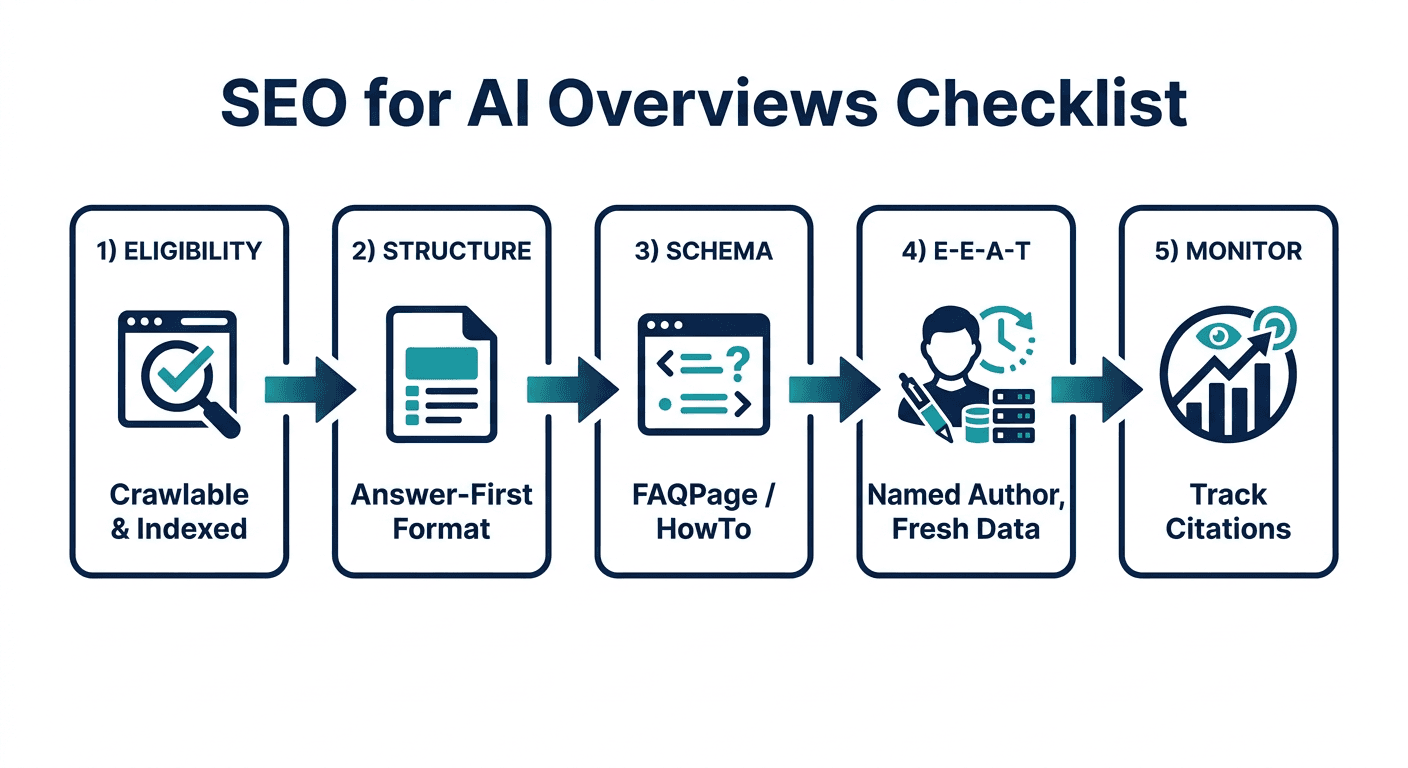
Step 1: Confirm the Page Is Even Eligible
Before touching a word of copy, rule out the boring failure mode: the page cannot be cited because it is not properly in the index.
- Crawlability. Check
robots.txtfor an accidental disallow, and confirm the page is not markednoindex. This sounds obvious, but it is the single most common reason a well-written page never shows up anywhere, AI Overview or otherwise. - Status codes. A page that intermittently 500s or soft-404s under load will not get crawled reliably enough to stay fresh in the model's source pool.
- Indexation. Search
site:yourdomain.com "your exact H1"to confirm Google actually has the current version indexed, not a stale cached copy from before your last edit. - Core Web Vitals and mobile rendering. Google has said page experience signals are unchanged for AI features versus regular Search. If the page fails Core Web Vitals or renders broken on mobile, fix that first; it is not AI-specific but it still gates eligibility.
None of this is new. It is the same technical SEO checklist you would run for ranking normally, because AI Overviews pull from the same eligible pool.
Step 2: Confirm the Query Actually Triggers an AI Overview
Not every search shows an AI Overview, and optimizing a page for a query that never surfaces one is wasted effort.
- Search the exact target phrase in an incognito window, signed out, in the country you are targeting.
- Test 3 to 5 close variants (singular vs. plural, "how to X" vs. "X guide", adding "2026" or "checklist"). AI Overviews are sensitive to phrasing; a slightly different variant can trigger or suppress the box entirely.
- Note which domains the overview actually cites. These are your real competitors for the feature, and they are frequently not the same three sites holding positions 1 to 3 in the blue links underneath.
- Repeat this check quarterly. AI Overview trigger rates and cited sources shift as Google's models retrain, so a page that was cited in Q1 can quietly lose the citation by Q3 with no change on your end.
Step 3: Restructure the Page So an LLM Can Lift a Clean Answer
This is the step most existing guides gloss over with "write good content." Here is the actual mechanics of what makes a passage extractable.
Answer first, context second. Put the direct answer to the query in the first 2 to 3 sentences after the heading, before background, before history, before "in this article we'll cover." The model is looking for a self-contained passage it can quote or paraphrase; buried answers get skipped for a competitor's page that leads with the answer.
One idea per section. Each H2 or H3 should resolve one sub-question completely, in a tight block, rather than spreading a single idea across three headings. A model extracting a passage grabs a contiguous chunk; a scattered explanation does not extract cleanly.
Lists, tables, and numbered steps over prose. Structured formats parse into machine-readable chunks far more reliably than dense paragraphs. If a section is naturally a sequence (steps, criteria, comparisons), format it as one.
Phrase headings as questions where it fits naturally. Not every H2 needs to be a question, but the ones mapping directly to a "People Also Ask" variant should be, in close to the exact phrasing searchers use.
Add a TL;DR or key-takeaway block near the top of longer pieces. It gives both the reader and the model a condensed, quotable summary before the detail.
Step 4: Add the Structured Data That Actually Matches the Page
Schema markup does not directly cause a citation, but it removes ambiguity for machine parsers about what the content is and how it is organized.
- Use
Article,FAQPage, orHowToschema depending on the page's actual format, never all three stacked on a page that is not genuinely structured that way. - The schema content must match what a human sees on the page. Mismatched schema (a FAQPage markup wrapping content that is not really Q&A) is a trust signal Google's Rich Results Test will flag, and a mismatch an LLM's fact-checking pass can also catch.
- Validate with the Rich Results Test after every content edit, not just at launch. A copy change that shifts an answer without updating the matching schema field is a common regression.
Step 5: Build the E-E-A-T Signals a Model Checks Before Citing
An AI system deciding whether to trust a passage enough to cite it is running a lightweight authority check, not unlike a human skimming for "who wrote this and can I trust it."
- Real, named authors with credentials, not "Admin," "Staff," or no byline at all. A bio with actual experience in the topic matters more here than it ever did for classic SEO.
- Dated content. Stats, examples, and screenshots older than 12 to 18 months read as stale to both readers and freshness-weighted retrieval. Update the date and the actual numbers, not just the visible "last updated" label.
- Primary-source citations. Link out to the original data, study, or documentation you are referencing, not just another blog's summary of it. Pages that cite primary sources are themselves easier for a model to treat as a trustworthy hub.
- External validation. Genuine mentions, backlinks, or citations of your brand elsewhere on the web reinforce that you are a real, recognized source on the topic, which matters for YMYL-adjacent queries especially.
Step 6: Monitor, Because This Moves Under You
AI Overview citations are not stable the way a page-1 ranking can be for months. The model retrains, competitors restructure their pages, and a citation you had can disappear with zero warning and no ranking-drop alert to tell you.
- Re-check your target queries on a schedule, not just once at launch.
- Watch Search Console's AI features / Search Appearance report for impressions tied to AI features, where available.
- Track which competitor is cited instead of you when you lose a citation; that tells you what changed on their end, which is often the fastest way to diagnose what to fix on yours.
This is the part manual checklists tend to skip entirely, because a checklist is a one-time pass and AI Overview visibility is not a one-time win. If you are running this across dozens of pages, Murkuz grades every page A to F for AI search readiness (structure, authority signals, citation potential, freshness), generates the specific task to fix whatever is missing, and re-checks after you publish, so a lost citation shows up as a task instead of a surprise three months later.
A Note on Effort vs. Impact
Not every item above is worth doing on every page. Here is how to prioritize when you are short on time:
| Fix | Effort | Typical impact on citation odds |
|---|---|---|
| Move the direct answer to the first 2-3 sentences | Low | High |
| Add a named author bio with real credentials | Low | Medium-high |
| Add matching FAQPage/HowTo/Article schema | Low-medium | Medium |
| Update stats and dates to current | Low | Medium |
| Restructure a prose section into a list or table | Medium | High |
| Add primary-source citations and outbound links | Medium | Medium |
| Fix crawlability/indexation issues | Low (once found) | Gating (blocks everything else) |
| Ongoing re-checking and monitoring | Ongoing | Compounding |
If you can only do three things this week: fix any crawlability blocker, move the answer to the top of the page, and add a real author bio. Those three cover the most common reasons a genuinely good page still gets skipped.
How This Fits Into Your Broader AI Search Strategy
This checklist optimizes a single page for a single query. If you are trying to build durable AI-search visibility across a whole site, the underlying workflow looks like the one in our full guide to ranking in Google AI Overviews: audit what you have, restructure the highest-opportunity pages first, add the proof (schema, authorship, freshness), then monitor continuously, because the "monitor" step is not optional, it is the difference between a citation you keep and one you quietly lose. Murkuz's workflow runs that detect-to-monitor loop automatically across every page instead of you re-running this checklist by hand each quarter.
FAQ
Does SEO for AI Overviews require different keywords than regular SEO?
No new keyword universe, but a shift in emphasis. Target the same core topics, but write for the specific question phrasing behind them (the "how," "why," and "what" variants), since AI Overviews trigger disproportionately on question-shaped queries rather than short head terms.
Do I need schema markup to appear in an AI Overview?
It is not a strict requirement, Google has said there are no special technical requirements beyond standard SEO, but structured data removes ambiguity for machine parsers and is a low-effort, low-risk addition with no real downside when it accurately reflects the page.
How long does it take to see a citation after making these changes?
There is no fixed timeline. It depends on how quickly the page gets recrawled, how the query's AI Overview trigger rate behaves, and how competitive the citation slot is. Treat it as an ongoing process to monitor, not a change you make once and check back on in a month.
Can a page rank well in regular Search but never get cited in the AI Overview?
Yes, and this is common. Ranking in the top 10 makes a page eligible but does not guarantee synthesis. A page can hold position 3 organically while a differently-structured page from position 7 gets the actual citation, because the model selected it as the cleaner passage to extract.
Is it possible to opt out of AI Overviews without losing regular search rankings?
Yes. Google's nosnippet meta tag (or the equivalent structured data control) can exclude a page from AI Overviews and other snippet features while leaving normal ranking untouched, which is useful for pages where you specifically do not want your content summarized rather than clicked.
Junaid Khalid is the founder of Ertiqah, the builder of Murkuz, and has run SEO as the first growth channel across multiple SaaS products before building a tool to do the repetitive parts of it automatically.