SEO for ChatGPT is not about ranking a URL. It is about getting your content picked as one of the sources ChatGPT pulls from when it answers a question in your space, and ideally getting your brand named directly in that answer. There is no results page to climb. There is a citation list, and you are either on it or you are invisible.
That single distinction explains why most "ChatGPT SEO" advice reads like recycled Google SEO with a new label stapled on. It is not wrong exactly, but it skips the part that actually matters: how ChatGPT decides what counts as a trustworthy source in the first place, and what you can concretely change on your site this week to improve your odds. This guide covers both, plus how to check whether you are already being cited and a short FAQ of the questions people actually ask about this.
How ChatGPT actually decides what to cite
ChatGPT's browsing and search features do not re-run your Google rankings. When a user's question needs current or specific information, ChatGPT fires a live web search (OAI-SearchBot handles the crawling), pulls back a short list of candidate pages, and then decides which of them to quote, summarize, or link. That decision leans on a few consistent signals.
The page has to be reachable and readable. If OAI-SearchBot is blocked in robots.txt, or your content only renders after a client-side JavaScript fetch, ChatGPT never sees it in the first place. This is the single most common reason a page that "should" get cited never does: it is not a content problem, it is an access problem.
The answer has to be extractable in one clean pass. A model summarizing search results is looking for a direct, quotable claim, not three paragraphs of scene-setting before the actual point. Content that states its answer up front and supports it afterward gets lifted into summaries far more often than content that saves the answer for the end.
The claim has to be specific enough to trust. "Many businesses see improvements" gives a model nothing to cite with confidence. "Checkout time dropped by 40 percent after simplifying the form" is a concrete, attributable fact. Public reporting on how AI search tools like ChatGPT and Perplexity behave consistently points to specificity and sourcing as differentiators between pages that get cited and pages that get skimmed past.
Authorship and freshness both function as trust signals. A named author with real, relevant expertise, and a page that reflects current information rather than a stale snapshot from three years ago, both raise the odds ChatGPT treats your page as a source worth quoting rather than one worth ignoring in favor of a more recently updated competitor.
None of these four are exotic. They are the same fundamentals that have always separated genuinely useful content from filler. ChatGPT just applies them at the moment of answering a question, not once a quarter during a crawl.
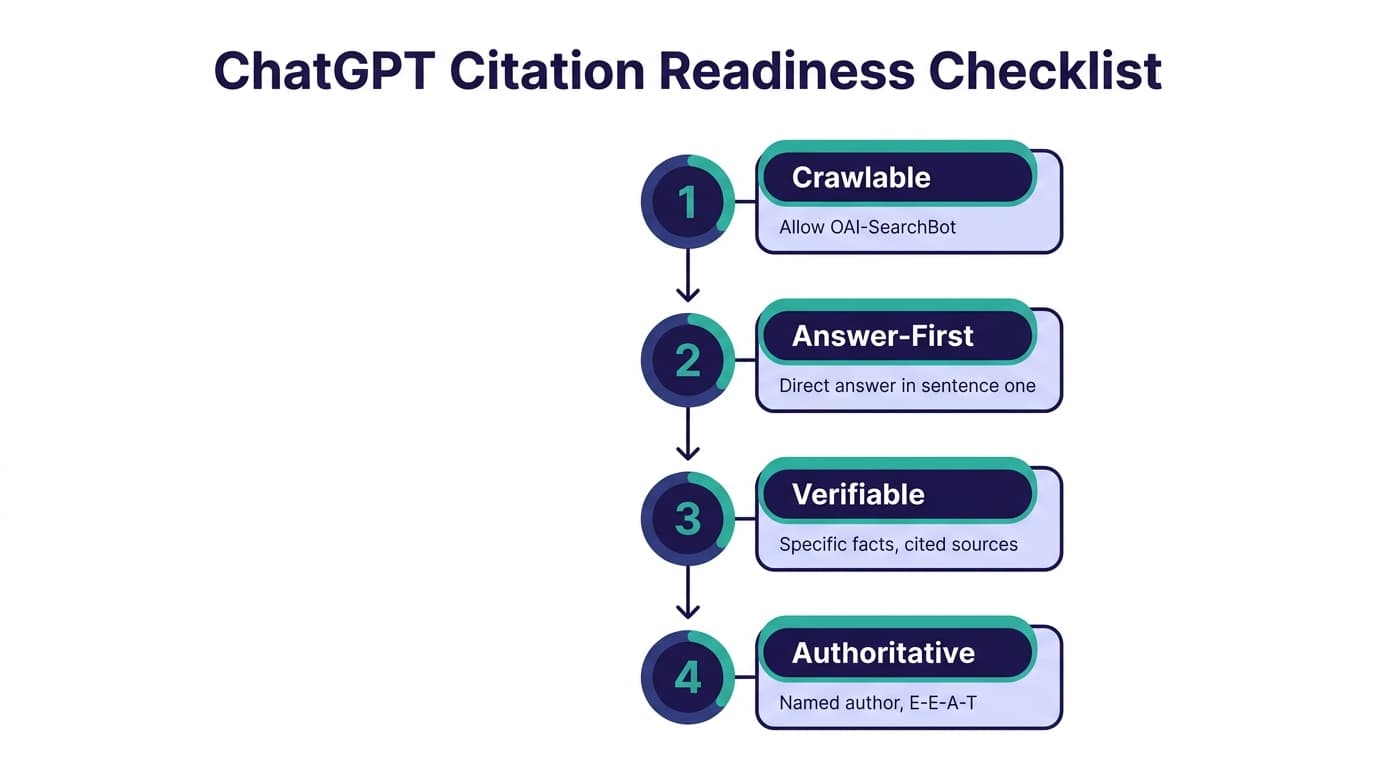
The 4-step checklist: crawlable, answer-first, verifiable, authoritative
Before touching anything else on a page, run it through these four checks in order. Fixing step one and skipping the rest is a common and costly mistake, since a crawlable page that still buries its answer or offers no verifiable facts will not get cited either.
| Step | What to check | The fix if it fails |
|---|---|---|
| 1. Crawlable | Is OAI-SearchBot allowed in robots.txt? Does the core content render without requiring a client-side interaction? | Remove any disallow rule targeting OAI-SearchBot; server-render or pre-render the primary content instead of gating it behind JS |
| 2. Answer-first | Does the first sentence under each heading directly answer the question that heading implies? | Rewrite the opening line of each section to state the answer, then explain and support it afterward |
| 3. Verifiable | Are claims specific numbers or facts, with a visible source, rather than vague generalities? | Replace "significantly improves" style language with an exact figure and a link to where it came from |
| 4. Authoritative | Does the page carry a real, named author with relevant credentials, visible on the page itself? | Add a genuine author byline and short bio; do not hide it on a separate about page nobody links to |
Step 1: Confirm ChatGPT can actually reach the page
Check robots.txt for a rule targeting OAI-SearchBot or GPTBot. If either is disallowed on the pages you want cited, nothing else in this guide will help, because the crawler never gets past the front door. Also check whether your CDN or bot-management layer (Cloudflare's bot-fight mode is a common culprit) is blanket-blocking AI crawlers under a generic "stop scrapers" setting turned on for an unrelated reason.
Then confirm the content itself is server-rendered or pre-rendered. A page that only shows its real content after a button click, a scroll event, or a client-side data fetch is functionally invisible to a crawler that reads the initial HTML response.
Step 2: Restructure for extraction, not for scrolling
Open every H2 and H3 with a direct, declarative sentence that answers the question implied by that heading. Save the nuance, caveats, and supporting detail for the sentences that follow. A heading like "How long does indexing take" followed immediately by "Most new pages get crawled within a few days to two weeks" is trivial for a model to lift cleanly. The same heading followed by three sentences of context before the actual answer is not.
Keep one idea per section. A section trying to answer two or three different implied questions at once gives the model nothing clean to extract; it has to guess which part is the actual answer. Split dense sections into narrower ones with their own headings.
Favor short paragraphs, numbered steps, and bullet points over long unbroken blocks. This is not just a ChatGPT preference, it is a readability preference generally, but it matters more here because the model is trying to lift a coherent unit of text, not paraphrase an entire page.
Step 3: Replace vague claims with checkable facts
Go through your existing pages and flag every sentence that makes a claim without a number or a source attached. "This dramatically reduces churn" is unverifiable. "Churn dropped from 6.2 percent to 4.1 percent over one quarter" is a fact a model can cite with confidence, and a reader can check.
Where you cite a statistic, link to where it came from. A claim with a visible source behind it functions as evidence the model can point to if pressed, which makes it a safer citation than an unsupported assertion, even if the underlying fact is true.
Step 4: Attach real authorship, not a generic byline
A "Team" byline or no byline at all gives ChatGPT no authority signal to weigh. A named author with a real bio, relevant credentials, and links to other work by that person gives it one. This is one of the more mechanical fixes on this list: write the bio once, attach it to every page that person authored, and keep it visible on the page itself rather than buried on a separate about page nothing links to.
This overlaps directly with classic E-E-A-T signals Google has talked about for years. AI search engines did not invent the idea that authorship matters; they just made it matter in a new context.
How to check if you are already being cited
You do not need a paid tool to start. Open ChatGPT (with browsing or search enabled) and run the actual questions your prospective customers would type, phrased the way a person actually types them, not as a keyword. Read the response and note which sources it cites or links.
Do this across a real list of queries relevant to your business, not just your brand name. Track which domains keep showing up. Those are your real competitors for this specific channel, and it is common for them not to be the same sites that outrank you on Google, since a page can rank well organically and still never get pulled into an AI answer.
Repeat the check periodically, not once. Citations shift as ChatGPT's live search results change and as competitors update their own content. A page that gets cited today can lose that spot to a competitor's fresher update next quarter, with no warning beyond the citation quietly disappearing.
Running that check by hand across dozens of pages and query variations gets tedious fast, which is the exact gap Murkuz's AI search readiness tooling is built to close: it grades every page A to F for AI-citation readiness against structure, authority, and freshness signals, and generates the specific fix needed, rather than leaving you to run the manual check page by page.
ChatGPT SEO vs. traditional SEO: what actually carries over
Most of what makes a page good for traditional SEO also makes it more citable in ChatGPT, but the emphasis shifts. <mark class="km-highlight" style="--hl:#FEF08A;background:#FEF08A">Traditional SEO optimizes for a ranking position; ChatGPT SEO optimizes for the probability of being the source a model quotes</mark>, and those are related but not identical goals.
- Backlinks still matter, indirectly. A well-linked, well-cited site across the web is more likely to be treated as an authoritative source generally, which feeds into how confidently a model treats anything on that domain.
- Keyword density stops mattering, clarity replaces it. Stuffing a target phrase into a page does nothing for extraction. A clean, direct answer to the implied question does everything.
- Traditional search intent matching still applies. A page has to genuinely answer the query a user is asking, whether that user typed it into Google or asked ChatGPT in conversational form.
- Freshness carries more weight than it does in classic organic rankings, since live search results skew toward recently updated, currently accurate content over an older page with more accumulated link equity.
- A page can win in one channel and lose in the other. It is entirely possible to rank on page one of Google and never appear in a single ChatGPT answer, because the two systems are evaluating different things at different moments.
Where this fits in a real content workflow
Treating "get cited by ChatGPT" as a one-time content audit misses how often the underlying facts and the competitive set both change. A page that passes the four-step checklist today can drift out of compliance within months: a statistic goes stale, a competitor publishes a more current version of the same answer, or a CMS migration accidentally re-introduces a JavaScript-only render on the exact pages you fixed.
This is the same content decay problem that affects traditional rankings, just showing up in a new place. The practical fix is the same discipline either way: catch the drift before it costs you the citation, fix the specific page, publish the fix, and confirm it actually worked rather than assuming it did. That loop, applied specifically to AI-citation readiness, is what Murkuz's AI search readiness use case automates: an A-to-F grade per page, a generated fix for whatever is missing, and a way to push that fix live without a separate round of manual CMS edits.
If ChatGPT is one of several AI answer engines you care about, note that Perplexity weighs some of these same signals differently, particularly freshness and crawler access; see Perplexity SEO for the surface-specific version of this same playbook.
FAQ
How do you do SEO for ChatGPT?
Confirm OAI-SearchBot can crawl your pages, restructure content so each section leads with a direct answer, replace vague claims with specific, sourced facts, and attach a real named author to the content. Those four fixes address the signals that most consistently separate cited pages from ignored ones.
What is SEO for ChatGPT called?
It is commonly called Generative Engine Optimization (GEO) or Answer Engine Optimization (AEO). Both terms describe the same underlying goal: getting an AI system to select and cite your content rather than optimizing for a ranked results position.
Is ranking on Google enough to get cited by ChatGPT?
No. A page can rank well organically and never appear in a ChatGPT answer, because ChatGPT's live search evaluates crawlability, extractability, and freshness at the moment it answers a question, which is a different process than a traditional crawl-and-index ranking pipeline.
How do I know if ChatGPT is citing my site?
Run your actual target queries in ChatGPT with browsing or search enabled, phrased the way a real user would ask them, and read which sources appear in the response. Repeat this across your priority topics periodically, since citations shift as ChatGPT's search results and your competitors' content both change.
Does content freshness really affect ChatGPT citations?
Yes. Because ChatGPT's search-enabled responses draw on live or recently crawled results rather than a static index alone, content that reflects current information has a real advantage over an older page with more historical authority but stale facts.
Junaid Khalid is the founder of Ertiqah and the builder of Murkuz, the SEO platform that closes the loop from detecting a ranking or citation problem to proving the fix worked. He has run SEO as the first growth channel across his own SaaS products, including the shift from chasing rankings to chasing AI citations.