SEO for LLM means writing and structuring your pages so ChatGPT, Perplexity, Gemini, and Google's AI Overviews can actually parse what you are saying and quote it back correctly. It is not a separate content strategy from regular SEO. It is regular SEO done with one extra constraint: a machine, not just a human, has to be able to lift a clean, accurate answer out of your page in a few seconds.
That constraint changes what "good content" looks like in small but concrete ways. Below is a practical, step-by-step process for getting there, built around the same handful of factors that keep showing up whenever you study which pages actually get cited and which ones don't.
Why "SEO for LLM" Is Not Just Regular SEO With Extra Steps
Google's crawler and an LLM's retrieval step do genuinely different jobs. A crawler indexes a page and ranks it against a query, largely on relevance and authority signals accumulated over time. An LLM does something narrower and more literal: at answer time, it retrieves a handful of pages, reads them, and decides sentence by sentence whether to repeat a specific claim, number, or framing.
That means a page can rank on page one of Google and still never get picked up in an AI answer, because ranking well and being easy to extract from are related but not identical skills. A page buried on page three can still get quoted by Perplexity if it happens to state a fact more plainly than anything else the model retrieved for that query.
If you want the fuller picture of the two separate ways a model finds you (training-time knowledge versus live retrieval) and how the mechanics work underneath this how-to, our guide to what LLM SEO actually is covers that in more depth. This article assumes that background and focuses entirely on the concrete steps to take.
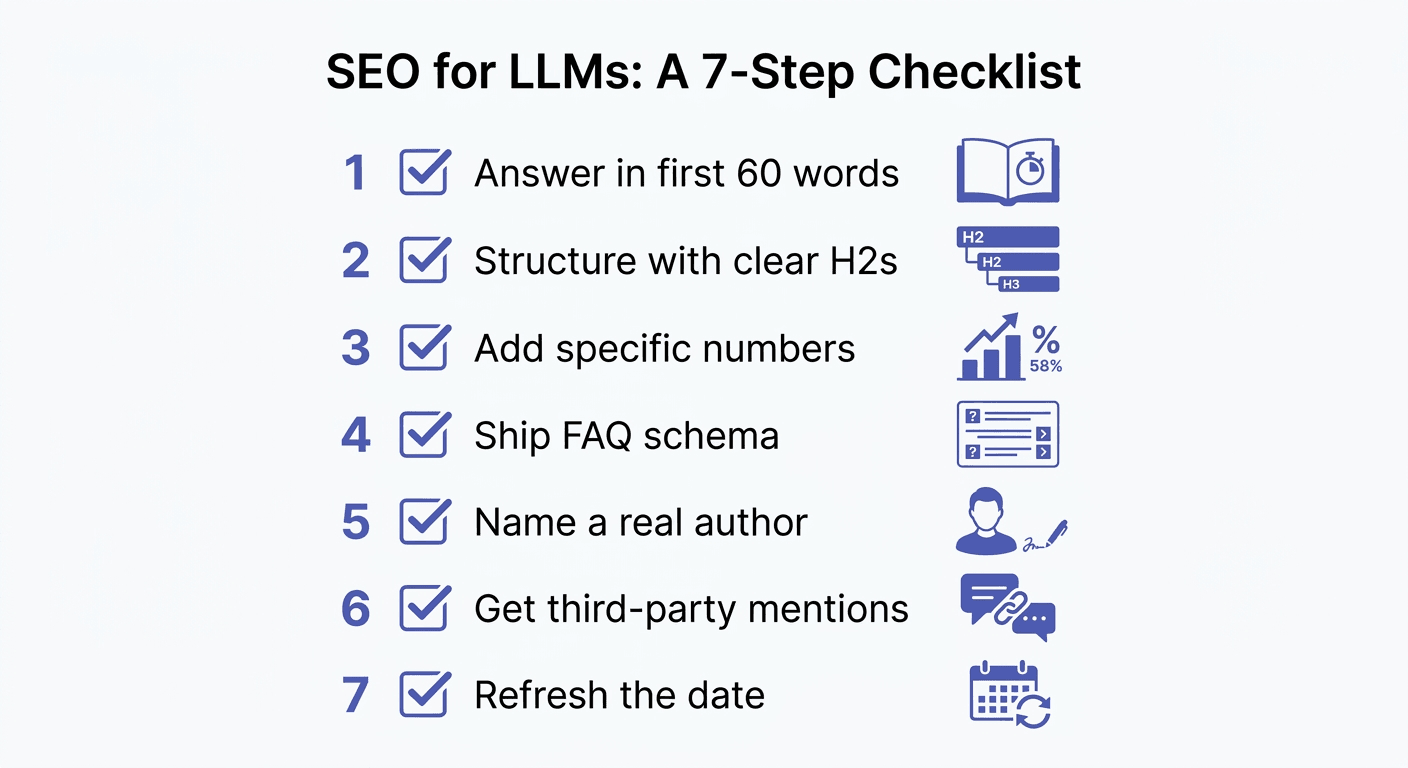
The 7-Step Process for SEO for LLMs
Work through these in order on any page you want an AI model to understand and cite. Each step targets one specific thing models are documented to reward.
1. Answer the question in the first 60 words
Put the direct answer to the implied query in the opening sentences, before any scene-setting, before a story, before "in today's digital landscape." Models favor a self-contained passage that answers the question without needing the rest of the page for context. If your first paragraph is a warm-up, the model has nothing to extract until paragraph three, and by then it has usually already pulled its answer from a competitor.
A useful test: delete everything after your first 60 words and read what remains. If it does not, on its own, answer the query a reasonable person typed in, rewrite the opening.
2. Structure the page so a machine can isolate one section at a time
Descriptive H2s and H3s that mirror how a person would actually phrase the question ("how much does X cost" rather than "pricing considerations") make it far easier for a model to grab exactly the section it needs. Short paragraphs, bullet points, and numbered steps do the same job: they let a retrieval system lift one clean chunk instead of having to summarize a wall of text and risk getting it wrong.
This is also just good writing for humans skimming on mobile, which is worth remembering: nothing in this list asks you to write worse for people in order to write better for models.
3. Replace vague claims with specific, checkable facts
"Significantly faster" and "many experts agree" are not quotable. A model has no confident way to repeat a vague claim without sounding like it is guessing, so it tends to skip it in favor of a source that made a harder, more specific statement. "40% faster in a same-hardware test" or "Google's own documentation states X" gives the model something concrete to lift.
This is the single highest-leverage edit on most existing pages: go through your best content and turn every adjective into a number, a name, or a cited source wherever you can back it up honestly. Do not invent numbers you cannot support. A fabricated stat that gets caught (and it does get caught, by readers and eventually by the models trained on corrections) is worse than an honest, hedged claim.
4. Add structured data that matches what is actually on the page
FAQPage, HowTo, and Article schema give a model an unambiguous, machine-readable shortcut to the same facts a human reader sees. Schema is a hint layer on top of good writing, not a replacement for it, and the golden rule is that it must describe exactly what is visible on the page. FAQPage schema listing questions that are not actually answered anywhere in your visible content is a trust problem waiting to surface, not a shortcut worth taking.
| Schema type | Use it for | What it signals to a model |
|---|---|---|
| Article | Any blog post or guide | Author, publish date, and headline as structured facts |
| FAQPage | A genuine FAQ section | Discrete question-answer pairs a model can lift directly |
| HowTo | Numbered step-by-step processes | An ordered sequence with a clear start and end |
| Organization | Your site's about/company info | Who publishes this content and why it should be trusted |
5. Attach a real, named author with visible expertise
A byline with a real name, a short bio, and a credible reason that person can speak on the topic is one of the E-E-A-T signals models lean on when deciding whether a source is trustworthy enough to cite. An anonymous "Team" byline or no byline at all is a small but real tax on your citation odds, especially on anything that reads as advice.
6. Earn independent mentions of the same fact elsewhere
If three unrelated, credible sites state the same fact about your product or claim, a model treats that fact as more trustworthy than if only your own site says it. This is the live-retrieval version of the older backlink signal: it is not really about link equity anymore so much as corroboration. Getting quoted, linked, or referenced by other sites, forums, and review pages remains one of the few genuinely durable levers here, because it is the one thing a page cannot manufacture entirely on its own.
7. Set a real last-updated date, and mean it
Retrieval-based answers lean toward content that looks current: a visible, accurate update date, statistics from the current year, and no dead links pointing at pages that no longer exist. Stale cornerstone content quietly falls out of rotation even when nothing about the underlying advice has changed, simply because a fresher competitor page displaced it in the retrieval set. Changing the timestamp without changing the content is the wrong fix. Actually refresh the stats, check the links, and update the date because both are true.
A Worked Example: Before and After
Take a common weak opening for a page targeting "how to reduce SaaS churn":
Before: "In today's competitive SaaS landscape, customer retention has become more important than ever. Many companies struggle with churn, and there are numerous strategies that businesses can consider to address this ongoing challenge."
Nothing in that paragraph is wrong, and nothing in it is quotable. It contains no number, no named method, and no direct answer.
After: "The fastest way to reduce SaaS churn is to fix your onboarding: SaaS companies that get a new user to a first meaningful action within 24 hours see meaningfully lower 90-day churn than those that don't, according to Baremetrics' churn benchmarks. Below are the four levers that move that number, in order of effort versus impact."
The second version answers the query immediately, names a concrete mechanism (onboarding speed), points to a real external source instead of an invented statistic, and sets up a scannable list. That is the entire "SEO for LLM" rewrite in miniature: same topic, same honesty, structured so a model has something to grab.
Common Mistakes That Undo All of the Above
- Writing two versions of a page, one for humans and one "optimized for AI." This usually just creates a worse, keyword-stuffed version that helps neither audience and doubles your maintenance burden for no real gain.
- Padding a real FAQ with fake questions nobody actually searches, instead of the narrow, specific sub-questions a model's query fan-out would actually generate around your topic.
- Blocking or throttling AI crawlers (GPTBot, PerplexityBot, and similar) in robots.txt while still expecting to show up in AI answers. If you want to be retrievable, the crawler has to be allowed to retrieve you.
- Chasing every new acronym (GEO, AEO, LLMO) as if each demands a separate strategy. They describe the same underlying work from slightly different angles; chasing the terminology instead of the fundamentals wastes time you could spend on the seven steps above.
FAQ
Is SEO for LLM different from traditional SEO?
Not fundamentally. It is traditional SEO plus an extra layer: your content also has to be easy for a model to isolate, verify, and quote, not just easy for a crawler to index and rank. If your technical SEO is broken, a model has the same trouble reaching your content that Googlebot does, so none of the seven steps above work in isolation from the basics.
How do I know if ChatGPT or Perplexity is citing my content?
Check your analytics for referral traffic from sources like chatgpt.com and perplexity.ai, since a citation does not always come with a click the way a ranked search result does. Beyond that, manually run your important target queries in each tool periodically and note whether your site appears and what exact sentence gets quoted, because there is no fully reliable, automated tracker for this yet the way there is for Google rank tracking.
Do I need to rewrite my whole site for LLM SEO?
No. Start with your highest-value existing pages (the ones already ranking reasonably or driving the most organic traffic) and run them through the seven steps above one at a time. A rewrite of everything at once is rarely necessary and usually less effective than fixing your best pages properly first.
Does structured data guarantee an LLM will cite my page?
No. Schema is a hint that makes your existing facts easier for a model to parse; it cannot manufacture trust or quality that is not already on the page. FAQPage schema over thin or inaccurate answers can hurt more than it helps if a model or a human reader catches the mismatch.
How long does it take to see results from optimizing for LLMs?
Live retrieval-based citations can shift within days of a content change, since models pull fresh pages on each query rather than relying only on a cached index. Training-data-based mentions (a model already "knowing" about you from its training set) are much slower and effectively locked in place until the next major training run, which is outside anyone's direct control.
Where This Fits Into a Broader SEO Workflow
Doing all seven steps by hand across a real site, every time a page decays or a competitor gets ahead, is the part that actually breaks down in practice. Most teams do it once for their best pages and then never circle back, which is exactly how good content quietly goes stale and drops out of AI answers a year later.
I have run SEO as the first growth channel across several of my own SaaS products, and the pattern holds regardless of whether the channel is Google or an AI answer: the pages that already do the fundamentals well (clear structure, real expertise, current facts) are the ones that pick up AI citations almost as a side effect, and the ones that skip the fundamentals do not suddenly start winning just because the surface changed.
That grading and re-checking is exactly what Murkuz's AI Search Gaps detection is built to automate. It scans your existing pages, grades each one A through F against structure, authorship, and freshness signals, and generates the specific fix, tightening a buried opening paragraph, attaching a real author profile, or flagging a stale update date, so you are working from a prioritized list instead of guessing which of a hundred pages to touch first. It will not promise you a citation from any specific model tomorrow; nothing legitimately can. What it can do is make sure you are not losing ground to something fixable, which is most of what determines whether SEO for LLM actually works on a real site over time.
Junaid Khalid is the founder of Ertiqah and the builder of Murkuz. He has run SEO as the first growth channel across his own SaaS products before building a platform around the process.