Most "SEO for SaaS companies" guides read like they were written for a content site that happens to sell software. They walk through keyword research, technical SEO, and link building as if a SaaS blog post converts the same way an ecommerce category page does. It does not. A SaaS reader almost never buys on the first visit. They read, they leave, they come back three weeks later after a demo call, and only then do they sign up. What actually works for SaaS SEO in 2026 is less about chasing more traffic and more about making sure the right traffic finds the right page, and that the pages you already have keep working instead of quietly rotting.
This guide is the tactical companion to our SaaS SEO strategy pillar. That piece covers the full framework: buyer-stage keyword tiers, content architecture, and pipeline-first reporting. This one is narrower and more hands-on: the specific tactics that are actually moving rankings and pipeline for SaaS companies right now, including the ones most 2025-era guides have not caught up to yet.
Start With Search Intent, Not Search Volume
The single most common SaaS SEO mistake is prioritizing keywords by volume instead of by where the searcher sits in the buying journey. A term like "project management" gets far more monthly searches than "asana vs monday for agencies," but almost none of that volume belongs to your product. The person searching the broad term is not ready to evaluate software yet.
For SaaS specifically, three keyword tiers matter more than raw volume:
- Bottom-of-funnel, named-entity keywords. Competitor comparisons ("[competitor] alternative"), integration pages ("[tool] + [your product] integration"), and role-specific feature pages. Low volume, extremely high intent.
- Middle-of-funnel, problem-aware keywords. "How to [solve the problem your product solves]." The reader knows they have a problem but has not decided software is the answer yet.
- Top-of-funnel, educational keywords. Broad category education. Useful for authority and internal linking, rarely for direct conversion.
The mistake is treating all three the same way and measuring them all on traffic. A bottom-of-funnel page with 40 monthly visits and a 3 percent trial conversion rate is worth more than a top-of-funnel page with 4,000 visits and a 0.1 percent rate. Build your content calendar backward from the bottom tier, not forward from a keyword tool's volume column.
Mine Your Product for Content Ideas, Not Just a Keyword Tool
Keyword tools show you what people search. They cannot show you what your specific users struggle with, ask about in onboarding, or bring up on every sales call. That gap is where most of the genuinely differentiated SaaS content comes from, and it is also the hardest thing for a competitor to copy because it depends on data only you have.
Three sources worth mining every quarter:
- Support tickets and in-app search queries. Recurring questions your support team answers manually are recurring questions worth a public page.
- Sales call objections. If prospects keep asking "how is this different from [competitor]" or "does this work with [integration]," that is a page, not just a talk track.
- Feature usage data. The features that convert trials but that users discover late are worth an SEO page that surfaces them earlier in someone else's research process.
This is the practical core of what we call Product-Led SEO: treat the product itself as the input to the content strategy, not a separate keyword-research exercise bolted on afterward.
Fix Internal Linking Before You Publish More
SaaS sites accumulate structural debt fast. A blog that started as 10 posts and grew to 200 rarely gets its internal linking revisited along the way, so new articles land as orphans, old cornerstone pages stop receiving the link equity newer pages could be sending them, and Google has a harder time understanding which pages matter most.
Before adding more net-new content, spend an afternoon on this instead:
- Identify your 3 to 5 true pillar pages (the ones that should rank for your highest-value terms) and audit whether your other content actually links up to them.
- Check for orphan pages: articles with zero internal links pointing at them. These rarely rank no matter how good the content is.
- Look for cannibalization: two or more pages competing for the same keyword, splitting authority between them instead of consolidating it.
This single pass, done properly, often moves rankings faster than publishing five new articles, because it is fixing a structural problem instead of adding more content on top of one.
Build for AI Search, Not Just Google's Blue Links
This is the part most 2025-era SaaS SEO advice has not caught up to. AI Overviews, ChatGPT, and Perplexity are increasingly where SaaS buyers do their early research, and being cited there requires a different content structure than ranking in traditional organic results, even though the two overlap.
What actually helps:
- Put the direct answer in the first two or three sentences. Language models extract and cite concise, complete answers. A long narrative windup before the answer buries exactly the part that gets quoted.
- Use real structure, not just prose. Tables, numbered steps, and bullet lists are easier for a model to parse and extract cleanly than dense paragraphs.
- Answer questions in the exact phrasing people actually ask them. A dedicated FAQ section matched to real "People Also Ask" phrasing performs well for both traditional snippets and AI citation.
- Attach real credentials to the content. Author bylines with actual experience, not just a generic "Team" byline, are an increasingly explicit trust signal both Google and AI models weigh.
Most SaaS content is written to be readable by a human skimmer. Very little of it is structured so a language model can lift a clean, citable answer out of it. That gap between what is common and what actually works is exactly where a new or underdog SaaS site can win visibility that domain authority alone would not otherwise get them.
Treat Old Content as an Asset That Needs Maintenance
A blog post that ranked well and drove signups a year ago is not a finished asset sitting safely on a shelf. It is a page that is actively decaying, whether or not anyone is watching it. Competitors publish fresher, more complete versions of the same topic. Statistics you cited go stale. The SERP itself shifts toward AI-generated answers that pull from newer sources. Your own product changes and the page stops accurately describing it.
Most SaaS marketing teams have no process for catching this. They publish four to eight articles a month and rarely go back to check the ones from a year ago, so the decline shows up as a slow bleed in a traffic graph nobody is watching closely enough to notice in time.
The fix is almost never a full rewrite. It is a targeted refresh: update the outdated stat, tighten the opening to answer the query faster, add the feature or integration that shipped since the page was written, and republish with the date updated. This is exactly the operational gap Murkuz is built to close: it scans your Search Console data every morning to catch pages that are losing rankings before the traffic drop is visible in your analytics, generates the refresh with your brand voice attached instead of a generic AI rewrite, pushes the fix straight to WordPress, Webflow, or Framer, and then proves whether that specific fix actually caused the ranking recovery, so "what's the ROI of our blog" gets answered with a scorecard instead of a screenshot of a traffic graph trending up. None of that replaces the tactics above. It replaces the manual, easy-to-neglect process of running them consistently across a growing library of pages.
Report Pipeline, Not Pageviews
The last thing that separates SaaS SEO that "actually works" from SEO that just produces a nice-looking traffic chart is what gets reported to leadership. A rising sessions graph does not answer the question a CEO actually asks, which is some version of "did this drive revenue."
Two changes fix this:
- Track signups and, where attributable, closed revenue by landing page, not just sessions and pageviews. Even a rough last-touch attribution model is more useful than none.
- Report in the language leadership already uses. "This cluster of eleven pages drove 40 trial signups last quarter" survives a budget conversation in a way "traffic is up 22 percent" does not.
<mark class="km-highlight" style="--hl:#FEF08A;background:#FEF08A">A SaaS SEO program that cannot show its work in signups or pipeline will eventually get its budget cut</mark>, regardless of how healthy the traffic numbers look, because traffic was never the actual goal.
A Quick Priority Checklist
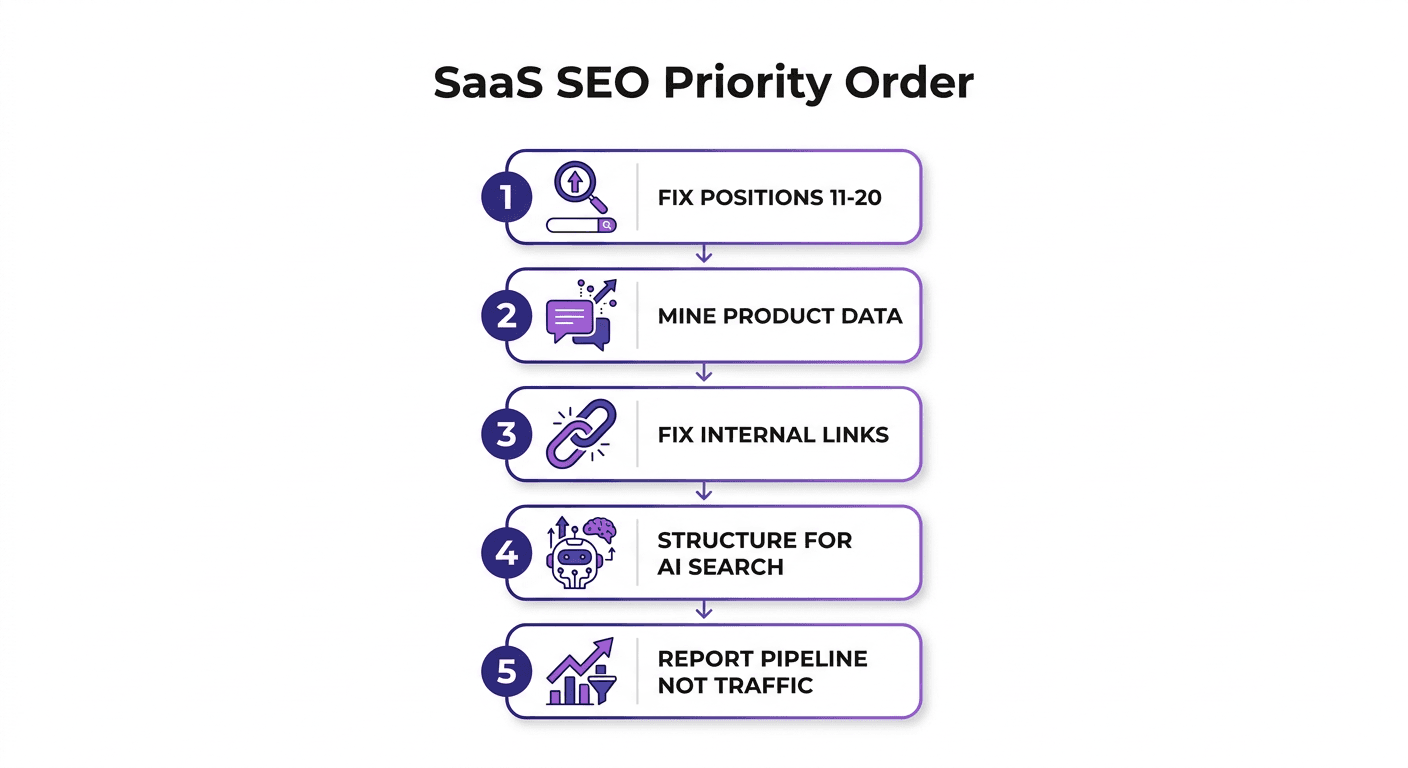
If you only do five things from this guide, do them in this order:
- Audit pages ranking in positions 11 to 20. These are usually one focused refresh away from page one, and faster to fix than publishing something new.
- Mine support tickets, in-app search, and sales objections for your next quarter of content, instead of starting from a keyword tool.
- Spend one afternoon fixing internal links and consolidating cannibalized pages before publishing anything else.
- Restructure your content template so every new page leads with a direct, extractable answer and includes a real FAQ section.
- Put a review date on every page you publish, so refreshing content becomes a habit instead of something that only happens by accident.
FAQ
What is the most important SEO tactic for SaaS companies right now?
Building content and page structure for AI search extraction, not just traditional organic ranking. Most SaaS content is written for human skimmers and structured in a way that is hard for a language model to lift a clean answer from. Leading with a direct answer, using real tables and lists, and matching FAQ phrasing to how people actually ask questions closes that gap.
How is SEO for SaaS companies different from SEO for other businesses?
The buying journey is longer and rarely converts on the first visit, so keyword strategy has to be organized by funnel stage and buying intent rather than by search volume alone. A SaaS SEO program also has to prove pipeline impact, not just traffic, because the metric leadership actually cares about is signups and revenue.
What are some SaaS SEO tips for a small team with no dedicated SEO hire?
Focus almost entirely on bottom-of-funnel, high-intent pages first: competitor comparisons, integration pages, and role-specific feature pages. These take less content volume to produce and convert far better than broad, top-of-funnel education content, which is the wrong place to start with limited resources.
How often should a SaaS company update its existing blog content?
Review your highest-traffic and highest-conversion pages at least twice a year, and treat any page showing a ranking decline as an immediate priority regardless of schedule. Content freshness is a real, measurable ranking factor, and pages updated at least once a year gain positions on average compared to pages left untouched.
What is SaaS organic growth and how does SEO drive it?
SaaS organic growth is new signups and revenue that come from unpaid search visibility rather than paid acquisition channels. SEO drives it by ranking pages that match real buying intent (comparisons, integrations, problem-aware content) high enough to capture prospects while they are actively evaluating solutions, at an acquisition cost that is typically well below paid channels over time.
Should SaaS companies still invest in traditional link building?
Yes, but selectively. Relevant, editorially earned links still carry real weight, especially from sites your actual buyers read. The tactic that fails is generic guest-post link building disconnected from your product's actual audience. It is better to invest in fewer, more relevant links than a high volume of low-relevance ones.
Junaid Khalid is the founder of Ertiqah, the company behind Murkuz. He has run SEO as the first growth channel across his own SaaS products, which is why Murkuz is built around closing the loop between finding a problem in your content and proving the fix actually worked.