Three acronyms, one confusing week of marketing Twitter, and everyone suddenly asking the same question: is SEO dead, and did AEO or GEO just replace it? Short answer: no. Slightly longer answer: SEO, AEO, and GEO are three different jobs, aimed at three different systems, and most sites need all three working at once, not a fight over which one wins.
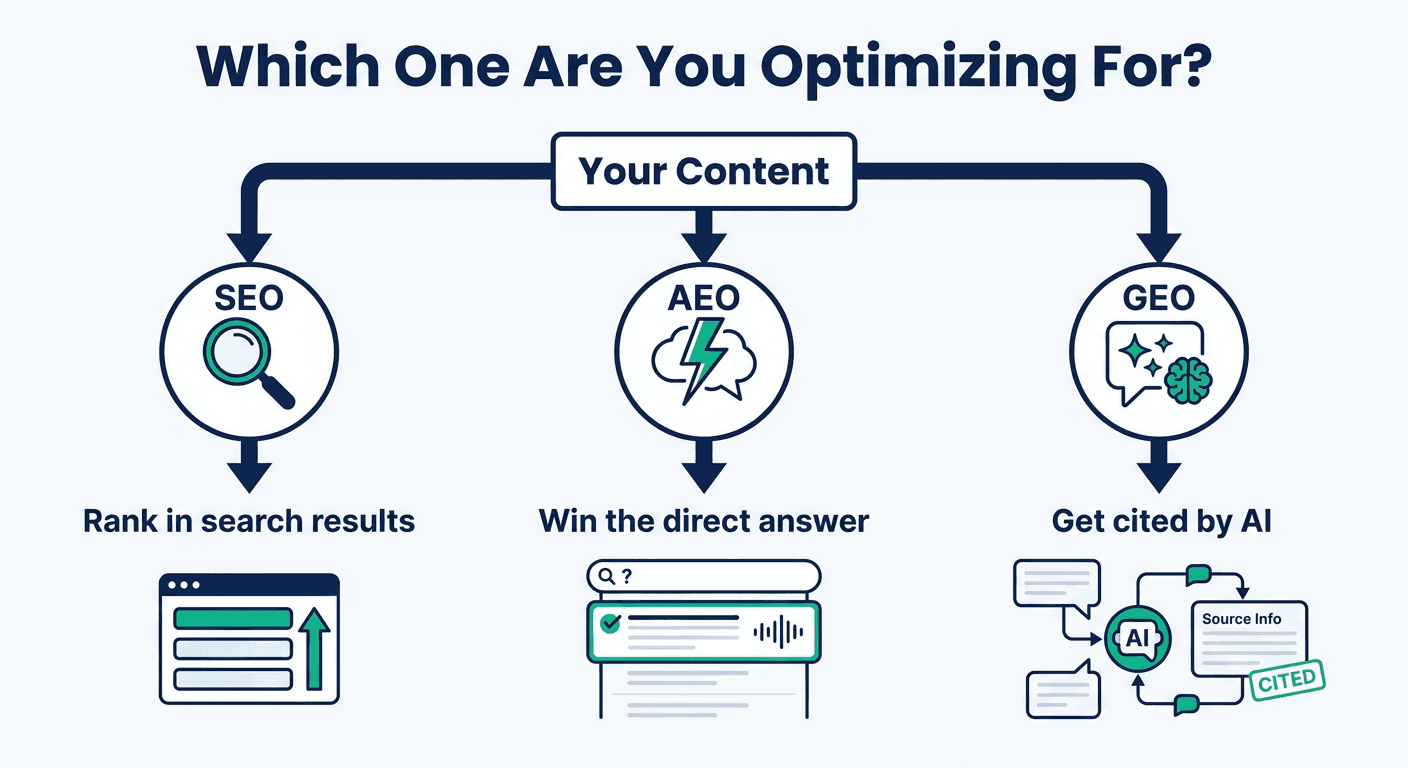
Here is the one-line version before we go deep. SEO gets your page ranked in the ten blue links. AEO gets your content picked as the direct answer, in a featured snippet or a voice response. GEO gets your content cited, quoted, or paraphrased inside an AI-generated answer from ChatGPT, Perplexity, or Google's AI Overviews. Same underlying content can do all three jobs. It just has to be built to be found, extracted, and trusted, in that order.
This guide breaks down what each acronym actually means, where they overlap, where they genuinely diverge, and what a working checklist looks like once you stop treating them as competing religions.
SEO vs AEO vs GEO: The Decoder Table
If you only read one section, read this one. Here is the side-by-side that most explainers gesture at but rarely nail down with specifics.
| SEO | AEO | GEO | |
|---|---|---|---|
| Full name | Search Engine Optimization | Answer Engine Optimization | Generative Engine Optimization |
| Optimizing for | A ranking position on a results page | Being selected as the single direct answer | Being cited or paraphrased inside a generated response |
| Primary platforms | Google, Bing | Featured snippets, "People Also Ask," voice assistants (Alexa, Siri) | ChatGPT, Perplexity, Google AI Overviews, Copilot |
| Selection logic | Ranks many documents by relevance and authority | Picks one winning answer (winner-takes-all) | Blends multiple sources into one new answer (probabilistic) |
| What wins | Backlinks, technical health, topical depth, search intent match | Answer-first formatting, one clean sentence, schema markup | Semantic clarity, freshness, named authorship, quotable structure |
| Success metric | Rankings, organic traffic, click-through rate | Snippet placement rate, position zero, voice-answer wins | Citation rate, brand mentions inside AI answers, share of voice |
| Output the user sees | A list of links to click | A direct on-page or on-screen answer | A synthesized paragraph, sometimes with a source link, sometimes without |
| Click-through | Standard, click to visit | Often skipped, the snippet answers it | Frequently zero-click; a citation is not a guaranteed visit |
The one-sentence version underneath the whole table: SEO ranks documents, AEO extracts one winning answer from those documents, and GEO rewrites several documents into a brand-new answer. Three different machines, three different jobs for your content to pass.
What Is SEO, Specifically
SEO is the discipline of getting a webpage to rank higher in a traditional search engine's organic results, so a real person clicks through to your site. It is the oldest of the three by two decades, and its mechanics are the most settled:
- Crawlers discover and index your pages by following links.
- Rankings are decided by relevance to the query, backlink profile, technical health (page speed, mobile usability, crawlability), and overall content quality.
- Success is measured in keyword rankings, organic sessions, and the click-through rate off the results page.
- The end product is a list. The user still chooses which link to open.
Every classic SEO tactic, keyword research, link building, technical audits, exists to move a URL higher on a page a human is actively scanning.
What Is AEO (Answer Engine Optimization), Specifically
AEO is the practice of structuring content so it gets selected as the single direct answer to a question, whether that shows up as a Google featured snippet, a "People Also Ask" expansion, or a spoken response from Alexa or Siri.
AEO sits closer to SEO than most people assume, because it still runs inside the same search engine, just in a different results feature. The differences that matter:
- The win condition is different. Standard SEO wants you ranked somewhere on page one. AEO wants you to be the one answer Google lifts out and displays directly, which is a winner-takes-all slot, not a ranking position.
- The formatting is different. AEO rewards a direct, self-contained answer in the first sentence or two, question-shaped headings that mirror how people actually type or speak a query, and FAQ or HowTo schema markup that hands the answer engine a clean, machine-readable version of the same content.
- The traffic trade-off is real. Winning the snippet often means the user gets their answer without clicking, so AEO can grow visibility while organic clicks on that exact query hold flat or fall. That trade is usually still worth it: the visibility and brand recall you keep from owning the answer slot outweighs the click you would have gotten anyway from a page-one ranking most searchers do not scroll past.
If SEO's question is "how do we rank," AEO's question is "how do we become the answer the engine already trusts enough to show without a click."
What Is GEO (Generative Engine Optimization), Specifically
GEO is the practice of structuring content so a generative AI system, ChatGPT, Perplexity, Google's AI Overviews, Copilot, chooses it as one of the sources it pulls from when synthesizing a conversational answer.
This is the newest and least settled of the three, but the pattern holds steady across every major AI system:
- The model retrieves and reads content from multiple sources related to the query, often through a retrieval step that looks nothing like a classic keyword match.
- It blends those sources into one new, conversational answer in its own words, typically drawing on two to six sources rather than crowning a single winner.
- Success is measured in citation rate, brand mentions inside generated answers, and share of voice across the AI tools your buyers actually use, not in a rank position.
- The user sees one answer. They may never click through to any of the underlying sources at all, which is why GEO gets called zero-click optimization.
The mechanics AI systems reward: an answer-first structure that states the core fact in the opening 40 to 60 words, semantic clarity over keyword density, current data and freshness signals, consistent entity naming (the same brand name and description everywhere, not five slightly different phrasings), and E-E-A-T signals, real named authors with real expertise, that give a model a reason to trust a claim enough to repeat it.
Where SEO, AEO, and GEO Actually Overlap
This is the part most "SEO vs AEO vs GEO" content skips entirely, and it matters more than the differences. None of these three run on separate infrastructure. AI systems still lean heavily on the traditional web index to discover and evaluate content in the first place. Google has said directly that AI Overviews draw from its core ranking systems, which means a page that is not indexed and ranking rarely earns an AI citation regardless of how "GEO-optimized" it looks on paper.
The shared foundation across all three:
- Topical authority. Every system favors a site that comprehensively covers a subject over one thin page chasing a keyword.
- Technical crawlability. If a bot cannot access or parse your page, no ranking system, answer engine, or AI retrieval layer will ever use it. Clean HTML, fast load times, and no accidental crawl blocks matter to all three.
- Structured content. Clear H2/H3 hierarchy, direct answers near the top, and schema markup help a featured snippet get pulled and help an AI model extract a clean quote for the exact same underlying reason.
- E-E-A-T signals. A named author with real credentials and clear sourcing helps a human Google quality rater, an AEO answer-selection system, and a GEO retrieval model all decide the same thing: can this claim be trusted enough to surface.
So the honest answer to "did AEO or GEO replace SEO" is no. They are layers built on the same foundation, each with its own measurement system and its own win condition. If your SEO fundamentals are weak, both your AEO and GEO performance will be weak too, because the retrieval and selection systems behind both still depend on the same signals of trust and structure that SEO has rewarded for years. For a deeper, side-by-side breakdown of just that one pairing, see our dedicated GEO vs SEO guide.
A Practical Checklist: What to Actually Do
If your fundamentals are already solid, here is what to add on top, mapped to which discipline it serves.
- Put a direct, one-sentence answer in the first 40 to 60 words. Serves AEO and GEO simultaneously. Both extraction and generation systems favor a clean, self-contained statement they can lift or paraphrase without hunting for it three paragraphs down.
- Build a genuine FAQ section with real PAA-style questions. The single easiest lever across all three disciplines, and still one of the most under-used. Most competing content in this exact space recommends an FAQ without actually including a proper one.
- Add FAQ and Article schema markup. Machine-readable structure that backs up what a human reader already sees, which helps AEO extraction directly and gives GEO retrieval a cleaner signal to work from.
- Attribute content to a named, credentialed author. AI systems and Google's quality raters both weigh authorship when deciding whether to trust a factual claim, so an anonymous or generic byline quietly costs you on both fronts.
- Keep statistics and claims current. Freshness is an explicit trust signal for GEO's retrieval systems specifically. A page citing 2023 numbers in 2026 is a weaker citation candidate than one with this year's data, even if the underlying advice has not changed.
- Use consistent entity naming. The same brand name, the same one-line description, everywhere it appears online. AI systems build confidence in a source partly through how consistently it is described across the web.
- Check whether your key pages block AI crawlers. GPTBot, ClaudeBot, and PerplexityBot respect
robots.txt, and a growing number of sites now publish anllms.txtfile as a curated map of their most citable pages. A blanket "block all bots" rule left over from years ago can make you invisible to GEO no matter how good the content is. - Track citations and snippet wins, not just rankings. Ask ChatGPT and Perplexity the exact questions your buyers would ask, and note whether you show up. A recurring manual spot-check across your 10 to 15 highest-intent questions is the AEO/GEO equivalent of a weekly rank check.
None of this replaces the SEO work underneath it. It sits on top.
Why This Gets Confusing (and Why It Is Worth Sorting Out)
Part of the confusion is genuinely the industry's fault. There is no standardized taxonomy yet: some teams say GEO, some say AEO, some say GSO (generative search optimization), and a few have started saying AIO or LLMO for the same general idea. They overlap enough in practice that reasonable people use them differently, which is exactly why a clear decoder is worth bookmarking instead of re-litigating every time the terms come up in a meeting.
The practical risk of staying confused is not academic. Picture a page ranking steadily at position 4 for a commercial query, a solid SEO result by any normal measure. Google now shows an AI Overview above the results that answers the query directly and cites three competitors, none of them you. The page's ranking has not moved an inch. Its click-through rate quietly falls anyway, because the AI Overview absorbed the query before most searchers ever reached the organic list. Classic rank tracking will not show this as a problem, because by its own metric, nothing broke.
That gap, a page that is fine by SEO's numbers and invisible by GEO's, is exactly where most teams get caught flat-footed. It is one thing to know you should keep content fresh, structured, and properly attributed. It is another to notice the moment a specific page stops showing up in AI answers, or that a competitor just took the citation you used to hold. Murkuz was built around that exact blind spot: it grades every page A through F for AI search readiness, checking the same structural signals covered above, clear answer placement, schema coverage, author attribution, content freshness, and turns each gap into a specific, prioritized task instead of leaving you to guess what to fix first. The same detection engine that watches for a traditional ranking drop watches for an AI-citation drop, because underneath the different acronyms, they are two symptoms of the same content health problem.
FAQ
Is AEO the same as GEO?
No, though they are closely related and often used loosely as synonyms. AEO is about winning a single extracted answer slot, a featured snippet or voice response, from a system that picks one winner. GEO is about being one of several sources an AI model blends into a newly generated answer. AEO is winner-takes-all; GEO is probabilistic, pulling from multiple sources at once.
Is GEO replacing SEO?
No. GEO is an additional optimization layer for how generative AI systems select and cite sources, not a replacement for ranking in traditional search. Most of the retrieval systems behind GEO still depend on the same web index and authority signals SEO has targeted for two decades.
Is SEO dead or evolving in 2026?
Evolving, not dead. Search volume and intent for traditional queries remain high. What has changed is that a growing share of queries now also surface an AI-generated answer alongside or instead of the ten blue links, which is why AEO and GEO have emerged as companion disciplines rather than replacements.
What are the four types of SEO?
Most frameworks split SEO into four working areas: technical SEO (crawlability, site speed, indexing), on-page SEO (content, keywords, headings, internal links), off-page SEO (backlinks and external authority signals), and local SEO (Google Business Profile and location-based ranking factors). AEO and GEO are newer, adjacent disciplines layered on top of these four, not a fifth type of SEO itself.
Which is better, SEO, AEO, or GEO?
None of them is "better" in isolation; they answer different questions. SEO earns clicks from traditional search. AEO earns the single answer slot inside a search engine's own features. GEO earns a citation or mention inside an AI-generated answer, often without a click at all. Optimizing for only one deliberately ignores a real and growing share of how people now find information.
Can one piece of content win at all three?
Yes, and that is the realistic goal rather than picking a lane. A page that ranks well technically, states a clear answer in its first few sentences, includes a genuine FAQ with schema markup, and cites current, well-attributed information is doing the work all three disciplines reward. You are not running three separate content strategies. You are running one, with two extra layers of structure and attribution on top of what solid SEO already required.
Junaid Khalid is the founder of Ertiqah, the company behind Murkuz. He has run SEO as the first growth channel across his own SaaS products, from early-stage keyword bets to the operational grind of keeping hundreds of pages from quietly decaying, which is the problem that led him to build Murkuz in the first place.